
TL;DR:
- Plumbing traps prevent sewer gases from entering homes by maintaining a water seal.
- California code mandates P-traps with proper venting and a 2 to 4-inch water seal.
- Regular inspection and maintenance prevent odors, leaks, and code violations in home plumbing.
Many homeowners in Orange County and Los Angeles County blame bad smells near drains on dirty pipes or poor ventilation. In reality, the culprit is often a small, curved section of pipe called a plumbing trap. These devices are required by law in every home, yet most homeowners have never thought twice about them. When a trap fails, dries out, or is installed incorrectly, it can allow dangerous sewer gases into your living space, create code violations, and lead to expensive repairs. Understanding how plumbing traps work is one of the most practical things you can do to protect your home and your family.
Table of Contents
- What is a plumbing trap and how does it work?
- Key plumbing trap requirements in Orange & LA County
- Types of plumbing traps and how to identify them
- Common problems with plumbing traps and their solutions
- When to DIY and when to call a professional plumber
- A practical perspective on traps: What most homeowners get wrong
- Home plumbing confidence starts with the right support
- Frequently asked questions
Key Takeaways
| Point | Details |
|---|---|
| Traps prevent sewer gas | Plumbing traps use a water seal to block harmful gases from entering your home. |
| Code compliance matters | California law requires P-traps for every fixture and prohibits S-traps to ensure safety. |
| Routine maintenance avoids odors | Pour water into unused drains monthly to prevent traps from drying out and causing smells. |
| Know your limits for repairs | DIY basic upkeep is fine, but installations should be handled by licensed professionals for compliance. |
What is a plumbing trap and how does it work?
A plumbing trap is a curved pipe section installed beneath every drain in your home, including sinks, tubs, showers, floor drains, and laundry fixtures. Its primary job is to block sewer gases from traveling back through your drain pipes and into your living space. It does this by holding a small amount of standing water called the “water seal.”
That water seal is the key to how a trap works. When water drains through the fixture, it passes through the curved section of pipe. A small amount of water always remains in the curve after the drain empties. This standing water physically blocks any gases from the sewer system from moving upward into your home. Without it, your drains would essentially be open connections to the municipal sewer or your septic system, and the gases produced there, including hydrogen sulfide and methane, could enter your home freely.
Here are the core facts about how traps function:
- A trap must maintain a water seal depth of 2 to 4 inches to be code compliant.
- The maximum allowed distance from a fixture outlet to the trap weir (the highest point of the trap’s outlet side) is 24 inches vertically or 30 inches horizontally.
- Every drain fixture in your home requires a trap unless a specific code exception applies.
- Traps also catch debris like hair and soap residue, which can reduce clogs further down the line, but this is a secondary function.
“A plumbing trap’s most critical role is protecting indoor air quality by blocking hazardous sewer gases. The water seal is not optional—it is the barrier between your home and the waste system.” This is why code enforcement takes trap requirements seriously.
A common misconception is that any curved pipe under a sink is automatically a functional trap. That is not always true. If the pipe is the wrong shape, improperly vented, or has dried out from lack of use, it may not be holding a water seal at all. You can learn more about plumbing terms explained to get familiar with the terminology before inspecting your own fixtures.
Pro Tip: If you notice a foul odor from a drain that you do not use often, the trap may have dried out. Simply pour a quart of water down the drain to restore the water seal. Do this for all rarely used drains at least once a month.
Key plumbing trap requirements in Orange & LA County
After understanding what a plumbing trap is and how it works, it is crucial to know the specific legal requirements in your area. Both Orange County and Los Angeles County enforce the California Plumbing Code (CPC), currently in its 2022 and 2025 editions. This code is stricter than the International Plumbing Code in some areas and directly affects what is and is not allowed in your home.
The CPC mandates P-traps for all new installations, prohibits S-traps due to their tendency to lose their water seal through siphoning, and requires proper venting for every trap to prevent siphonage. Every fixture must have a trap with a 2 to 4 inch water seal. These are not suggestions. They are enforceable code requirements that apply to every home in our service area.
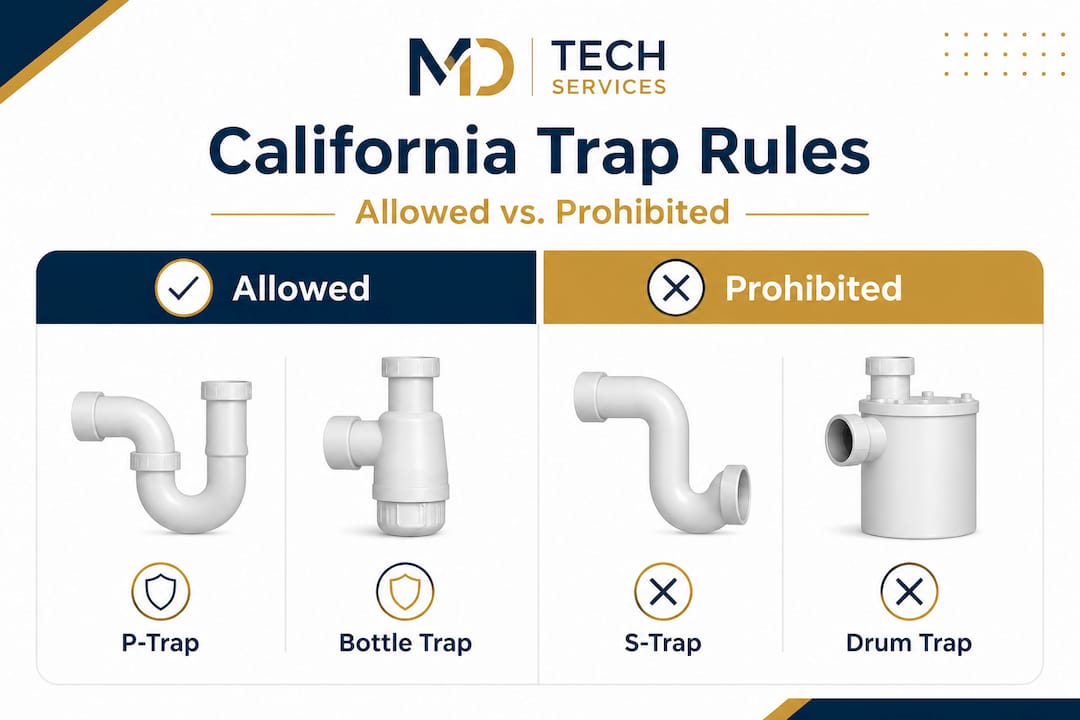
Here is a comparison of compliant versus noncompliant trap setups:
| Setup | Code status | Reason |
|---|---|---|
| P-trap with proper venting | Compliant | Maintains water seal, prevents siphoning |
| S-trap (older homes) | Not compliant | Prone to siphoning, loses water seal |
| P-trap without venting | Not compliant | Siphoning risk, seal loss |
| Drum trap (older homes) | Not compliant | Difficult to maintain, obsolete |
| P-trap with correct seal depth | Compliant | Meets 2 to 4 inch seal requirement |
To verify your home’s plumbing complies with local code, follow these steps:
- Locate the trap under each sink, tub, and shower in your home.
- Identify the shape. A P-trap curves like the letter “P” on its side. An S-trap curves in an S-shape.
- Check that the trap is connected to a vent pipe. Look for a vertical pipe running up through the wall behind the fixture.
- Look for visible leaks, cracks, or corrosion on the trap body and connections.
- If you find an S-trap or a trap with no visible vent connection, contact a licensed plumber to assess the situation.
For guidance on plumbing safety compliance, it is always better to confirm with a professional rather than assume your older home meets current standards.
Types of plumbing traps and how to identify them
With a clear sense of code requirements, it is important to recognize which trap types are and are not allowed in your home. Southern California homes, especially those built before 1980, may have outdated trap configurations that no longer meet current code.
P-trap: This is the only type of trap permitted for new installations under the CPC. It looks like a “P” turned on its side, with a horizontal outlet that connects to the wall drain. The curved bottom holds the water seal, and the horizontal outlet allows proper venting. P-traps are made from PVC, ABS plastic, or chrome-plated brass.
S-trap: This trap curves in two directions, resembling the letter “S.” It was common in homes built before the 1970s. The problem with an S-trap is that the downward curve on the outlet side creates a siphon effect when water drains quickly, pulling the water seal out of the trap completely. Once the seal is gone, sewer gases have a direct path into your home. The CPC prohibits S-traps for this exact reason.
Drum trap: These are cylindrical traps found in some very old homes, often under bathtubs. They are no longer code compliant and are difficult to clean or inspect. If you find one, it should be replaced.
Bottle trap: These are decorative traps sometimes used with vessel sinks or exposed plumbing. They may be acceptable in limited situations but are not standard and should be verified for code compliance.
Here is a quick reference table:
| Trap type | Appearance | Code status in CA | Common location |
|---|---|---|---|
| P-trap | P-shape on its side | Compliant | Sinks, showers, tubs |
| S-trap | S-shape | Not compliant | Older sinks |
| Drum trap | Cylindrical canister | Not compliant | Older bathtubs |
| Bottle trap | Bottle-shaped | Verify with plumber | Decorative sinks |
Key ways to identify your trap type:
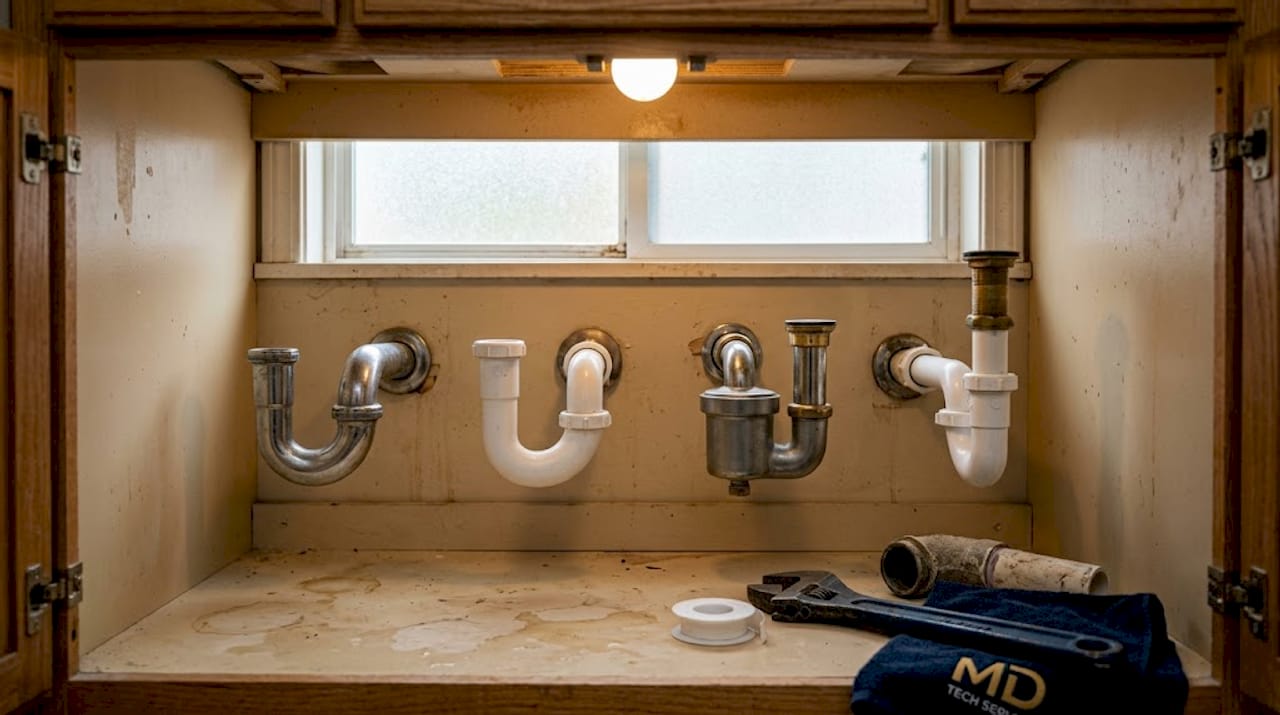
- Open the cabinet under your sink and look at the pipe configuration.
- A P-trap exits horizontally into the wall. An S-trap exits downward through the floor.
- Drum traps are usually found under older tubs and look like a round metal canister.
Pro Tip: Not sure what you are looking at? Take a clear photo of the pipes under your sink and compare it to the table above, or share it with a licensed plumber for a quick assessment.
Common problems with plumbing traps and their solutions
Understanding which traps you have leads naturally to the problems you might face and how to fix them or when to bring in a professional.
The most frequent trap issues in Orange County and Los Angeles County homes include dry traps, leaks at joints, clogs, and improper installation. Each has distinct warning signs and solutions.
Follow these troubleshooting steps when you suspect a trap problem:
- Check for odors. A sulfur or rotten egg smell near a drain is the most common sign of a dry or failed trap.
- Run water into the drain. If the smell goes away after running water for 30 seconds, the trap was simply dry and is now restored.
- Inspect for visible leaks. Look under the sink for water stains, drips, or moisture on the cabinet floor.
- Check the trap body for cracks. Plastic traps can crack with age or impact. Chrome traps can corrode.
- If smells persist after running water, the trap may be improperly installed, missing a vent, or there may be a leak you cannot see. Call a licensed plumber.
For Orange County and LA County homeowners, checking for dried traps in rarely used drains such as guest bathrooms is especially important. Pouring water monthly into these drains is a simple and effective preventive measure.
“Improper trap configuration can expose your home to sewer gas, which is not just unpleasant but a genuine health and safety risk. Code violations discovered during a home sale can delay or kill a deal entirely.”
Monthly maintenance habits to keep traps in good condition:
- Pour water into all floor drains, guest bath sinks, and other rarely used fixtures.
- Check under kitchen and bathroom sinks for moisture or drips.
- Avoid pouring grease or harsh chemical drain cleaners down drains, as these can damage trap materials over time.
- Note any slow drains, which can indicate a partial clog in or near the trap.
Pro Tip: If odors linger even after you have run water down the drain, you may have an unseen leak or an incorrect trap setup. Do not ignore this. Contact a licensed plumber to inspect the situation, especially before a home inspection or resale.
You can also review common plumbing issues and plumbing maintenance basics for a broader picture of what to watch for throughout your home.
When to DIY and when to call a professional plumber
Once you recognize a plumbing trap problem, it is crucial to know your limits as a homeowner and when expert help is not just wise, but required.
Some tasks are straightforward and safe for most homeowners to handle:
- Pouring water into dry traps to restore the water seal.
- Cleaning hair and debris from a trap using a trap removal tool or by unscrewing the clean-out plug.
- Checking for visible leaks and tightening slip-joint connections by hand.
- Monitoring for recurring odors and noting when they occur.
Other situations require a licensed plumber. California law requires licensed professionals for most plumbing installations and significant repairs. Attempting to replace a trap, reroute drain lines, or add venting without a license can result in code violations that show up during plumbing inspections and complicate home sales.
Signs that you need to hire professional plumbers rather than handling it yourself:
- Persistent odors even after refilling the trap with water.
- Visible leaks at pipe joints that do not stop after hand-tightening.
- A cracked or broken trap body that needs replacement.
- Discovery of an S-trap or drum trap that needs to be brought up to code.
- Any new trap installation as part of a renovation or addition.
- Failed home inspection due to plumbing code violations.
Pro Tip: DIY attempts on non-compliant traps can create code violations that are flagged during resale inspections. A licensed plumber’s work comes with documentation that protects your investment and keeps your home legally compliant.
According to Orange County code requirements, homeowners are responsible for maintaining code-compliant plumbing. When in doubt, it is always safer and more cost-effective to call a professional than to risk a violation.
A practical perspective on traps: What most homeowners get wrong
Here is something we see regularly in Orange County and Los Angeles County homes: a homeowner notices a smell, runs water down the drain, and assumes the problem is solved. Sometimes it is. But often, the real issue is not the trap itself. It is the venting.
Even a perfectly shaped, properly installed P-trap will fail to hold its water seal if the vent system is blocked, missing, or incorrectly sized. Venting allows air into the drain system so that water flows freely without creating a vacuum. Without proper venting, the draining water pulls the water seal right out of the trap through siphoning. The CPC requirement for proper venting exists precisely because of this relationship between traps and air pressure.
Consider a hypothetical that we see play out often. A homeowner in Anaheim remodels their bathroom and replaces an old sink. The contractor installs a new P-trap but skips the vent connection to save time. The trap looks correct. It holds water initially. But every time the sink drains, the water seal gets pulled out. Within weeks, the bathroom smells like sewer gas. The homeowner pours water down the drain repeatedly, never understanding why the smell keeps coming back. Eventually, a home inspector finds the missing vent and the repair costs far more than it would have if done correctly the first time.
This is why we recommend including trap and vent inspection as part of any annual plumbing check-up. A visual check of the trap is not enough. You also need to know that the vent system is intact and functioning. For deeper plumbing safety insights, understanding how traps and vents work together is essential knowledge for any homeowner.
Pro Tip: Make annual inspections of all traps and vents part of your home maintenance routine. Include this in a full plumbing check-up, especially if your home is more than 20 years old or has recently had any drain work done.
Home plumbing confidence starts with the right support
Knowing how plumbing traps work is genuinely useful knowledge. But knowing when to act on that knowledge—and who to call—is what protects your home in the long run.

At MDTech Services, we provide reliable plumbing repair service for homeowners throughout Orange County and Los Angeles County. Whether you need a trap replaced, a vent issue resolved, or a full plumbing inspection to confirm your home is code compliant, our licensed technicians are ready to help. We also offer a full range of types of plumbing services to address everything from routine maintenance to complex repairs. Scheduling a plumbing inspection is one of the most effective ways to catch issues before they become costly problems. Contact us today to book your appointment and get the peace of mind you deserve.
Frequently asked questions
Why does my sink smell if I haven’t used it recently?
If a trap dries out, it loses its water seal, allowing sewer gases to enter your home. Pour water into unused drains monthly to restore the seal and prevent odors.
Are S-traps allowed in California homes?
No. S-traps are prohibited under the California Plumbing Code. Only P-traps are permitted for new installations because S-traps are prone to siphoning out their water seal.
How can I tell if my plumbing trap is working?
A properly working trap holds water, produces no sewer odors near the drain, and shows no visible leaks or moisture beneath the fixture.
Is it safe for homeowners to replace a plumbing trap themselves?
Basic cleaning is generally fine, but California law often requires a licensed plumber for compliant trap installation or replacement to avoid code violations.
What’s the required depth for a plumbing trap’s water seal?
The water seal depth must be between 2 and 4 inches, as required by both the International Plumbing Code and the California Plumbing Code.