
TL;DR:
- Many homeowners assume their thermostat is accurate because it turns the system on and off, but calibration ensures the displayed temperature matches the actual room temperature. Proper calibration prevents unnecessary energy use, uneven comfort, and equipment wear caused by false temperature readings, especially during high-demand periods. Combining accurate calibration with effective scheduling and correct placement maximizes HVAC efficiency and reduces energy costs in homes.
Most homeowners in Orange County and Los Angeles County assume their thermostat is working correctly simply because it turns the system on and off. The reality is more complicated. A thermostat that displays 72°F may actually be reading 68°F or 75°F inside your home, and that gap silently drives your HVAC system to work harder than it should. The result shows up on your energy bills and in the uneven comfort you feel room to room. This guide explains exactly what calibration means, why it matters, and how to take action.
Table of Contents
- What thermostat calibration actually does
- Thermostat calibration vs. energy-saving strategies
- Common calibration mistakes and how to avoid them
- How to check and adjust your thermostat’s calibration
- The overlooked reality: Control accuracy is only half the efficiency equation
- Professional help and next steps for full HVAC efficiency
- Frequently asked questions
Key Takeaways
| Point | Details |
|---|---|
| Accuracy matters | Calibrated thermostats ensure your HVAC system runs only as needed, boosting comfort and savings. |
| Scheduling is vital | Programmed setbacks and schedules deliver most energy savings, even when calibration is perfect. |
| Avoid common errors | Improper placement and skipped checks mimic calibration issues and can undermine results. |
| Step-by-step testing works | Rely on repeated, stabilized thermometer comparisons before making adjustments to your thermostat. |
What thermostat calibration actually does
After understanding why calibration is frequently overlooked, let’s clarify what calibration actually means for your home.
Thermostat calibration refers to aligning what your thermostat displays with what the actual air temperature is in the room. When those two numbers match, your HVAC system cycles on and off at the right moments. When they don’t match, your system operates based on false information, and the results can range from mild discomfort to significantly inflated utility costs.
The core role of calibration is to ensure the thermostat’s measured and displayed indoor temperature matches the actual room temperature, so the HVAC system cycles to the intended conditions. Without that accuracy, your system has no reliable reference point.
Here’s what happens in practical terms. If your thermostat reads warmer than the actual room, the air conditioner runs longer than necessary, overcooling your home and increasing runtime costs. If it reads cooler than the actual temperature, the system shuts off too early, leaving your home warm and causing the compressor to short-cycle more frequently. Both scenarios accelerate wear on your equipment.
Understanding the energy-saving potential built into a properly calibrated thermostat starts with recognizing these daily patterns.
Signs your thermostat may be out of calibration
- Rooms feel consistently warmer or cooler than the temperature displayed
- Your system runs for unusually long periods without reaching the set temperature
- Energy bills increase without a clear change in usage habits
- The HVAC unit cycles on and off rapidly within short time frames
- Some areas of your home feel noticeably different from others despite a consistent setting
“Calibration accuracy is not just about comfort preferences. When a thermostat reads incorrectly, every heating or cooling decision your system makes is based on flawed data. Even a 2-degree offset can add meaningful unnecessary runtime over the course of a month.” — HVAC industry best practice guidance
The table below summarizes how calibration errors affect system performance:
| Calibration Error | System Behavior | Likely Impact |
|---|---|---|
| Reads 2°F too warm | A/C runs longer than needed | Higher cooling costs |
| Reads 2°F too cool | Heater shuts off early | Insufficient warmth |
| Reads 4°F or more off | Frequent short-cycling | Equipment wear and high bills |
| Accurate reading | Correct cycling intervals | Normal comfort and efficiency |
Calibration errors this small may seem insignificant, but over weeks and months of daily cycling, the cumulative effect on your energy costs and equipment longevity is real.

Thermostat calibration vs. energy-saving strategies
Knowing how calibration works, it’s essential to understand how it fits alongside other big-picture energy savers.
Calibration sets the foundation, but it is not where the biggest energy savings originate. Preventing unnecessary runtime through calibration helps avoid short-cycling and wasted operation, but the largest and most consistent energy reductions for homeowners come from thermostat setbacks and scheduling rather than calibration alone.
The U.S. Department of Energy estimates that homeowners can save about 10% per year on heating and cooling by turning their thermostat back 7 to 10 degrees for 8 hours a day from its normal setting. That statistic applies when you combine accurate calibration with a consistent scheduling plan. Calibration without scheduling leaves significant savings on the table. Scheduling without calibration means your schedule is being executed with inaccurate temperature data. You need both working together.
| Strategy | What it does | Energy impact |
|---|---|---|
| Calibration | Ensures accurate temperature reading | Prevents unnecessary runtime |
| Scheduling/programming | Controls when the system operates | Up to 10% annual savings |
| Placement and settings | Eliminates environmental interference | Improves reading accuracy |
These three strategies stack on top of each other. When you get all three right, the efficiency gains are consistent and measurable.
Pro Tip: If you have a programmable or smart thermostat, set up weekday and weekend schedules that reflect your actual routine. A calibrated thermostat paired with a well-designed schedule can meaningfully reduce your monthly bill without any sacrifice in comfort.
You can find more detailed guidance on combining these tactics in our smart HVAC efficiency tips resource, as well as a practical energy-saving HVAC checklist built specifically for homeowners in our region.
Southern California’s climate adds another layer to this conversation. Orange County and Los Angeles County homeowners deal with warm summers, mild winters, and occasional heat events that push HVAC systems hard. A thermostat that reads inaccurately during those high-demand periods can push a system toward overwork at exactly the wrong moment. Calibration combined with a smart schedule protects your equipment and your comfort year-round.
Common calibration mistakes and how to avoid them
With a sense of how calibration compares to other efficiency tactics, you should know which pitfalls catch most homeowners.
Many homeowners assume their thermostat is miscalibrated when the actual problem is where the thermostat is located and what it’s exposed to. Placement near drafts, windows with direct sunlight, or heat-producing appliances can cause the sensor to read incorrectly, even when the thermostat’s internal calibration is perfectly fine. These placement and environment factors mimic calibration error and lead homeowners to adjust the wrong thing entirely.
Adjusting the calibration offset on a thermostat placed in direct afternoon sunlight will not fix the problem. Moving the thermostat or adding shading will. Treating the symptom without identifying the correct cause is one of the most common and costly mistakes in home HVAC efficiency. You can review a full breakdown of these kinds of errors in our HVAC troubleshooting steps guide.
Common calibration mistakes to avoid
- Performing a calibration check during an unusual weather event when indoor temperatures are not stable
- Relying on a single temperature reading rather than averaging multiple readings over time
- Assuming a smart or newer thermostat cannot have calibration issues
- Neglecting to check thermostat placement before attributing problems to calibration
- Making multiple adjustments in quick succession without allowing the system to stabilize between changes
- Using a low-quality or uncalibrated reference thermometer for comparison
- Skipping re-checks after making an adjustment
Pro Tip: Before you attempt any calibration adjustment, spend a few minutes checking what is near your thermostat. Look for nearby vents, lamps, windows with afternoon sun exposure, and drafty areas. Many issues that appear to be calibration errors are actually placement problems, and fixing those is faster, easier, and free.
One related area that trips up homeowners is failing to recognize that calibration and maintenance are connected. A dirty thermostat sensor or dust accumulation inside the unit can also affect accuracy. Our HVAC maintenance steps guide walks through how to keep your entire system in reliable condition, including simple cleaning steps that support accurate thermostat operation. Understanding common home maintenance mistakes in general can also help you think more clearly about when issues are environmental versus mechanical.
How to check and adjust your thermostat’s calibration
Armed with error-prevention knowledge, here’s exactly how you can verify and adjust calibration at home.
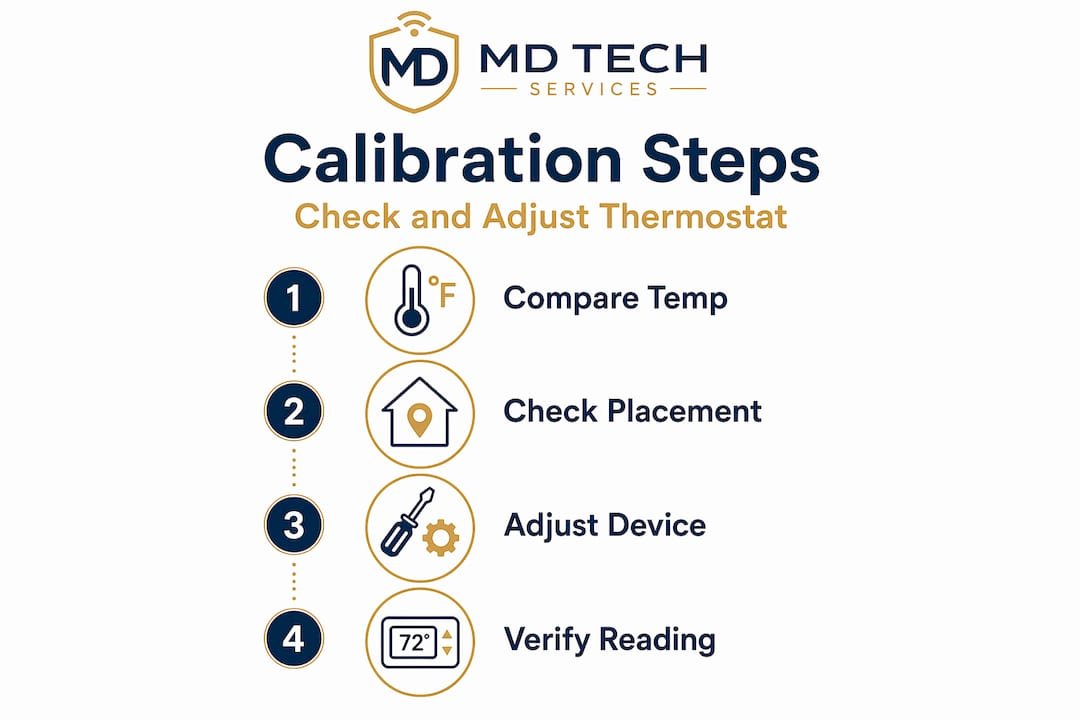
The calibration verification process is straightforward, but it requires patience. One of the most important things to understand is that a single temperature reading is not reliable enough to base an adjustment on. Reliable calibration testing requires repeating checks at least three times at different times of day and under similar conditions, allowing readings to fully stabilize before recording them.
Here is the step-by-step process:
-
Prepare your reference thermometer. Use a quality digital thermometer that you trust to be accurate. Place it near your thermostat, at the same height, and away from vents, windows, or appliances. Allow it to sit for at least 15 minutes before recording any reading.
-
Record the first comparison reading. Note what your thermostat displays and what your reference thermometer reads. Write both numbers down with the time.
-
Wait and repeat. Come back at a different time of day, ideally when indoor conditions are stable. Perform the same reading and record the result.
-
Take a third reading. Repeat the process one more time. Three readings over different periods give you a reliable picture of the actual offset.
-
Calculate the average difference. If all three readings show a consistent 2-degree difference, you have a reliable calibration offset to work with. If the difference varies widely, environmental factors may be influencing the readings.
-
Adjust if needed. Many thermostats allow a calibration offset setting in the menu. Consult your user manual for the specific method. For older mechanical thermostats, a small adjustment screw inside the unit may control the calibration.
-
Re-verify after adjusting. Wait at least 24 hours after making an adjustment, then repeat the three-reading process to confirm the offset has been corrected.
“Patience during calibration testing is not optional. Rushing through readings or relying on a single moment produces unreliable results. The three-reading approach across different times of day is what separates an accurate calibration from a guessed one.”
If you complete this process and still find your thermostat reading inconsistently, or if the offset is large enough that manual adjustment does not resolve it, that is when calling a licensed HVAC technician makes sense. Some thermostat issues point to sensor failure or system compatibility problems that require professional diagnosis. Integrating your thermostat with smart home systems can also provide additional data points that help identify persistent calibration drift.
The overlooked reality: Control accuracy is only half the efficiency equation
Having learned the hands-on process of calibration, it’s time to address a final expert truth homeowners often overlook.
At MDTech Services, we see a consistent pattern in Orange County and Los Angeles County homes. Homeowners invest time and effort into calibrating their thermostat and then expect a noticeable drop in their energy bills. When that drop doesn’t appear, they assume something is wrong with their equipment. Most of the time, calibration is working perfectly. The problem is that calibration was expected to do more than it can.
Thermostat calibration is best understood as control accuracy. It ensures your setpoint-to-actual temperature relationship is correct, but the most predictable energy reductions come from verified scheduling and setback strategies, combined with the right thermostat type and settings for your specific HVAC equipment.
This is especially true for homeowners with heat pumps, which are increasingly common across Southern California. Heat pumps require specific thermostat settings and thermostat compatibility to operate efficiently. A well-calibrated thermostat paired with the wrong settings for a heat pump system will still perform poorly. The type of thermostat you have matters as much as how accurately it reads the room.
We also see homeowners focus on calibration while ignoring insulation and HVAC efficiency factors in their home’s envelope. A perfectly calibrated thermostat in a poorly insulated home is still fighting a losing battle. Every efficiency gain stacks when you address multiple factors at once. Calibration is a foundational step, not the final one.
Our honest recommendation is this: verify your calibration, confirm your thermostat placement is correct, build a reliable schedule with setbacks, and then evaluate your system as a whole. That is the approach that produces lasting results.
Professional help and next steps for full HVAC efficiency
To make these efficiency wins lasting, here’s how expert help can fill in the gaps.
Calibration checks you can handle on your own are a great starting point, but they only tell part of the story. If you have adjusted your thermostat, confirmed its placement, and set a solid schedule and still see comfort problems or high bills, a professional system evaluation is the right move. Our licensed technicians at MDTech Services serve homeowners across Orange County and Los Angeles County with responsive, reliable HVAC diagnostics and repair.

A full system check covers more than just the thermostat. It includes verifying refrigerant levels, inspecting electrical connections, testing airflow, and confirming that every component is operating within the right parameters. If your system has an underlying issue driving those bills up, our team will identify it. You can learn more about what’s involved in a professional HVAC repair visit, or explore how we approach troubleshooting HVAC problems for homeowners in our area. Book an appointment online or call us directly. We are here to help you get your system running the way it should.
Frequently asked questions
How often should I check my thermostat’s calibration?
Check thermostat calibration at least once a year, and also repeat calibration checks whenever you notice comfort issues or an unexplained spike in your energy bill.
Does a smart thermostat still need calibration?
Yes, even smart thermostats can experience drift over time. Any thermostat can be affected by placement issues or environmental factors that cause inaccurate readings, particularly after power outages or firmware updates.
What tools do I need to calibrate my thermostat?
You need a reliable digital room thermometer as a reference for comparison against your thermostat’s reading, along with your user manual and possibly a screwdriver for accessing adjustment settings on older units.
Can thermostat location affect calibration accuracy?
Absolutely. Placement near drafts, direct sunlight, or supply vents can skew readings significantly, and these placement and environment issues can look identical to a calibration error, so always check location first before adjusting any settings.