
TL;DR:
- Unbalanced airflow is a common cause of uneven comfort in homes, often more impactful than equipment issues.
- Proper airflow balancing involves measuring and adjusting ductwork, dampers, and registers to ensure consistent air delivery to every room.
You run the AC all afternoon, yet the bedroom at the end of the hall stays stuffy while the living room feels like a refrigerator. This frustrating pattern affects countless homeowners in Orange County and Los Angeles County, and the root cause is often not the equipment itself. The real problem is unbalanced airflow. Airflow balancing is one of the most overlooked aspects of home comfort, yet it can make a significant difference in how consistently your HVAC system heats and cools every room. This guide explains what airflow balancing is, how it works, and what you can do to fix it.
Table of Contents
- What is airflow balancing? The basics explained
- How does airflow balancing work?
- Standards and methods: What the pros use
- Common challenges and what affects balancing
- Homeowner checklist: Steps to better airflow and comfort
- Why most homeowners underestimate airflow balancing
- Get expert airflow help for lasting comfort
- Frequently asked questions
Key Takeaways
| Point | Details |
|---|---|
| Airflow balancing defined | It ensures every room in your home receives the right amount of heated or cooled air for comfort. |
| DIY vs. pro methods | Basic balancing can be done by homeowners, but pros use advanced tools and standards for lasting results. |
| Common obstacles | Duct design, filter issues, and system sizing often limit how well airflow balancing works. |
| Proven standards | ASHRAE and professional TAB procedures set clear targets for home airflow balancing accuracy. |
| When to get help | Call a professional if comfort issues or airflow problems persist after basic steps. |
What is airflow balancing? The basics explained
Airflow balancing means adjusting your home’s HVAC system so that the right amount of conditioned air reaches every room. It is not about cranking up the thermostat or simply replacing your equipment. It is about making sure your ductwork, registers, and dampers work together to deliver air where it is actually needed, in the right quantities.
According to residential balancing standards, balancing usually focuses on adjusting dampers and registers while using quantitative measurements, including airflow at registers and system pressure, to correct comfort problems like hot and cold spots and weak airflow. In plain terms, a technician looks at how much air is moving through each register, compares it to what the design calls for, and then makes adjustments until each room is getting what it needs.
It is also worth clarifying a common point of confusion. Air balancing is often used interchangeably with system balancing, but the air-side portion specifically focuses on measuring and adjusting air distribution through ductwork and terminals, while other forms of balancing may address broader system aspects like refrigerant charge or mechanical components. When most homeowners talk about fixing hot and cold spots, they are dealing with the air-side version.
Here is what proper airflow balancing addresses in a residential home:
- Uneven temperature distribution across different floors or rooms
- Weak airflow from specific vents or registers
- Excessive pressure in parts of the duct system that cause noise or strain on equipment
- Over-conditioned spaces that waste energy by delivering too much air to rooms that do not need it
- Under-conditioned spaces that stay uncomfortable regardless of thermostat settings
Airflow balancing is not a luxury reserved for new construction. Homes settle over time, furniture arrangements change, and duct systems develop small leaks or blockages that slowly shift air delivery away from its original design. Regular monitoring and small adjustments can prevent major comfort complaints before they develop into costly repair situations.
If you want to understand how HVAC efficiency tips connect to airflow, properly balanced systems use less energy to maintain comfort, because the equipment does not have to compensate for air going to the wrong places.
How does airflow balancing work?
With the basics covered, it is helpful to see what airflow balancing looks like in practice. The process combines inspection, measurement, and adjustment, and it can range from simple DIY tweaks to a full professional evaluation depending on how complex your system is.
Here is a general step-by-step breakdown of how airflow balancing is carried out:
- Identify problem areas. Walk through your home and note which rooms feel noticeably hotter, colder, or stuffier than others. Pay attention to rooms on upper floors, at the ends of long duct runs, or behind closed doors.
- Inspect registers and dampers. Check that all supply and return registers are open and unobstructed by furniture, curtains, or rugs. Locate any inline duct dampers and note their current positions.
- Measure existing airflow. Professionals use a tool called a flow hood or capture hood to measure the cubic feet per minute (CFM) of air coming out of each register. Homeowners can use a simple anemometer for a rough reading, though these are less accurate.
- Adjust dampers and registers. Based on measurements, dampers are partially closed in over-supplied rooms and opened wider in under-supplied ones. This redirects air toward rooms that need it most.
- Retest and confirm. After adjustments, airflow is measured again to verify that each room is within an acceptable range of its target CFM. This step is critical and often skipped in DIY attempts.
- Document and monitor. A record of settings and measurements helps you identify future drift and makes re-balancing faster.
Airflow adjustments using dampers and registers, combined with pressure measurements, are the core method for correcting residential comfort problems. This confirms that even at the homeowner level, measurement matters. Guessing at register positions without any data behind it often makes one room better while making another worse.
Pro Tip: Before touching any dampers, spend one full day noting temperatures in each room at the same time of day. A simple notepad log gives you a starting baseline so you can tell whether your adjustments are actually working.
For persistent issues, review our HVAC troubleshooting guide for additional diagnostic steps. If your ductwork has not been serviced in years, it may also be time to clean air ducts, since buildup inside ducts reduces overall airflow and throws off any balancing work you do.
Standards and methods: What the pros use
While homeowners can do some airflow balancing, professionals rely on measurable standards and exact procedures to get results that hold up over time.
The industry standard for professional balancing falls under a process called TAB, which stands for Testing, Adjusting, and Balancing. TAB technicians follow structured procedures to measure airflow, compare it against design specifications, and bring the system within acceptable tolerances. HVAC airflow balancing depends on procedural standards and commissioning frameworks, and recognized TAB procedures reference acceptable tolerances for terminal airflow commonly expressed as a percentage of design airflow. In most residential applications, a tolerance of plus or minus 10 percent of the design CFM is considered acceptable.
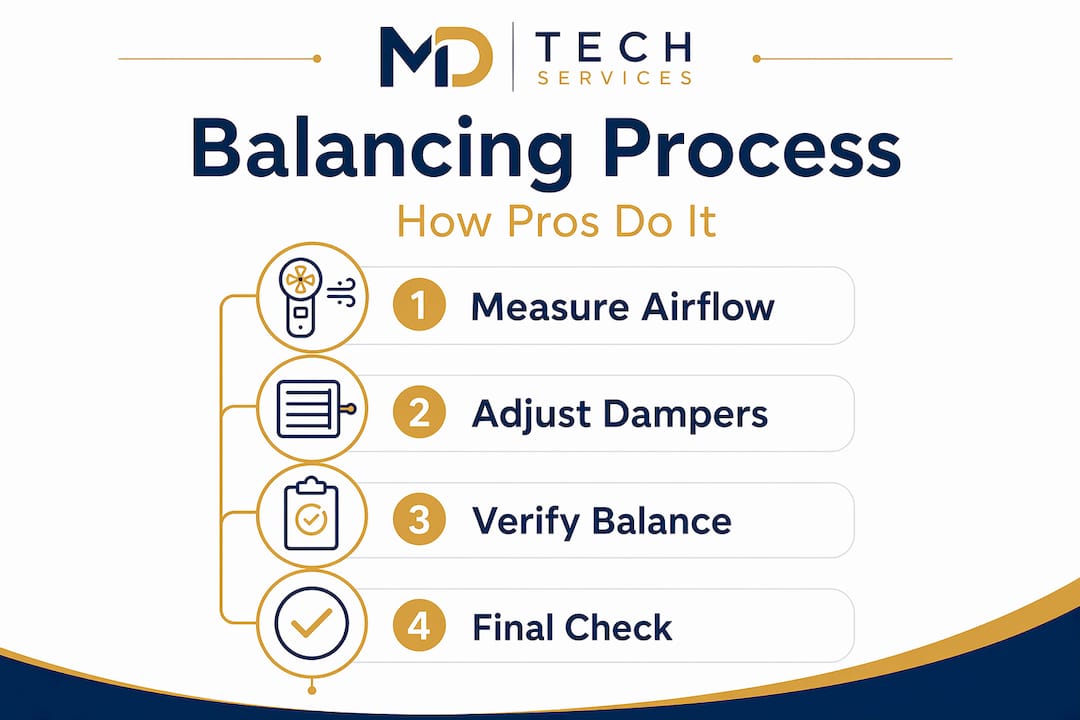
ASHRAE Standard 111 is the formal technical reference for TAB procedures. It defines measurement methods, instrument requirements, and acceptable deviation ranges for both supply and return air terminals.
| Room / Terminal | Design CFM target | Acceptable range (10% tolerance) | Measurement method |
|---|---|---|---|
| Master bedroom | 120 CFM | 108 to 132 CFM | Flow hood at register |
| Living room | 200 CFM | 180 to 220 CFM | Flow hood at register |
| Kitchen | 80 CFM | 72 to 88 CFM | Anemometer or flow hood |
| Second bedroom | 100 CFM | 90 to 110 CFM | Flow hood at register |
| Hallway return | 350 CFM | 315 to 385 CFM | Return grille measurement |
What professional standards cover that DIY approaches usually miss:
- Static pressure testing across the air handler to identify restrictions in the duct system
- Return air verification to ensure the system can pull enough air back for re-conditioning
- Fan performance curves to confirm the blower is operating at its designed speed
- Duct leakage assessment to find air that is being lost before it reaches the registers
- Coil and filter pressure drop measurement to detect blockages affecting total system airflow
Understanding the connection between HVAC and air quality helps explain why professional balancing matters beyond comfort. Unbalanced systems can pull in unconditioned air from attics or crawlspaces, which carries dust, humidity, and pollutants into your living spaces. For more context on terms used by HVAC professionals, our HVAC terms explained resource is a useful reference.
Common challenges and what affects balancing
Knowing the standards, it is equally important to understand what can go wrong, because several factors in real homes make airflow balancing difficult even for experienced technicians.
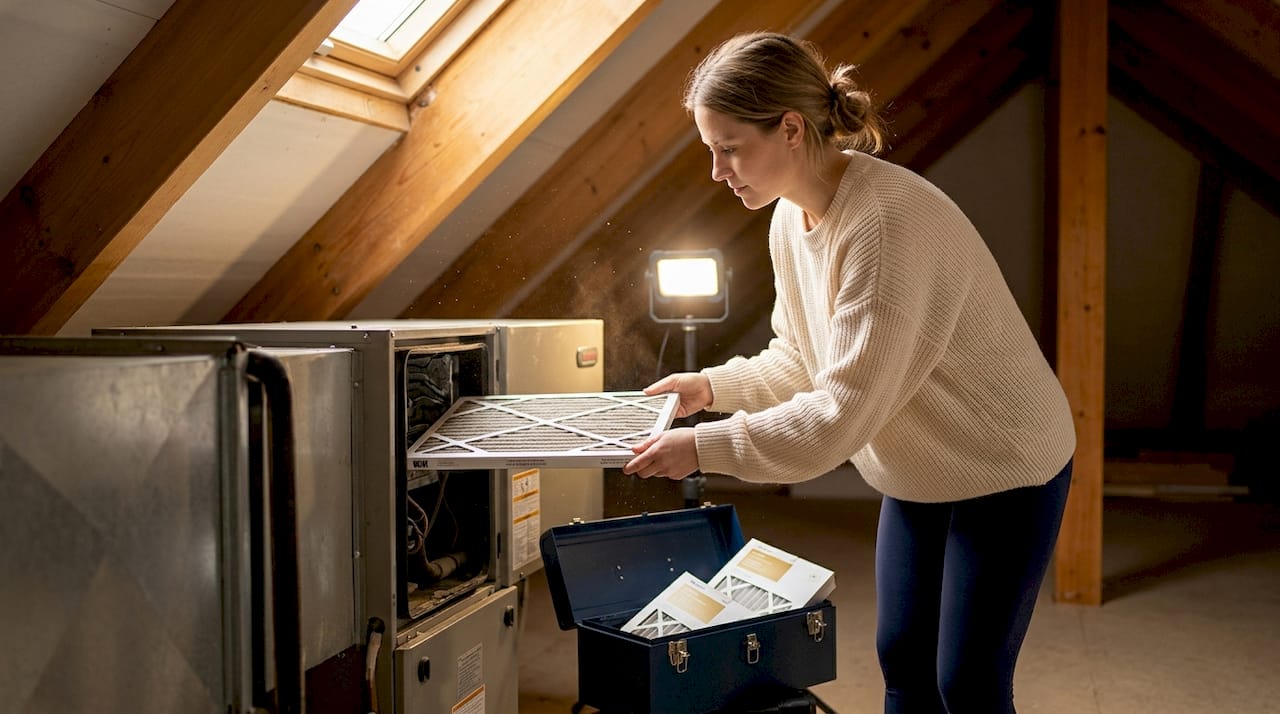
Duct, filter, and coil resistance is one of the most frequent reasons systems cannot meet their airflow targets. When sizing and component selection are off, balancing becomes inconsistent or impossible without first correcting the underlying problem. You cannot balance air delivery if there is not enough total air moving through the system to begin with.
Proportional balancing methods are a recognized technical approach where dampers are adjusted based on the ratio of measured airflow to design airflow. However, these methods assume the fan and system are operating within a usable range. If the system is severely undersized or obstructed, proportional adjustments will not produce predictable results.
| Common obstacle | Impact on airflow balancing | Corrective action needed |
|---|---|---|
| Dirty or clogged air filter | Reduces total system airflow, making all rooms harder to balance | Replace filter before any balancing attempt |
| Undersized supply ducts | Limits maximum CFM possible in affected branches | Professional duct modification or redesign |
| High coil resistance (dirty evaporator) | Raises static pressure across the air handler, drops fan output | Professional coil cleaning |
| Duct leaks in unconditioned spaces | Air lost before reaching registers, throwing off all measurements | Duct sealing before balancing |
| Closed or blocked return grilles | Starves the system of return air, causing pressure imbalances | Clear obstructions, verify return sizing |
Pro Tip: Always address filter replacement and basic maintenance first. Attempting to balance a system running with a dirty filter or restricted coil is like trying to fine-tune a car engine while the fuel line is clogged. Fix the obvious problems first, then measure.
Homes with HVAC zone systems face an added layer of complexity, because each zone has its own damper controls and pressure characteristics. Balancing a zoned system requires coordinating adjustments across zones to avoid creating pressure problems in one area while fixing another.
Homeowner checklist: Steps to better airflow and comfort
Challenges identified, here is how you can start making a real difference in your home’s airflow and comfort today. These steps move from the easiest wins to knowing when a professional is the right call.
- Clear all supply and return registers. Move furniture, rugs, and curtains away from any vents. Even a partially blocked return grille can disrupt whole-system airflow.
- Replace the air filter. Use the correct MERV rating for your system. A filter that is too restrictive can drop airflow more than a dirty one. Check your system manual for the recommended range.
- Walk the home and map temperatures. Use a simple indoor thermometer in each room at the same time of day for three consecutive days. This reveals patterns that a single reading will miss.
- Inspect and adjust registers. Open registers fully in rooms that feel under-served. Partially close registers in rooms that receive too much air. Make one adjustment at a time and allow 24 hours before evaluating.
- Check inline duct dampers. These are usually located in the ductwork near the air handler or at branch points. Confirm they are not fully closed and that their positions match seasonal needs.
- Look for obvious duct issues. Check visible ductwork in the garage, attic access points, or crawlspace for disconnected joints, tears, or crushing. These cause significant air loss and can undermine any balancing effort.
- Call a professional for persistent problems. If rooms remain uncomfortable after two weeks of adjustments, professional airflow measurements using instruments like flow hoods and manometers are needed to identify what DIY methods cannot detect.
Pro Tip: If adjusting one room’s register suddenly makes another room noticeably worse, that is a sign of a deeper duct sizing or leakage issue. One room improving at another’s expense is not balance. It is a symptom of a system that needs professional evaluation.
For a full maintenance schedule that supports ongoing comfort, review our HVAC maintenance steps guide. Staying ahead of small issues is always less expensive than waiting for a comfort crisis.
Why most homeowners underestimate airflow balancing
Most HVAC guides focus on equipment: what size unit to buy, when to replace the compressor, or whether to upgrade to a smart thermostat. Airflow balancing rarely gets the same attention, and that is a mistake that costs homeowners real money over time.
Here is the truth we see repeatedly in our work across Orange County and Los Angeles: a home with properly balanced airflow will outperform a home with newer equipment and poor airflow balance, nearly every time. The equipment is only as effective as the delivery system that carries conditioned air to each room.
When airflow is unbalanced, the system works harder to compensate. Rooms that are under-supplied cause occupants to push the thermostat further, which runs the equipment longer and drives up energy bills. Rooms that are over-supplied waste conditioned air and create uncomfortable humidity swings. Neither situation is good for the equipment or the people living in the home.
We also see homeowners treat comfort problems as a reason to replace perfectly functional equipment. Before investing in a new system, it is worth asking whether the existing equipment, running on a properly balanced duct system, would actually solve the problem. In many cases, it would. Addressing airflow first is often the smarter and far less expensive path. Understanding the role of HVAC in homes helps make that case clearly. The system is only as good as the distribution network supporting it.
Get expert airflow help for lasting comfort
If you have worked through the checklist and the problems persist, that is a clear signal that your home needs professional airflow balancing. Guessing at damper positions without accurate measurements often creates new problems while masking the original ones.

MDTech Services helps homeowners across Orange County and Los Angeles County get real, lasting results from their HVAC systems. Our experienced technicians use proper measurement tools and follow recognized procedures to identify exactly where your airflow is falling short and what it will take to fix it correctly. Whether you need a full HVAC repair evaluation, step-by-step HVAC troubleshooting, or guidance on related appliance repair services, our team is ready to help. Contact us today to schedule your service and stop living with uncomfortable rooms.
Frequently asked questions
Can I balance my home’s airflow myself?
You can improve airflow by adjusting registers and replacing filters, but persistent issues often require professional HVAC instruments and expertise. Professional measurements using flow hoods and pressure gauges reveal problems that visual inspections and DIY adjustments simply cannot detect.
What are signs my airflow is unbalanced?
Hot or cold spots in specific rooms, weak air coming from certain vents, and unusually noisy HVAC operation are all reliable signs of airflow imbalance in your home.
How do professionals balance airflow?
HVAC professionals measure airflow and pressure at each terminal using specialized tools, compare results to design specifications, and adjust dampers and registers to bring air delivery within acceptable tolerances. TAB procedures define the exact methods and standards used in this process.
What causes airflow imbalance besides dampers?
Dirty filters, undersized ducts, high coil resistance, and poor original system design often create problems that basic damper adjustments cannot resolve without first correcting the underlying issue.
Does airflow balancing improve energy efficiency?
Yes, properly balanced airflow allows your HVAC system to run at its intended efficiency, which reduces runtime, lowers energy bills, and decreases wear on mechanical components over time.