
TL;DR:
- A thermostat is a device that monitors room temperature and signals HVAC systems to turn on or off, controlling home comfort and energy use. Proper placement, maintenance, and selecting the right type—manual, programmable, or smart—are essential for optimal performance and savings. Advanced thermostats learn routines and can significantly reduce energy bills when installed correctly and paired with well-maintained systems.
A thermostat is a temperature-regulating device that acts as the command center of your HVAC system, monitoring ambient air conditions and signaling your heating or cooling equipment to turn on or off based on your chosen target temperature. Every time your furnace kicks on or your air conditioner shuts off, your thermostat made that call. Understanding how this device works, which type fits your home, and where it should be installed gives you real control over your comfort and your energy bills. This guide covers all of it, from the basic thermostat definition to the latest smart technology.
What is a thermostat and how does it work?
A thermostat does not produce heat or cooling on its own. It is a passive control device that monitors the air temperature around it and triggers your HVAC equipment to start or stop. Think of it as a switch with a brain: it reads the room, compares what it finds to your set target, and acts accordingly.
Modern thermostats operate through a three-stage cycle:
- Sensing: A temperature sensor, either a thermistor in digital models or a bimetallic strip in older mechanical units, reads the current air temperature at the thermostat’s location.
- Comparing: The device compares the measured temperature against your programmed setpoint. If the room is too cold or too warm, the thermostat prepares to act.
- Controlling: The thermostat signals HVAC equipment to activate or deactivate by completing or breaking an electrical relay circuit. Once the target temperature is reached, the system shuts off automatically.
This cycle repeats continuously throughout the day. The key difference between mechanical and digital operation is precision. Mechanical thermostats use bimetallic strips that respond slowly due to thermal mass, which can cause temperature swings of 1 to 3 degrees. Electronic sensors in digital and smart thermostats react faster and hold temperatures within a fraction of a degree. That tighter control translates directly into fewer unnecessary heating and cooling cycles.
Pro Tip: If your system seems to run constantly without reaching the set temperature, the problem is often the thermostat sensor, not the furnace or air conditioner. A quick thermostat calibration check can confirm whether the sensor is reading accurately.
What are the main types of thermostats?
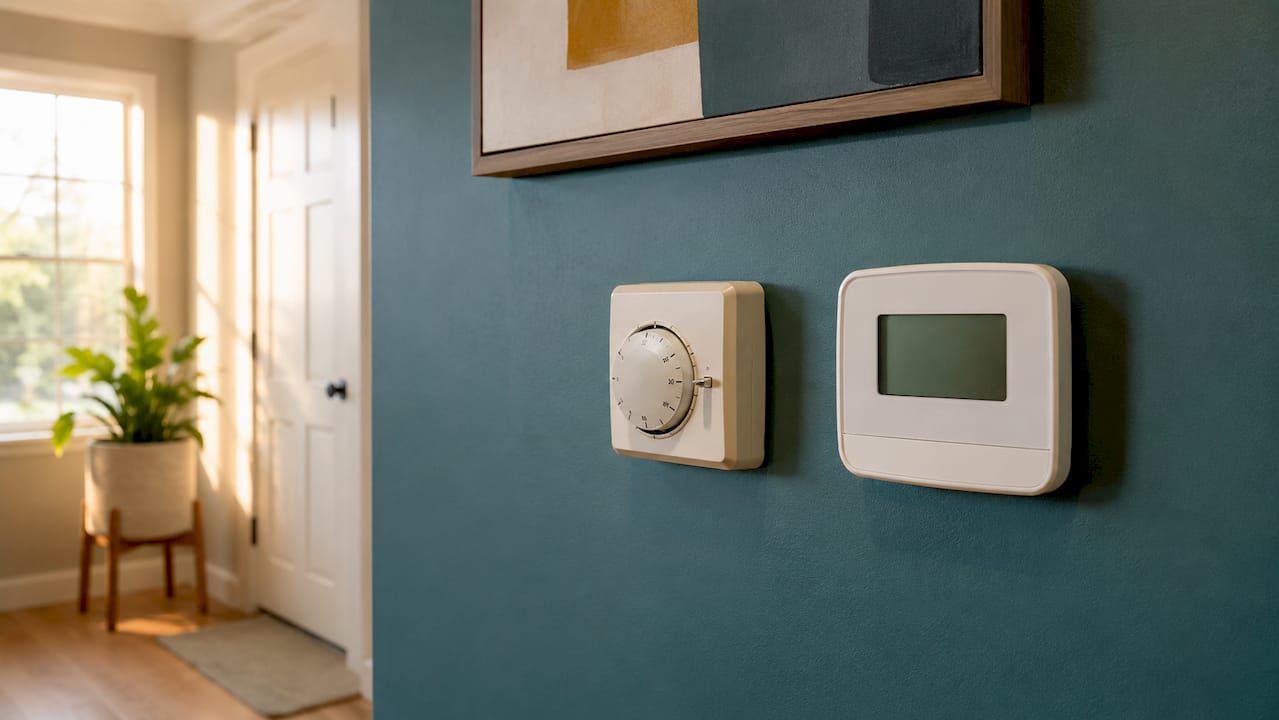
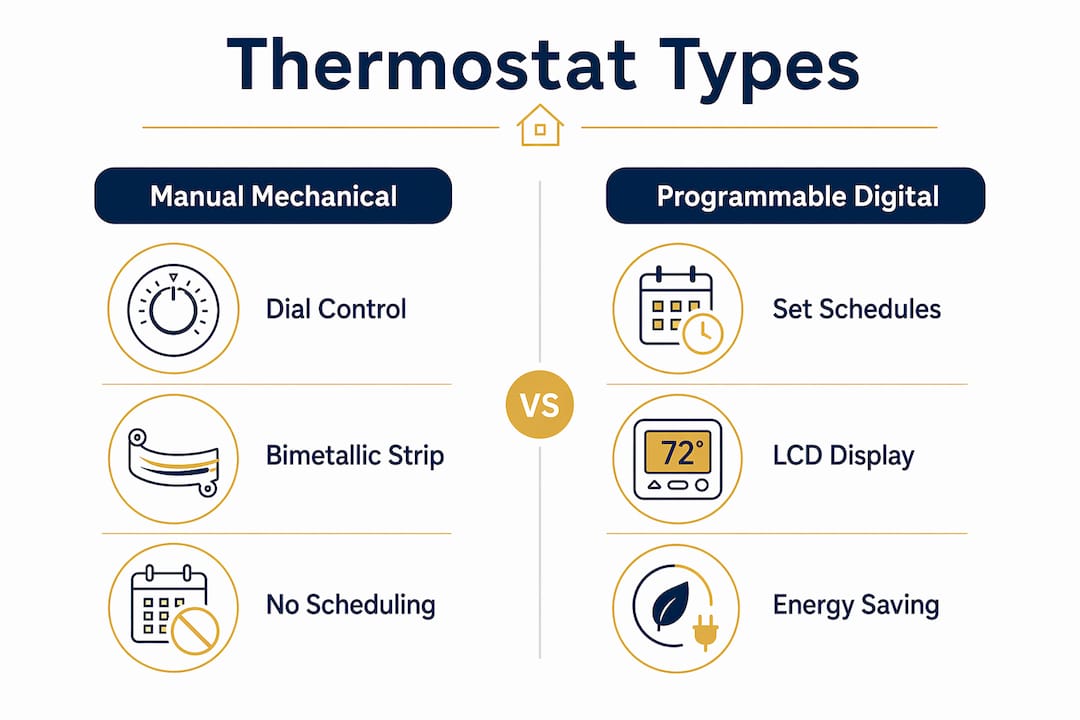
Thermostat technology falls into three categories: manual mechanical units, programmable digital units, and smart Wi-Fi-enabled thermostats. Each serves a different type of homeowner, and choosing the wrong one for your lifestyle costs you money.
Manual mechanical thermostats
These are the classic dial or slider models found in older homes. They use a bimetallic strip to sense temperature and require you to adjust the setting by hand every time you want a change. They are reliable and inexpensive, but they offer no automation and no scheduling. If you forget to turn down the heat before leaving for work, it runs all day.
Programmable digital thermostats
Programmable models let you set temperature schedules in advance, such as lowering heat at night and raising it before you wake up. Brands like Honeywell Home offer programmable units with 7-day scheduling, meaning you can set a different program for every day of the week. These units display temperature digitally and respond faster than mechanical models. They are the practical middle ground for homeowners who want automation without a monthly subscription or app dependency.
Smart Wi-Fi thermostats
Smart thermostats, including models from Google Nest and Ecobee, connect to your home Wi-Fi and allow control through smartphone apps or voice assistants like Amazon Alexa and Google Assistant. Smart thermostats use AI and connectivity to learn your schedule and preferences, automatically adjusting temperature and reducing energy use without any manual input. They also integrate with HVAC zone systems for room-by-room control in larger homes.
| Feature | Manual Mechanical | Programmable Digital | Smart Wi-Fi |
|---|---|---|---|
| Temperature accuracy | 1 to 3 degree swing | Within 1 degree | Fraction of a degree |
| Scheduling | None | 7-day programs | Automatic learning |
| Remote control | No | No | Yes, via app |
| Smart home integration | No | Limited | Full (Alexa, Google) |
| Typical cost range | $20 to $50 | $50 to $150 | $150 to $300+ |
- Manual models suit rental properties or vacation homes where simplicity matters most.
- Programmable thermostats work well for households with consistent daily routines.
- Smart thermostats deliver the best return for homeowners who are home irregularly or want to monitor energy use in real time.
Does thermostat placement affect your home’s comfort?
Placement is the most overlooked factor in thermostat performance. Thermostat performance depends heavily on sensor accuracy and proper placement, and a poorly located unit will give your HVAC system false readings regardless of how advanced the technology is. Professionals consistently rank sensor location above software features when diagnosing comfort problems.
Here are the placement mistakes that cause the most problems:
- Exterior walls: Walls that face the outside are cooler in winter and warmer in summer than interior walls. A thermostat mounted here reads the wall temperature, not the room temperature.
- Direct sunlight: Sunlight hitting the thermostat causes it to read higher than the actual room temperature, triggering unnecessary cooling cycles.
- Near vents or registers: Air blowing directly across the sensor creates false readings and causes the system to short-cycle, meaning it turns on and off too frequently.
- Kitchens or bathrooms: Heat and humidity from cooking or showers skew readings and cause the system to overcorrect.
Incorrect placement causes frequent cycling and increases wear on HVAC equipment. Short-cycling is one of the leading causes of premature compressor failure in air conditioning systems, and it is almost always preventable.
The correct location is an interior wall in a frequently occupied room, roughly 5 feet from the floor, away from windows, vents, and appliances. A hallway between the main living areas of your home is often ideal because it captures an average of the temperatures throughout the space.
Pro Tip: Your thermostat only measures air temperature at its exact location. It does not read air inside your ductwork or in rooms far from the unit. If one room is always too hot or too cold, the issue may be HVAC zoning rather than the thermostat itself.
How do modern thermostats contribute to energy savings?
Smart thermostats analyze historical usage and thermal trends to reduce energy consumption, which is the primary reason homeowners upgrade from basic programmable models. The learning capability means the device builds a profile of when you are home, when you sleep, and when the house is empty, then adjusts heating and cooling cycles to match that profile without any manual input.
Remote control through smartphone apps adds another layer of savings. If you leave for a weekend trip and forget to adjust the thermostat, you can do it from your phone rather than letting the system run at full comfort settings for two days. Google Nest and Ecobee both offer geofencing features that detect when your phone leaves a set radius and automatically shift the home into an energy-saving mode.
Smart thermostats do more than switch heat on and off. They learn your home’s thermal behavior over time and use that data to pre-heat or pre-cool spaces more efficiently, reducing the total runtime of your HVAC system.
Integration with smart home ecosystems like Amazon Alexa, Apple HomeKit, and Google Home allows thermostats to coordinate with other devices. For example, smart blinds can close automatically when the thermostat detects rising indoor temperatures from sunlight, reducing the cooling load before the air conditioner even needs to start. These energy-saving strategies compound over a full year of operation.
Regular HVAC maintenance also plays a direct role in how effectively your thermostat manages the system. A thermostat sending the right signals to a poorly maintained furnace or air conditioner still produces poor results. Clean filters, charged refrigerant, and calibrated equipment let the thermostat do its job accurately.
Key takeaways
A thermostat controls your home’s comfort by sensing temperature, comparing it to your setpoint, and signaling your HVAC system to act. Its accuracy depends as much on placement and maintenance as on the technology inside it.
| Point | Details |
|---|---|
| Thermostat function | It signals HVAC equipment to start or stop; it does not generate heat or cooling itself. |
| Technology differences | Smart and digital models hold temperature within a fraction of a degree versus 1 to 3 degrees for mechanical units. |
| Placement matters most | Poor placement causes short-cycling and HVAC wear, regardless of thermostat quality. |
| Smart thermostat value | Learning algorithms and remote control reduce energy use by optimizing heating and cooling cycles automatically. |
| Maintenance connection | A well-placed, calibrated thermostat only performs well when paired with a properly maintained HVAC system. |
What we’ve learned from years of thermostat service calls
After years of HVAC service calls across Orange County and Los Angeles County, the pattern we see most often is this: homeowners invest in a quality smart thermostat, install it themselves, and then wonder why their energy bills barely change. In almost every case, the thermostat was placed on an exterior wall or near a supply vent, and it was reading temperatures that had nothing to do with actual room comfort.
The technology inside a Google Nest or Ecobee is genuinely impressive. But a $300 smart thermostat mounted in the wrong spot will perform worse than a $40 programmable unit in the right location. Placement is not a minor detail. It is the foundation everything else builds on.
We also see homeowners skip thermostat calibration entirely after installation. A thermostat that reads 2 degrees high will run your air conditioner longer than necessary every single day. Over a full cooling season in Southern California, that adds up to real money. Calibration takes minutes and costs nothing if you know what to check.
Our honest recommendation: match the thermostat type to how you actually live, not how you think you live. If your schedule changes week to week, a learning smart thermostat earns its cost. If your routine is consistent, a programmable digital unit does the job at a fraction of the price. Either way, get the placement right first.
— MDTECH
Keep your thermostat and HVAC system running right
When your thermostat is working correctly, your home stays comfortable and your energy bills stay predictable. When something goes wrong, whether it is a sensor fault, a wiring issue, or a system that won’t respond to the thermostat’s signals, the fix requires a licensed technician who understands both the control side and the equipment side.

Mdtechservices provides licensed HVAC repair and appliance service throughout Orange County and Los Angeles County. Our technicians diagnose thermostat and system issues accurately, so you get a real fix rather than a temporary patch. If your heating or cooling system is not responding the way it should, explore our HVAC repair services or use our HVAC troubleshooting guide to identify the problem before calling. We offer online appointment booking and same-area response for homeowners who need reliable service fast.
FAQ
What is a thermostat in simple terms?
A thermostat is a device that monitors the air temperature in your home and tells your heating or cooling system when to turn on or off. It does not produce heat or cooling itself. It only controls the equipment that does.
How does a thermostat know when to turn on the heat?
The thermostat’s sensor reads the current room temperature and compares it to your set target. When the room drops below that target, the thermostat completes an electrical circuit that signals your furnace or heat pump to start running.
What is the difference between a programmable and a smart thermostat?
A programmable thermostat follows a fixed schedule you set manually, such as lower temperatures at night and higher ones in the morning. A smart thermostat learns your routine automatically and allows remote control through a smartphone app, offering more flexibility and typically greater energy savings.
Why does my thermostat keep turning on and off repeatedly?
Frequent on-and-off cycling, called short-cycling, is most often caused by poor thermostat placement near a vent, window, or exterior wall. The sensor picks up false temperature readings and triggers the system unnecessarily. Relocating the thermostat or checking for nearby heat sources usually resolves the issue.
How often should a thermostat be replaced?
Most thermostats last 10 to 15 years before sensor accuracy degrades noticeably. If your system runs longer than expected, your home never reaches the set temperature, or the display becomes unreliable, those are signs the unit may need replacement or professional calibration.