
TL;DR:
- Verifying that technicians hold specific licenses, EPA 608, and NATE certifications ensures legal compliance and high-quality repairs. Homeowners should promptly check credentials through state portals, request insurance documentation, and ask targeted questions before hiring. Doing so reduces liability, protects property, and guarantees professional standards for appliance, HVAC, or plumbing work.
A licensed technician is defined as a trade professional who holds state-issued authorization, federal certifications, or both to legally perform specialized work on appliances, HVAC systems, or plumbing in residential properties. Knowing how to choose licensed technicians correctly protects your home, your family, and your legal standing as a property owner. The credentials that matter most include state trade licenses, EPA Section 608 certification for refrigerant handling, and NATE certification for HVAC quality. Skipping verification on any of these is not a minor oversight. It is the difference between a repair that holds and one that creates liability.
What licensing and certifications should you verify before hiring?
Selecting certified technicians starts with understanding that not all credentials are equal. A general business license does not prove technical competence. In California, for example, HVAC contractors must hold a C-20 classification specifically. A general business license is legally insufficient proof for specialized trade work. This distinction matters whether you are hiring for appliance repair, HVAC maintenance, or plumbing service.
Here are the core credentials to verify before you commit to any technician:
- State trade license: Confirm the license is active, matches the trade classification for the work being done, and shows no disciplinary history. State licensing boards publish this information publicly.
- EPA Section 608 certification: Federal law mandates EPA 608 certification for any technician handling refrigerants. A technician without it is working illegally, and the liability falls on the property owner who hired them.
- NATE certification: The North American Technician Excellence credential is voluntary, but NATE-certified technicians pass rigorous exams covering installation, service, and system diagnostics. It signals a higher standard of technical proficiency beyond the legal minimum.
- General liability insurance: Covers property damage caused during the job. Request a Certificate of Insurance (COI) directly from the carrier, not a verbal confirmation.
- Workers’ compensation insurance: Protects you from liability if a technician is injured on your property. This is non-negotiable for any job involving physical labor in your home.
One critical point most homeowners miss: verify the specific technician’s credentials, not just the company’s. Federal law requires that the individual handling refrigerants holds EPA 608 certification. A company-level license does not automatically extend compliance to every employee on the team.
Pro Tip: Ask the company to provide the license number and EPA certification number of the technician who will actually show up at your door. A reputable company will provide this without hesitation.

How do you verify a technician’s qualifications and reputation?
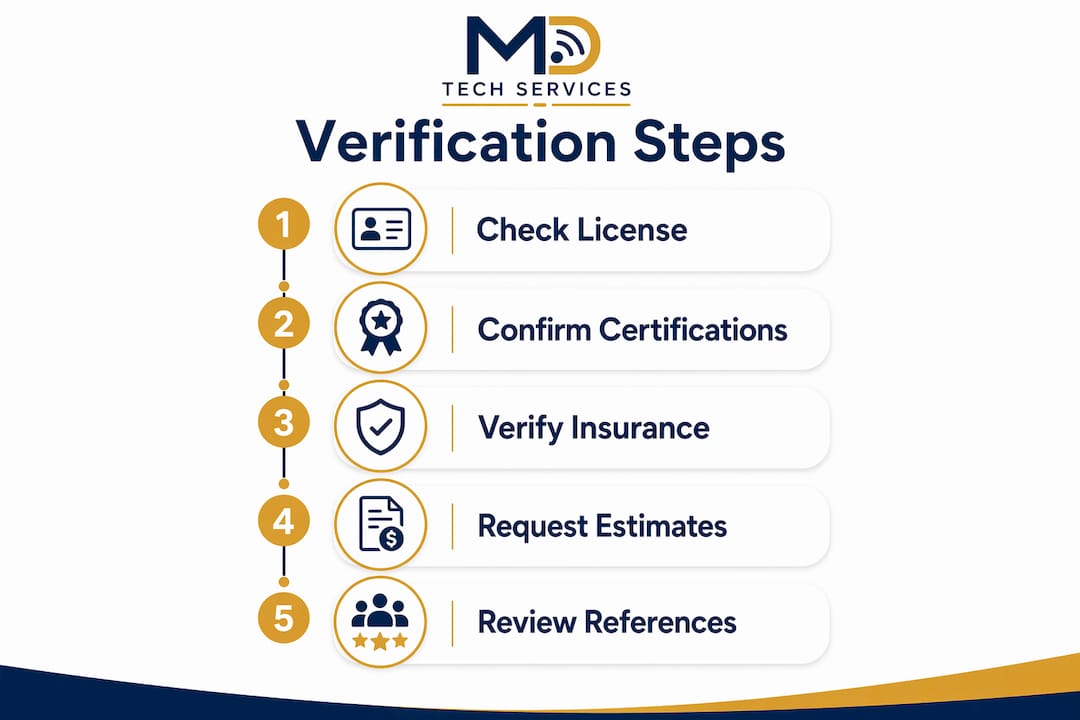
Verification is faster than most homeowners expect. Checking a license through state portals takes about 2 minutes using a license number or company name. That two minutes can save you thousands in faulty repairs or legal exposure. Here is a step-by-step process to follow before signing any service agreement.
- Search the state licensing board portal. In California, the Contractors State License Board (CSLB) lets you look up any contractor by name, license number, or business name. Confirm active status, trade classification, and any complaints or disciplinary actions.
- Verify EPA 608 certification. The EPA does not maintain a public registry, but you can ask the technician to show their certification card and cross-reference the issuing organization (such as ESCO Group or Mainstream Engineering) directly.
- Check NATE certification status. NATE maintains a technician certification lookup on their official website. Search by name or certification number to confirm current standing.
- Request the Certificate of Insurance. A proper COI must come directly from the insurance carrier, not a PDF the company emails you. Call the carrier to confirm coverage dates and policy limits.
- Evaluate online reviews critically. Star ratings alone are not reliable. Review depth and business responses to negative feedback reveal far more about how a company handles problems than a 4.8-star average ever will.
- Assess business longevity. Companies in business for 5 or more years carry a track record that newer operations simply cannot match. Longevity reduces the risk of hiring an unlicensed or fly-by-night operator.
| Verification step | What it tells you |
|---|---|
| State license board lookup | Active status, trade classification, disciplinary history |
| EPA 608 certification check | Legal authorization to handle refrigerants |
| NATE certification lookup | Voluntary technical proficiency above licensing baseline |
| COI from insurance carrier | Current coverage for liability and workers’ comp |
| Review content analysis | How the company handles disputes and customer concerns |
For plumbing specifically, Mdtechservices has published a detailed walkthrough on verifying a plumber’s license that applies the same logic across other trades.
What questions should you ask before hiring a technician?
The right questions do two things at once. They gather factual information and they reveal how transparent a technician is willing to be. A qualified professional will answer every one of these without deflecting.
- “Can you provide your license number and its expiration date?” This confirms the license is current and gives you something concrete to verify independently.
- “Do you hold EPA Section 608 certification, and can I see the card?” For any HVAC or refrigeration work, this is a legal requirement, not a preference.
- “How many jobs similar to mine have you completed in the past year?” Experience with your specific appliance brand or system type (Sears, Carrier, Rheem, etc.) matters more than general years in business.
- “Who exactly will perform the work, and what are their credentials?” The person who shows up may not be the licensed technician you vetted. Confirm this in advance.
- “Can you provide a written, itemized estimate?” Low bids frequently omit scope or use substandard parts. A fair estimate includes itemized costs, warranty terms, and labor documentation.
- “Who is responsible for pulling permits and scheduling inspections?” For HVAC replacements or plumbing modifications, permits are legally required. A technician who dismisses this question is a red flag.
Pro Tip: Get everything in writing before any work begins. A detailed written estimate with warranty terms protects you if the job goes wrong and gives you clear recourse.
Understanding why certified technicians matter for home repairs helps you frame these questions with confidence and recognize when an answer is incomplete.
Common mistakes to avoid when choosing licensed technicians
Most hiring mistakes come down to shortcuts. Homeowners under time pressure accept verbal assurances, skip verification steps, or choose the lowest bid without understanding what they are actually getting.
The most costly mistake is choosing based on price alone. A low bid often signals missing scope, inferior parts, or an unlicensed operator who cannot legally perform the work. Fair pricing reflects the actual cost of licensed labor, quality parts, and proper insurance coverage.
“Avoid lowest bids; fair pricing reflects scope and quality, protecting homeowners from hidden costs and poor workmanship.” — HVAC Seer
Assuming a general business license covers specialized trades is the second most common error. It does not. A contractor licensed for general construction cannot legally perform HVAC refrigerant work or licensed plumbing without the specific trade classification to match.
Accepting verbal insurance confirmation is equally risky. A technician who says “yes, we’re insured” without providing a COI from the carrier is giving you nothing you can verify. Reputable companies provide COIs promptly. Delays or refusals are a direct warning sign.
Finally, overlooking local expertise costs homeowners more than they realize. A technician unfamiliar with Orange County or Los Angeles County permit requirements may complete a job that fails inspection, leaving you responsible for corrections. Local knowledge is not a bonus feature. It is a practical requirement for compliant, lasting repairs.
Key takeaways
Choosing a licensed technician correctly requires verifying state trade licenses, EPA Section 608 certification, NATE credentials, and insurance documentation before any work begins.
| Point | Details |
|---|---|
| Verify specific credentials | Check the individual technician’s license and EPA 608 status, not just the company’s. |
| Use state portals for fast checks | License lookups through state boards take about 2 minutes and confirm active status. |
| Request a COI from the carrier | Verbal insurance confirmation is insufficient; get written proof directly from the insurer. |
| Ask for itemized written estimates | Fair estimates include labor, parts, warranty terms, and permit responsibilities. |
| Prioritize longevity and reviews | Companies with 5 or more years in business and substantive review responses carry lower risk. |
What we have learned from years of verifying technician credentials
After working in appliance repair, HVAC, and plumbing services across Orange County and Los Angeles County, the pattern we see most often is this: homeowners who skip the two-minute license verification are the same ones calling us to fix what an unlicensed operator left behind. The verification step feels like extra work until the moment it saves you from a $3,000 correction job.
One thing most hiring guides do not say plainly enough: certifications and customer feedback need to be weighed together. A NATE-certified technician with a history of ignoring customer complaints is not a better choice than a licensed technician with five years of clean reviews and clear communication. Both matter. Neither alone is enough.
We also find that the quality of a technician’s communication before the job predicts the quality of their work. A technician who provides a clear, itemized estimate, answers your questions directly, and confirms permit responsibilities upfront is showing you their professional standard before they touch a single component. That transparency is a credential in itself.
Our advice: do not treat the lowest price as a starting point for negotiation. Treat it as a warning. Reliable, licensed technicians who carry proper insurance and pull required permits cannot compete with unlicensed operators on price. Nor should they have to. You are not just paying for the repair. You are paying for the accountability that comes with it.
— MDTECH
Why Mdtechservices is the right choice for licensed home repairs

Mdtechservices employs licensed technicians verified for appliance repair, HVAC service, and plumbing work across Orange County and Los Angeles County. Every technician on our team carries the required state trade license and EPA Section 608 certification where applicable, and we provide full insurance documentation before any job begins. Our pricing is transparent and itemized, with no hidden fees and clear warranty terms on every service call.
Whether you need appliance repair for a refrigerator or ice machine, or you are looking for a complete HVAC repair guide to understand what your system needs, Mdtechservices delivers expert service backed by proper credentials. Call us or book online to schedule your appointment today.
FAQ
What does a licensed technician mean for home repairs?
A licensed technician holds state-issued trade authorization specific to their field, such as HVAC, plumbing, or electrical work, confirming they meet legal standards for that type of service. Licensing protects homeowners from unqualified work and ensures the technician is accountable to a state regulatory body.
Is EPA Section 608 certification required for HVAC work?
EPA Section 608 certification is federally required for any technician who handles refrigerants, and working without it is illegal under federal law. Always ask for the certification card before allowing refrigerant-related HVAC work in your home.
How do I verify a technician’s license quickly?
State licensing board portals allow you to look up any contractor by name or license number in about 2 minutes, confirming active status, trade classification, and any disciplinary history.
What is NATE certification and do I need it?
NATE (North American Technician Excellence) is a voluntary certification that signals technical proficiency beyond the legal licensing minimum, and NATE-certified technicians typically deliver more accurate diagnostics and longer-lasting repairs. It is not legally required, but it is a strong quality indicator when choosing between candidates.
Should I always get a written estimate before hiring?
A written, itemized estimate is non-negotiable for any home repair job. It documents labor costs, parts, warranty terms, and permit responsibilities, protecting you if disputes arise after the work is complete.