
TL;DR:
- Choosing an HVAC system in Orange and Los Angeles Counties depends on your home’s duct condition, climate, and energy codes. Ductless mini-splits offer high efficiency and zoning control for homes without ductwork, while central split systems suit homes with good duct integrity. The optimal choice balances your home’s needs, installation quality, and compliance requirements for lasting comfort and efficiency.
Choosing the right HVAC system for your home in Orange County or Los Angeles County isn’t as straightforward as picking a brand you recognize. Every home is different. Some were built decades ago without ductwork. Others sit in coastal neighborhoods where humidity and mild winters create unique comfort challenges. Add California’s strict energy codes and a wide range of system types on the market, and the decision can feel overwhelming. This guide walks you through the key factors to weigh, the main system types available, and how to match the right option to your home’s actual needs so you get lasting comfort without overpaying on energy bills.
Table of Contents
- What to consider before choosing your HVAC system
- Ducted split systems: Central comfort for whole homes
- Ductless mini-split systems: Flexible and efficient
- Other important HVAC types: Hybrid, packaged, and geothermal systems
- Side-by-side comparison: Which HVAC system is right for you?
- Our take: There’s no single ‘best’—fit matters most
- Take the next step for expert HVAC installation or replacement
- Frequently asked questions
Key Takeaways
| Point | Details |
|---|---|
| Ductwork impacts choice | Homes with or without ductwork require different HVAC systems and influence both cost and comfort. |
| Energy codes matter | California’s Title 24 requires minimum efficiency standards for permitted HVAC installations. |
| Mini-splits save energy | Ductless mini-splits can achieve up to 35 SEER2 and avoid duct-related energy losses. |
| Hybrid and geothermal options | Hybrid and geothermal systems offer flexibility and top efficiency but suit specific home needs. |
| Professional assessment is key | An expert evaluation ensures you choose the best HVAC type for energy savings and comfort in your home. |
What to consider before choosing your HVAC system
Before you compare equipment specs or prices, you need to look at your home’s existing conditions. The factors below will shape every decision that follows.
- Ductwork condition and availability. If your home already has ducts, their condition matters. Leaky or poorly sized ducts can cancel out the efficiency gains of a top-rated system. If you have no ducts at all, your options shift significantly.
- Regional climate. Orange and Los Angeles Counties experience hot, dry summers and mild winters, with coastal areas adding humidity and fog. These patterns affect which heating and cooling technologies perform best year-round.
- California Title 24 compliance. As noted by HVAC compliance professionals, California Title 24 Part 6 sets enforceable minimum efficiency and construction standards for HVAC in newly built or significantly altered buildings, and compliance is a condition of permit approval and final inspection sign-off. Ignoring this can delay your project or result in failed inspections.
- Zoning and comfort priorities. Do you want whole-home conditioning or do you need more control over individual rooms? Zoning requirements affect which systems are practical.
- Budget. Upfront installation costs and long-term operating costs don’t always move in the same direction. A higher-efficiency system often costs more to install but saves money monthly.
The Department of Energy points out that energy efficiency outcomes are highly contingent on duct availability and condition, climate needs, and zoning, because duct losses and poor installation quality can dominate the final result regardless of system type. That’s an important reality check before you focus on equipment alone.
Pro Tip: Before scheduling any HVAC quotes, walk your attic or crawl space and look for visible duct damage, gaps at joints, or insulation that’s fallen away. These conditions need to be on the table when you talk to an installer. You can also explore energy-efficient HVAC tips to better understand how your home’s envelope affects system performance.
With the groundwork set, let’s dive into the core types of residential HVAC systems.
Ducted split systems: Central comfort for whole homes
The most familiar residential setup is the central split system. According to industry sources, residential split systems consist of an outdoor condensing unit paired with an indoor air handler that distributes conditioned air via ductwork throughout the home. This is the system most Southern California tract homes were built with, and it remains a reliable whole-home solution when existing ductwork is in good condition.
Here’s what makes central split systems a strong choice for many homeowners:
- Consistent whole-home comfort. Every room receives conditioned air through the same distribution network, which makes temperature management predictable.
- Wide availability of equipment and service technicians. Because split systems are the most common residential HVAC type, parts are accessible and licensed technicians are experienced with them.
- Scalable options. You can choose systems with variable-speed air handlers that improve comfort and reduce energy use compared to older single-stage units.
- Compatibility with smart thermostats. Most modern split systems pair easily with programmable and Wi-Fi-enabled thermostats for improved control.
The key limitation is duct dependency. If your ducts have significant leaks, poor insulation, or incorrect sizing, your new system will underperform. Studies consistently show that duct losses in unconditioned spaces like attics can waste 20 to 30 percent of conditioned air before it ever reaches a room.
“Common residential HVAC system types are typically grouped by distribution method, whether ducted central or ductless, and by heating technology, whether heat pump, furnace, or boiler.” This framing, supported by the Department of Energy, is a useful starting point for any homeowner trying to sort through the options.
| Feature | Central split system |
|---|---|
| Best for | Homes with existing, good-condition ductwork |
| Heating technology | Heat pump or gas furnace |
| Energy efficiency | SEER2 ratings from 15.2 to 25 |
| Zoning capability | Limited without add-on damper systems |
| Installation complexity | Moderate to high if duct repair needed |
You can learn more about how these systems compare as a category by reviewing the difference between HVAC and AC systems, which helps clarify terminology before you start talking to contractors.
Central split systems are familiar to many, but not every house can use ducts effectively.
Ductless mini-split systems: Flexible and efficient
Not every home has usable ductwork, which makes ductless options especially practical for Orange and Los Angeles County homeowners.
Ductless mini-splits consist of a compact outdoor unit connected to one or more indoor air-handling units mounted on walls or ceilings. Each indoor unit conditions a specific zone independently. According to the Department of Energy, ductless mini-split heat pumps are specifically designed for homes that need heating and cooling without adding ductwork, including retrofits and room additions, and they avoid the energy losses associated with duct systems.
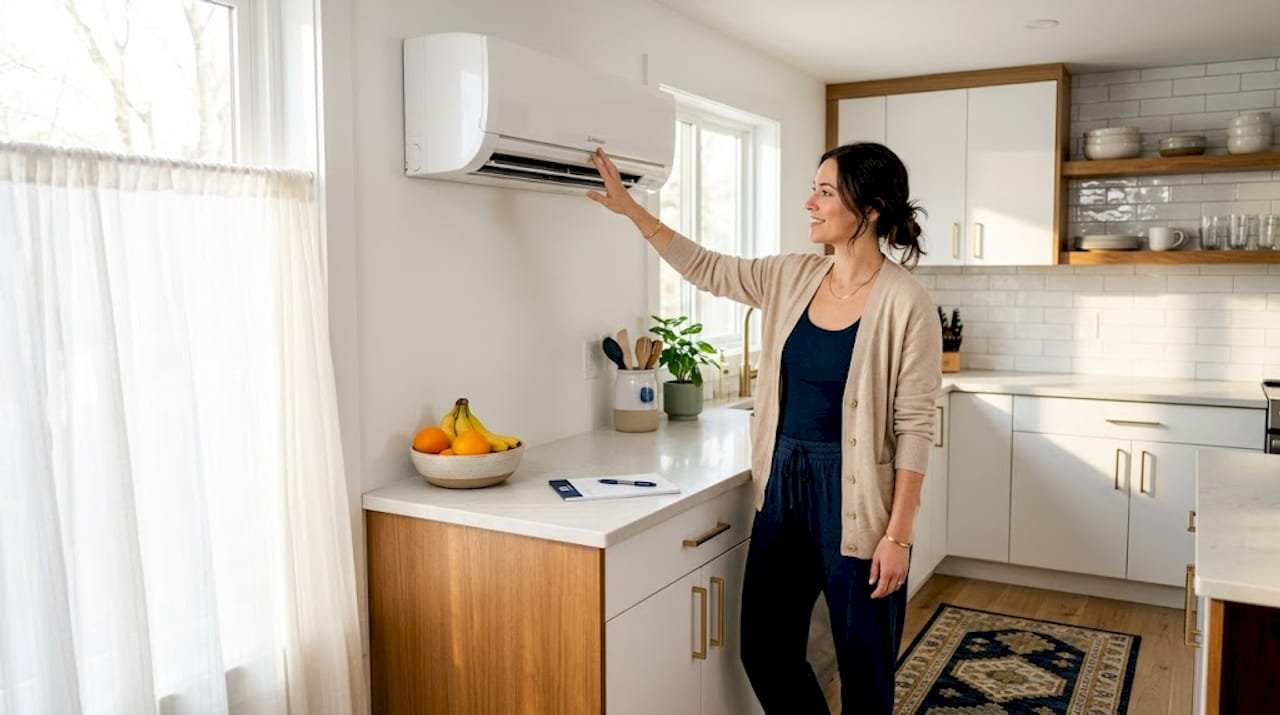
Additionally, ductless mini-split air conditioners are commonly used as retrofit add-ons in homes that already use non-ducted heating systems such as hydronic, radiant panel, or space heater setups, and they work well for room additions where extending existing ductwork simply isn’t practical.
Key benefits of going ductless include:
- High SEER2 ratings. Ductless systems can achieve SEER2 ratings up to 35, which is significantly higher than most central systems on the market.
- Zoned control. Each indoor unit operates independently, so you can cool the living room without conditioning bedrooms that are unoccupied.
- No duct losses. Duct leakage accounts for up to 30 percent of conditioned air waste in many homes. Eliminating ducts entirely cuts this loss to zero.
- Quieter operation. Because the compressor sits outside and the indoor units are compact, noise levels inside the home are low.
- Faster installation. For homes without existing ductwork, mini-split installation avoids the significant cost and disruption of duct construction.
The main tradeoff is aesthetics. Wall-mounted indoor units are visible and not every homeowner prefers their look. Ceiling cassette models offer a less intrusive option, but they cost more to install.
Pro Tip: If you’re adding a room, converting a garage, or finishing a bonus space, a mini-split is almost always the right choice. Running new ductwork to remote areas of the home adds considerable cost and often reduces efficiency in the process. Learn more about the value of upgrading your HVAC for efficiency before committing to any one approach.
Other important HVAC types: Hybrid, packaged, and geothermal systems
Beyond the main options, some homes may benefit from hybrid solutions or space-saving packaged units.
Industry resources confirm that commonly referenced residential HVAC types include hybrid systems that combine heating technologies, packaged systems that house all components in one outdoor cabinet, and geothermal heat pumps that draw on the earth’s stable underground temperature.
Hybrid systems pair an electric heat pump with a gas furnace. The system automatically switches between the two depending on outdoor temperature and energy cost. In mild Southern California winters, the heat pump handles most of the workload efficiently. On unusually cold nights, the furnace kicks in where a heat pump alone might struggle. This approach gives you flexibility without sacrificing comfort.
Packaged systems contain the compressor, air handler, and in some cases the furnace all in a single outdoor cabinet, typically installed on the roof or beside the home’s foundation. These systems are common in smaller homes, condos, and commercial-adjacent properties where interior space is limited. They’re simpler to service because all components are in one location, and they free up indoor square footage.
Geothermal heat pumps use the earth’s consistent underground temperature, which in California sits around 55 to 60 degrees Fahrenheit year-round, to heat and cool your home. They are the most energy-efficient option available, but installation requires ground loop excavation and a significantly higher upfront investment. Long-term operating costs are dramatically lower, and federal tax credits are available to offset the initial expense.
| System type | Best use case | Efficiency level | Upfront cost |
|---|---|---|---|
| Hybrid | Homes with mild but variable winters | High | Moderate to high |
| Packaged | Limited interior space, rooftop install | Moderate to high | Moderate |
| Geothermal | Long-term ownership, high efficiency goals | Very high | High |
For homes that want advanced control over multiple zones, understanding HVAC zone systems can clarify how these system types work together. If you’re still building your foundational knowledge, a look at how HVAC systems work is a practical starting point. Real-world automation integration, covered through HVAC automation examples, shows how modern systems can be managed remotely for even greater savings.
Side-by-side comparison: Which HVAC system is right for you?
Now that we’ve covered all the main options, see how they stack up against each other.
| System type | Efficiency (SEER2) | Ideal home | Ductwork needed | Zoning flexibility |
|---|---|---|---|---|
| Central split | 15.2 to 25 | Existing duct homes | Yes | Limited |
| Ductless mini-split | 15.2 to 35 | No duct, retrofits | No | High |
| Hybrid | 15 to 25+ | Variable winter climates | Yes | Moderate |
| Packaged | 14 to 21 | Small homes, rooftop | Yes (short runs) | Low |
| Geothermal | Equivalent to 30+ | Long-term owners | Optional | Moderate |
According to the Department of Energy, ducted heat pumps typically achieve SEER2 ratings between 15.2 and 25, while ductless mini-splits can reach up to 35 SEER2. That efficiency gap is real and measurable on your utility bill over time.
Follow these steps to reach your final decision:
- Assess your ductwork. Have a licensed technician inspect the condition, sizing, and leakage rate of existing ducts before committing to any ducted system.
- Check your climate zone. Orange and LA County homes in inland areas need stronger cooling capacity than coastal homes. Your local climate shapes system sizing.
- Review California Title 24 requirements. Confirm which efficiency ratings are required for your permit category before selecting equipment.
- Get multiple quotes. Request itemized bids that separate equipment cost, labor, and any ductwork modifications needed.
- Ask about rebates. Southern California utilities and state programs regularly offer rebates for high-efficiency heat pump installations.
Understanding the role of HVAC in your home’s comfort helps you evaluate these decisions with better context. Practical guidance on reducing AC bills also illustrates how efficiency gains translate into real savings month over month.
Our take: There’s no single ‘best’—fit matters most
After working with homeowners across Orange and Los Angeles Counties, we’ve seen one pattern repeat itself: the homeowner who buys the highest-rated system on the market and still ends up with uneven temperatures and high bills. The reason is almost always installation quality or duct condition, not the equipment itself.
The industry often markets HVAC as if efficiency ratings are the whole story. They’re not. A 20 SEER2 system installed in leaky ducts will underperform a 16 SEER2 system in a sealed, properly sized duct system every single time. This is what the research consistently shows, and it’s what we see on the job.
California’s Title 24 requirements are another area where homeowners get caught off guard. Compliance isn’t a technicality you handle after the install. It should drive your system selection from the beginning. Choosing equipment that doesn’t meet minimum efficiency thresholds can mean failed inspections and costly replacements. We strongly encourage you to review HVAC decision terminology so you understand what specifications to look for before any contractor conversation.
Our honest advice is this: seek out a professional who will assess your home before recommending a product. A technician who recommends a specific brand without asking about your ductwork, climate zone, or comfort goals is not giving you the evaluation you need. The right system is the one that matches your home’s actual layout, your budget, and the permit requirements in your area.
Take the next step for expert HVAC installation or replacement
When you’re ready to move from research to action, trusted HVAC pros can help you choose and install the perfect system for your home.
At MDTech Services, we work with homeowners across Orange and Los Angeles Counties to evaluate their current setup, identify the right system type, and handle installation with licensed technicians who understand California’s Title 24 requirements. Whether you need a full system replacement, a ductless retrofit for an addition, or a second opinion before signing a contract, we’re here to help. Our HVAC repair and installation guide walks you through what the process looks like, and you can also explore your options for repair or installation help if you’re still weighing which direction makes the most sense for your home. Contact us today to schedule a professional evaluation.
Frequently asked questions
Which HVAC type is best for older homes without ductwork?
Ductless mini-split heat pumps are ideal for older homes or additions where new ductwork isn’t practical, as confirmed by the Department of Energy. They offer zoned control and high efficiency without the disruption of duct construction.
What is the most energy-efficient HVAC system?
Geothermal systems and high-SEER ductless mini-splits typically offer the highest efficiency for residential use. Mini-splits can reach 35 SEER2, while geothermal systems deliver even greater long-term savings for homeowners committed to their property.
Do I need to consider building codes for HVAC replacement in Los Angeles?
Yes. California Title 24 Part 6 sets minimum efficiency standards for HVAC in altered buildings, and compliance is required for permit approval and final inspection sign-off. Skipping this step can result in failed inspections.
Can I combine more than one type of HVAC system in my home?
Yes. Hybrid systems combine a heat pump with a gas furnace to provide flexible, cost-effective heating across different temperature conditions, making them a practical option for homes with variable seasonal demands.