
Many Orange County and Los Angeles homeowners invest in high-end HVAC equipment expecting lower energy bills, only to find their system still struggles to keep up. The real culprit is often hiding in the attic or inside the walls. Duct insulation prevents up to 20-30% loss of conditioned air in unconditioned spaces like attics, meaning your system could be working overtime for no reason. Upgrading your insulation is one of the most impactful steps you can take to improve comfort, reduce energy costs, and extend the life of your HVAC equipment.
Table of Contents
- Understanding the basics: Why insulation matters in HVAC
- Where insulation counts: Attic, walls, floors, and ductwork
- How insulation drives energy savings and comfort
- Types of insulation for HVAC: Pros, cons, and best choices
- Maximizing HVAC performance: Sealing and insulation strategies
- Take your next step: Expert help for HVAC insulation upgrades
- Frequently asked questions
Key Takeaways
| Point | Details |
|---|---|
| Attic and duct insulation boost efficiency | Upgrading attic and duct insulation can reduce energy loss by up to 30% and improve indoor comfort. |
| Seal before insulating | Air leaks should always be sealed before adding insulation to maximize your HVAC system’s performance. |
| Choose the best material for your climate | Select insulation materials like spray foam or fiberglass based on your home’s location and moisture risk. |
| Calculate your payback | Most upgrades pay for themselves within 3-5 years thanks to lower energy bills. |
| Professional input makes a difference | Expert guidance ensures proper installation and ongoing efficiency for Orange County and LA homes. |
Understanding the basics: Why insulation matters in HVAC
Insulation is not just about keeping your home warm in winter. In Southern California, where summers push attic temperatures to extreme levels, insulation is your first line of defense against heat gain. It works as a thermal barrier, slowing the movement of heat into or out of your living spaces and reducing the demand placed on your HVAC system every single day.
Insulation in HVAC systems primarily serves as a thermal barrier that minimizes heat transfer through building envelopes and ductwork, directly reducing HVAC workload. When your system runs less often and for shorter cycles, it experiences less wear and lasts longer. That is a real, measurable benefit that equipment upgrades alone cannot deliver.
Here is what proper insulation does for your home:
- Maintains consistent indoor temperatures room to room
- Reduces how often your HVAC system cycles on and off
- Lowers monthly energy bills by reducing wasted conditioned air
- Extends the lifespan of your HVAC equipment
- Improves indoor air quality by reducing infiltration of outside air
“Most homeowners focus on the HVAC unit itself, but the building envelope, including insulation, determines how hard that unit has to work. A well-insulated home can outperform a poorly insulated one even with a smaller system.”
For more ways to get the most from your system, explore these HVAC efficiency tips and learn how HVAC filtration benefits your indoor air quality alongside insulation improvements.
Where insulation counts: Attic, walls, floors, and ductwork
Not all insulation upgrades deliver equal results. In OC and LA homes, certain areas offer a much higher return on investment than others. Knowing where to focus first saves you money and gets you results faster.
The attic is the single highest-priority area for most SoCal homeowners. OC attics reach up to 140-160°F in summer, and any ductwork running through that space loses a significant portion of its conditioned air before it ever reaches your rooms. Upgrading attic insulation from R-19 to R-38 can save $300-500 per year in Orange County, making it one of the fastest-payback upgrades available.
Key insulation areas ranked by impact for OC/LA homes:
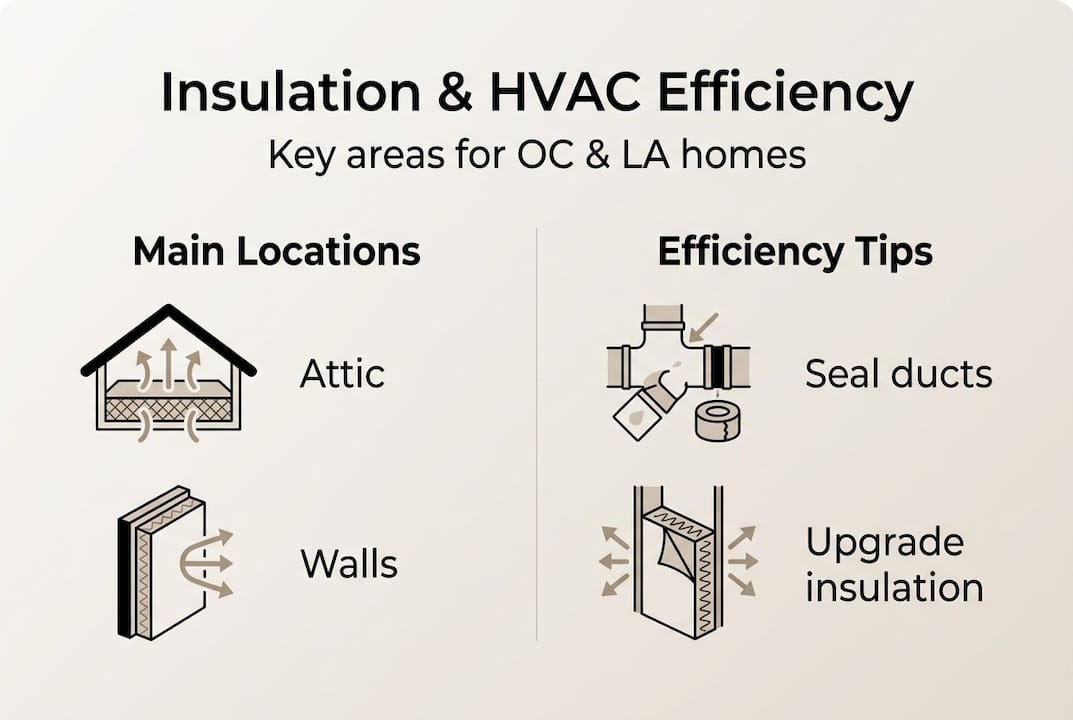
- Attic: Highest priority. Extreme heat gain makes this the biggest source of energy loss.
- Ductwork in unconditioned spaces: A close second. Leaky, uninsulated ducts waste 20-30% of conditioned air.
- Exterior walls: Important for comfort but typically lower ROI than attic or duct work.
- Floors over crawl spaces: Relevant for older homes with raised foundations.
| Location | Priority | Typical energy impact | Notes |
|---|---|---|---|
| Attic | Very high | 20-30% loss potential | R-38 recommended for OC/LA |
| Ductwork | Very high | 20-30% loss potential | Seal before insulating |
| Exterior walls | Medium | 10-15% loss potential | Spray foam or rigid foam |
| Floors/crawl space | Lower | 5-10% loss potential | Older homes with raised foundations |
For a deeper look at how your ductwork affects energy use, read about ductwork and energy loss and use our HVAC efficiency checklist to assess your home.
How insulation drives energy savings and comfort
The numbers behind insulation upgrades are straightforward and compelling. Upgrading insulation yields 15-30% savings on heating and cooling costs based on DOE benchmarks, with a payback period of 3-5 years in Orange County. For most homeowners, that is a better return than many appliance or system upgrades.
Beyond the bill savings, your home simply feels better. Hot spots, cold rooms, and humidity swings are often symptoms of poor insulation rather than a failing HVAC unit. Fixing the insulation addresses the root cause.
“Reducing HVAC cycling through better insulation does not just save energy. It reduces mechanical stress on the compressor, fan motors, and heat exchanger, which are the most expensive components to replace.”
Here is a practical breakdown of what you can expect:
| Upgrade | Estimated annual savings | Payback period |
|---|---|---|
| Attic insulation R-19 to R-38 | $300-500 | 3-5 years |
| Duct sealing and insulation | $200-400 | 2-4 years |
| Combined attic and duct upgrade | $500-900 | 3-5 years |
Steps to maximize your insulation investment:
- Schedule a home energy audit to identify the biggest loss areas.
- Seal all duct connections and air leaks before adding insulation.
- Upgrade attic insulation to at least R-38 for OC/LA climate zones.
- Insulate ductwork running through unconditioned spaces like attics or garages.
- Pair insulation upgrades with an HVAC tune-up for the biggest efficiency jump.
Pro Tip: Combining duct sealing and insulation with a professional HVAC tune-up in the same visit maximizes your efficiency gains and often qualifies for utility rebates in Orange County and Los Angeles.
If you are considering upgrading HVAC for savings, pairing that with insulation work delivers far better results than either upgrade alone. Also, do not overlook seasonal HVAC maintenance to keep your system running at peak efficiency year-round.
Types of insulation for HVAC: Pros, cons, and best choices
Choosing the right insulation material matters as much as choosing the right location. Each material has strengths and limitations, and the best choice depends on your home’s construction, budget, and specific climate exposure in OC or LA.
Fiberglass offers R-2.9 to 3.8 per inch, spray foam delivers R-6 to 7 per inch with superior air sealing, while rigid foam and cellulose fill specialty roles depending on the application. Spray foam is the top performer for air sealing, but it costs more upfront.
| Material | R-value per inch | Best use | Cost level | Air sealing |
|---|---|---|---|---|
| Fiberglass batts | 2.9-3.8 | Attics, walls | Low | Poor without sealing |
| Spray foam | 6.0-7.0 | Ducts, rim joists | High | Excellent |
| Rigid foam board | 3.8-6.5 | Walls, under slabs | Medium | Good |
| Cellulose | 3.2-3.8 | Attics, walls | Low-medium | Moderate |
Key considerations when choosing insulation:
- Fiberglass is budget-friendly but requires a perfect, gap-free install to perform as rated.
- Spray foam seals and insulates in one step, making it ideal for ductwork in hot attics.
- Rigid foam works well on exterior walls and is moisture-resistant, which matters for coastal LA homes.
- Cellulose is made from recycled material and performs well in attics when properly installed.
- Vapor-permeable materials are the better choice for humid coastal areas in Los Angeles.
Pro Tip: Insulation gaps, compression, or thermal bridging (where heat bypasses insulation through framing) can reduce effective performance by 20-50%. Installation quality matters as much as the material you choose.
For more guidance on getting the most from your insulation, review these effective insulation tips and consider scheduling preventative HVAC maintenance to keep everything working together.
Maximizing HVAC performance: Sealing and insulation strategies
The sequence of your insulation project matters. Many homeowners make the mistake of adding insulation over leaky ducts, which locks in the problem rather than solving it. The right approach always starts with sealing.
Seal ducts and air leaks first using mastic sealant or foil tape, not cloth tape, before adding any insulation. Cloth tape degrades quickly in hot attics and fails within a few years. Once sealed, insulation locks in the efficiency gains you have already created.
Radiant barriers add value in sunny SoCal attics by reflecting radiant heat before it even reaches your insulation layer. Combined with proper insulation and sealing, this approach can push efficiency improvements to the higher end of the 15-30% range.
Step-by-step strategy for OC/LA homeowners:
- Inspect all accessible ductwork for gaps, disconnections, or deteriorated tape.
- Apply mastic sealant or foil tape to all duct joints and connections.
- Seal air leaks around light fixtures, plumbing penetrations, and attic hatches.
- Add or upgrade attic insulation to R-38 minimum.
- Insulate ductwork running through the attic or garage with appropriate wrap.
- Install a radiant barrier on the attic roof deck if not already present.
- Schedule an HVAC tune-up immediately after insulation work is complete.
Additional tips for sustained efficiency:
- Check insulation condition every 5-7 years for settling, moisture damage, or pest intrusion.
- Keep attic ventilation clear so insulation performs as designed.
- Ducts located inside conditioned space require little or no insulation, saving on materials and labor.
Pro Tip: If your ducts run through conditioned space, such as inside a dropped ceiling or interior closet, you can skip duct insulation there entirely and redirect that budget to the attic or exterior walls where it will have a bigger impact.
Pairing your insulation project with a smart thermostat for energy savings amplifies the results significantly. And committing to regular HVAC maintenance ensures your newly efficient system stays that way for years.
Take your next step: Expert help for HVAC insulation upgrades
You now have a clear picture of where insulation makes the biggest difference, which materials perform best, and how to sequence your upgrades for maximum results. The next step is putting that knowledge into action with the right professional support.

At MDTech Services, we work with Orange County and Los Angeles homeowners every day to improve HVAC performance through expert repair, maintenance, and efficiency upgrades. Whether you need a full system assessment or targeted help with ductwork, our licensed technicians are ready to help. Start with our complete HVAC repair guide to understand your options, or walk through our HVAC troubleshooting process to identify what your home needs most. You can also explore our broader appliance repair for homeowners services if other systems in your home need attention. Contact us today to book an efficiency assessment and start saving.
Frequently asked questions
How much can I save by upgrading attic insulation in Orange County?
Upgrading attic insulation from R-19 to R-38 can save $300-500 per year in Orange County homes, with a typical payback period of 3-5 years depending on your current energy use.
Should I seal my ducts before insulating?
Yes. Sealing ducts first with mastic or foil tape ensures you are not locking air leaks under new insulation, which would reduce the effectiveness of the entire upgrade.
Is spray foam insulation worth it for my HVAC system?
Spray foam delivers superior air sealing and higher R-values per inch, making it the top choice for ductwork in hot attics. Fiberglass is a solid budget option if installed without gaps or compression.
Are radiant barriers effective in SoCal attics?
Radiant barriers add value in sunny Southern California attics by reflecting heat before it penetrates your insulation layer, which is especially useful during peak summer months.
Do ducts in conditioned spaces need insulation?
Ducts located inside conditioned space need little or no insulation, which lets you redirect your budget to higher-impact areas like the attic or exterior walls.