
ABS and PVC are both rigid plastic pipes used for drains, waste and vent lines, and for most homeowners the choice comes down to what is already in the walls, what your local code allows and what your plumber is set up to install. ABS is almost always black and PVC is usually white, so you can often tell which you have in seconds. The two are not interchangeable at the joint, and that is where most mistakes happen. This guide explains how they differ, where each belongs, how to connect them correctly, and what to do when the pipe that fails is copper rather than plastic.
TL;DR
- ABS is typically black and PVC is typically white. Both serve as interior drain, waste and vent (DWV) pipe and as building sewer pipe.
- Do not join ABS to PVC with ordinary cement. Use an approved transition fitting, because transition cement is not approved.
- Neither material is automatically “better.” Local code, the existing system and installation quality matter more than the plastic.
- Pinhole leaks in copper supply lines are a separate problem. A patch is temporary, and several pinholes usually point to a larger piping decision.
- If you own property in Orange County or Los Angeles County and are unsure what you have, our licensed plumbing team can identify and repair it.
Table of Contents
- What ABS and PVC Actually Are
- How to Tell ABS From PVC in Your Home
- ABS vs PVC Drain Pipe: Side-by-Side
- Which One Is Better?
- Can You Glue ABS to PVC?
- When Repair, When Replacement
- Copper Pipe Leaks: A Different Problem
- Our Perspective
- Get a Licensed Plumber to Look at It
- Practical Checklist Before Any Drain or Pipe Project
- FAQ
- Sources
What ABS and PVC Actually Are
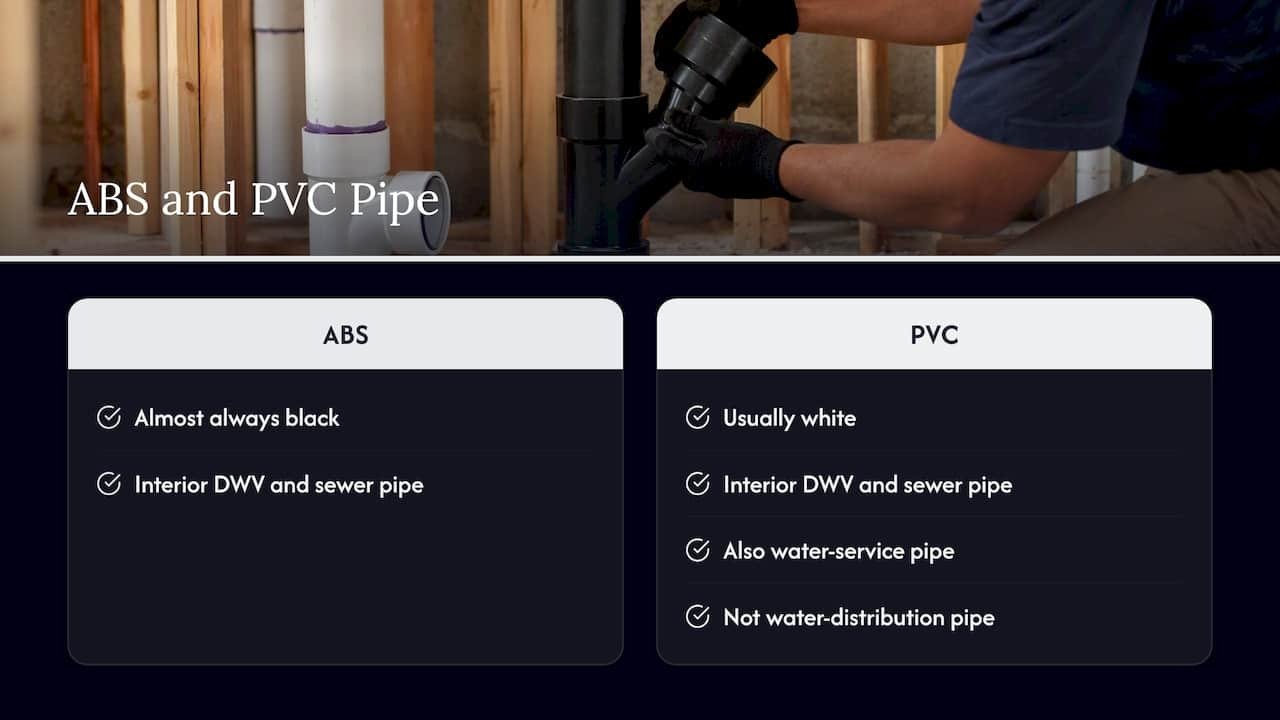
ABS (acrylonitrile butadiene styrene) and PVC (polyvinyl chloride) are both thermoplastic pipes. They move wastewater out of your home by gravity, which is why they are called DWV pipe: drain, waste and vent. According to the American Society of Home Inspectors, both are used as interior DWV pipe and as building sewer pipe, ABS is almost always black, and PVC is usually white. The same source notes that PVC also appears as water-service pipe, the line that brings water to the house from the street, but not as water-distribution pipe inside the home.
That last point clears up a common mix-up. When people search for ABS or PVC plumbing, they are usually asking about drains. Pressurized hot and cold water lines inside a house are a different category, typically copper or PEX, and we cover copper problems further down.
How to Tell ABS From PVC in Your Home
You do not need tools to make a first identification. Look at the pipe where it is exposed: under a sink, in a crawl space, in a garage, or at a cleanout.
- Color. Black pipe is generally ABS. White pipe is generally PVC.
- Printed markings. Pipe usually carries a stamped or printed label along its length that names the material and size. Look for “ABS” or “PVC” and “DWV.”
- Weight. If you can hold a short piece of each, PVC tends to feel heavier than ABS of the same size.
- Age and location. A recently repiped or remodeled section may be a different material from the rest of the house.
Color is a good clue but not proof. Paint, dirt and sun exposure can hide the original shade, and some pipe is manufactured in other colors. If the marking is unreadable or the pipe is buried or behind a wall, a camera inspection settles it. Our guide to what a pipe inspection involves explains what you can expect.
ABS vs PVC Drain Pipe: Side-by-Side
The table below keeps to the points that matter for a homeowner. Where we mention joining details, they come from the home inspector source cited above.
| Factor | ABS | PVC |
|---|---|---|
| Usual color | Black | White |
| Common uses | Interior DWV, building sewer | Interior DWV, building sewer, water service |
| Joining | Solvent cement, no primer required | Primer and solvent cement usually required |
| Primer exception | Not applicable | The 2015 IRC allows cement without primer on DWV pipe 4 inches and smaller |
| Connecting to the other type | Needs an approved transition fitting | Needs an approved transition fitting |
| Typical drawback | Some installers find it less convenient where primer-free work is not the priority | Extra step of priming adds time to the job |
Two things stand out. First, the joining process differs: ABS needs no primer, while PVC usually does. Second, neither pipe can be casually mixed with the other.
Which One Is Better?
Honest answer: it depends on the building, and anyone who says one plastic wins everywhere is oversimplifying. Online discussions tend to split along regional and personal habit. Some installers prefer ABS for its simpler one-step joining, and others prefer PVC for its feel and the range of fittings they stock. Both are accepted DWV materials in the places that allow them.
What decides the right choice for your project:
- Local code. Jurisdictions adopt plumbing codes differently and amend them. Your city or county building department, or a licensed plumber who works there daily, is the authority on what is permitted for your address.
- What you already have. Matching the existing system avoids transition fittings, and fewer transitions mean fewer places for a problem to start.
- Where the pipe runs. Trade publication Journal of Light Construction recommends cast iron for drain lines through living spaces, and says ABS or PVC can be used under the house to save money. Noise is the reason: plastic drain lines can be louder than cast iron when water rushes through them.
- Installer experience. A clean, properly supported, correctly cemented system in either material outperforms a sloppy job in the other.
How long will each last?
You will see numbers like 50 to 80 years quoted for plastic drain pipe. Those figures come from general home-inspection commentary, and the same commentary stresses that lifespan varies with material, usage and installation quality. Treat any single number as a rough expectation, not a guarantee. What shortens life in practice is physical damage, poor support, bad joints and ground movement, not the plastic’s color.
Can You Glue ABS to PVC?
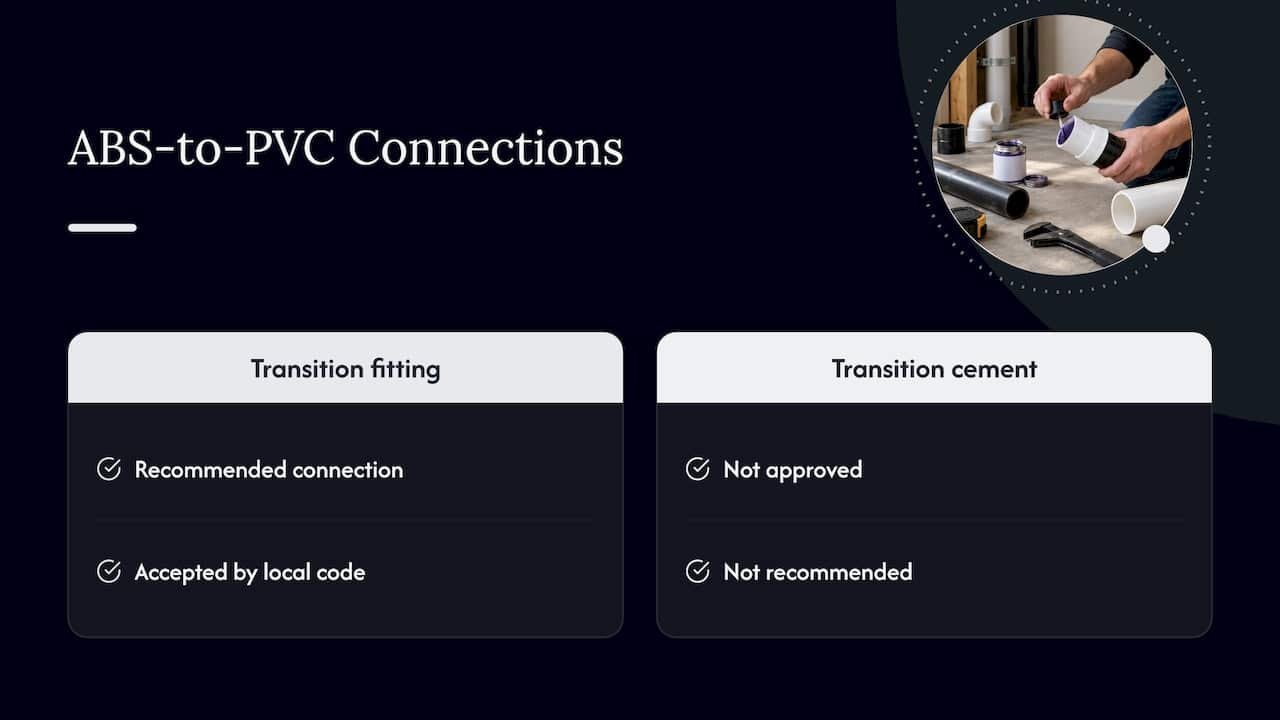
Not with ordinary cement, and not by improvising. The home inspector guidance says ABS-to-PVC connections should use an approved transition fitting, and that transition cement is not approved. In plain terms: if a repair puts an ABS pipe next to a PVC pipe, use a purpose-made transition coupling that your local code accepts, rather than a “universal” cement that promises to bridge the two.
This matters because a failed joint on a drain line does not always announce itself. A slow seep inside a wall or under a slab can run for months before you see a stain.
Joining each type correctly
- PVC: usually primer first, then solvent cement. The 2015 IRC permits cement without primer on DWV pipe 4 inches and smaller, but your local adopted code decides whether that applies to you.
- ABS: solvent cement without primer.
- Any mix of the two: an approved transition fitting at the junction.
Support and bracing
Joints are only part of a sound drain. The 2024 International Plumbing Code requires rigid bracing or other rigid support where horizontal drainage or waste pipes 4 inches and larger change direction by more than 45 degrees, so the upstream pipe cannot move in the direction of flow. Which edition of the code your city enforces varies, so confirm locally before assuming a detail applies.
When Repair, When Replacement
A cracked section of ABS or PVC in an accessible spot is often a straightforward repair. Replacement makes more sense when:
- the same line has failed more than once,
- the system mixes materials with improvised connections,
- the pipe is sagging, which can cause standing water and repeated clogs,
- a camera inspection shows cracks, offset joints or root intrusion.
Older homes in Southern California may also have cast iron drain lines, which need a different approach. See our page on cast iron plumbing repair if your home predates plastic DWV. And because every drain needs air to flow properly, it helps to understand how vent piping works before any rerouting.
Copper Pipe Leaks: A Different Problem
Many people who search ABS vs PVC are really dealing with a leak, and often the leaking pipe is copper. Copper carries pressurized supply water, so the rules differ from drains. Here is what the guidance says.
What a pinhole leak means
A pinhole is a tiny perforation, often from corrosion that has pitted the pipe wall from the inside. It rarely means one bad spot. According to SharkBite, pinholes indicate a weak pipe, and epoxy can fill the hole temporarily while leaving the surrounding damaged pipe in place. Water chemistry plays a role: the U.S. EPA has described simple copper pipe loop systems used to monitor and predict whether a water supply tends to cause pitting corrosion.
Homeowners have reason to take it seriously. A professional paper from the American Society of Civil Engineers notes that copper pinhole leaks concern homeowners because of insurance costs, property value, taste and odor issues, water damage, health concerns and stress.
Temporary fixes vs a real repair
Epoxy and compression wraps can stop a drip while you arrange a proper repair. SharkBite’s guidance is that the lasting fix is to replace the damaged pipe or use a slip fitting, and that soldering over a pinhole is not ideal because hairline trickles can reopen the joint.
For a replacement section, SharkBite’s repair instructions call for cutting out the copper about 6 inches on each side of the pinhole and deburring the remaining pipe before installing the new section with push-to-connect fittings.
How a soldered repair works
If the repair is soldered, the sequence from Family Handyman is: shut off the main water supply, drain the line, cut about 1 inch beyond each side of the leak, clean and flux the surfaces, center a sweat sleeve, solder it, then restore water and check for leaks. The same article says a pinhole needing less than 1/2 inch of pipe removed can use an ordinary coupling, while a longer gap needs a sweat coupling cut to length.
The joint must be dry. Fine Homebuilding explains that water in the joint impedes heating and weakens the solder bond, so turn off the water heater and supply and open house valves to relieve pressure first.
Safety points before you touch the pipe
- Asbestos. The U.S. EPA warns that repairing a pipe leak may disturb asbestos-containing thermal insulation. Work beyond small-scale, short-duration maintenance should be done by trained and accredited asbestos professionals. If your pipes are wrapped in old, crumbly insulation in an older home, stop and have it assessed.
- Lead. The EPA’s guide advises ventilating during soldering, using lead-free solder on drinking-water plumbing, removing solder debris, cleaning aerators and flushing supply pipes after the work.
- Water and electricity. Shut off the water heater before draining the line, as above, and keep electrical devices away from wet areas.
When to stop patching
SharkBite suggests considering a full PEX repipe if you notice multiple pinholes, a higher water bill or lower water pressure. Our view is similar: one leak in an otherwise sound line is a repair, while a second or third pinhole means the pipe is failing from within and further patches will chase the problem around the house.
Our Perspective
We see the same pattern in homes across Orange County and Los Angeles County. A homeowner asks which plastic is better, when the real question is whether the work being done is correct and permitted. Material matters less than the joint, the support and the code.
Our advice is plain. Identify what you have before you buy parts. Match the existing material where you can, and use an approved transition fitting where you cannot. Do not let a temporary patch become the permanent plan, especially on copper supply lines. A leak that shows up as a stain on a ceiling has usually been leaking for a while, so earlier inspection costs less than later water damage.
We also encourage regular attention to the system as a whole. Routine plumbing checks and a sensible preventative approach catch small failures while they are still small repairs, and that holds whether your pipes are plastic, copper or cast iron.
— MDTECH
Get a Licensed Plumber to Look at It
If you are staring at a mix of black and white pipe, or a damp spot under a copper line, you do not have to guess. MDTech Services provides plumbing repair across Orange County and Los Angeles County, and our licensed technicians can identify your drain material, make correct connections and repair or replace failing supply lines. We give you upfront pricing before work begins, and you can book online.

To schedule a visit, go to our plumbing repair services page or call us. If a leak is active, shut off the water at the main valve first, then reach out. For property managers and landlords, we can look at several units in one visit.
Practical Checklist Before Any Drain or Pipe Project
- Identify the pipe material by color, markings and size.
- Check with your local building department about which code edition applies and whether the work needs a permit.
- Decide whether you are matching the existing material or transitioning, and if transitioning, buy an approved fitting.
- Confirm support and bracing for horizontal runs, particularly 4-inch pipe and larger.
- For copper, shut off and drain the line, keep the joint dry and plan for a lasting repair, not a wrap.
- If insulation on old pipe looks like it might contain asbestos, do not disturb it.
- Run water and watch the repair for leaks, then check again after a day.
If pipes run near appliances, a leak can also damage them. Our plumbing emergency checklist walks through what to do in the first minutes of a leak.
FAQ
Is ABS or PVC better for drain pipe?
Neither wins in every case. Both are accepted DWV materials, and the right choice depends on your local code, what is already installed and who is doing the work. Matching your existing pipe usually avoids transition fittings and keeps the job simpler.
Can you glue ABS to PVC?
Not with standard cement. Guidance from the American Society of Home Inspectors says an approved transition fitting should be used, and that transition cement is not approved. Ask your plumber or building department what your jurisdiction accepts.
How can I tell whether I have ABS or PVC?
Start with color: ABS is almost always black and PVC is usually white. Then check the printed markings along the pipe. If the pipe is painted, buried or unmarked, a licensed plumber can confirm the material with an inspection.
Can I fix a pinhole leak in copper pipe myself?
You can slow it temporarily with epoxy or a compression wrap, but those leave the weakened pipe in place. A lasting repair means replacing the damaged section, and if you find more than one pinhole, a larger repipe may be the better decision. A licensed plumber is the right call when the pipe is in a wall, near old insulation or if you are unsure about soldering safely.
Sources
- Plumbing Pipes, American Society of Home Inspectors
- The drain-waste-vent system field guide, JLC
- 2024 Plumbing Study Companion, ICC
- How to Fix Pinhole Leaks, SharkBite
- How to Repair a Copper Pinhole Leak, SharkBite
- Fixing Leaky Copper, Fine Homebuilding
- How to Repair Long Sections of a Leaking Copper Pipe, Family Handyman
- Safe Work Practices, US EPA
- Lead in Your Home: A Parent’s Reference Guide, US EPA
- A Simple Approach to Assessing Copper Pitting Corrosion, US EPA
- Criteria for Plumbing System Replacement, ASCE