
Rusty tap water usually comes from iron: either sediment and corrosion inside your own plumbing or water heater, or a short disturbance in the utility’s main. If the color clears after a few minutes of running a cold tap, the cause is almost always local and fixable. If it stays brown, shows up only on the hot side, or comes with a metallic taste, you need to work out where it starts. This guide shows you how, and tells you when to stop DIY checks and call a licensed plumber.
TL;DR
- Brown, orange or red water is most often iron from corroding pipes, a tired water heater, or a disturbance in the water main. Iron itself is mainly an appearance and taste issue.
- Hot water only points to the water heater. Hot and cold both point to the main line or the home’s piping.
- Run the cold tap for a few minutes. If it clears, it was likely sediment. If it stays discolored, call your water utility or a plumber.
- Corrosion can also release lead from older plumbing. Boiling does not fix that, and test kits are not reliable for it. Use a state-certified lab.
- Rust that keeps coming back means pipes or fittings are failing. Repair beats flushing.
Table of Contents
- What rusty tap water actually is
- Find the source in ten minutes
- The common causes, and what each one means
- Why does water taste metallic?
- Is rusty water safe to drink?
- What to do right now
- When flushing is not enough
- Our perspective: treat rusty water as a diagnosis
- Get the source checked
- FAQ
- Sources
What rusty tap water actually is
Rust is iron that has reacted with oxygen. Iron occurs naturally in rock and soil, and it also makes up steel and cast iron pipes, water heater tanks and some fittings. When tiny particles of it break loose, they tint the water yellow, orange, red or brown.
The EPA sets a secondary standard for iron of 0.3 mg/L. Above that level, water can look colored, taste metallic and stain fixtures and laundry. Secondary standards cover appearance, taste and smell, not health. That is why a glass of rusty water is unpleasant, yet not automatically dangerous in the way a contaminant such as lead can be.
That distinction matters, and we come back to it below, because the same corrosion that makes rust can carry other metals with it.
Find the source in ten minutes
Before you call anyone, run a few simple checks. They tell you whether the problem sits in your house or outside it, and they give a plumber useful information if you do need one.
Step 1: Check hot and cold separately
Fill a clear white glass from the cold tap, then another from the hot tap of the same faucet.
- Only hot is discolored: the likely source is sediment or corrosion in the water heater. Hot water also picks up dissolved metals from pipe materials more quickly than cold water does, so the hot side often shows trouble first.
- Both are discolored: the cause is more likely corrosion in the service line or interior piping, or a utility-side event.
- Only one faucet is affected: look at that fixture’s supply line, shutoff valve and aerator.
Step 2: Run the cold tap and watch
Open the cold tap nearest to where water enters your home and let it run. If the water clears within a few minutes, sediment built up in your own pipes or fixtures and was stirred loose. That points to an internal plumbing issue rather than a city-wide problem. If it stays brown, the source is steadier and needs attention.
The Los Angeles Department of Water and Power notes that when discoloration comes from the street main, the water usually stays discolored for a few hours. If your neighbors see the same thing at the same time, call the utility first.
Step 3: Ask who else is affected
A quick message to a neighbor tells you a lot. Main breaks, hydrant flushing and nearby construction can stir up rust in the street main. If only your home is affected, the cause is on your side of the meter.
Step 4: Look at the particles
If you find hard brown or orange flecks in the water or clogging aerators, they are probably bits of rusted steel from the inside of pipes. LADWP says these particles are mostly iron and not a health concern, but they can clog washing machine screens, showerheads and faucet aerators. Unscrew the aerator and rinse it. If it fills up again within days, pipes are shedding material.
The common causes, and what each one means
| What you see | Likely cause | Typical next step |
|---|---|---|
| Brown or orange hot water only | Sediment or corrosion in the water heater | Flush the tank, inspect the anode rod and tank condition |
| Brown water on both, clears in minutes | Disturbance in the main or loosened sediment in home pipes | Flush cold taps, then monitor |
| Brown on both, does not clear | Corroding service line or interior piping | Plumber inspection |
| Rust-colored water after a plumbing project | Disturbed sediment or mixed metals | Flush, then inspect new connections |
| Metallic taste, water looks clear | Dissolved metals from fixtures or pipes | Flush, then test through a certified lab |
| Rust at one faucet only | Fixture, supply line or valve | Replace the part |
Aging galvanized or cast iron pipes
Galvanized steel and cast iron rust from the inside over decades. The wall thins, scale builds up and flakes break off. You often see this as reduced pressure along with brown water. If your home has older iron piping, a cast iron plumbing repair assessment shows how far the corrosion has gone and whether sections can be replaced instead of the whole system.
A water heater that is failing
A tank holds a lot of water for a long time. Sediment collects at the bottom, and the steel tank slowly corrodes once its protective anode rod is used up. If only the hot side runs rusty, start here. Our water heater maintenance checklist covers draining the tank and checking the anode rod. A tank that is rusting through is a replacement job, not a flush.
Mixed metals
Joining different metals without proper dielectric fittings sets up galvanic corrosion. California water utilities describe how joining copper and galvanized steel without the right fittings speeds up corrosion and pipe damage, sometimes without any sign until a leak develops. This is common after an earlier repair done with whatever part was on hand. If your piping is a patchwork, a plumbing pipe repair visit can identify the transitions that need correcting.
Failing fixtures and supply lines
If the rust appears at one tap only, the culprit may be a corroded shutoff valve, an old braided or metal supply line, or the faucet body itself. This is the cheapest cause to fix and the easiest to confirm, because the other taps run clean.
Why does water taste metallic?
A metallic or “like metal” taste often travels with rusty water, but it can appear when the water looks perfectly clear. Iron at levels above the EPA’s 0.3 mg/L secondary guideline can cause a metallic taste along with staining. Copper and zinc from pipes and fixtures can taste metallic too, especially in water that sat in the pipes overnight.
A useful test: taste water right after you turn on the tap, then again after running it for two minutes. If the taste fades, the metal came from water sitting in your plumbing. If it does not, ask your utility for its latest water quality report, or have the water sampled.
Is rusty water safe to drink?
The rust itself is mainly an aesthetic problem. The concern is what else the corrosion may release.
The corrosion process that creates rust can also leach other metals such as lead into your water. The CDC says lead cannot be seen, tasted or smelled, and that there is no safe blood lead level for children. Homes with plumbing or solder installed before 1986 deserve particular attention. If a young child or a pregnant person lives in the home, contact your local health department or water utility about lead testing instead of waiting to see whether the water clears.
Two points that surprise people:
- Boiling does not help. Boiling will not remove metals such as lead or copper and can concentrate them as water evaporates. If officials issue a do-not-drink advisory, follow their instructions, which usually mean bottled water.
- Home test kits are not a good answer for metals. The California State Water Board suggests asking your utility for its water quality data, or having a licensed professional collect samples for analysis by a state-certified laboratory. For lead, the sampling method matters. First-draw samples are collected after water has sat in the pipes for at least six hours.
If you are in Orange County or Los Angeles County, your utility’s annual water quality report is the starting point. It lists what the utility tests for and what it found, and the number on it is a reason to call, not a reason to panic.
What to do right now
- Do not drink or cook with discolored water. Use bottled water until it runs clear.
- Flush. Public health guidance says to flush faucets for 30 seconds to two minutes before using water for drinking or cooking, and to contact your utility or a plumber if it stays discolored afterward. Start with the cold tap closest to the main line, then work through the house.
- Hold off on laundry. Washing white clothes in rusty water leaves orange stains that are hard to remove. Wait until the water runs clear.
- Do not run the water heater with discolored supply. Drawing rusty water into the tank adds to sediment. Wait for the supply to clear.
- Call your utility if neighbors are affected or the water stays brown.
- Call a licensed plumber if only your home is affected and flushing does not clear it, or if the discoloration returns within days.
A word on a popular tip: some online advice suggests running every tap on cold at full pressure for 20 minutes. It can push loose sediment out, but it wastes water, and it does nothing about corroding pipe walls. Flush to confirm what is happening, not to fix it.
When flushing is not enough
Rust that keeps returning is a symptom. Here are the signs that point to repair or replacement:
- Brown water returns within days of flushing
- Water pressure has dropped over months
- Pinhole leaks, green or white crusty buildup, or damp spots on walls
- Rust on the hot side of a water heater more than a decade old
- A history of mixed-metal repairs
- Plumbing or solder from before 1986
Pipes that are corroding can also fail. Our guide on why pipes burst explains how that weakening turns into a leak. If your copper lines are the concern, copper pipe plumbing repair can address failing sections and fittings.
Residential water quality is shared responsibility. Water utilities treat water to meet federal standards, but they do not control the materials inside your walls. Californian utility reports say property owners should have all plumbing work done by licensed professionals who follow current plumbing codes, which prevents cross-connections and incompatible materials that accelerate corrosion.
Our perspective: treat rusty water as a diagnosis
We work on homes in Orange County and Los Angeles County, and the pattern we see is that rusty water is rarely one problem. It is a clue. Homeowners often arrive after trying a filter or a long flush, and the water looks clean for a week. Then it returns, because nothing about the source changed.
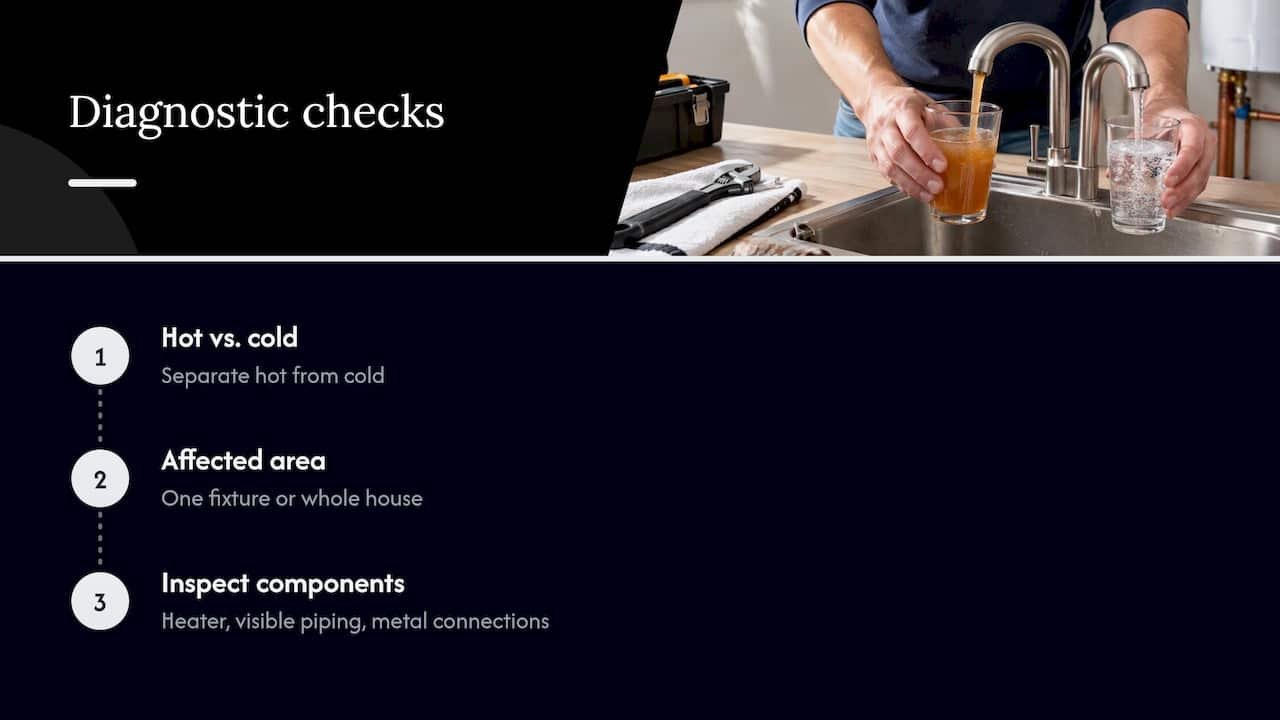
Our approach follows the same order as the checks above. We separate hot from cold, identify whether one fixture or the whole house is affected, and look at the water heater, the visible piping and the connections between different metals. Plumbing and water heater work sit alongside our appliance and HVAC service, so a rusty-water call can also include a look at the water heater, the supply lines to your dishwasher, washer and ice maker, and any other appliance fed by the same lines.
Our view is simple. Fix the cause, not the color. A filter may improve the glass in your hand, but it does not stop a pipe from corroding or a tank from rusting through. We also recommend written, upfront pricing before work begins, and we hold licensed technicians to the same code standards that utilities say protect water quality. If your water raises a health question, such as lead in an older home, we tell you to involve your utility or a certified lab, because plumbers repair pipes and labs measure water.
— MDTECH
Get the source checked
If your water is brown, rusty or metallic and the cause is not obvious, we can inspect your plumbing and water heater and explain what we find before any repair. We offer plumbing repair services across Orange County and Los Angeles County, with licensed technicians and 24/7 emergency availability. You can book an appointment online or call us. For a quick self-check first, our plumbing checklist for homeowners walks through the visible signs of trouble.
If you rent, tell your landlord or property manager before any work begins, since authorizing repairs is their decision.
FAQ
Why is my hot water clear but my cold water brown?
This is less common than the reverse. It usually means the cold line is carrying the sediment, from corroding supply piping, a rusted shutoff valve or a disturbance in the main, while the water heater tank is in fair shape. Run the cold tap and see if it clears. If it does not, have a plumber inspect the cold supply piping.
Why does my water taste like metal?
Iron, copper or zinc in the water is the usual reason. Iron above the EPA’s 0.3 mg/L secondary guideline can give water a metallic taste and stain fixtures. Flush the tap for a couple of minutes and taste again. If the taste stays, ask your utility for its water quality report, and consider a sample through a state-certified lab.
Is brown water from the faucet dangerous?
Iron by itself is mostly a nuisance. The risk is that corroding plumbing can also release lead or other metals, and you cannot see or taste lead. Avoid drinking discolored water until it runs clear, and contact your utility or health department if you have a baby, a young child or a pregnant person at home, or if the water stays discolored.
Will a filter fix rusty water?
A filter can reduce visible particles at one tap, but it does not remove the cause. If your pipes or water heater are corroding, the problem continues behind the filter. Identify the source first, then decide whether filtration still makes sense.
How long should I run the tap to clear rusty water?
Start with 30 seconds to two minutes for drinking-water flushing. If the water is still discolored after a few minutes of running the cold tap, stop wasting water and call your utility or a plumber.
Sources
- EPA: Secondary Drinking Water Standards, Guidance for Nuisance Chemicals
- CDC: Chemicals That Can Contaminate Tap Water
- CDC: About Lead in Drinking Water
- CDC: Drinking Water Advisories Overview
- California State Water Board: Lead Sampling for Individual Homeowners
- California water utility report, 2017: flushing guidance
- California water utility report, 2018: galvanic corrosion
- California water utility report, 2022: licensed plumbing work
- LADWP: Water Quality FAQs