
Most of the time, a Whirlpool fridge that stops dispensing water has a clogged filter, a closed or kinked supply line, an active control lock, a frozen line, or a failing inlet valve. Start with the safest check: confirm the control lock is off and the water shutoff valve is open. Before touching any plumbing, unplug the refrigerator and shut off the water.
TL;DR:
- Whirlpool recommends 40 to 80 psi for household pressure, gives 30 to 120 psi as the operating range, and specifies 40 to 60 psi for reverse osmosis.
- Replace the filter every six months, or sooner if flow drops; removing a clogged filter temporarily puts the refrigerator into bypass mode and restores dispensing.
- With the lock off, no click or hum when pressing the paddle suggests a failed switch, while flow only under extra pressure points to paddle wear.
- Do not thaw a suspected frozen line yourself; call a qualified technician, and leave valve testing, electrical diagnostics, and internal plumbing repairs to professionals.
Table of Contents
- What can you check in a few minutes?
- Is the water supply or pressure the problem?
- How do you handle a clogged filter and flush the system?
- Could the control lock or dispenser paddle be at fault?
- What are the signs of an inlet valve or internal plumbing failure?
- How do you thaw a frozen water line?
- When should you call a professional?
- Our practical note on dispenser problems and safe repair choices
- Book on-site Whirlpool refrigerator repair with our team
- FAQ
What can you check in a few minutes?
These checks are non-invasive, and together they restore flow more often than any repair. Work through them in order.
- Toggle the control lock off and try dispensing again.
- Press a sturdy glass firmly against the dispenser paddle or pad so it fully engages.
- Look behind the refrigerator for kinks, and confirm the wall shutoff valve is fully open.
- Remove the water filter to test whether flow returns, since a clogged filter is a common culprit.
- If you changed the filter recently, flush the system following Whirlpool’s steps, covered below.
Whirlpool’s own product help for no water dispensing lists these same items: control lock, filter installation, water-line installation, pressure, and paddle engagement.
Is the water supply or pressure the problem?
A fridge can only dispense what reaches it. If the supply side is restricted, the dispenser may trickle or give you nothing at all.
- Confirm the shutoff valve is fully open.
- Check that the supply line uses the type of tubing specified for your refrigerator model. Whirlpool discourages self-piercing saddle valves because they can clog and cut pressure.
- Look for kinks or pinches. A fridge pushed too far back against the wall can crimp the line, so leave a service loop of tubing.
- Compare flow by opening another cold tap in the house.
Whirlpool says household pressure of 40–80 psi is optimal, with the system operable between 30–120 psi. If you have a reverse-osmosis system, Whirlpool wants 40–60 psi at the inlet. RO systems often fall short of that, so let the storage tank refill, or temporarily bypass the RO unit or other inline restrictions to test.
Pro Tip: If flow improves when the RO tank is full and fades after a few glasses, pressure is your problem, not the fridge.
How do you handle a clogged filter and flush the system?
A clogged filter is the usual reason flow drops or stops. Whirlpool says to replace the filter every 6 months or sooner if flow decreases.
Replace the water filter every 6 months, or sooner if flow slows. If you cannot replace a clogged filter right away, remove it and the refrigerator runs in bypass mode so water still dispenses.
If flow returns with the filter out, the old filter was almost certainly clogged. Leave it out until your replacement arrives. Here is the process:
- Dispense water for a moment to relieve line pressure before removing a stuck filter.
- Use the eject button or the grille access method in Whirlpool’s guidance to release it.
- Seat the new filter fully and lock it in place.
- Follow Whirlpool’s flushing instructions to cycle the dispenser until the system is flushed.
- Reset the filter status light if your model requires it.
Flushing clears trapped air and carbon dust. It also stops the chattering noise during dispensing that air pockets cause. Many models also need a manual reset of the filter status light after a replacement.
Could the control lock or dispenser paddle be at fault?
Rule these out before you touch any plumbing. The control lock disables the dispenser controls entirely, so a stray button press can look like a broken fridge.
- Find the control lock on the dispenser panel and toggle it. Your owner’s manual shows the exact button for your model.
- Press a sturdy glass against the paddle or pad and listen for a click or hum from the actuator. Silence suggests the switch is not registering.
- Look for a recessed, cracked or loose paddle that cannot press the switch behind it.
- If water comes out only when you press at a certain spot or with extra force, the paddle or its switch is probably wearing out.
If the lock is off, the glass presses cleanly and you hear nothing, move on to the inlet valve.
What are the signs of an inlet valve or internal plumbing failure?
The inlet valve opens to let water into the fridge. If the supply is good, the filter is fine and still nothing dispenses, the valve may be faulty. Confirming that takes voltage testing and usually a part replacement.
- Unplug the refrigerator before inspecting anything.
- Check the supply fittings for leaks, damage or loose connections, and tighten what you can reach by hand.
- Note whether the ice maker also stopped, since both draw from the same valve.
- Avoid probing electrical connections yourself.
This is where we step in. Valve replacement and sealed-electrical diagnostics call for the right tools and a safety-first approach, and a licensed technician protects your warranty as well. If your checks turn up a drip, our guide to a refrigerator water line leak covers what to do right now.
Pro Tip: Photograph the valve area and any fittings before the visit. It saves diagnosis time.
How do you thaw a frozen water line?
A frozen line often follows cold ambient temperatures, a recent move or restricted airflow. The dispenser may stop completely, or give a weak stream that fades.
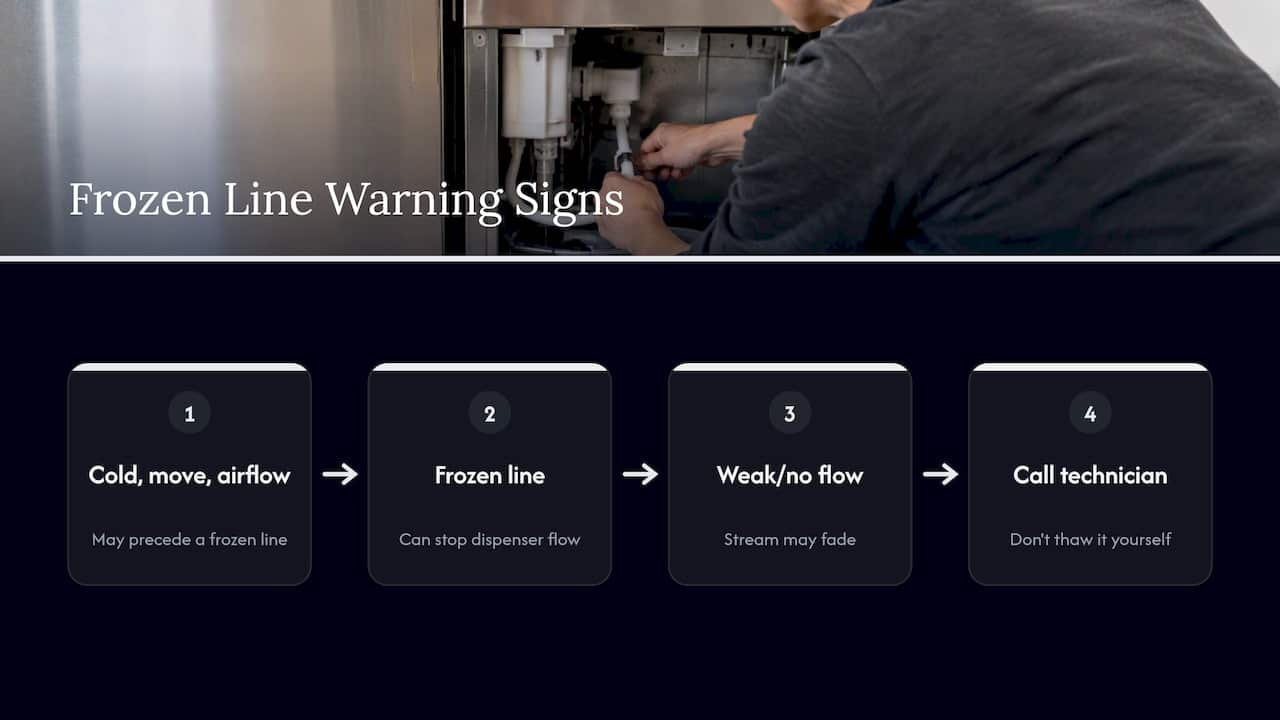
Do not try to thaw the line yourself. Contact a qualified technician to diagnose and address a frozen water line.
When should you call a professional?
Stop the DIY work and call when the problem goes beyond filters, tubing and settings.
- Inlet-valve testing or replacement is needed.
- Internal plumbing must be replaced.
- Electrical diagnostics or a control board issue is likely.
- Leaks keep returning.
- The sealed system would have to be opened.
To speed up the visit, have your model and serial number ready, list the symptoms and what you already tried, and keep photos handy. A professional repair may help you avoid risks around water and electricity. Check your warranty terms before arranging service.
Our practical note on dispenser problems and safe repair choices
We repair Whirlpool refrigerator dispensers and inlet valves with licensed technicians and a safety-first approach. A typical visit covers on-site diagnosis, a repair quote, and parts and warranty handling. Write down every step you tried before we arrive, because it shortens the diagnosis. Most dispenser problems are simple, and the ones that are not deserve proper tools. Know where your own limit is, and book when you reach it.
— MDTECH
Book on-site Whirlpool refrigerator repair with our team
If your checks come up empty, we can come to you. Our licensed technicians handle Whirlpool refrigerator repair, and you can book online through our appliance repair services page.
- Have your model and serial number ready.
- Describe the symptoms and the steps you already tried.
- Send photos of the dispenser and supply connection if you can.
- Pick a time online.
For brand-specific details, see our Whirlpool refrigerator repair page.
FAQ
Why is my ice maker not making water?
Usually the same causes that stop the dispenser: a clogged filter, a closed or kinked supply line, or low pressure. Both the ice maker and the dispenser draw from the inlet valve, so a failing valve can stop both.
Why does my Whirlpool refrigerator dispense water but not ice?
Water flow means the supply and valve are likely working. Look at the ice maker and its mold or chute instead, since a frozen blockage or a faulty ice component is more likely. Our step-by-step refrigerator fix guide helps you sort the possibilities.
How do I remove a stuck water filter?
Dispense water first to relieve line pressure, then use the eject button or the grille access method from Whirlpool’s guidance. Turn the filter gently rather than forcing it, and call a technician if it will not release.
Can I use the fridge while the filter is out?
Yes. Removing a clogged filter lets the refrigerator run in bypass mode, so water still dispenses until you install a replacement. Flush the system after you put the new filter in.