
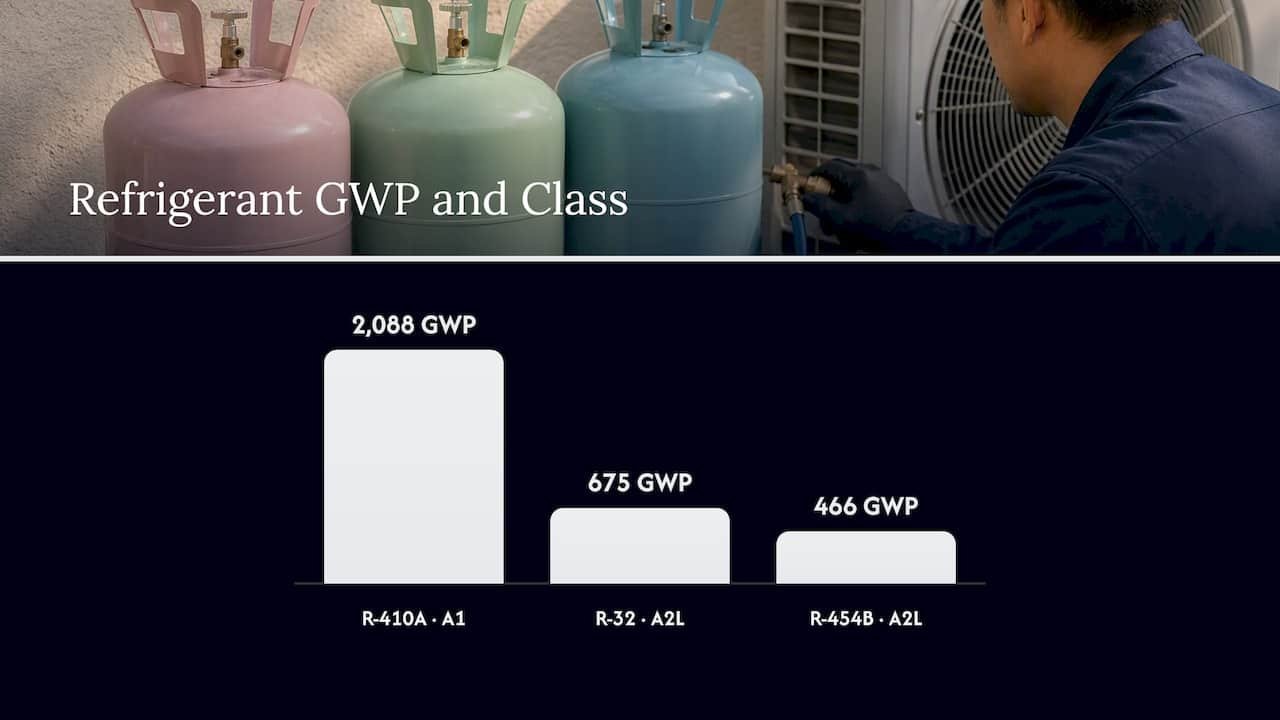
R-32 is the newer, lower-impact refrigerant, and R-410A is the one inside most air conditioners installed in the last two decades. They are not interchangeable. R-32 has a global warming potential (GWP) of 675 against 2,088 for R-410A, runs at higher pressure, and is classed as mildly flammable. You cannot top off an R-410A system with R-32, and for most homeowners the real question is not which one to pick but what to do with the system they already have.
We repair and install HVAC equipment across Orange County and Los Angeles County, so this is the version we give homeowners on the phone: what changed, what stays the same, and what to do next.
TL;DR
- R-410A is the legacy refrigerant, rated A1 (non-flammable). R-32 is rated A2L (mildly flammable) and has about one third of the GWP.
- Neither can go into the other’s equipment. R-32 needs hardware built for its higher pressures, so there is no drop-in swap.
- For new residential AC, the federal rules now steer manufacturers to R-32 and R-454B, so the choice is usually made by the model you buy, not by you.
- If your R-410A system works, it can keep running. If it leaks, the decision is repair versus replace, and a licensed technician should make that call.
- A2L systems need updated installation safety practices, which is a reason to hire licensed, trained technicians.
Table of Contents
- What R-410A and R-32 actually are
- R-410A vs R-32 at a glance
- Why the change is happening
- Safety: what “mildly flammable” means in a home
- Efficiency and performance: is R-32 better?
- Can you use R-32 in an R-410A system?
- What to do if you already own an R-410A system
- What to ask an installer about an A2L system
- Our perspective at MDTech Services
- Need AC repair or a new system in Orange or Los Angeles County?
- FAQ
- Sources
What R-410A and R-32 actually are
R-410A is a blend, half R-32 and half R-125. R-32 is a single compound, difluoromethane. That detail matters because R-32 is already half of what is in your R-410A system, which is why the two behave similarly in some ways and differently in others.
The Oak Ridge National Laboratory work on low-GWP refrigerants lists both side by side: R-410A as an A1 blend with a GWP of 2,088, and R-32 as an A2L refrigerant with a GWP of 675. It also lists R-454B, a blend of R-32 and R-1234yf, with a GWP of 466 and the same A2L class.
Both are hydrofluorocarbons (or blends containing them), and neither damages the ozone layer. The reason for the change is climate impact, not ozone.
R-410A vs R-32 at a glance
| Factor | R-410A | R-32 |
|---|---|---|
| Composition | Blend of R-32 and R-125 | Single compound |
| GWP | 2,088 | 675 |
| Safety class | A1, non-flammable | A2L, mildly flammable |
| Operating pressure | Baseline | Higher |
| Use in new residential AC | Prohibited from Jan. 1, 2025 | Allowed |
| Works in an existing R-410A system | Yes | No |
| Typical charge size | Baseline | Smaller |
The federal rule behind the “prohibited” line is summarized in the Department of Energy’s overview of residential refrigerant changes. Its table lists residential and light commercial HVAC with a January 1, 2025 date and a GWP limit of 700, with R-410A prohibited and R-32 and R-454B allowed. That limit is the reason R-32, at 675, qualifies and R-410A, at 2,088, does not.
Why the change is happening
The EPA’s Significant New Alternatives Policy (SNAP) program decides which refrigerants are acceptable for which uses. The agency’s list of substitutes for residential and light commercial air conditioning still shows R-410A as acceptable under older decisions, but newer rules and GWP limits now govern what manufacturers can build into new equipment.
In practice, this means new split systems and heat pumps use either R-32 or R-454B. EPA’s Final Rule 23 lists R-454B among the substitutes acceptable subject to use conditions for new residential air conditioning and heat pumps. Final Rule 25 added more refrigerants, including R-32, under use conditions in specific applications.
“Subject to use conditions” is the phrase to remember. These refrigerants are allowed, but only if the equipment and the installation meet safety requirements.

Safety: what “mildly flammable” means in a home
R-410A is rated A1. R-32 and R-454B are rated A2L. The A2L class means the refrigerant is flammable, but it ignites with difficulty, burns slowly, and needs a fairly high concentration in the air to do so.
That does not make a home with an R-32 system dangerous. It means the installation has to be done to current codes. ASHRAE Standard 15.2 covers this for residential equipment, and the goal is that even in a full leak the refrigerant concentration stays well under the level where it could burn. One requirement worth knowing: Addendum b to Standard 15.2-2024 deals with leak detection where A2L equipment shares a space with open-flame appliances such as a gas furnace, unless distance or combustion air requirements are met.
If you have gas appliances in the same closet, garage or utility room as your air handler, ask any installer how they will meet this requirement before you sign. A professional should be able to explain it in plain terms. If the answer is vague, keep looking.
For context on how ASHRAE classifies refrigerants, its refrigeration resources page describes Standard 34, which assigns safety classes by toxicity and flammability, and Standard 15, which covers safe use of the equipment.
Efficiency and performance: is R-32 better?
The common claim is that R-32 moves heat more efficiently and needs less refrigerant per system. There is truth in that. R-32 systems are generally designed with smaller refrigerant charges, and manufacturers market higher efficiency ratings on R-32 equipment.
But two cautions apply.
- Efficiency belongs to the whole system, not the refrigerant alone. Compressor, coil design, expansion device, airflow and ductwork decide the real result. Oak Ridge researchers warn against trial-and-error approaches and say performance depends on how well the manufacturer integrates the new refrigerant into the design.
- R-32 is not the only new option. R-454B was developed to behave more like R-410A in operation, and the Department of Energy notes that manufacturers often favor it for new designs for that reason. Which one your next AC uses depends on the model.
So when you compare two quotes, compare SEER2 ratings, warranty terms, and installation quality, not just the refrigerant name on the label.
Can you use R-32 in an R-410A system?
No. The DOE states plainly that existing R-410A equipment cannot simply be refilled with the new refrigerants. R-32 runs at higher pressures than R-410A, and the oils, components and controls are engineered for a specific refrigerant. Putting the wrong one in can lead to compressor damage, poor performance and early failure.
There is also a safety issue. An R-410A system was not built or tested for a flammable refrigerant, so mixing in R-32 puts you outside the equipment’s design and outside the installation rules.
The reverse is also true: do not put R-410A into an R-32 system. Always match the refrigerant to the nameplate on the outdoor unit.
What to do if you already own an R-410A system
Most homes in our service area still have R-410A systems. Here is how we suggest thinking about it.
If it is running well
Keep it maintained. A clean coil, good airflow and a correct refrigerant charge protect both efficiency and the compressor. Our guide on why refrigerant levels matter for your AC system explains what low charge does to cooling and energy use.
If it is low on refrigerant
An AC does not use up refrigerant. If the charge is low, there is a leak, and adding refrigerant without finding it is a short-term fix at best. Read our explanation of what refrigerant recharging involves, and if you are in Los Angeles, our breakdown of AC refrigerant leak repair costs shows what to expect and why we suggest asking for an EPA 608 certified technician.
If it is old, leaking or failing
This is where the refrigerant question becomes a replacement question. A major repair on an older system, such as a new compressor or coil, may not make sense when a new system carries a fresh warranty. Our repair or replace guide for air conditioners walks through the math, and signs of a failing HVAC system helps you spot trouble early.
If you do replace, expect a new system with R-32 or R-454B. A partial swap, such as a new outdoor unit on an old indoor coil, has to be checked for compatibility, so ask the installer to confirm in writing that the matched components are rated for the refrigerant being used.
What to ask an installer about an A2L system
Whether your new system uses R-32 or R-454B, these questions separate careful contractors from careless ones:
- Which refrigerant does the system use, and why that model?
- How will you meet the A2L safety requirements in my home, including leak detection if gas appliances are nearby?
- Are your technicians trained and certified to handle A2L refrigerants? EPA 608 certification is the baseline for handling refrigerants.
- Will the work be permitted and inspected by my city or county building department?
- What does the warranty cover, and does it stay valid with this installation?
- What is the total price in writing before work begins?
A contractor who answers these clearly is giving you the information that protects your family and your warranty.
Our perspective at MDTech Services
Homeowners call us worried that their R-410A air conditioner is about to become obsolete. It is not. A working system keeps working, and service technicians can keep maintaining it. The refrigerant change is a manufacturing shift for new equipment, and it should not push you into replacing a system that still cools your home well.
What we do care about is the handoff between old and new. A2L refrigerants are safe when installed to code, and they are unforgiving when they are not. That is why we put licensed technicians, correct matching of components and warranty-safe work ahead of speed, even though we respond quickly and offer 24/7 emergency availability. We give upfront pricing so you can compare an honest repair against a replacement without pressure.
If you are choosing between repairing an R-410A system and moving to R-32 or R-454B, we suggest deciding on the age of the system, the repair cost, and the warranty on the new equipment. The refrigerant name comes last, because the manufacturer’s engineering decides it for you.
— MDTECH
Need AC repair or a new system in Orange or Los Angeles County?
We handle air conditioning repair, HVAC repair and heating and cooling work for homeowners, landlords and property managers. Tell us what refrigerant your system uses, the age of the unit and what it is doing, and we will help you work out whether repair or replacement makes sense. You can book an appointment online or call us.
FAQ
Can I use R-32 in an R-410A system?
No. R-32 runs at higher pressures and is mildly flammable, while R-410A equipment was designed for a non-flammable refrigerant at lower pressures. The Department of Energy says existing R-410A systems cannot be refilled with the new refrigerants. A mismatch risks compressor damage and unsafe operation.
Will R-410A be phased out of service use?
New residential equipment can no longer be built for R-410A under the federal GWP limit of 700, which took effect January 1, 2025, per the DOE summary. That applies to new equipment. The EPA still lists R-410A as an acceptable substitute in its SNAP table, and we are not aware of a rule that requires you to replace a working system. Availability and price of service refrigerant can change, so ask your technician.
What are the downsides of R-32?
The main ones are the A2L flammability class and the higher operating pressure. Both are manageable with proper equipment design and a code-compliant installation, but they raise the bar for installer training. R-32 also is not the only choice, since R-454B is often favored by manufacturers for its closer match to R-410A.
Is R-32 more efficient than R-410A?
Its properties allow smaller charges and good heat transfer, and manufacturers design R-32 systems for high efficiency. The result you get still depends on the full system design and the quality of the installation, so compare SEER2 ratings and warranties rather than refrigerant names alone.
Should I choose R-32 or R-454B for a new AC?
Usually you do not choose. The manufacturer picks the refrigerant for each model, and your decision is which model, brand and installer to trust. Ask for the refrigerant type, the efficiency rating and the A2L safety plan in the written quote.
Sources
- EPA: Substitutes in residential and light commercial air conditioning and heat pumps
- Department of Energy: The changing world of residential refrigerants
- Oak Ridge National Laboratory and AHRI: Implementing low-GWP, energy-efficient refrigerants
- ASHRAE: Addendum b to Standard 15.2-2024
- ASHRAE: Refrigeration resources
- EPA: SNAP Final Rule 23 fact sheet
- EPA: SNAP Final Rule 25 fact sheet