
TL;DR:
- Proper gas line inspection includes phased pressure testing and validation to ensure ongoing safety and code compliance. These inspections detect hidden leaks, improper materials, missing safety features, and prevent insurance issues. Regular evaluations are especially vital in older or inaccessible lines to maintain safety and peace of mind in California homes.
A new gas appliance in your home feels like a job well done, but a successful installation does not automatically mean your gas lines are safe or code-compliant going forward. Many homeowners in Orange County and Los Angeles County are surprised to learn that California law requires phased inspections and pressure testing on permitted gas piping work, and that skipping these steps can void insurance claims, lead to failed permits, and create genuine safety risks. This guide walks you through everything you need to know about gas line inspection, from what California code actually requires to how professionals detect problems you can’t see from the outside.
Table of Contents
- Why gas line inspection matters for Orange and LA County homes
- What actually happens during a professional gas line inspection?
- Advanced and alternative gas line inspection methods
- How utilities and emergency response support home gas safety
- The hidden value of professional gas line inspection: Our take
- Professional help for gas line inspection and safe appliance installation
- Frequently asked questions
Key Takeaways
| Point | Details |
|---|---|
| Inspection is code-required | California law mandates phased inspections and pressure testing for home gas lines to ensure safety. |
| Gaps in access need expertise | Buried or complex lines require alternative methods and expert validation to prevent missed hazards. |
| Inspections protect homeowners | Professional inspection reduces risk, helps with insurance, and identifies problems before they become major. |
| Utilities and pros work together | Utility programs and licensed pros both play roles in leak detection, response, and overall home safety. |
Why gas line inspection matters for Orange and LA County homes
Gas safety is not just a best practice in California. It is a legal requirement backed by the California Plumbing Code. Many homeowners assume that once an appliance is installed and “looks fine,” there’s nothing else to check. That assumption can be costly.
Permitted gas piping work requires phased inspections with pressure testing as a required diagnostic step in California. This means your contractor cannot simply run new gas lines and call it done. The work must be inspected by a licensed authority before walls or floors are closed up, and again after the final appliance connection is made.
Why does this matter beyond legal compliance? Consider what gas line inspections actually catch:
- Small leaks at fittings or joints that are undetectable by smell at low flow rates
- Improper materials or connectors that don’t meet current California code standards
- Missing seismic shutoff valves, which are required in many Southern California jurisdictions due to earthquake risk
- Appliances connected to undersized lines, which can cause poor combustion and carbon monoxide risk
- Piping that was concealed without a proper rough inspection, which is a permit violation
From an insurance standpoint, your homeowner’s policy may deny claims related to gas leaks or fires if work was done without permits or failed inspection. This is a real financial risk that many homeowners don’t consider until it’s too late.
Pro Tip: If you recently had a gas appliance installed and aren’t sure whether a permit was pulled, you can contact your local building department in Orange County or LA County to verify the permit status before your next home sale or insurance renewal.
If you are planning any gas appliance upgrade or fuel switch, it’s also worth reviewing gas appliance conversion requirements for California, since LP to natural gas conversions trigger their own inspection requirements. Additionally, understanding the importance of venting is critical because improper venting combined with undetected leaks can create dangerous indoor air quality conditions.
Now that we’ve seen why skipping inspection is risky, let’s clarify exactly what a professional gas line inspection involves.
What actually happens during a professional gas line inspection?
The inspection process follows a defined sequence of steps. Most homeowners don’t realize there are actually multiple required phases, not just a single visit at the end of a job.
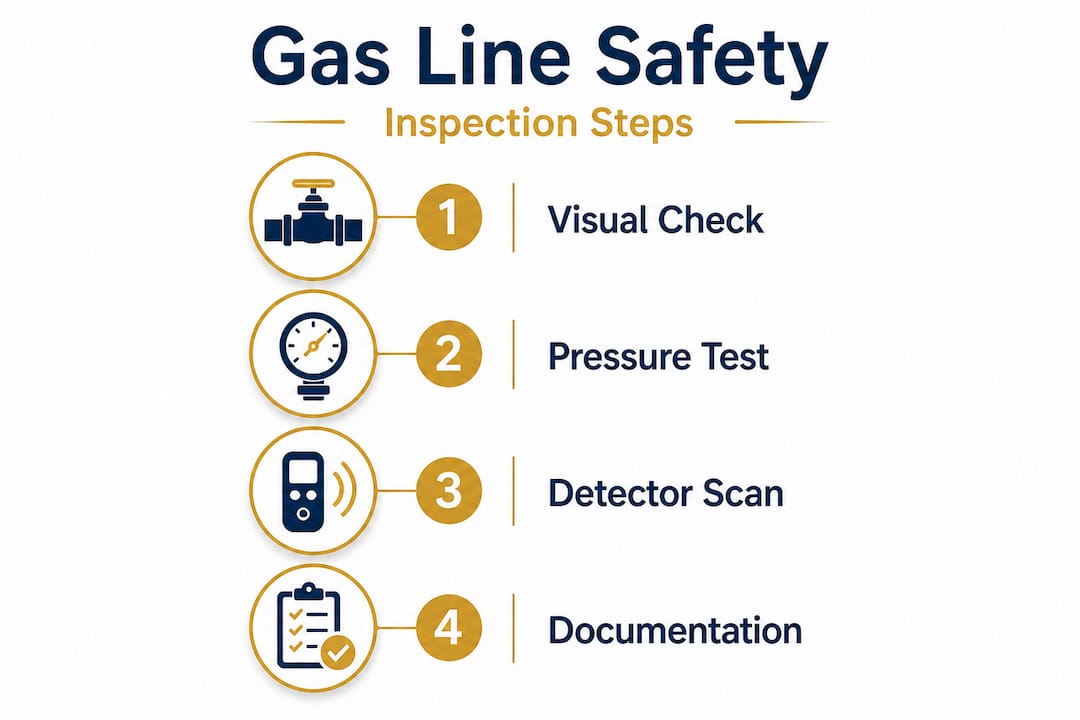
Here is how a standard permitted gas line inspection works in California:
- Permit issuance. Before any work begins, a licensed contractor pulls the required permit from your local building department.
- Rough inspection. Once the gas piping is installed but before any walls, floors, or ceilings are closed, an inspector visits to verify materials, fittings, routing, and connections meet code.
- Pressure test. The inspector or contractor applies pressure to the gas lines using air or inert gas. This is a required diagnostic step to confirm there are no leaks in the system, and phased inspections confirm that rough work is approved before concealment proceeds.
- Concealment. Only after the rough inspection passes can walls and ceilings be closed.
- Final inspection. After all appliances are connected and functional, the inspector returns to verify the final installation, including seismic shutoff valve installation where required, and confirms the system is safe for operation.
Here’s a side-by-side comparison of physical inspection versus technology-aided inspection methods:
| Inspection method | How it works | Best used for | Limitations |
|---|---|---|---|
| Physical/visual inspection | Inspector examines joints, materials, fittings | Accessible, exposed piping | Cannot see inside walls |
| Pressure testing | Air or gas pressurizes the line to detect leaks | All new or modified lines | Confirms leaks exist, not exact location |
| Electronic gas sensors | Detects methane or gas concentration in air | Leak location in open spaces | Less effective in enclosed areas |
| Camera inspection | Visual feed inside larger pipes | Assessing corrosion or damage | Limited to larger diameter pipe |
Methane sensors and other inspection technologies are part of utility system safety programs, and licensed inspectors may use electronic detection tools alongside traditional methods to locate suspected leaks before or after pressure testing.
Documentation is as important as the inspection itself. A completed inspection record serves as proof of code compliance for insurance purposes and is required when selling your home. Buyers and their agents regularly request permit and inspection histories, and missing records can delay or derail a transaction.

Pro Tip: Ask your contractor for copies of all inspection sign-off documents and store them with your home’s important records. These matter more than most homeowners realize when it comes time to sell or file a claim.
For a broader look at how inspections protect your household, the appliance safety steps covered by licensed technicians complement the gas line work, and a detailed safety test guide is available for homeowners who want to understand the full scope.
Understanding the core process helps, but not all gas lines are alike. Next, let’s look at cases where standard inspection faces real challenges.
Advanced and alternative gas line inspection methods
Some gas lines present challenges that make traditional visual inspection and standard pressure testing difficult or impossible. Buried lines, older homes with complex layouts, and lines running under slabs or through areas with no access panels all fall into this category.
When standard inspection isn’t feasible, professionals turn to alternative methods. One of the most widely referenced is ECDA (External Corrosion Direct Assessment). ECDA is a structured process used to assess buried metallic gas piping for corrosion risk without excavating the entire line.
Here’s how alternative methods stack up:
| Method | What it assesses | Requires excavation? | Validation needed? |
|---|---|---|---|
| ECDA | Corrosion risk on buried metallic pipe | Targeted spots only | Yes, direct inspection |
| Inline Inspection (ILI) | Internal pipe condition | No | Yes, data review |
| Hydrostatic testing | Pressure integrity | No | Monitoring results |
| Direct visual inspection | Surface condition, fittings | Yes, full access | No, direct confirmation |
When inline inspection is not feasible on buried or complex lines, alternatives like ECDA are used but require validation through direct examination. This is a critical point for homeowners to understand. An alternative method can flag areas of concern, but it cannot definitively confirm a line is safe without some form of direct verification at the suspect location.
What does this mean practically? If you live in an older home in areas like East LA, Pasadena, or parts of Orange County where homes may have original galvanized or older steel gas piping buried in the yard or under the foundation, you should specifically ask your licensed contractor how they will validate any indirect findings. “We scanned it” is not the same as “we confirmed it.”
Key questions to ask your inspector about buried or inaccessible lines:
- What specific method will you use to assess lines I can’t see?
- If you identify a concern, how will it be validated?
- Will any excavation be required, and will a new permit be needed?
- Are there any sections of pipe that cannot be assessed with current methods?
Taking care of buried lines is also part of a broader preventive maintenance approach. Homeowners who schedule annual plumbing inspections catch problems before they reach emergency status, and gas line assessment can be bundled with those visits for efficiency.
Even with the best methods, inspection is only part of total safety. How do utilities and cities keep the public protected?
How utilities and emergency response support home gas safety
Your gas line inspection doesn’t operate in isolation. Southern California homeowners are served by utilities that run formal, documented safety programs designed to detect, respond to, and prevent gas-related incidents at a system level.
SoCalGas and PG&E run risk-based safety programs with strong leak detection and rapid response benchmarks. These programs include infrastructure monitoring, leak abatement timelines, and published performance metrics that track how quickly hazardous leaks are addressed. This is not just regulatory box-checking. These programs have measurable response standards that utilities are held to by the California Public Utilities Commission.
Here is how the utility safety ecosystem connects to your home:
- Transmission and distribution monitoring covers the lines up to your meter. What happens inside your property is your responsibility.
- Leak reporting is a shared function. If you smell gas, calling SoCalGas or your utility gets an emergency response team dispatched. Do not rely on a scheduled inspection visit for suspected active leaks.
- Meter-level shutoffs are managed by the utility, but seismic shutoff valves inside your home are your responsibility and must meet local code.
- Abatement timelines mean utilities are required to fix known leaks on their infrastructure within defined time windows, prioritized by hazard level.
The key point is that utilities handle the infrastructure outside your home, and your licensed contractor handles everything on your side of the meter. These are two separate systems of responsibility, and each must be maintained independently. Knowing how to recognize appliance leaks in Orange and LA County homes is a practical skill every homeowner should have, because the sooner a problem is identified, the sooner the right team can address it.
With the inspection process and team ecosystem clear, here’s how to ensure your home’s gas lines stay safe and why long-term planning matters.
The hidden value of professional gas line inspection: Our take
At MDTech Services, we’ve worked with homeowners across Orange County and Los Angeles County who assumed their gas systems were fine because “nothing had gone wrong yet.” That reasoning is understandable. Gas lines are largely invisible, and if your appliances are running, it’s easy to conclude that everything is working correctly.
But here’s what we see regularly in the field: a home that passed inspection five years ago during a kitchen remodel may now have a small fitting leak that developed from vibration, ground settling, or a connector that wasn’t quite right to begin with. The homeowner never smelled gas because the leak is slow and the area is ventilated. The appliance still runs. Everything looks fine. Until it doesn’t.
We’ve seen situations in older homes in Anaheim, Glendale, and Long Beach where gas piping installed decades ago had no seismic shutoff valve, used materials that are now code-prohibited, and had never been inspected since original construction. The homeowners weren’t negligent. They simply didn’t know what they didn’t know.
Our perspective is straightforward: inspection is not just a regulatory step you check off during a project. It’s an ongoing responsibility, especially in a seismically active region like Southern California where ground movement can stress connections over time. The homes that benefit most from proactive inspection are often those where no work has been done recently, because those are the systems that haven’t been looked at in years.
We strongly encourage homeowners to treat gas line inspection as a periodic safety priority, not just a project-triggered requirement. Understanding how plumbing protects your home as a system, gas lines included, reframes inspection from an expense into an investment with measurable returns in safety and peace of mind.
Armed with this perspective, you’re in a stronger position to make inspection part of your home’s ongoing safety plan.
Professional help for gas line inspection and safe appliance installation
When your home’s gas system needs expert attention, MDTech Services provides licensed, code-compliant inspection and installation services across Orange County and Los Angeles County. We understand local code requirements, permitting processes, and what it takes to keep your home safe and insurable.

Whether you’re installing a new gas appliance, planning a fuel conversion, or simply haven’t had your gas lines checked in several years, our team is ready to help. We make the process straightforward, from scheduling to final documentation. You can schedule a plumbing inspection online, explore our gas appliance conversions service for LP to natural gas projects, or learn more about our full range of appliance repair services for Orange and LA County homeowners. Your safety is our priority, and we’re here when you’re ready.
Frequently asked questions
How often should I have my home’s gas lines inspected?
Homeowners should schedule a gas line inspection during any new appliance installation, major renovation, or LP to natural gas conversion, and every few years for older systems that haven’t been recently evaluated.
Is gas line inspection required by law in California?
Yes. Permitted gas piping work in California requires inspections before concealment and at final completion, including mandatory pressure testing and verification of required safety features like seismic shutoff valves.
Who can perform a legal gas line inspection in Orange or LA Counties?
Only licensed plumbers or gas fitters who have pulled the proper permits are authorized to inspect or certify gas line work in compliance with California law. Unlicensed work does not satisfy code or insurance requirements.
What inspection methods are used for buried or inaccessible gas lines?
When direct access isn’t possible, alternative methods like ECDA are used to assess buried metallic piping, but findings must be validated through direct examination at suspect locations to confirm actual safety.
What happens if a gas leak is detected during inspection?
All repairs must be completed and re-inspected before the gas line can be approved for service. For active or hazardous leaks, utilities provide emergency response with defined timelines for hazard abatement based on leak severity.
Recommended
- Why venting gas appliances matters for safe homes in 2026
- Step-by-Step Guide to Appliance Safety Inspections at Home
- Gas Appliance Conversion – Ensuring Safe Home Upgrades
- Essential Appliance Safety Inspection Steps for Homeowners
- Top pool fence safety features every homeowner needs – The Glass Railing Store