
A dual fuel system is a hybrid HVAC setup that pairs an electric heat pump with a gas, propane, or oil furnace, both sharing the same ductwork and controlled by a single intelligent thermostat. According to Trane’s glossary, the system automatically switches between the two heat sources based on outdoor temperature, running whichever is more economical at that moment. The result is a setup that delivers year-round comfort without locking you into one fuel type or one efficiency profile.
For most homeowners in mixed or cold-winter climates, a dual fuel system typically lowers heating bills compared to a heat pump that falls back on electric resistance strip heat. Two quick reasons it works:
- Lower operating cost: The heat pump handles mild weather efficiently, while the furnace takes over during deep cold when gas or propane is cheaper to run than electric resistance heat.
- Built-in backup: If the heat pump fails or the grid experiences issues, the furnace keeps your home warm without interruption.
Three things signal a quality installation: a licensed HVAC technician, a true dual-fuel or hybrid thermostat (not a standard programmable unit), and a properly calibrated switchover temperature.
Table of Contents
- How does a dual fuel system work?
- What are the benefits and drawbacks of dual fuel systems?
- When is a dual fuel system right for your home?
- What does installation and maintenance cost, and how long will the system last?
- Heat pump only vs. furnace only vs. dual fuel: how do they compare?
- What should you ask your HVAC installer before committing?
- Key Takeaways
- Why the “set it and forget it” promise has a catch
- Mdtechservices can help you evaluate, install, and maintain your dual fuel system
- Further reading and authoritative sources
How does a dual fuel system work?
The system has four core components: an air-source heat pump, a gas or propane furnace, a shared duct system, and a dual-fuel thermostat or control module. The heat pump is a reversible refrigerant-cycle unit, meaning it moves heat into your home in winter and out of it in summer. The furnace sits in the air handler position and fires only when the outdoor temperature drops below a set threshold.
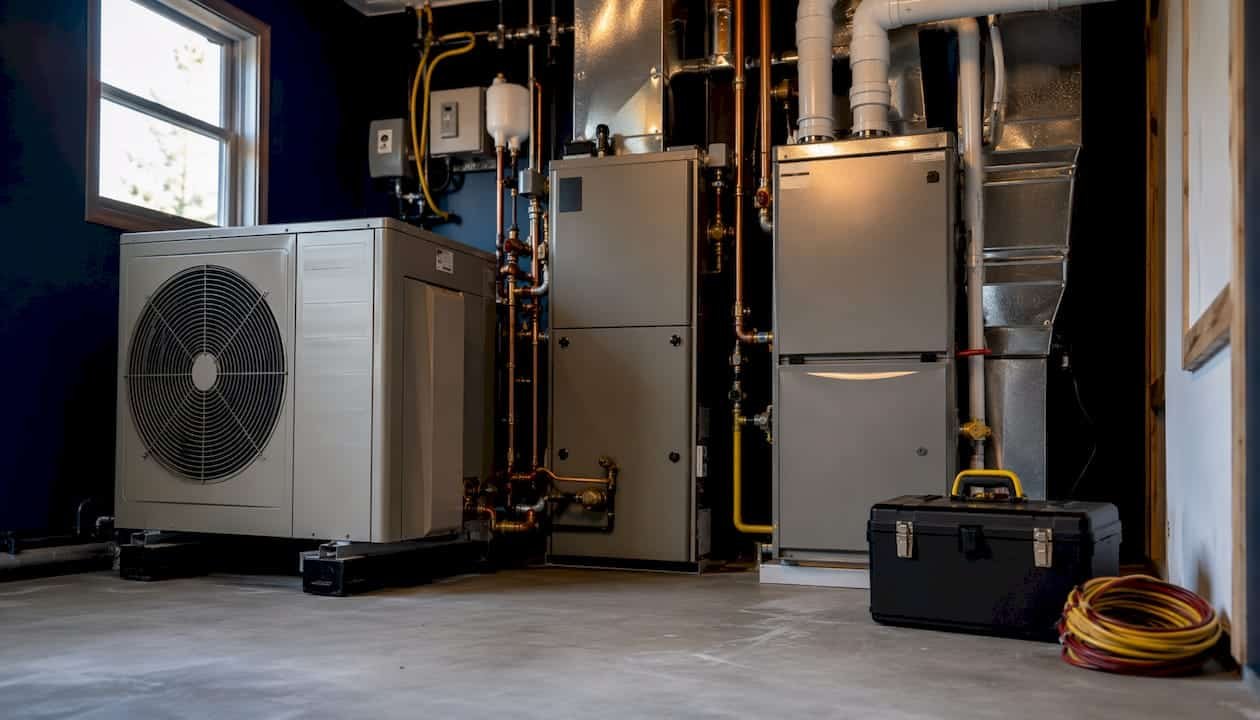
The thermostat is where the intelligence lives. It monitors outdoor air temperature continuously and compares it against a programmed switchover point. When the temperature falls below that point, the controller shuts off the heat pump and fires the furnace. Modern controls are designed so the two units never run for heating simultaneously; the heat pump is fully de-energized before the furnace ignites, preventing inefficient overlap.

| Component | Role | Notes |
|---|---|---|
| Air-source heat pump | Primary heat source in mild weather; provides all cooling | Reversible refrigerant cycle |
| Gas/propane/oil furnace | Backup and primary heat in deep cold | Shares existing ductwork |
| Shared duct system | Distributes conditioned air from either unit | No separate ducting needed |
| Dual-fuel thermostat | Controls switchover logic; monitors outdoor temp | Must be wired for dual-fuel operation |
The switchover temperature, also called the economic balance point, typically falls somewhere in the 25°F–45°F range for U.S. homes, but the exact number depends on your local electricity rate, gas price, and the heat pump’s coefficient of performance (COP). A well-calibrated installer derives this number from a simple formula: divide your electricity cost per BTU by the heat pump’s COP, then compare it to your gas cost per BTU adjusted for furnace efficiency. When gas wins that comparison, the furnace runs.
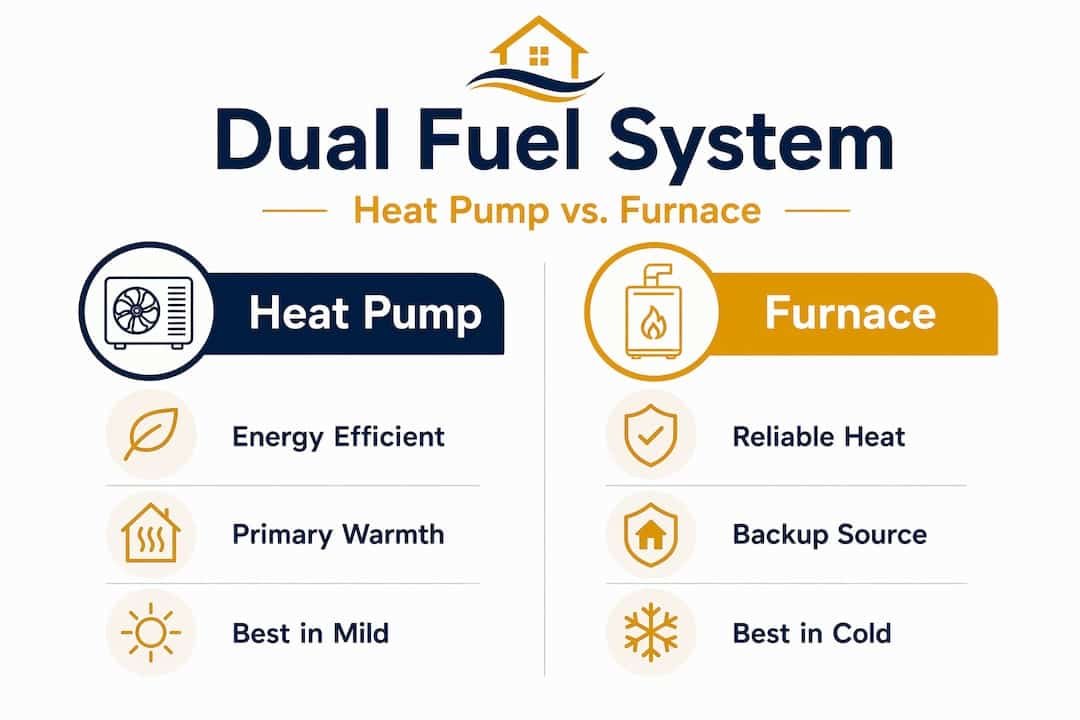
Advanced systems go further. Rate-aware controllers can factor in time-of-use electricity pricing, switching to the furnace during peak-rate hours even when temperatures are moderate. That layer of logic can reduce both operating cost and grid-related emissions beyond what a simple temperature-based switchover achieves.
What are the benefits and drawbacks of dual fuel systems?
Benefits
- Lower heating bills: Sources estimate homeowners can save roughly 30–50% on heating costs compared to heat-pump systems that rely on electric resistance backup, though actual savings vary by climate and local fuel prices.
- Year-round cooling: The heat pump handles all cooling in summer, so you get a full air conditioning system included.
- Reduced furnace wear: The furnace runs only during the coldest days, not throughout the entire heating season, which extends its service life.
- Extended equipment life: Because each component operates mainly under conditions where it performs efficiently, manufacturers commonly cite combined system life in the 20–25 year range with proper maintenance.
- Resilience: If the heat pump goes down, the furnace continues heating your home without any manual intervention.
Drawbacks
- Higher upfront cost: You are buying two heating systems, not one, plus a specialized thermostat and the labor to wire and commission both.
- Added complexity: Two fuel supply chains (electricity and gas or propane) mean two utility relationships and two sets of maintenance needs.
- Installer calibration required: A standard thermostat will not manage switchover logic correctly. Proper wiring and commissioning by a licensed technician are non-negotiable.
- Not ideal for all climates: In very mild climates where temperatures rarely drop below 40°F, the furnace may almost never run, making the added cost hard to justify.
On the environmental side, dual fuel reduces the hours your system spends on inefficient electric resistance strip heat, which tends to be the highest-emission heating mode on most U.S. grids. Whether it beats a well-designed all-electric system depends on your local grid’s carbon intensity.
When is a dual fuel system right for your home?
The decision comes down to four variables: your climate’s coldest design temperatures, the condition of your existing furnace, local electricity versus gas pricing, and whether your priority is the lowest monthly bill or the lowest carbon footprint.
Dual fuel usually makes the most sense when:
- You live in a cold-winter U.S. region (think the Midwest, Mid-Atlantic, or mountain states) where temperatures regularly drop below 30°F for extended periods, making insights from Hybrid House – Κατασκευή Σπιτιού, Χτίσιμο Σπιτιού, Κατασκευές Κατοικιών on hybrid home design and energy strategies especially relevant.
- You already have a functional furnace in good condition. Keeping an existing furnace and adding a heat pump costs significantly less than a full all-electric conversion, making the economics much more attractive.
- Natural gas or propane is substantially cheaper per BTU than electricity in your area during peak winter demand.
- You want “set and forget” comfort, where one thermostat manages everything automatically without you adjusting anything seasonally.
When a different system may serve you better:
- You live in a mild climate like coastal Southern California, where winter lows rarely threaten heat pump performance. A heat pump alone handles the load efficiently.
- Your utility offers low-cost, low-carbon electricity and you are committed to full electrification. In that case, a cold-climate heat pump with no gas backup may be the cleaner, simpler path.
- Your furnace is near end of life and you are replacing everything anyway. A full system replacement opens the door to sizing a cold-climate heat pump correctly from the start.
Pro Tip: Check your local utility’s rate schedule before setting a switchover temperature. If your electricity rate spikes during peak hours in winter, a rate-aware thermostat can shift more load to the furnace during those windows, saving more than a fixed temperature threshold alone.
What does installation and maintenance cost, and how long will the system last?
Upfront cost depends on several factors: the heat pump model and its capacity (sized by a Manual J load calculation), whether you are connecting to existing ductwork or modifying it, the condition of the furnace (reuse versus replace), the thermostat type, and local labor rates. If your home currently runs on propane and you want to switch to natural gas, a gas appliance conversion adds permitting and line work to the project cost. Always request itemized quotes that separate the heat pump, furnace work, thermostat and controls, labor, permits, and commissioning.
For ongoing maintenance, a dual fuel system requires attention to both components:
- Annual heat pump service: Refrigerant charge check, coil cleaning, airflow verification, and electrical connections.
- Annual furnace tune-up: Burner inspection, heat exchanger check, combustion safety verification, and filter replacement.
- Thermostat calibration check: Confirm the switchover temperature still reflects current local fuel prices, especially after a significant rate change.
- Filter changes: Every 1–3 months depending on filter type and household conditions.
- Switchover logic verification: At installation and annually, confirm the controller correctly de-energizes the heat pump before the furnace fires.
Lifespan expectations are favorable. With proper maintenance, manufacturers including Trane indicate combined system service life in the 20–25 year range. Heat pumps typically last 15–20 years; gas furnaces often reach 20 years or more. Because neither unit carries the full heating load year-round, wear is distributed across both, which supports that longer service life.
Pro Tip: Ask your installer to document the switchover temperature setting and the fuel price assumptions behind it. Tape that note inside the furnace cabinet. When rates change, you have a reference point for recalibration.
For more on keeping your HVAC system running efficiently between service visits, the HVAC efficiency checklist at Mdtechservices covers filter schedules, airflow checks, and seasonal prep steps.
Heat pump only vs. furnace only vs. dual fuel: how do they compare?
| Dimension | Heat pump only | Furnace only | Dual fuel |
|---|---|---|---|
| Efficiency / operating cost | Very high in mild weather; costly with resistance backup in deep cold | Consistent; depends on gas price | Highest overall; uses cheapest source at each temperature |
| Best climate | Mild winters or mild-cold with cold-climate model | Any climate; best where gas is cheap | Mixed or cold-winter climates |
| Upfront cost | Moderate | Low to moderate | Highest (two systems) |
| Comfort and backup heating | Good; resistance backup is expensive to run | Reliable; no cooling without separate AC | Excellent; furnace backs up heat pump automatically |
| Maintenance needs | Annual heat pump service | Annual furnace tune-up | Both annually |
| Expected lifespan | 15–20 years | 20+ years | 20–25 years combined |
The economic balance point shifts the recommendation by climate. In regions where outdoor temperatures stay above 35°F most of the winter, a heat pump alone handles the load without expensive resistance backup. As design temperatures drop lower, the furnace share of annual heating hours grows, and the dual fuel advantage over heat-pump-only systems increases. Furnace-only systems remain competitive where gas is inexpensive and cooling is handled separately, but they offer no efficiency advantage in shoulder seasons the way a heat pump does.
For a broader look at HVAC system types and how they compare across different home configurations, Mdtechservices has a dedicated guide worth reviewing before you finalize your decision.
What should you ask your HVAC installer before committing?
Getting the right system installed correctly depends as much on the questions you ask as on the equipment you choose. Professional installation and calibration are where dual fuel systems succeed or fail in practice. Here is a numbered checklist to take into every quote conversation:
- Request a Manual J load calculation. Never accept a system sized by rule of thumb. Manual J determines the correct heat pump and furnace capacity for your specific home.
- Ask what switchover temperature they recommend and why. A qualified installer should derive it from your local electricity and gas rates and the heat pump’s rated COP, not guess at a round number.
- Confirm the thermostat is wired for true dual-fuel operation. A standard two-stage thermostat will not manage the switchover correctly. Ask to see the thermostat model and its dual-fuel compatibility documentation.
- Ask whether both units meet your heating load independently. The furnace should be able to heat your home on its own on the coldest design day. The heat pump should cover the load down to its rated balance point.
- Request separate line items on the quote: heat pump unit, furnace reuse or replacement, thermostat and control wiring, labor, permits, and commissioning/checkout of switchover logic.
- Ask for proof of technician licensing and local references. In California, HVAC contractors must hold a valid C-20 license. Ask to see it.
- Request a written maintenance plan that includes annual heat pump service, furnace tune-up, and switchover verification at each visit.
Pro Tip: Ask the installer to perform a live switchover test before they leave. Set the thermostat to call for heat, then lower the outdoor temperature sensor reading below the balance point and confirm the furnace fires and the heat pump shuts off. If they cannot demonstrate this, the commissioning is not complete.
Note that the thermal balance point (when the heat pump physically cannot keep up with heat loss) differs from the economic balance point. A thorough installer considers both when programming the controller.
Key Takeaways
A dual fuel system delivers the best heating economics in mixed and cold-winter U.S. climates by running an electric heat pump during mild weather and switching to a gas furnace automatically when temperatures drop below the economic balance point.
| Point | Details |
|---|---|
| What it is | A heat pump and gas/propane furnace share one duct system and one thermostat, switching automatically. |
| When it saves money | Most effective in cold-winter or mixed climates where gas is cheaper than electric resistance heat. |
| Switchover temperature | Set between 25°F and 45°F based on local fuel prices and heat pump COP; adjustable as rates change. |
| Installation requirements | Requires a licensed technician, a true dual-fuel thermostat, Manual J sizing, and documented switchover testing. |
| Mdtechservices | Provides HVAC inspection, heat pump and furnace installation, thermostat setup, and gas conversions in Orange County and Los Angeles County. |
Why the “set it and forget it” promise has a catch
Most homeowners are drawn to dual fuel systems for exactly the reason the marketing describes: one thermostat, automatic switching, no seasonal adjustments. That part is real. What the brochures understate is that the system only delivers on that promise if the switchover temperature was set correctly at installation and revisited when fuel prices shift.
Utility rates in California have moved significantly over the past several years. A switchover point that made economic sense when the system was installed may now be costing you money if electricity rates have risen relative to gas, or vice versa. The “set and forget” comfort is genuine. The economics require at least an annual check.
There is also a common misconception that any heat pump plus any furnace equals a dual fuel system. The thermostat and control wiring are what make it a true hybrid. Without a dual-fuel-capable controller properly commissioned, you may end up with two systems that fight each other, run simultaneously, or default to the less efficient option. The hardware is only half the job.
Mdtechservices can help you evaluate, install, and maintain your dual fuel system
Homeowners in Orange County and Los Angeles County who are weighing a dual fuel upgrade have a local resource that handles every step of the process. Mdtechservices provides HVAC inspection, heat pump and furnace installation, thermostat and control wiring, and gas appliance conversions for properties running on LP or natural gas. Every installation includes a Manual J load assessment, switchover temperature discussion, and a written quote with separate line items so you know exactly what you are paying for.
If your furnace is aging or your current heat pump relies on electric resistance backup, an on-site evaluation from Mdtechservices will tell you whether a dual fuel retrofit makes financial sense for your specific home. The team is licensed, local, and familiar with the permit requirements and utility rate structures in both counties. To schedule an inspection or request a quote, visit the HVAC repair and installation service page and book directly online.
Further reading and authoritative sources
- U.S. Department of Energy — Heat Pump Systems: The federal baseline on how heat pumps work, efficiency ratings, and climate suitability across U.S. regions.
- ENERGY STAR — Federal Tax Credits: Current federal tax credit eligibility for qualifying heat pumps and high-efficiency furnaces; useful before finalizing your equipment selection.
- Trane — Dual Fuel Heat Pump Glossary: Manufacturer definition, component overview, and lifespan guidance from one of the leading residential HVAC brands.
- Lennox — BBB Profile: Background on Lennox Industries, a major manufacturer of dual fuel-compatible heat pumps and furnaces.
- NEEA — Advancing Dual-Fuel Residential HVAC White Paper: Industry white paper on advanced control strategies, rate-aware switching, and grid interaction potential for dual fuel systems.
- California Energy Commission: State-level guidance on residential energy systems relevant to California homeowners evaluating HVAC upgrades.