
TL;DR:
- A compressor increases gas pressure by reducing its volume and is essential in systems like air conditioners and manufacturing plants. Choosing the right type for your duty cycle and application prevents early failure and reduces energy costs. Proper selection and maintenance ensure reliable operation and compliance in sensitive industries.
A compressor is a mechanical device that raises the pressure of a gas by reducing its volume. That single function sits at the center of your home’s air conditioning, your refrigerator, and nearly every manufacturing plant in the country. Understanding what is a compressor, how it works, and which type fits your situation saves you money, prevents equipment failure, and helps you make smarter decisions when something breaks. This article covers the core principles, major types, real-world applications, and practical selection guidance you need.
What is a compressor and how does it differ from a pump?
A compressor increases gas pressure by mechanically reducing the space the gas occupies. That definition separates it from a pump, which moves liquids that are already nearly incompressible. The distinction matters because gas behaves differently under pressure. It changes density, temperature, and volume simultaneously, which is why compressor design is more complex than pump design.
Compressors appear in HVAC systems, refrigerators, pneumatic tools, natural gas pipelines, and large industrial plants. Each application demands a different pressure range, flow rate, and duty cycle. Knowing the difference between compressor types is the first step toward understanding why one unit works perfectly in a home workshop while another is built for a factory running 24 hours a day.
How does a compressor work?
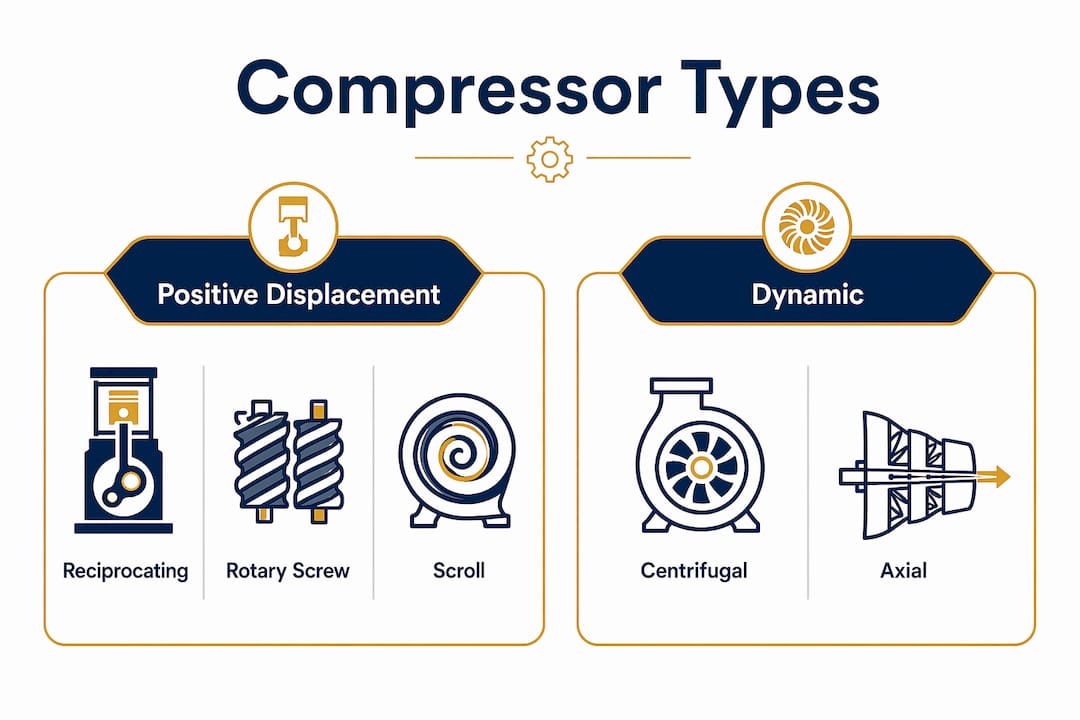
Compressors operate on two primary principles: positive displacement and dynamic compression. Each principle produces pressure in a fundamentally different way, and that difference determines which industries and applications each type serves best.
Positive displacement compression
Positive displacement compressors trap a fixed volume of gas and then mechanically squeeze it into a smaller space. The pressure rises as the volume shrinks. Common examples include:
- Reciprocating (piston) compressors: A piston moves back and forth inside a cylinder, drawing in gas and then compressing it on the return stroke.
- Rotary screw compressors: Two interlocking helical screws trap gas between their threads and push it toward a smaller outlet.
- Scroll compressors: Two spiral-shaped plates, one fixed and one orbiting, compress gas toward the center.
- Rotary vane compressors: Sliding vanes inside a rotor create shrinking chambers as they rotate.
Most positive displacement units deliver consistent pressure regardless of flow rate. That reliability makes them the dominant choice for industrial and commercial air supply.
Dynamic (kinetic) compression
Dynamic compressors use high-speed rotating impellers to accelerate gas to very high velocity, then convert that velocity into pressure through a diffuser. Centrifugal compressors reach discharge pressures up to 1,500 psi, and axial compressors add roughly 1.2 times the pressure per compression stage. These units shine in very high-volume, continuous-flow applications like large power plants and petrochemical facilities.
Staging and intercooling
Compression generates heat. When you compress gas significantly, its temperature rises fast enough to damage seals, reduce efficiency, and shorten equipment life. Multi-stage compression with intercooling between stages prevents excessive temperature buildup and keeps the process thermodynamically efficient. Intercooling removes heat between stages so each subsequent stage starts with cooler, denser gas.
Pro Tip: If you hear a compressor running unusually hot or cycling off on thermal protection, the first thing to check is whether the cooling system, whether air-cooled fins or a water-cooled intercooler, is blocked or fouled.
What are the main types of compressors?
Most industrial and commercial installations use positive displacement compressors, while dynamic types serve very high-volume continuous processes. Here is a breakdown of the major categories.
Reciprocating compressors
Reciprocating compressors are the most common entry-level units. They handle flow rates from 1 to 100 CFM and typically cost between $500 and $15,000. Their key limitation is duty cycle. Reciprocating compressors suit intermittent use at 50–60% duty cycles, meaning they need rest time between compression cycles. Running them continuously causes overheating and premature wear. They work well in auto shops, small manufacturing operations, and home garages.
Rotary screw compressors
Rotary screw compressors are built for continuous operation at 80–100% duty cycles. They handle 15 to 500+ CFM and cost between $8,000 and $100,000 or more depending on capacity. Rotary screw compressors last 80,000–100,000+ hours with proper maintenance, making them the preferred choice for factories, food processing plants, and large commercial facilities. Units equipped with Variable Speed Drive technology adjust motor speed to match demand, delivering the highest energy efficiency in continuous operations.
Centrifugal and axial compressors
Centrifugal and axial compressors are economical only in massive facilities where flow rates are extremely high. A centrifugal unit uses a spinning impeller to accelerate gas radially outward, converting velocity to pressure in a diffuser. Axial compressors move gas parallel to the shaft through a series of rotating and stationary blade rows. Both types are found in large power generation plants, petrochemical refineries, and jet engines.
Oil-lubricated vs. oil-free compressors
| Feature | Oil-lubricated | Oil-free |
|---|---|---|
| Air purity | Contains trace oil vapor | Certified clean air output |
| Maintenance cost | Lower upfront | Higher upfront, lower contamination risk |
| Typical use | General industrial, auto shops | Food, pharma, electronics manufacturing |
| Compliance | Standard industrial codes | Strict purity regulations required |
| Cost | Lower purchase price | Higher purchase price |
Oil-free compressors are mandatory in food, beverage, and pharmaceutical manufacturing to prevent product contamination. A single oil contamination event in a pharmaceutical line can result in a product recall. The higher upfront cost of oil-free units is always justified in those environments.
How to select the right compressor for your needs
Failure to assess duty cycle and CFM needs is the most common cause of compressor system failures. Getting the selection wrong does not just mean poor performance. It means equipment that fails early and costs far more to operate.
Follow these steps to make the right choice:
- Assess your duty cycle. Calculate how many minutes per hour the compressor will actually run. If it runs more than 60% of the time, a reciprocating unit will overheat. Choose a rotary screw unit for anything above that threshold.
- Calculate your CFM requirement. Add up the CFM demand of every tool or process that will run simultaneously, then add a 25% buffer for future growth and pressure drop in the lines.
- Determine your pressure needs. Most pneumatic tools require 90–100 psi. Some industrial processes need 150 psi or more. Match the compressor’s rated pressure to your actual requirement, not the highest number on the spec sheet.
- Decide on oil-free or oil-lubricated. If your application involves food production, pharmaceuticals, or sensitive electronics, oil-free air is a compliance requirement, not an option.
- Factor in total cost of ownership. A cheaper reciprocating unit running continuously will cost more in energy and repairs within two years than a properly sized rotary screw unit.
Using a mismatched compressor leads to failure within 18 months and can increase energy bills by 30%. That outcome is entirely avoidable with accurate upfront assessment.
Pro Tip: Before purchasing, run your compressor selection past a licensed technician who can verify your CFM and pressure calculations against your actual piping layout. Undersized lines waste pressure and make even a correctly sized compressor perform poorly.
Common uses of compressors in HVAC and manufacturing
Compressors serve as the functional core of two of the most critical systems in any building: climate control and production utilities.
HVAC applications
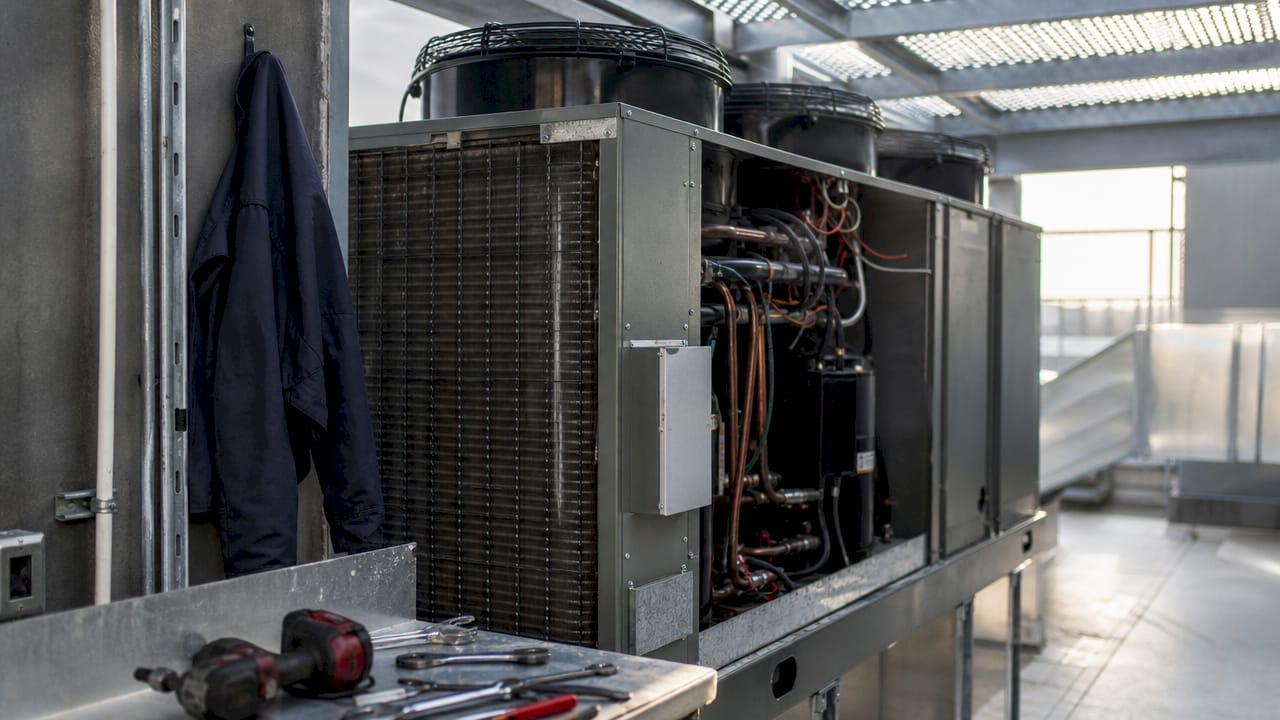
The compressor is the heart of every HVAC system, circulating refrigerant at the correct pressure and temperature to move heat from inside a building to the outside. Without a working compressor, refrigerant cannot change state, and the system cannot transfer heat. Understanding HVAC compressor failure modes helps homeowners catch problems early before a full system breakdown.
Key HVAC compressor functions include:
- Compressing low-pressure refrigerant vapor from the evaporator into high-pressure, high-temperature vapor
- Driving refrigerant through the condenser where heat is released to the outside air
- Maintaining the pressure differential that allows the refrigerant to absorb and release heat efficiently
- Cycling on and off (or modulating speed in variable-capacity units) to match the building’s cooling load
Manufacturing and industrial applications
In manufacturing, compressed air is often called the “fourth utility” alongside electricity, water, and gas. Pneumatic tools, automated assembly lines, spray painting systems, and conveyor controls all depend on a reliable compressed air supply. Sensitive environments like electronics fabrication require oil-free compressed air to prevent contamination of circuit boards and components. Regular HVAC maintenance practices apply equally to industrial compressed air systems: filter changes, drain valve checks, and belt inspections prevent the most common failures.
Key takeaways
A compressor raises gas pressure by reducing volume, and selecting the wrong type for your duty cycle causes failure within 18 months and drives energy costs up by 30%.
| Point | Details |
|---|---|
| Core compressor definition | A compressor increases gas pressure by mechanically reducing the volume of the gas. |
| Two operating principles | Positive displacement traps and squeezes gas; dynamic compression accelerates gas with impellers. |
| Duty cycle drives type selection | Reciprocating units suit 50–60% duty cycles; rotary screw units handle 80–100% continuous operation. |
| Oil-free is mandatory in sensitive industries | Food, pharmaceutical, and electronics manufacturing require oil-free compressed air for compliance. |
| Wrong selection is costly | A mismatched compressor fails within 18 months and can raise energy bills by 30%. |
What I’ve learned from years of compressor-related service calls
After years of working on HVAC systems and appliances across Orange County and Los Angeles County, the pattern is clear: most compressor problems trace back to decisions made before the unit was ever installed. Homeowners and facility managers alike tend to focus on purchase price and ignore duty cycle, CFM requirements, and air quality needs. That approach costs far more in the long run.
The detail I see overlooked most often is oil-free specification. A client running a small food prep operation once called us because their compressor kept contaminating product. The unit was a standard oil-lubricated model installed by a previous contractor who never asked about the application. Swapping to an oil-free unit solved the problem immediately and brought them into compliance.
My honest advice: treat compressor selection the same way you treat any major appliance decision. Get the specs right first, then find a unit that fits. A correctly sized, properly maintained compressor runs quietly in the background for decades. A wrong one becomes your most expensive recurring repair bill. If your HVAC compressor is already showing signs of trouble, do not wait for a full failure. Early diagnosis almost always costs less than emergency replacement.
— MDTECH
Compressor repair and HVAC service from Mdtechservices
When your compressor fails, whether in your home’s air conditioner, refrigerator, or another major appliance, the cost of waiting grows fast. A failed HVAC compressor in a California summer is not a minor inconvenience.

Mdtechservices serves homeowners across Orange County and Los Angeles County with licensed, experienced technicians who specialize in HVAC repair and diagnosis. From compressor diagnostics to full appliance repair, the team provides reliable service with clear communication and no guesswork. If you are dealing with a compressor issue or want to get ahead of a potential failure, Mdtechservices makes it straightforward to schedule appliance repair and get your system running correctly again. Book an appointment online or call the team directly.
FAQ
What is a compressor in simple terms?
A compressor is a mechanical device that increases the pressure of a gas by squeezing it into a smaller volume. It is used in HVAC systems, refrigerators, pneumatic tools, and industrial plants.
How does a compressor work in an HVAC system?
The compressor pressurizes refrigerant vapor, raising its temperature so it can release heat through the condenser. This pressure cycle is what allows your air conditioner to move heat out of your home.
What are the main types of compressors?
The main types are reciprocating (piston), rotary screw, scroll, centrifugal, and axial compressors. Positive displacement types like rotary screw dominate industrial and commercial installations above 25 CFM.
What is the difference between oil-free and oil-lubricated compressors?
Oil-lubricated compressors use oil to reduce friction and seal internal components, while oil-free units use alternative materials and designs to deliver clean, uncontaminated air. Oil-free compressors are required in food, pharmaceutical, and electronics manufacturing.
How long does a compressor last?
Rotary screw compressors last 80,000–100,000+ hours with proper maintenance. Reciprocating compressors have shorter service lives, especially when run beyond their rated duty cycle of 50–60%.