
TL;DR:
- An expansion valve regulates refrigerant flow into the evaporator coil, controlling superheat and enabling efficient cooling.
- Faulty valves often cause symptoms like coil freezing, inconsistent cooling, and short cycling, but most failures result from poor maintenance or low refrigerant levels.
An expansion valve is a refrigerant metering device that controls how much refrigerant enters your HVAC system’s evaporator coil. It sits between the condenser and the evaporator, and its job is to drop refrigerant pressure sharply so the refrigerant can absorb heat and cool your home. Without it, your air conditioner cannot regulate temperature or run efficiently. The two main types you will encounter in residential systems are the thermostatic expansion valve (TXV) and the electronic expansion valve (EEV). Understanding what an expansion valve does helps you recognize problems early and make smarter decisions about HVAC maintenance.
What is an expansion valve and what does it do?
An expansion valve controls refrigerant flow into the evaporator coil by metering the amount of refrigerant released based on system demand. That metering function is what makes efficient cooling possible. Without accurate flow control, your system either floods the evaporator with too much refrigerant or starves it with too little.

The valve sits right at the entrance to the evaporator coil, where refrigerant enters the coil as a warm, high-pressure liquid. As it passes through the valve’s narrow orifice, pressure drops sharply. That pressure drop triggers a phase change: the liquid refrigerant begins to evaporate inside the coil, absorbing heat from your indoor air in the process.

One concept you will hear often is superheat. Superheat is the temperature of refrigerant vapor above its boiling point at a given pressure. The expansion valve’s primary job is to regulate refrigerant superheat, not to set your room temperature directly. Evaporator temperature is actually controlled by compressor capacity and system pressure, not the valve alone. That distinction matters when you are troubleshooting a cooling problem.
How does an expansion valve work inside an HVAC system?
The mechanical process behind a thermostatic expansion valve (TXV) follows four clear steps:
- Sensing: A temperature-sensing bulb, filled with a special fluid, attaches to the evaporator outlet pipe. As refrigerant temperature at the outlet rises, the fluid in the bulb expands and increases pressure on the valve’s diaphragm.
- Modulating: That increased pressure pushes the valve needle open, allowing more refrigerant to flow into the evaporator.
- Balancing: A spring inside the valve pushes back against the diaphragm. The valve settles at a position where bulb pressure, spring pressure, and evaporator pressure reach equilibrium.
- Correcting: If the evaporator outlet gets too cold (low superheat), bulb pressure drops, the spring closes the valve slightly, and refrigerant flow decreases.
The temperature-sensing bulb and spring diaphragm work together continuously, making small adjustments dozens of times per minute. This keeps superheat stable without any electronic input.
Electronic expansion valves (EEVs) replace that mechanical sensing with a digital controller and a stepper motor. The controller reads temperature and pressure sensors throughout the system and adjusts the valve needle with far greater speed and accuracy than a mechanical TXV can achieve.
Pro Tip: If your system short-cycles (turns on and off rapidly), a miscalibrated TXV sensing bulb is a common cause. A licensed technician can check bulb contact and insulation in under 30 minutes.
The expansion valve creates the pressure drop that allows refrigerant to evaporate inside the coil and absorb heat. That pressure drop is the physical engine behind every degree of cooling your system delivers.
What are the main types of expansion valves?
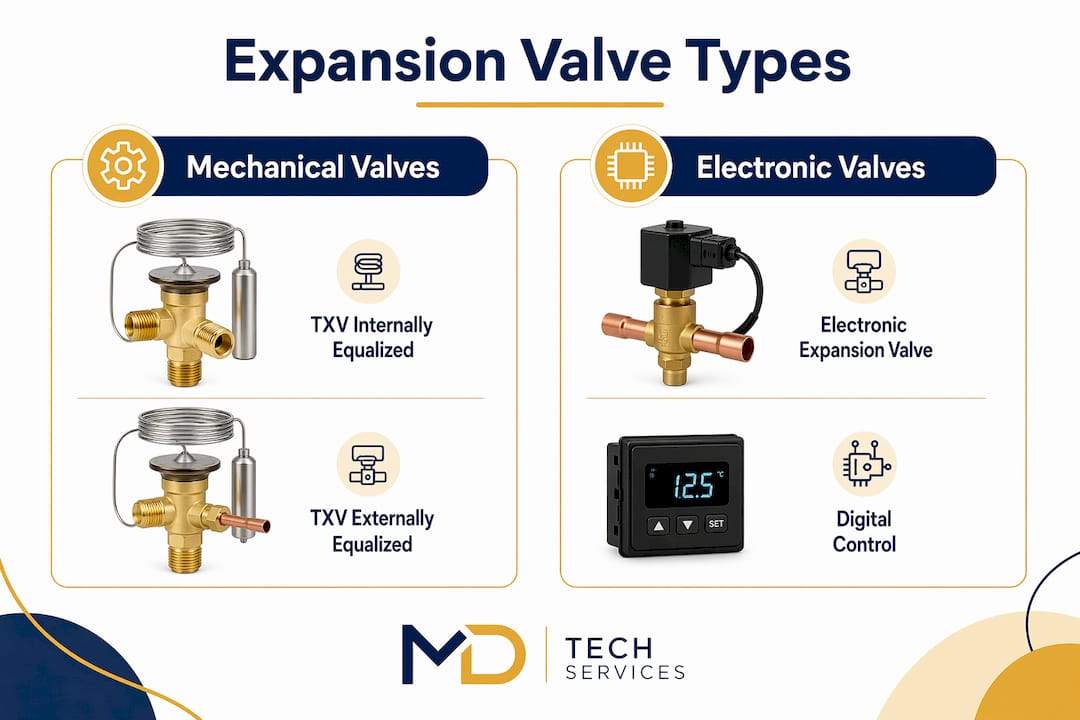
The three types you will find in residential HVAC systems each handle refrigerant flow differently, and choosing the wrong type for your system causes real performance problems.
Thermostatic expansion valves (TXV): internally equalized
An internally equalized TXV senses evaporator inlet pressure to balance the valve. It works well in systems where the pressure drop across the evaporator coil is small. When pressure drop is large, the valve reads the wrong signal and superheat climbs higher than it should, reducing cooling efficiency.
Thermostatic expansion valves (TXV): externally equalized
An externally equalized TXV adds a small tube that connects to the evaporator outlet instead of the inlet. This design compensates for pressure drop through the evaporator by sensing outlet pressure directly. The result is stable superheat even when load conditions vary. Most residential split systems with longer evaporator coils use externally equalized valves for this reason.
Electronic expansion valves (EEV)
EEVs use a stepper motor and digital controller to position the valve needle with accuracy that mechanical valves cannot match. They respond faster to load changes, work well in variable-speed systems, and make diagnostics easier because the controller logs data. All modern Trane cooling systems use electronic expansion valves, reflecting the industry shift toward digital refrigerant control.
| Feature | TXV (internally equalized) | TXV (externally equalized) | EEV |
|---|---|---|---|
| Control method | Mechanical bulb and spring | Mechanical bulb with outlet sensing | Digital controller and stepper motor |
| Best for | Short evaporator coils, low pressure drop | Longer coils, variable loads | Variable-speed and high-efficiency systems |
| Superheat stability | Moderate | Good | Excellent |
| Diagnostic capability | None | None | Built-in data logging |
| Typical cost | Lowest | Low to moderate | Highest |
Key differences between valve types at a glance:
- TXVs require no power source and are simple to replace.
- Externally equalized TXVs handle evaporator pressure drop better than internally equalized models.
- EEVs integrate with smart thermostats and variable-speed compressors.
- EEVs cost more upfront but reduce energy use over the system’s life.
What are the signs of a faulty expansion valve?
A failing expansion valve produces recognizable symptoms before the system fails completely. Catching them early protects your compressor, which is far more expensive to replace than the valve itself.
Common signs of expansion valve problems include:
- Frozen evaporator coil. A faulty valve causes evaporator freeze by flooding the coil with too much refrigerant, preventing proper evaporation. You may notice ice on the indoor unit or reduced airflow from vents.
- Inconsistent cooling. Rooms that were comfortable last summer now feel warm. The valve may be sticking open or closed intermittently.
- High indoor temperatures. When the valve fails closed, refrigerant flow stops and the system blows warm air despite running continuously.
- Short cycling. The system turns on, runs briefly, then shuts off before reaching the set temperature.
- Compressor overheating. Improper refrigerant flow from a stuck valve sends liquid refrigerant back to the compressor, causing serious damage over time.
Pro Tip: Before calling a technician, check your air filter first. A clogged filter restricts airflow across the evaporator coil and mimics every symptom of a bad expansion valve. Replace the filter, run the system for an hour, and see if symptoms clear.
For a broader look at signs of failing HVAC systems, Mdtechservices has a detailed guide that covers expansion valve symptoms alongside other common HVAC problems. If you suspect compressor damage from a stuck valve, get a professional assessment before running the system further.
Never attempt to adjust the TXV superheat setting yourself. Improper adjustments worsen system performance because the valve controls superheat, not room temperature, and the two do not respond the same way to valve changes.
How to maintain your expansion valve and extend its life
Expansion valves rarely fail on their own. Most valve problems trace back to neglected system maintenance, contaminated refrigerant, or incorrect refrigerant charge. Protecting the valve means protecting the whole system.
Practical maintenance steps that directly affect valve health:
- Schedule annual HVAC service. A licensed technician checks refrigerant charge, inspects the sensing bulb for contact and insulation, and verifies superheat readings. Annual service catches valve drift before it becomes valve failure.
- Maintain proper refrigerant charge. Low refrigerant charge forces the valve to stay wide open, which stresses the mechanism. Proper refrigerant levels are the single most important factor in valve longevity.
- Keep airflow clear. Dirty coils and clogged filters create abnormal pressure conditions that confuse the valve’s sensing mechanism. Clean or replace filters every 1–3 months depending on your home environment.
- Avoid DIY valve adjustments. TXV superheat settings require calibrated gauges and refrigerant pressure readings. Guessing the adjustment creates bigger problems than the original symptom.
- Ask about EEV upgrades. If your system is older and uses a mechanical TXV, upgrading to an EEV during your next service provides better diagnostics and more stable superheat control.
Consistent maintenance keeps the valve’s internal components free of debris and moisture. Moisture inside the refrigerant circuit is a leading cause of valve freeze-up, where ice forms inside the valve orifice and blocks refrigerant flow entirely. A technician can install a filter-drier in the refrigerant line to prevent this.
Key Takeaways
An expansion valve controls refrigerant superheat, not room temperature directly, and its health depends on proper refrigerant charge, clean airflow, and annual professional service.
| Point | Details |
|---|---|
| Core function | The valve meters refrigerant into the evaporator to regulate superheat, not room temperature. |
| Main types | TXV (internally or externally equalized) and EEV each suit different system sizes and loads. |
| Failure symptoms | Frozen coil, inconsistent cooling, and short cycling are the clearest signs of valve trouble. |
| Biggest protection | Maintaining correct refrigerant charge prevents most expansion valve failures before they start. |
| DIY limit | Never adjust TXV superheat settings without calibrated gauges and professional training. |
What I have learned from years of expansion valve calls
Homeowners almost always assume the expansion valve is the problem when their AC stops cooling well. The truth is that the valve is usually the last thing to fail. In my experience, the real culprits are low refrigerant charge, a dirty evaporator coil, or a failed sensing bulb that lost contact with the outlet pipe.
The most common mistake I see is a homeowner who read online that they could adjust the TXV to “get more cooling.” They turn the adjustment stem a few times and call us when the system freezes solid an hour later. The valve does not control how cold your house gets. It controls superheat. Those are two completely different things, and confusing them leads to expensive repairs.
Electronic expansion valves have genuinely changed how we diagnose these systems. When a home has an EEV, I can pull data from the controller and see exactly how the valve was behaving before the problem appeared. With a mechanical TXV, diagnosis is slower and more interpretive. If you are replacing an older system or doing a major repair, asking about EEV compatibility is worth the conversation.
The other thing I tell every homeowner: a frozen evaporator coil is not always the valve. Check your filter first. We have driven across Orange County to diagnose a “faulty expansion valve” that turned out to be a filter that had not been changed in 18 months. A clean filter costs three dollars. A service call costs considerably more.
— MDTECH
Mdtechservices can help with your HVAC expansion valve
Expansion valve problems rarely announce themselves clearly, and misdiagnosing them wastes time and money. Mdtechservices serves homeowners across Orange County and Los Angeles County with licensed HVAC technicians who diagnose refrigerant flow issues, superheat problems, and valve failures accurately the first time.

For a complete picture of what professional HVAC service covers, the HVAC repair guide on the Mdtechservices website walks through every major component, including expansion valves, evaporator coils, and compressors. If your system is showing any of the symptoms covered here, the HVAC troubleshooting guide is a good starting point before booking a service call. Mdtechservices offers online appointment booking and same-area response for homeowners who need reliable, fast answers to cooling problems.
FAQ
What does an expansion valve do in an AC system?
An expansion valve meters refrigerant into the evaporator coil and creates the pressure drop that allows refrigerant to evaporate and absorb heat. Its primary function is regulating superheat, not setting room temperature.
What are the signs of a bad expansion valve?
A frozen evaporator coil, inconsistent cooling, high indoor temperatures, and short cycling are the most common signs. Faulty valve symptoms appear before complete system failure, so acting early prevents compressor damage.
Can a homeowner replace an expansion valve themselves?
Replacing an expansion valve requires handling refrigerant, which is regulated under EPA Section 608 and requires a certified technician. DIY replacement is not legal or safe without proper certification and equipment.
What is the difference between a TXV and an EEV?
A TXV uses a mechanical sensing bulb and spring to control refrigerant flow, while an EEV uses a digital controller and stepper motor. EEVs respond faster, offer built-in diagnostics, and work better with variable-speed systems.
How long does an expansion valve last?
A well-maintained expansion valve typically lasts the life of the HVAC system, often 15–20 years. Contaminated refrigerant, moisture in the system, and incorrect refrigerant charge are the leading causes of early valve failure.