
Most freestanding refrigerators need about 1/8 to 1 inch of space on each side, about 1/2 to 1 inch above, and 1 to 2 inches behind, plus extra room on the hinge side if the door swings next to a wall. Those are the general minimums GE Appliances publishes, and other brands land in the same range, but the exact figure is printed in the installation instructions for your model. If you are placing a new refrigerator in an Orange County or Los Angeles County kitchen, our technicians handle appliance installation so the fit, the water line and the airflow are checked together.
TL;DR
- Typical minimums: 1/8 to 1 inch per side, 1 inch on top, 1 to 2 inches at the back (GE’s general figures). Brands vary, so use your model’s sheet.
- Next to a wall, the hinge side needs more: about 2 inches to 3 3/4 inches in the Whirlpool and Samsung sheets we reviewed, so the door can swing open.
- Too little space traps heat from the cooling system, which can lower cooling performance and raise your electric bill.
- Built-in models have their own rules: specific opening widths, top-grille room and a door that opens 90 degrees.
- Measure the opening, the doorway and the delivery path before the new unit arrives.
Table of Contents
- The standard clearances at a glance
- Side and top clearance
- Rear clearance
- Door swing: the hinge side and the wall
- Built-in and cabinet-depth models
- What happens when a refrigerator is too close
- How to measure before delivery
- A note for landlords and property managers
- Our approach to refrigerator installation
- Our perspective
- FAQ
- Sources
The standard clearances at a glance
The clearance is not a building code number. It comes from each manufacturer’s installation instructions, and it exists for three reasons: air has to move around the cooling components, the doors have to open, and the cabinet has to be reachable for the water and electrical connections. The table below shows what several published model sheets say. They are examples of the range, not a rule for your refrigerator.
| Source | Sides | Top | Back | Hinge side next to a wall |
|---|---|---|---|---|
| GE general minimums | 1/8 to 1 in. | 1 in. | 1 to 2 in. | Check the model manual |
| Whirlpool model W10325087 (2015 guide) | 1/2 in. | 1/2 in. | 1 in. | 3 3/4 in. |
| Whirlpool model W11105301 (2017 guide) | 1/2 in. | 1/2 in. | 1 in. | 2 in. |
| Samsung RS27T5201SR (2021 sheet) | 3/8 in. | 3/8 in. | 1 in. | 2.5 in. |
| Samsung RF28R7351 | 3/8 in. | 3/8 in. | 2 in. | 3 3/4 in. |
| LG USA support (2023) | 4 in. gap around the unit | 4 in. | 4 in. | Varies by model |
Two things stand out. First, two models from the same brand can ask for different numbers, as the Whirlpool and Samsung rows show. Second, the sheets disagree on how generous the gap should be, which is why a guess based on the old refrigerator is risky. A larger or newer unit may need more room than the one it replaces.
Side and top clearance
Side and top gaps are the smallest numbers on the sheet, usually a fraction of an inch. They are there so the cabinet or wall does not rub the case and so air can escape. GE’s general guidance puts the top at 1 inch measured above the case, not above the hinge, and it adds that once the minimums are met the refrigerator can sit beside a dishwasher, range or wall oven. Carpet type can also affect airflow under the unit, so a refrigerator on a thick rug in a den or garage needs more attention than one on kitchen tile.
Heat matters as much as the gap. Whirlpool’s instructions for model W10645932B rate the unit for 55°F to 110°F, with a preferred range of 60°F to 90°F, and say not to install it near an oven or radiator. That is relevant for a garage refrigerator in a Southern California summer, where the ambient temperature can pass what the unit is designed for.
If the refrigerator is going under or beside cabinetry, check the cabinet above it as well. A cabinet that hangs lower than the top of the unit leaves no room for the 1 inch GE lists, and it blocks the upper hinge area on some French door models.
Rear clearance
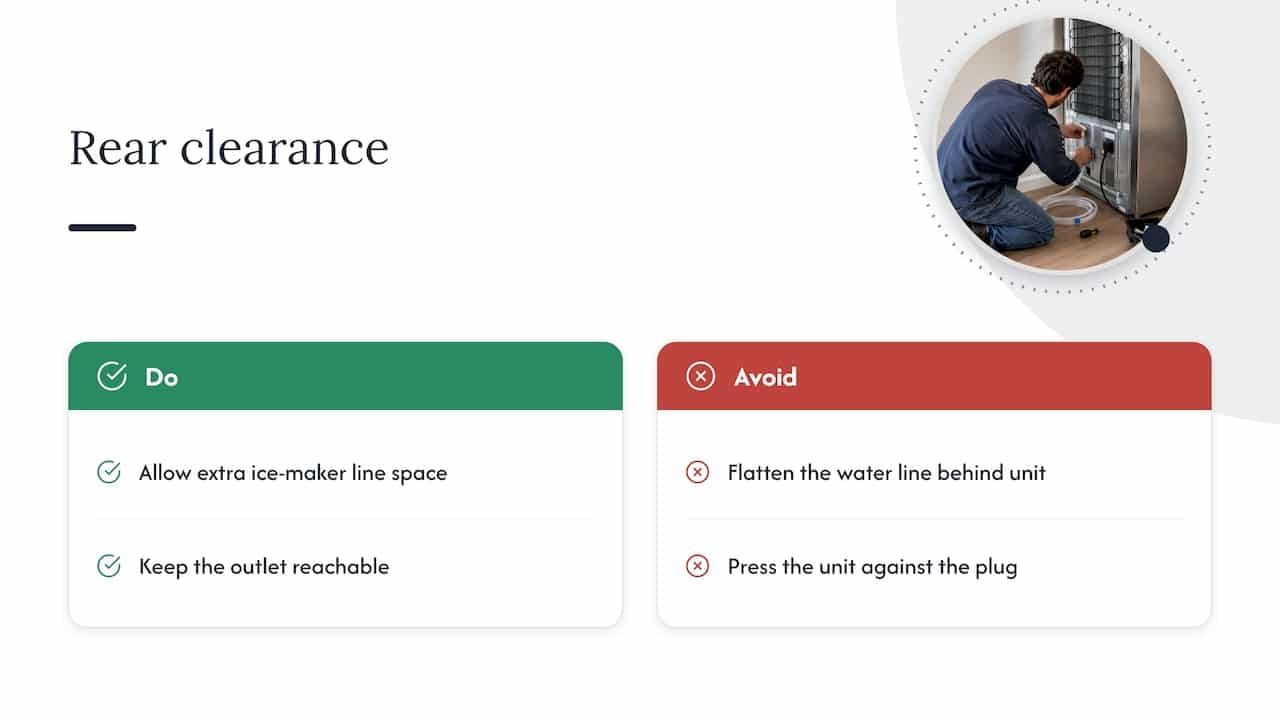
The back is where heat leaves the refrigerator and where the power cord and water line live. Most sheets ask for 1 to 2 inches. Whirlpool’s guide for W10325087 notes that a model with an ice maker needs additional rear space for the water-line connection. Samsung says its 1 inch rear minimum is for air circulation and for the water and electrical connections.
This is where installs go wrong in practice. A copper or braided water line pushed flat behind the unit can kink, and a kinked line is a common source of slow leaks. If that is your situation, see our guide to a refrigerator water line leak. A gas-free refrigerator still needs the outlet to be reachable, so avoid placing the plug so the unit sits hard against it.
Door swing: the hinge side and the wall
The clearance people underestimate is the one next to a wall. A refrigerator door, especially one with a thick handle, has to swing open far enough to pull out the drawers and bins. Manufacturers give a separate hinge-side figure for that, and it is larger than the side gap:
- Whirlpool’s product help page gives 2 1/2 inches next to a fixed wall for door swing on full-size models.
- Samsung’s RF28R7351 sheet asks for 3 3/4 inches along a wall so the door opens 90 degrees without the handle touching, and advises against a wall placement if you want the best door opening.
- Whirlpool’s W11105301 guide describes a normal cabinet cutout of 36 inches, widening to a 54 inch total opening if the refrigerator is against an extended wall and you want to pull the crisper pans out.
The crisper pans are the useful test. If the door opens 90 degrees but the drawer still catches on a side wall, you have a clearance problem even though the door technically opens. Measure the wall side from the hinge pin, and note the handle depth, not only the width of the box.
Built-in and cabinet-depth models
Built-in refrigerators are designed to sit flush with cabinets, so their numbers come as a cutout, not as a gap. KitchenAid’s built-in instructions list opening widths of 35 1/2, 41 1/2 and 47 1/2 inches for the 36, 42 and 48 inch models, and ask for 1/2 inch for top-grille removal and airflow. Its bottom-mount built-in dimension guide says the door must open at least 90 degrees, with 4 1/2 inches between the refrigerator and a corner wall, and that overlay panels or custom handles can require more.
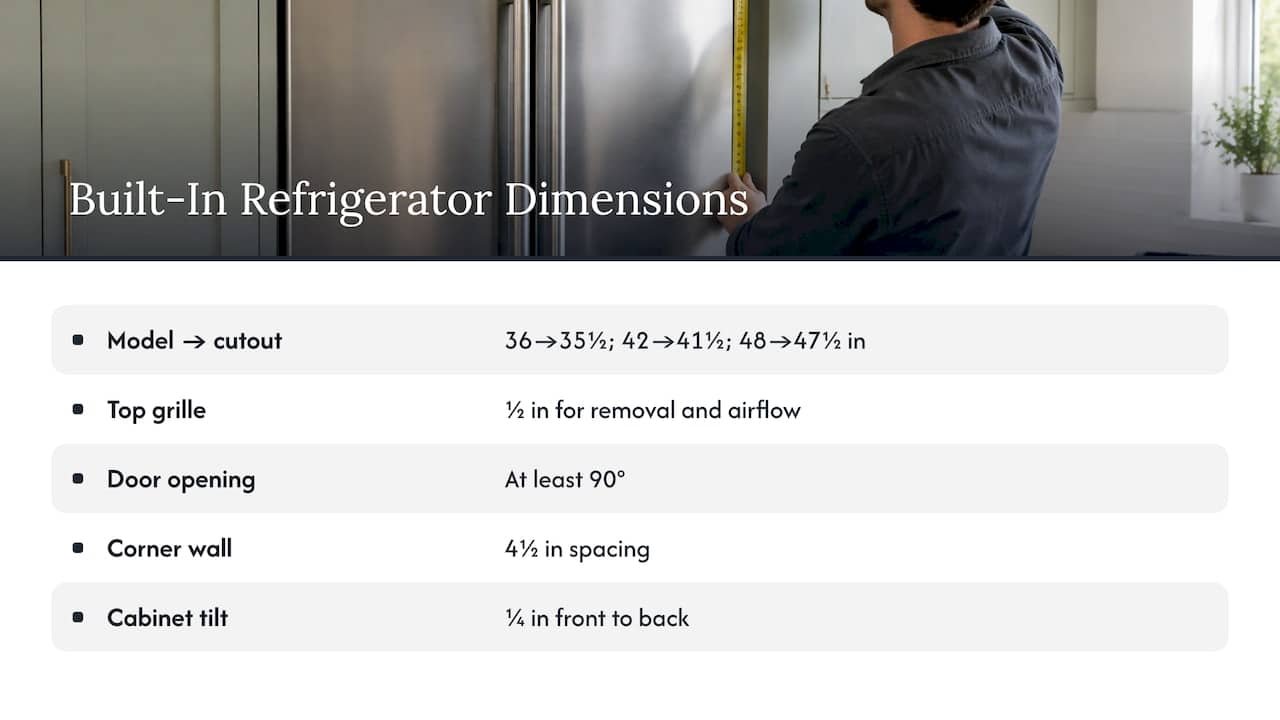
The same installation sheets are strict about the cabinet. One built-in instruction set calls for the cabinet sides to tilt 1/4 inch from front to back so the doors close and seal properly. That kind of detail is why built-in jobs are better left to an installer. We can set the unit, level it and confirm the doors seal, as part of our appliance installation services.
What happens when a refrigerator is too close
LG’s USA support page explains the risk plainly: if the surrounding space is too narrow, heat from the cooling motor at the back cannot disperse, which reduces cooling performance and can raise your electricity bill. A compressor that runs longer has more wear to absorb, so spacing is a maintenance issue as well as an installation one.
Watch for these signs after a new install or a kitchen remodel:
- The back or sides of the refrigerator feel hot to the touch.
- The compressor runs almost constantly.
- Food near the back freezes while the door shelves stay warm.
- The door does not close on its own, or the gasket does not seal because the cabinet is out of level.
A door that will not seal is a separate repair. Our fridge door repair page covers it, and if the unit is running hot we can look at the whole refrigerator through our refrigerator repair service.
How to measure before delivery
Samsung’s Will It Fit guide gives a clear method. Measure height with the flooring and hinge clearance in mind, width including any countertop overhang, and depth including molding or trim. Then compare the refrigerator’s depth or width against the narrowest opening on the delivery route. Here is a routine that puts that into practice.
- Find the model sheet. Look up the installation instructions or dimension guide for the exact model number you are buying. Write down the side, top, back and hinge-side numbers.
- Measure the opening at three heights. Walls and cabinets are rarely square. Use the smallest width you find.
- Add the clearances to the refrigerator’s width and height. A 36 inch wide refrigerator needs more than a 36 inch opening. The general sheets suggest at least 1/2 inch per side, and the model sheet may ask for more.
- Check the depth. Include the door handles. Compare against countertop edge and any trim, and keep 1 to 2 inches behind for the connections.
- Measure the delivery path. Front door, hallway, turns, stair railings, and any doorframe. The Samsung guide says the narrowest point is what counts.
- Check the swing. Mark where the door will open and confirm it clears a wall, island or dishwasher door.
A frequent question is whether a 35.75 inch refrigerator fits a 36 inch space. On paper it does, with 1/8 inch on each side, which falls inside GE’s general side minimum but below the 3/8 to 1/2 inch that several model sheets list. Whether that works depends on the sheet for that exact model. It also leaves no allowance for a wall that is out of plumb.
A note for landlords and property managers
If you manage several units, keep the model-specific dimension sheet with each appliance. A replacement refrigerator rarely has the same depth, handle projection or hinge-side clearance as the old one, and a swap that was approved on width alone is the most common reason a delivery gets turned around at the door. Record the cutout size, the hinge side and the water-line position once, and the next replacement is a quick comparison. The tenant can then be told in advance how much of the kitchen will be blocked while the work is done.
Our approach to refrigerator installation
We serve homeowners, landlords and property managers in Orange County and Los Angeles County. For a refrigerator replacement, our technicians handle the install, and we work from the manufacturer’s sheet for your model. If the refrigerator needs a water line, a leveling adjustment or a repair after it is placed, the same visit can cover it. We also install and repair across all major brands, including refrigeration, ice machines and kitchen appliances. You can start with our appliance installation services page and book online.

If the unit is already running and something is off, our appliance repair services cover refrigerators and freezers, and our appliance installation guide explains the safe-setup basics for the rest of the kitchen. If you are planning a range or dishwasher next to the refrigerator, the same clearance thinking applies: see range hood height and how to install a dishwasher.
Our perspective
Clearance problems are easy to prevent and slow to notice. A refrigerator that is a half inch too tight does not fail on delivery day. It runs warm for months, the compressor works harder, and the owner blames the appliance.
We start every refrigerator job with the model’s own installation sheet, because the numbers differ by brand and by model, and the opening, the hinge side and the water line all have to work together. Our technicians are licensed, and we aim to give upfront pricing so you know what the job involves before we begin.
Our aim is a long-term, warranty-safe installation: the right gap, a level cabinet, a door that seals and a water line that is not pinched. If you are in Orange County or Los Angeles County, that is the job we want to do for you.
MDTECH
FAQ
How much space do you need around a refrigerator?
GE’s general minimums are 1/8 to 1 inch per side, 1 inch above and 1 to 2 inches behind. Many model sheets ask for 1/2 inch at the sides and top and 1 inch at the back, and LG advises about 4 inches around its units. Use the sheet for your model number.
Can a refrigerator go right next to a wall?
Yes, if the hinge side has enough room for the door to swing. The sheets we reviewed ask for about 2 to 3 3/4 inches on that side. Samsung notes that a wall placement is not ideal for the fullest door opening.
Can a refrigerator sit next to a dishwasher or oven?
GE says it can once the side clearances are met. Whirlpool’s instructions advise against placing the unit near an oven or radiator because of the heat, so give a range or wall oven extra consideration.
What happens if my fridge is too close to the wall?
Heat from the cooling system cannot disperse, which LG says can reduce cooling performance and raise your electricity bill. Doors may also hit the wall and fail to open fully, so drawers cannot be removed.
Sources
- GE Appliances: Refrigerator Minimum Air Clearance Requirements
- Whirlpool dimension guide W10325087-D
- Whirlpool dimension guide W11105301-D
- Whirlpool: Proper Location and Environment for a Refrigerator
- Samsung Will It Fit guide, RF28R7351
- Samsung installation sheet, RS27T5201SR
- LG USA: space needed between the wall and refrigerator
- KitchenAid built-in installation instructions
- KitchenAid bottom-mount built-in dimension guide