
CSST (corrugated stainless steel tubing) and black iron pipe are both approved ways to carry natural gas or propane to your appliances, and neither is better in every house. CSST is flexible and fast to install, so it usually wins in finished walls and long, winding runs. Black iron is rigid and tough, so it usually wins in exposed, short, straight runs. The right choice depends on your layout, your local code and how the system is bonded, and a licensed technician who looks at the actual route can settle it in one visit. If you are in Orange County or Los Angeles County and adding a range, dryer, furnace or outdoor line, we can do that walk-through for you.
TL;DR
- CSST is thin, flexible stainless tubing with a yellow or black jacket. It bends around obstacles, needs far fewer fittings and goes in much faster.
- Black iron is rigid steel pipe with threaded joints. It takes impacts better and is the usual pick for exposed areas such as garages and utility rooms.
- Any gas piping system that contains CSST must be bonded to the electrical grounding system. California’s plumbing code spells out how.
- Total cost depends on the route more than the material. Fast CSST labor can offset a higher material price, and a short straight run can favor black iron.
- The two can be combined in one system, but the transition fittings and the inspection have to be right.
Table of Contents
- What each pipe actually is
- Side by side
- Installation: where CSST saves time
- Durability: where black iron earns its place
- Bonding: the one requirement you should know
- Cost: the route matters more than the material
- Which one for which job
- Mixing CSST and black iron in one system
- What to ask before you hire anyone
- Our perspective
- Get the gas line looked at by a local licensed team
- FAQ
- Sources
What each pipe actually is
Black iron pipe is rigid steel pipe, joined with threaded fittings. The installer measures each section, cuts it, threads the ends and screws everything together. That is why it feels old-school: it has been used for gas for generations, and a good job lasts.
CSST is a thin-walled, flexible stainless steel tube, usually covered by a yellow or black polyethylene jacket. It comes on a spool and is cut to length, then connected with mechanical fittings. A wall thickness comparison shows how different they are: CSST is about 0.008 inches thick against 0.12 inches for black iron, which explains both its flexibility and its need for protection.
The fuel gas code does not pick a winner. According to the American Society of Home Inspectors, the code recognizes steel pipe, copper, CSST and polyethylene (underground only), allows different materials in the same system and gives no preference to one over another. So the question is never “which is legal” but “which fits this house.”
Side by side
| Factor | CSST | Black iron pipe |
|---|---|---|
| Material | Flexible stainless steel tube, plastic jacket | Rigid steel pipe |
| Joints | Few, because it runs in long lengths | Many threaded joints |
| Installation speed | Much faster, especially in finished walls | Slower: measure, cut, thread, assemble |
| Impact resistance | Needs protection where it could be struck | High |
| Best location | Retrofits, tight or complex routes, long runs | Exposed, short, straight runs |
| Electrical bonding | Required | Part of the normal system grounding practice |
| Fittings | Manufacturer-specific | Standard threaded fittings |
Installation: where CSST saves time
The biggest practical difference is labor. Trade magazine Plumbing & Mechanical reported that 75 feet of 3/4-inch CSST weighs about eight pounds, while the same length of steel pipe weighs 85 pounds. The same article quotes an industry technical director estimating CSST goes in about two and a half times faster than rigid pipe on an average job, and notes that fewer fittings mean fewer potential leak points.

In a real home this matters most when the gas line has to reach somewhere the structure was not built for. Think of a second-story kitchen with an unfinished space below, a new outdoor kitchen on the far side of a patio, or an older Orange County or Los Angeles home where cutting open plaster is expensive. CSST can be fished through walls and ceilings with far less demolition. Rigid pipe needs straight, accessible paths, and every turn adds a fitting.
Durability: where black iron earns its place
Black iron is the tougher of the two. Its thicker wall resists nail strikes, drill bits and bumps, which is why it remains a common choice in basements, garages and utility rooms where the pipe stays visible and can be knocked.
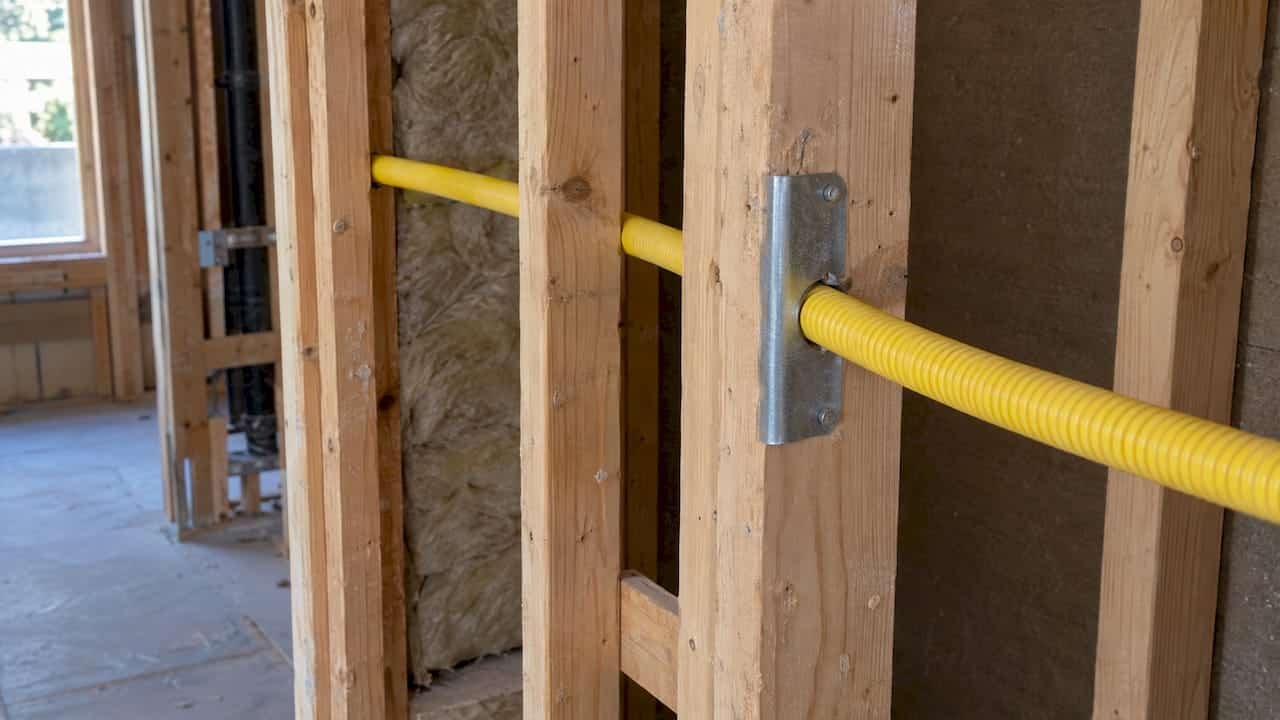
CSST has its own protection rules. Where it passes through wood framing, a steel striker plate is used so a screw or nail cannot reach the tube, and metal framing calls for a protective sleeve or grommet. In California, the striker plate must extend at least 1½ inches beyond the tubing on each side. These are routine details for an installer who works with the product, and they are the reason CSST jobs should be done by someone qualified rather than improvised.
Bonding: the one requirement you should know
The safety conversation about CSST comes down to lightning. Its thin wall can be damaged by an electrical arc from a direct or nearby strike, and a hole in a gas line is a fire risk. The fix is well established: bonding, which means connecting the gas piping to the home’s electrical grounding system so stray electrical energy has a safe path.
Under NFPA 54, the national fuel gas code, any gas piping system containing even one segment of CSST must be electrically continuous and bonded to the grounding electrode system, using a copper jumper of at least 6 AWG no longer than 75 feet. California’s current rules are consistent. The 2025 California Plumbing Code took effect on January 1, 2026, and requires the bond where the gas service enters the building, attached to a metallic pipe or fitting rather than to the corrugated tubing itself.
A few points for homeowners:
- Bonding is done once and then forgotten, but it has to be done correctly. The jumper should be visible and secure at the point of entry.
- Newer CSST comes with a black, electrically conductive jacket. The American Society of Home Inspectors explains that the traditional yellow jacket protects against weather and chemicals, while the black jacket also helps protect against arcing. Bonding is still part of the installation.
- If your home has older yellow CSST and you do not know whether it was bonded, a licensed technician can check it during a gas line inspection.
If you smell gas at any time, leave the house, do not use switches or phones inside, and call your gas utility or 911 from outside. Do not wait for a repair appointment.
Cost: the route matters more than the material
Per foot, CSST material generally costs more than black iron. But black iron takes more hours, so on a retrofit through finished walls the totals can land close together, and on a short, straight run in a garage black iron can come out ahead. The honest answer is that layout, number of turns, wall access, the number of appliances and permit requirements move the price more than the pipe type does.
Two mistakes to avoid when you compare quotes:
- Comparing a per-foot price for one material with a lump sum for another. Ask for the full scope: pipe, fittings, bonding, shutoff valves, pressure test, permit and patching.
- Assuming the cheapest material means the cheapest job. A route that needs fifteen threaded joints and two walls opened up is not cheap just because the pipe is.
For local numbers and what a permit adds, see our guides to gas line installation costs and Los Angeles gas line costs, permits and timeline. Our pricing approach is upfront, so you know the scope before work starts.
Which one for which job
Adding a range, cooktop or dryer in a finished kitchen or laundry room
The line usually has to travel through walls, a floor or an attic. CSST is typically the practical choice because it avoids opening large sections of wall. Expect a striker plate wherever it crosses framing and a bonding check at the service entry.
Moving a water heater or furnace gas connection in a garage or utility room
These runs are often short, straight and exposed. Black iron fits well here, since it resists accidental impact from storage, vehicles and tools.
Outdoor kitchen, BBQ line or fire pit
The pipe type depends on the route. Underground sections follow separate rules, and the code limits polyethylene pipe to underground use. A technician will look at distance, burial and the appliance load before choosing.
Converting an appliance between propane and natural gas
A conversion changes the appliance, not just the pipe, but the supply line and pressure also have to suit the new fuel. If you are making a switch, read our overview of gas appliance conversion in California and have the line checked at the same visit.
Rental properties
Landlords and property managers often have mixed piping from different decades. Documenting what is in the building, whether it is bonded and where the shutoffs are makes later repairs faster.
Mixing CSST and black iron in one system
A hybrid system is common: black iron from the meter or main run, then CSST branches into walls to reach appliances. The code allows combining materials, so this is a legitimate design. What matters is the transition.
- Use the approved fittings for the connection point. CSST terminates with a manufacturer fitting that threads onto the black iron.
- Keep to one brand for the tubing and its fittings. According to a technical services director quoted in Plumbing & Mechanical, each manufacturer’s tubing and fittings are designed and tested together, and the standard does not test interoperability between brands. The City of Morton, Illinois, also notes that CSST fittings are manufacturer-specific, so parts from one brand cannot be used to repair or extend another. Future repairs and additions should use the same system.
- Protect the tubing where it crosses framing, as described above.
- Bond the whole system at the service entry.
- Pressure test before anything is concealed. A common test is at least 10 psi for at least 15 minutes with no pressure drop, according to a summary of California requirements. Your local building department’s inspection is part of the job, and it protects you when you sell the home.
This is why a casual tie-in is risky. The pieces look simple, but the brand match, bonding and test are what make the connection safe.
What to ask before you hire anyone
- Is the technician licensed, and will they pull a permit where your city requires one?
- Which material do they propose for each section, and why?
- Will the CSST be bonded, and where will the jumper be?
- How will the tubing be protected where it passes through framing?
- Will the quote include pressure testing, shutoff valves and wall repair?
- Who handles the inspection, and when?
The answers should be specific to your house. If a quote names a pipe type without having seen the route, it is a guess.
Our perspective
Homeowners often come to us with the question framed as CSST against black iron, as if one has to lose. In our work the better question is where each one belongs in your house. A flexible line reaching a kitchen island through a finished wall is a different job from a rigid line serving a furnace in the garage.
Our licensed technicians look at the route first, then the appliance load, the shutoff locations, the bonding and what your city will inspect. We explain the plan in plain terms and give you upfront pricing before the work begins, so you can compare scope, not just a number.
Gas work is also tied to everything the gas feeds. Because we repair and install gas appliances, handle LP to natural gas conversions and offer plumbing and HVAC service, one visit can cover the line, the appliance connection and the ventilation. For emergencies, our team states 24/7 availability.
MDTECH
Get the gas line looked at by a local licensed team
If you are adding an appliance, relocating a connection or wondering whether your existing CSST was bonded, we serve homeowners, landlords and property managers across Orange County and Los Angeles County. Our gas appliance repairs and appliance installation services cover the appliance end of the line, and you can book a visit through our website.
For the bigger safety picture, our guide to gas safety at home covers shutoffs, leak signs and routine checks, and our article on seismic gas shutoff valves is worth reading in earthquake country.
FAQ
Is CSST or black iron better for a residential gas line?
Neither wins everywhere. CSST suits finished walls, long runs and many turns because it installs quickly with few joints. Black iron suits short, exposed runs where impact resistance matters. The fuel gas code gives no preference to either material.
Is CSST safe?
CSST is a code-approved material when it is installed by a qualified installer and bonded to the home’s grounding electrode system. The bonding addresses the lightning arcing risk. If you are unsure whether older CSST in your home was bonded, a licensed technician can inspect it.
Can you connect CSST to an existing black iron line?
Yes, the code allows different materials in one system. Use the manufacturer’s approved transition fittings, keep the tubing and fittings from the same brand, protect the CSST through framing, bond the system and have the job tested and inspected.
Is CSST cheaper than black iron?
The material usually costs more, but installation takes much less time, so total costs can be close. The route, number of appliances, wall access and permit requirements affect the final price more than the pipe type. Ask for a written scope that includes bonding, testing and repairs.
Sources
- Customer Piping Information, Village of Morton, Illinois (2017)
- Inspecting Homes with CSST Gas Piping, American Society of Home Inspectors (2020)
- Keep Your CSST Fittings Straight, Plumbing & Mechanical (2014)
- CSST vs Black Iron Gas Pipe Compared (2026)
- Flexible Gas Line Code in California: CSST Requirements
- National Fuel Gas Code (NFPA 54): Scope and Application