
A typical gas line installation runs $500 to $750 for a standard appliance hookup, with most complete jobs landing between $120 and $2,000. If you’re running new service from the street to your house, plan for $2,000 to $10,000 or more, since that involves trenching, permits, and utility coordination that a simple indoor extension doesn’t.
Installed pricing usually breaks down to $15 to $50 per linear foot, depending on routing complexity, and appliance hookups follow their own pattern. A gas stove connection typically costs $500 to $1,200, while a whole-house furnace tie-in runs higher because of pipe sizing requirements.
The fastest way to move from “ballpark” to “actual number” is simple: measure your run length from the meter or existing line to the appliance, then get written bids from at least two licensed plumbers or gas fitters. Everything else in this guide helps you evaluate what’s inside those bids.
- National average for a standard hookup is usually a few hundred dollars.
- Typical full-project range: $120–$2,000
- New service from the street: $2,000–$10,000+
- Per-foot installed cost: $15–$50
Quick fact: Many homeowners are surprised that per-foot installed pricing can range as low as $15 for a simple indoor run but climb past $50 once trenching or wall concealment enters the picture.
Key Takeaways
Accurate gas line budgeting depends on knowing your exact run length, appliance BTU demand, and whether your project requires trenching or new utility service.
| Point | Details |
|---|---|
| Know your baseline | Standard hookups average $500–$750; new service from the street runs $2,000–$10,000+. |
| Per-foot pricing varies widely | Simple indoor runs cost $15–$25/ft, while trenched or wall-concealed routes reach $35–$50+/ft. |
| High-BTU appliances change the scope | Pool heaters, generators, and tankless water heaters can require meter or pipe upsizing. |
| Permits and testing aren’t optional | Budget $50–$300 for permits and $75–$150 for pressure testing on every job. |
| Choose a licensed, tested installation | MDTech Services provides licensed technicians who pressure-test and code-check every gas line job in Orange County and Los Angeles County. |
Table of Contents
- Gas Line Installation Cost Breakdown: Materials, Labor, and Permits
- How Much It Costs to Connect Common Household Appliances
- What Site Conditions Push Your Quote Higher or Lower
- Why DIY Gas Line Work Isn’t Worth the Risk
- How to Get an Accurate Gas Line Installation Estimate
- Real Budget Examples for Common Gas Line Projects
- Why Homeowners Trust MDTech Services for Gas Line Work
- What the Cost Numbers Don’t Tell You
- Get a Gas Line Estimate Built Around Your Actual Appliances
- Sources
Gas Line Installation Cost Breakdown: Materials, Labor, and Permits
A contractor’s quote is really four separate costs stacked together: materials, labor, permits, and testing. Understanding each one lets you spot an inflated bid before you sign it.
Per-foot pricing tiers. Simple indoor runs, the kind that connect an existing line to a nearby appliance, typically cost $15 to $25 per foot installed. Once you’re dealing with underground trenching or routing gas pipe behind finished walls, that number jumps to $35 to $50 or more per foot. One cost-modeling tool pegs the national baseline closer to $70 per linear foot for mixed indoor and outdoor projects, which shows how much routing conditions swing the final number.
Materials by pipe type. The pipe material you choose affects both material cost and labor time:
- CSST (corrugated stainless steel tubing): Flexible and faster to install around obstacles, which can lower labor hours even though the material itself costs more per foot.
- Black iron: The traditional standard for gas lines, durable but labor-intensive to thread and fit, especially around corners.
- HDPE (high-density polyethylene): Common for underground runs from the meter or street, valued for corrosion resistance.
- Copper: Less common for gas today but still used in specific regional codes and older retrofit situations.
Flexible tubing like CSST reduces the number of joints and fittings a technician needs on a job, which can shave real time off labor. That said, CSST often requires bonding to code, and skipping that step is one of the more expensive mistakes to fix after the fact.
Labor rates. Plumbers and gas fitters bill anywhere from $45 to $200 per hour depending on your region and the technician’s experience level. Simple hookups might need just one technician for two to four hours. Complex runs involving trenching or meter relocation often require a two-person crew across a full day or more, and labor becomes the dominant line item once a job stretches past a single afternoon.
Permits and testing. Most municipalities require a permit for gas line work, and fees typically run $50 to $300, with complex jobs sometimes landing higher depending on local code review requirements. Pressure testing, which confirms the line holds pressure without leaking before it’s approved, usually adds another $75 to $150. Skipping this step isn’t an option: inspectors require documented pressure tests before signing off on new gas work, and for good reason.
Pro Tip: Ask your contractor to itemize the permit fee and pressure test separately from labor. Some bids bundle these together, which makes it hard to tell if you’re being charged fairly for either one.
How Much It Costs to Connect Common Household Appliances
Your total cost depends heavily on which appliance you’re hooking up, since BTU demand and typical installation distance vary a lot from one device to the next.
- Gas stove or range: $500–$1,200, assuming a nearby existing line and straightforward kitchen access.
- Gas dryer: $150–$500, typically one of the cheaper hookups since dryers sit close to existing utility connections.
- Water heater (standard tank): $300–$800, though tankless units often cost more because they demand higher BTU input.
- Furnace: $350–$1,000, with cost climbing based on distance from the main gas line and furnace BTU rating.
- Fireplace (gas insert or line extension): $200–$800, depending on whether the line runs through finished walls or an accessible basement.
- Outdoor grill: $400–$1,500, largely driven by trenching distance and any concrete or patio restoration required.
- Pool heater: $500–$2,000, since pool heaters are high-BTU appliances that sometimes require larger supply pipe.
- Whole-house generator: $600–$2,500, again tied to BTU load and how far the generator sits from the meter.
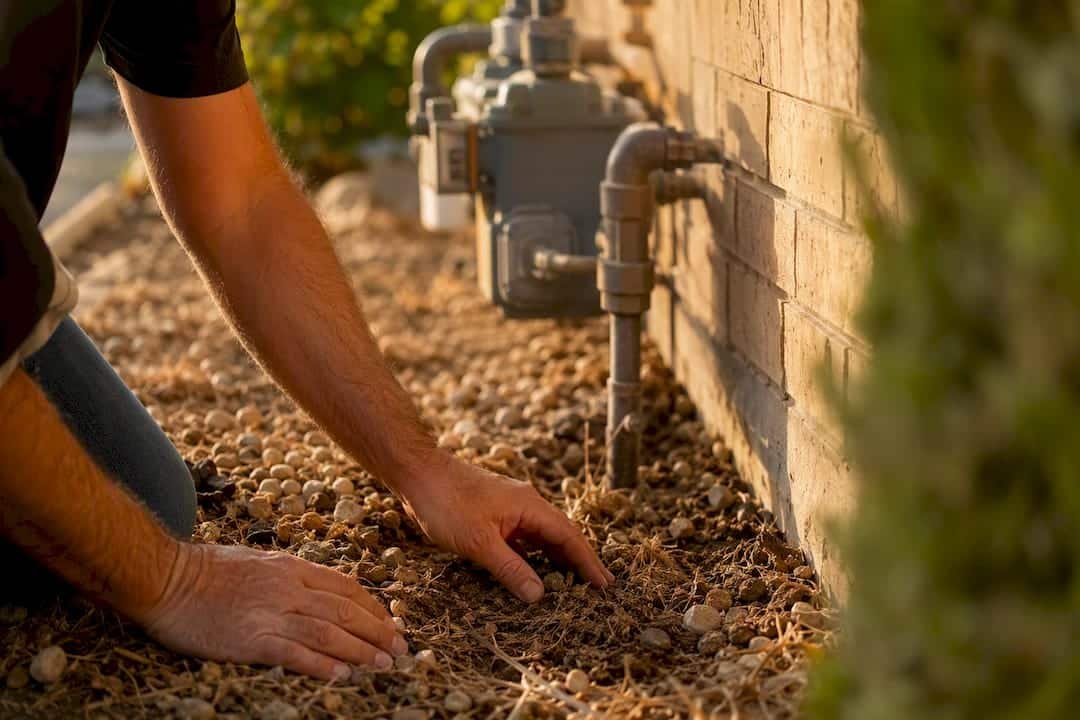
High-BTU appliances change the math beyond just their own hookup cost. Tankless water heaters, pool heaters, and standby generators draw enough gas volume that they can force upsized piping or even a meter and regulator upgrade elsewhere in the system. If you’re adding one of these appliances to a home with an older or undersized meter, budget for that possibility upfront rather than discovering it mid-project.
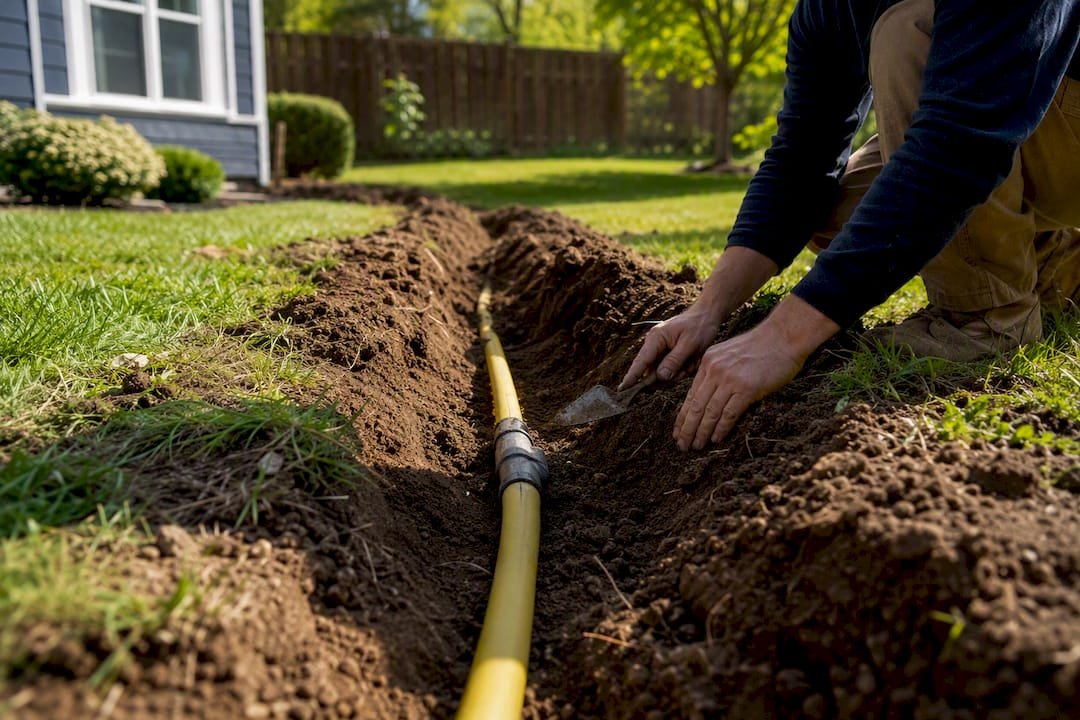
Outdoor installations carry their own cost layer. Trenching below the frost line, patching a driveway or patio slab, and restoring landscaping after the trench closes can add several hundred dollars beyond the pipe and labor themselves.
Pro Tip: If you’re adding a pool heater or generator, ask your contractor to confirm your current meter’s capacity before finalizing a quote. An undersized meter turns a straightforward hookup into a bigger utility-coordination project.
What Site Conditions Push Your Quote Higher or Lower
The single biggest cost swing in any gas line project comes from how the pipe physically gets from point A to point B. Two homes needing the same 50 foot run can see wildly different bids based on what’s in the way.
- Trenching versus horizontal directional drilling (HDD). Standard trenching digs an open channel, which is cheaper per foot but tears up landscaping along the entire route. HDD bores underground without an open trench, protecting your yard but typically running higher per foot due to specialized equipment. For runs crossing driveways, mature landscaping, or hardscaping, HDD often pays for itself in restoration savings.
- Finished-wall routing. Running gas pipe behind drywall or through finished basement ceilings means cutting access points and patching afterward. This can add real cost to what looks like a simple indoor job on paper.
- Meter relocation. If your project requires moving the gas meter, expect added utility-company coordination, since many utilities require their own crew or approval for meter work, which extends both cost and timeline.
- Landscape and hardscape repair. Concrete, pavers, and mature landscaping in the pipe’s path all carry restoration costs that some initial bids leave out entirely.
- Code-driven add-ons. Sediment traps at appliance drops and CSST bonding requirements are code mandates, not upsells, but they sometimes appear as late additions if a contractor’s initial walkthrough missed them.
The gap between a trenched route and an HDD route, or between an open run and a finished-wall run, is exactly why extending an existing line typically costs $350 to $2,000 while a brand-new service from the street runs $2,000 to $10,000 or more. New service almost always means trenching under a yard or driveway, plus direct coordination with your gas utility for the tap-in itself.
Why DIY Gas Line Work Isn’t Worth the Risk
Gas line installation is one of the few home projects where doing it yourself isn’t just risky, it’s usually illegal without the right license. Most jurisdictions require a licensed plumber or gas fitter to pull a permit and perform pressurized gas work, and inspectors won’t sign off on unpermitted work even if it looks fine.
The most common DIY and unlicensed-contractor mistakes that fail inspection include:
- Missing sediment traps at appliance drops, which are required to catch debris before it reaches the appliance’s burner assembly.
- Incorrect pipe sizing for the BTU load, which can starve an appliance of gas or create pressure problems elsewhere in the system.
- Improper CSST bonding, a code requirement in many areas that protects against electrical arcing if the line is struck by lightning.
If you ever suspect a gas leak, treat it as an emergency. Leave the house immediately, don’t flip light switches or create any spark, and if you can safely reach the shutoff valve at the meter on your way out, turn it off. Call your utility’s gas emergency line and a licensed contractor from a safe location, never from inside the house.
Where you can genuinely help is in preparation: clear access to your meter and crawlspace or attic, write down the BTU ratings for every appliance you want connected, and photograph the areas a contractor will need to route through. This speeds up estimates and keeps your gas safety at home checklist current for future reference.
Pro Tip: Keep a written list of every gas appliance’s BTU rating in a kitchen drawer or phone note. It saves real time when you’re gathering quotes from multiple contractors.
How to Get an Accurate Gas Line Installation Estimate
Comparing bids only works if every contractor is quoting the same scope. Vague requests invite vague, incomparable numbers.
- Define the exact scope. Specify total run length, indoor versus outdoor routing, every appliance being connected, and whether shutoff valves and sediment traps are included at each drop.
- Ask about materials and bonding. Confirm what pipe type they plan to use and whether CSST bonding is included in the quoted price or billed separately.
- Confirm permit handling. A reputable contractor pulls the permit themselves and includes that cost in the bid rather than leaving it to you.
- Ask about testing and warranty. Every job should include a pressure or leak test before final inspection, and most licensed contractors back their work with a labor warranty of one to two years.
- Request an itemized breakdown. Materials, labor, permits, excavation, and restoration should appear as separate lines, not one lump sum.
Watch for a few warning signs as you compare bids:
- A quote significantly lower than every other bid you’ve received, often a sign of unlicensed work or missing scope items.
- No mention of permits or inspection scheduling.
- Reluctance to provide license and insurance information when asked directly.
Reasonable timelines run from a single day for a simple appliance hookup to one to two weeks for new service installation, factoring in permit approval and utility scheduling. Weather delays and utility coordination are common contingencies, so build a little schedule flexibility into your expectations rather than assuming the first quoted date is fixed.
Real Budget Examples for Common Gas Line Projects
Seeing how the numbers add up for a specific scenario often clarifies a budget faster than ranges alone.
- Short indoor run (connecting a new stove, 10 feet from existing line): Pipe and fittings around $150, labor at two hours and $90/hour comes to $180, permit and inspection around $75. Total: roughly $400–$500.
- Outdoor grill with trenching (25 foot trench across a patio): Trenching and restoration around $600, pipe and fittings $200, labor $400, permit and pressure test $150. Total: roughly $1,200–$1,400.
- New service from the street (60 foot underground run plus meter tap-in): This jumps to the $2,000–$10,000+ range because it involves utility coordination, deeper trenching to meet code depth, and often a new meter set. Excavation alone can account for a third of the total.
- Whole-house retrofit (multiple appliances, mixed indoor and outdoor routing): Budget $2,500–$5,000 or more, and add a 10 to 15 percent contingency for unexpected obstacles like buried utilities or older wall framing that complicates routing.
Why Homeowners Trust MDTech Services for Gas Line Work
MDTech Services brings licensed technicians and hands-on experience with LP-to-natural-gas conversions to every gas line job across Orange County and Los Angeles County.
- Licensed, background-checked technicians handle every installation
- Every job includes pressure testing and code compliance verification
- CSST bonding checked and completed where required by local code
- Online booking makes scheduling an estimate straightforward
What the Cost Numbers Don’t Tell You
Most gas line pricing guides treat this like a pure math problem: measure the feet, multiply by a rate, add labor. That approach misses the variable that actually determines whether your project stays on budget, which is appliance BTU planning done before the quote instead of after the pipe is in the wall.
The conventional advice tells homeowners to shop for the lowest per-foot rate. That’s backwards. A contractor quoting a low per-foot price who hasn’t asked about your pool heater’s BTU rating or your generator’s startup load is setting you up for a change order once they discover your meter can’t handle the demand. The technicians who ask about appliance specs before quoting are the ones who protect you from that surprise.
If there’s one thing worth prioritizing first, it’s this: document every appliance’s BTU rating before you call anyone for a quote. That single step turns a generic per-foot estimate into an accurate, appliance-specific number, and it’s the difference between a quote you can trust and one that grows once work begins.
— MDTECH
Get a Gas Line Estimate Built Around Your Actual Appliances
Most online calculators can give you a per-foot number, but they can’t tell you whether your meter handles a pool heater’s BTU load or whether your walls need finished-wall routing. Mdtechservices closes that gap by sending licensed technicians who assess your specific appliances, routing, and meter capacity before quoting a price, not after work has started.

That matters most for homeowners adding high-demand appliances like tankless water heaters, generators, or pool heaters, where an inaccurate initial assessment turns into a costly mid-project change order. Mdtechservices technicians handle the full appliance installation process alongside gas line work, including LP-to-natural-gas conversions, pressure testing, and code compliance checks, all documented before final sign-off.
If you’re planning a gas appliance hookup or a full LP-to-natural-gas conversion in Orange County or Los Angeles County, book an online appointment with Mdtechservices to get a written estimate based on your home’s actual layout and appliance specs.
Sources
- How Much Does Gas Line Installation Cost? (2026) — HomeGuide
- Gas Line Installation Cost Calculator (2026) — HomeCostCalc
- How Much Do Gas Line Installation or Repairs Cost? 2026 Data | Angi
- Cost to Install Gas Line — BobVila