
The best air conditioner for a coastal home is a correctly sized unit with corrosion-resistant coils and cabinet, installed and maintained by a licensed technician who knows how salt air behaves in Orange and Los Angeles County. Brand matters less than three decisions: how far you are from the water, whether the unit’s coil and cabinet are built for salt, and whether the size is calculated for your house instead of guessed. At MDTech Services, our licensed technicians handle HVAC services across both counties, and this guide gives you the selection logic we would walk through with you at your door.
TL;DR
- Salt can travel about two miles inland, so homes in Huntington Beach, Newport Beach, Seal Beach, Long Beach, Redondo Beach and Santa Monica, and many streets behind them, should treat corrosion as a selection factor.
- Look for coastal-rated construction: protected coils, coated cabinet and fan guard, sealed electrical parts and good drainage.
- Size the system with a load calculation (ACCA Manual J and Manual S), not by the size of the old unit. Oversizing leaves coastal homes cool but clammy.
- Check the warranty wording for seacoast corrosion, and register the equipment.
- Plan on regular coil rinsing and yearly inspection, and book repair early when you see corrosion signs.
Table of Contents
- Why salt air is hard on an air conditioner
- What a coastal-rated air conditioner should have
- Size it for humidity, not just heat
- Efficiency ratings and system type
- Read the warranty before you sign
- Placement and upkeep that extend the life of the unit
- A selection checklist you can use with any quote
- Where we come in
- Our perspective
- FAQ
- Sources
Why salt air is hard on an air conditioner
An outdoor condenser is a metal coil with air pulled through it all day. In a coastal neighborhood that air carries salt. Salt and moisture settle on the fins, tubing, screws and cabinet, and corrosion follows. As the coil corrodes, it transfers heat less well, so the system works longer for the same cooling. Manufacturers also note that corroded equipment dehumidifies poorly, which leaves the house feeling clammy even when the thermostat reads correctly.
How fast this happens depends on several things at once. Distance from the ocean, wind direction, relative humidity and coil temperature all play a part, and so do contaminants such as pollution, road salt and irrigation spray. That last one surprises many homeowners: a sprinkler head that wets the condenser every morning can do damage even a few miles from the beach.
In practice, the question is not simply “am I on the coast?” Ask yourself:
- Can I smell or taste the ocean on a typical afternoon?
- Does the condenser sit on a side of the house that gets onshore wind?
- Do I see white crust, pitting or flaking paint on the unit, gutters, patio furniture or grill?
- Is the unit on a rooftop or balcony, where it gets more direct exposure?
If the answer to any of these is yes, choose and maintain equipment as a coastal installation.
What a coastal-rated air conditioner should have
“Coastal” is not a single standard, but the features that matter are consistent across the better-built models. When you compare quotes, ask for these by name on the spec sheet.
| Feature | What it does for you |
|---|---|
| Corrosion-resistant coil | Protects the part that fails first. Some designs use welded aluminum coils with a zinc cladding layer and thicker tubing walls, rather than a copper tube with aluminum fins. |
| Protected joints | Heat-shrink wrap over copper-to-aluminum joints reduces the galvanic corrosion that starts where dissimilar metals meet. |
| Coated cabinet and fan guard | Sheet metal coated on both sides with baked-on powder paint slows rust on the panels people see. |
| Zinc-plated hardware | Screws and brackets are common rust points and matter at service time, when panels are removed. |
| Sealed electrical components | Keeps salt-laden moisture off the controls and wiring. |
| Good drainage | Prevents water, and the salt it carries, from sitting at the base of the unit. |
Coil design deserves the most attention. One manufacturer’s documentation explains that lanced fins, which have small cut slots, can trap contaminants and encourage corrosion, so smooth fins with an epoxy-type coating are a feature worth asking about. Read the coil page of the spec sheet and ask your technician which of these items the model you are considering actually includes.
For the basics of the part that takes the beating, our guide to what a condenser coil is and how it works explains why keeping it clean and intact matters for efficiency and lifespan.
Size it for humidity, not just heat
A coastal-grade coil on the wrong-sized unit is still the wrong system. Sizing is where most comfort problems start, and it is more important near the coast, where humid summer days put a heavy moisture load on the system alongside the heat.
An air conditioner does two jobs: it lowers temperature (sensible load) and removes moisture (latent load). Total capacity combines both, and it changes with conditions. Ratings are nominal figures at 95°F outdoors and 80°F indoors, which is not your hottest or most humid day.
Why oversizing backfires
An oversized unit cools the air quickly, satisfies the thermostat, and shuts off before it has pulled much moisture out. It then starts again a few minutes later. Federal building-science guidance warns that oversized systems short-cycle before removing moisture, which causes high-humidity problems. The same guidance ties selection to ACCA Manual J (the load calculation) and Manual S (equipment selection), with the manufacturer’s rated capacity at design conditions between 95% and 115% of the calculated load, or the next nominal half-ton size.
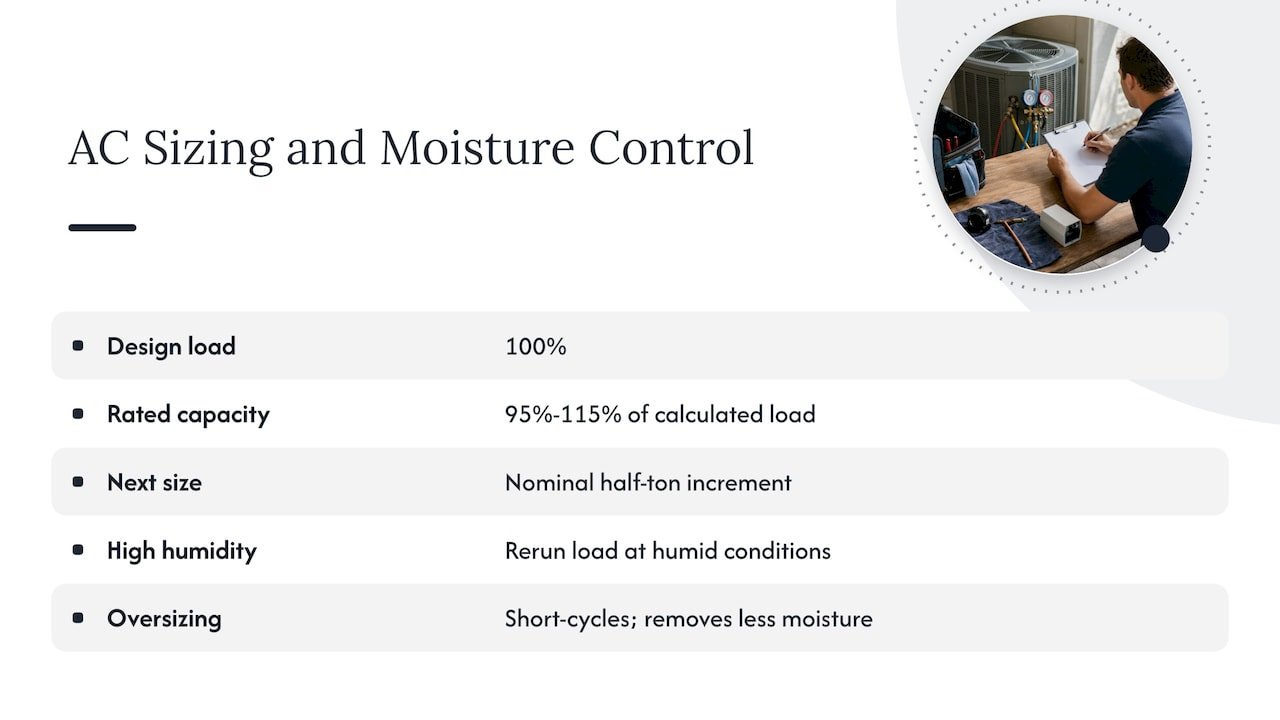
An industry paper on humidity control goes further for warm, humid climates: keep equipment within 15% of the calculated loads, and when moisture control matters, being 10% undersized is better than being 10% oversized. It also recommends rerunning the load calculation at a high-humidity condition to confirm the unit can handle peak latent load.
ACCA describes Manual S as the method that uses heating and cooling loads, manufacturer performance data and regional design conditions to select equipment and prevent short cycling. That is the process to expect from a contractor, and it is a different thing from matching the tonnage on the old nameplate.
A worked example
Say your 1,600 square foot Seal Beach home has a 3-ton unit that was installed when the house had older single-pane windows. You have since replaced the windows and added attic insulation. The old 3 tons may now be more than the house needs. If a recalculated load comes out near 2.5 tons, the right target is a nominal 2.5-ton unit, which falls inside the 95% to 115% window. A 3.5-ton replacement would cool fast, cycle often and leave the rooms damp.
If your system already runs in short bursts, see our guide to AC short cycling causes before deciding whether the issue is size, a failing part or a dirty coil.
Efficiency ratings and system type
Once size and construction are settled, compare efficiency. SEER2 measures seasonal cooling efficiency under the current federal test procedure, and our explainer on the SEER2 rating shows how to read it. A higher number lowers your cooling bill, but it should be the last tiebreaker, after correct sizing and corrosion protection.
Other choices worth discussing:
- Variable-speed or inverter operation. These units run longer at lower output, which helps with moisture removal and comfort. Our article on inverter vs. non-inverter AC explains why sizing decides the savings.
- Heat pump or AC plus furnace. Many Southern California homes now choose a heat pump because it cools and heats from one outdoor unit. See how a heat pump works in SoCal homes, and for a general side-by-side of the two approaches, this heat pump vs AC comparison lays out the trade-offs.
- Refrigerant. Newer systems use newer refrigerants, which affects service and parts. We cover this in the role of refrigerants in home cooling systems.
- Sound rating. If the condenser sits near a bedroom or a neighbor’s fence, compare decibel ratings.
For a wider overview, see types of air conditioning systems for energy-efficient homes and best HVAC system types for home comfort.
Read the warranty before you sign
Coastal-rated equipment typically comes with warranty terms written around corrosion. One manufacturer’s coastal documentation states a five-year parts limited warranty in residential use when the failure mechanism is seacoast corrosion, and notes that cosmetic corrosion does not count as part failure. A spec sheet for one coastal heat pump lists a 10-year parts limited warranty with timely registration within 90 days.
Three practical points follow:
- Confirm which parts are covered and for how long, and whether labor is included. Parts warranties usually do not cover labor.
- Register the equipment inside the registration window.
- Keep installation and maintenance records. Warranty-safe installation and documented upkeep are what keep that coverage usable years later.
Placement and upkeep that extend the life of the unit
The same unit lasts longer in a good location with regular care. A few habits make a real difference:
- Keep sprinklers off the condenser. Redirect spray heads so they do not wet the unit.
- Keep clearance. Leave space around the unit for airflow, and trim plants back so leaves and moisture do not collect on the coil.
- Shade and shelter. Place the condenser, where practical, on the side of the house less exposed to onshore wind, without blocking airflow.
- Rinse gently. A light rinse from a garden hose across the outside of the coil can wash off surface salt. Switch the power off first and never use a pressure washer, which bends fins.
- Schedule a yearly tune-up. A technician can clean the coil properly, inspect the cabinet, check drainage and tighten electrical connections.
Watch for warning signs: white or green crust on the coil, flaking paint, rust at the base, refrigerant oil stains on tubing, rising electric bills, weak airflow, warm air, or a damp feeling indoors. Small refrigerant leaks from pinhole corrosion get worse over time, so early attention costs less than a failed compressor. If you notice any of these, our HVAC troubleshooting guide for homeowners helps you describe the symptoms, and air conditioning repair gets a technician to the unit.
If you are weighing repair against replacement, why timely HVAC repair matters explains how delay raises the cost.
A selection checklist you can use with any quote
Before you approve an installation, make sure the proposal answers these:
- Was a Manual J load calculation performed for this house, and what capacity does it call for?
- Does the selected model’s capacity at design conditions fall within the acceptable range of that load?
- Which corrosion protections does the model have: coil type, joint protection, coated cabinet, fan guard, hardware?
- What do the warranty terms say about seacoast corrosion, and how do I register?
- Where will the condenser sit, and how will water, sprinklers and drainage be handled?
- What is the maintenance plan for the first year?
If a quote only names a tonnage and a brand, you are missing the information that decides how the unit performs near the coast.
Where we come in
MDTech Services provides HVAC repair, heating and cooling, and appliance installation for homeowners, property managers and landlords across Orange County and Los Angeles County. Our technicians are licensed, we give upfront pricing, and we offer 24/7 emergency availability. Whether you need a corroded coil inspected, a failing unit repaired, or help comparing equipment for a replacement, start with our heating and cooling page or book through mdtechservices.com.

Landlords and property managers with several coastal units can use the same checklist across properties, so every building gets consistent sizing, protection and upkeep.
Our perspective
We work on local homes, so we see the pattern coastal owners care about: the unit is rarely the only problem. Choosing the right equipment starts with the house, its load, its location and its exposure to salt, and then moves to the model.
Our approach is to treat selection, installation and maintenance as one job. Correct sizing keeps humidity under control. Corrosion-resistant construction protects the coil, and a warranty-safe installation keeps your coverage intact. Regular service finds small corrosion before it becomes a compressor replacement.
Because we are local to Orange County and Los Angeles County, we respond quickly when a system fails in a heat wave, and our licensed technicians offer long-term solutions rather than quick patches. If you are choosing a new unit, repairing an existing one or comparing quotes, we are glad to talk it through.
MDTECH
FAQ
How far from the ocean do I need a coastal AC unit?
Salt can be carried as far as two miles inland, and wind, humidity and sprinkler spray change how severe it is. If you are within a couple of miles of the water, or see salt crust on outdoor metal, choose coastal-rated equipment. Our technicians can assess your exact address.
Does a coastal AC cost more than a standard unit?
Coastal-rated models generally cost more because of coated components and protected coils. We give upfront pricing for the specific system and installation, so you can compare the full cost against the protection you get.
Is a bigger AC better in a humid coastal home?
No. A unit larger than the calculated load cools quickly, shuts off early and removes less moisture, so rooms feel cool but damp. Correct sizing by load calculation gives better comfort and fewer starts and stops.
How often should a coastal AC be serviced?
Have it inspected and cleaned at least once a year, and rinse surface salt from the coil gently with the power off between visits. Book sooner if you see corrosion, weak cooling or short cycling.
Sources
- Carrier coastal heating and air: corrosion-resistant HVAC systems
- Bryant coastal HVAC units
- Carrier WeatherShield documentation
- Carrier coastal air conditioners and heat pumps warranty document
- Coastal heat pump specification sheet
- Air Conditioning, Building America Solution Center (PNNL)
- Manual S Residential Equipment Selection, ACCA
- Sizing Air Conditioners Properly, Proctor Engineering
- Proper Humidity Control, Hourahan
- Heat Pump vs AC comparison