
A power surge can damage appliances instantly or wear them down over months, and the damage is often invisible until a refrigerator warms up, a control board stops responding or an air conditioner fails to start. If you suspect a surge hit your home in Orange County or Los Angeles County, unplug the affected appliances, document what you see, and have a technician check them before you run them again. We repair household appliances and HVAC systems across both counties, and the sections below cover what a surge does, what to check, how to file a claim and how to protect what you own.
TL;DR
- A surge is a brief spike above the normal voltage of your outlets. It can burn out circuit boards at once, or slowly erode components when small surges repeat.
- Warning signs include tripped breakers, flickering lights, blinking clocks, a burning smell, scorch marks or humming at outlets, and appliances that behave differently than before.
- After a surge, unplug affected items, photograph the damage, keep receipts and contact your insurer and, if the cause was the grid, your utility.
- Layered protection works best: a whole-house device installed by a licensed electrician, plus plug-in protectors for electronics. Refrigerators are the exception to plug-in protectors.
- Have a repair technician inspect any appliance that was running during a surge before you rely on it again.
Table of Contents
- What a power surge does inside an appliance
- Signs your home had a surge
- Which appliances are most at risk
- What to do right after a surge
- Who pays: insurance and the utility
- Protecting appliances from the next surge
- Why a repair technician belongs in your plan
- Get your appliances checked in Orange County and Los Angeles County
- FAQ
- Sources
What a power surge does inside an appliance
Standard household power in the US is 120-volt AC. That number is an average. The voltage actually rises and falls in a wave, and State Farm explains that its peak is about 169 volts. A surge is any moment when the voltage goes above that peak. The extra energy can create an electrical arc, and the heat of that arc can damage circuit boards and other components.
Surges are very short. The National Institute of Standards and Technology (NIST), the federal measurement agency, describes a surge as a voltage spike lasting only a few millionths of a second. Even so, appliances built for the normal 120-volt supply can be damaged or have their controls upset. NIST says the results range from repair bills to, in rare cases, a fire.
Modern appliances are more exposed than older ones because they run on electronics. A washer with a digital control panel, a refrigerator with an electronic board, a microwave or a smart thermostat all rely on small components that tolerate very little excess voltage.
Two kinds of damage
Immediate failure. One large surge shorts out a board or a motor. The appliance is dead, or it powers on and shows error codes.
Gradual wear. State Farm notes that smaller, repeated surges can slowly erode component integrity and shorten an appliance’s lifespan. This is why a dishwasher or dryer can fail months after a storm with no obvious cause.
Where surges come from
Most people think of lightning, and State Farm calls it the most powerful cause. Surges also come from utility grid switching, and from inside your own home: motors in air conditioners and refrigerators create small surges every time they turn on and off. Repeated switching is one reason an older home with a heavily loaded circuit can wear out electronics faster than expected.
Surges are also common when power returns after an outage. AAA Club Alliance advises unplugging items during an outage for that reason.
Signs your home had a surge
Some signs are in the house itself rather than in a single appliance. AAA lists these as common indicators:
- Tripped circuit breakers
- Lights that flicker or look dimmer than normal
- Electric clocks that blink or show the wrong time
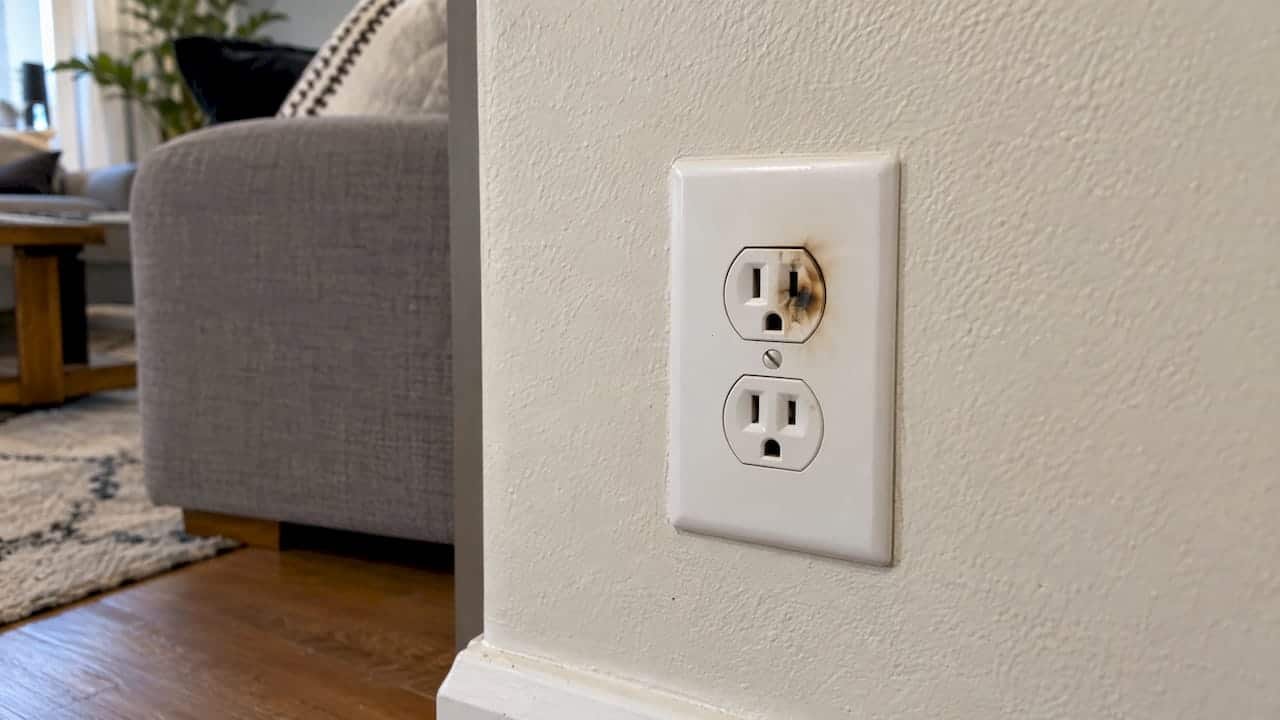
- A burning smell or scorch marks around an outlet
- Humming from an outlet
- Outlets with reset buttons that have moved to the reset position
If you see scorching, smell burning or hear humming, stop using that outlet and call a licensed electrician. That is a wiring safety issue, not an appliance repair.
A surge can also damage appliances without any breaker tripping. One electrician’s guide explains why: breakers respond to sustained overcurrent, not to a spike that lasts a fraction of a second. A quiet panel does not mean your appliances are fine.
Signs on the appliance
After a surge, look for:
- A control panel that is blank, dim or showing error codes
- Buttons or touchscreens that no longer respond
- A refrigerator or freezer that is warmer than normal
- An air conditioner that does not start, or trips repeatedly
- A dryer or oven that does not heat the way it did before
- A new smell of burning plastic
If one of those matches, our guides on signs of appliance failure and when you need appliance repair can help you judge how serious it is.
An appliance that was switched off is not necessarily safe. A Birmingham electrician’s guidance points out that control boards can stay powered in standby, so a unit that looked off during the surge can still be damaged.
Which appliances are most at risk
The more electronics an appliance contains, the more vulnerable it is. The Chicago electrician’s guide mentioned above ranks smart TVs, computers and smart thermostats as very high vulnerability. It puts refrigerators with electronics, microwaves and digital washers and dryers in the high category.
For most homeowners, the practical list looks like this:
| Appliance | Why it is exposed | What you may notice |
|---|---|---|
| Refrigerator or freezer | Electronic control board and compressor | Warm interior, clicking, no restart |
| Washer and dryer | Digital controls, motors | Dead display, cycles that will not start |
| Oven, range, cooktop | Electronic ignition and clock boards | No ignition, wrong time, error codes |
| Dishwasher | Control board | Does not respond or will not drain |
| Air conditioner and furnace | Compressors, control boards, thermostats | Fails to start, trips the breaker |
| Microwave | Control board | Display blank, no heating |
Can a surge break a fridge?
Yes. GE Appliances’ support documentation says the compressor is sensitive to temperature and current overloads and shuts itself down during a surge as protection. If the refrigerator does not restart, food can spoil quickly. If yours is warm after a surge or outage, we cover the next steps in our guide to a GE refrigerator not cooling after a power outage.
Can a surge damage an outlet?
Yes. Mister Sparky states that electrical arcs from a surge generate heat that can damage outlets and can fry circuit breakers. That is why scorch marks or a hot outlet should be treated as urgent. Our overview of GFCI outlets explains the reset buttons on kitchen, bathroom and garage outlets, which is the first thing to check after a surge.
What to do right after a surge
Work through these steps in order. They combine guidance from AAA Club Alliance and American Family Insurance, summarized in plain terms.
- Stay safe first. If you smell burning or see smoke or scorch marks, leave the area and call 911 if there is a fire risk. Do not touch a hot or scorched outlet.
- Unplug. If the power went out after the surge, AAA advises resetting, unplugging and repowering electronics before you reset breakers. Unplug appliances and electronics so a second surge when power returns cannot hit them.
- Inspect one item at a time. Check appliances, electronics and outlets individually, and check your HVAC system as well. A lamp or phone charger plugged into an outlet is a simple way to see whether the outlet still has power.
- Check breakers and GFCIs. Reset any tripped breakers and GFCI outlets only after unplugging sensitive devices.
- Document everything. American Family Insurance advises making a list of damaged items, taking photos and keeping receipts as soon as it is safe. Note the date, the weather and whether the neighbors lost power.
- Contact your insurer. Ask about starting a claim and review your deductible before you decide whether filing makes sense.
- Get appliances inspected before reuse. Running a damaged appliance can turn a repairable board failure into a bigger problem.
Our appliance safety inspection steps give you a structured way to go through the house after an event like this. Note that the electrical work itself, such as an outlet or a panel, belongs to a licensed electrician.
Who pays: insurance and the utility
This is the question that often decides what you do next. The answer depends on what caused the surge.
Homeowners insurance
Progressive explains that a surge caused by lightning or another covered peril may be covered under personal property coverage. That coverage can pay to repair or replace damaged appliances and electronics, up to your limit and minus your deductible. Built-in items, such as a furnace or water heater, may fall under dwelling coverage. The same page notes that insurers typically exclude internal component damage from surges generated within the electrical system unless your policy covers utility-caused surges.
Some policies add a separate endorsement. MoneyGeek reports that equipment breakdown coverage can cover power surges, short circuits and voltage irregularities that damage appliance motors, circuit boards or wiring, while excluding wear and tear and poor maintenance. Read your policy or ask your agent whether you have it.
A worked example: if a lightning-related surge ruins a $900 refrigerator control system and your deductible is $1,000, a claim would pay nothing, so the deductible is worth checking before you file. Conversely, several damaged items at once, such as a refrigerator, a TV and an air conditioner, can add up past the deductible.
Your electric utility
If the surge came from the grid, such as a transformer fault, your utility may take a claim. Southern California Edison’s website says that if you have appliance damage from a power surge, you can download a residential claim form and submit it with supporting documentation. It also asks customers to report the surge through its Outage Center, choosing “Voltage” in the form. If another utility serves your address, check its claims process.
For either route, written documentation of the damage helps. A written repair assessment that identifies the failed part is the sort of record that supports a claim. Ask us for one when you book.
Protecting appliances from the next surge
The keyword people type most often here is about surge protectors, so this section is worth reading closely.
Plug-in protectors
Point-of-use protectors are the surge strips or wall-plug units you buy at a hardware store. The Electrical Safety Foundation International (ESFI) rates them “good” protection: they protect only what is plugged in and must be replaced over time or after a major surge. ESFI also stresses that a plain power strip and a surge protector are not the same product.
Practical points for choosing one:
- State Farm suggests choosing units with a failure indicator light or alarm, and replacing them periodically.
- Washington State’s Department of Labor & Industries notes that a surge protector outlet protects only the item plugged into it, not the circuit, and most should be replaced after a large surge.
- Look for UL 1449 listing, the safety standard for these devices.
- If your TV, modem or game console connects to cable, satellite or phone lines, NIST says a surge can enter through either system. Combined protectors that cover both power and communications lines may be needed.
Refrigerators are the exception
GE’s documentation advises against connecting a refrigerator to a surge protector. A protector can override the compressor’s own shutdown protection, so the refrigerator may fail to restart and the food may spoil. Plug your refrigerator directly into a grounded wall outlet, and rely on whole-house protection for it. Our guide to electrical grounding in appliances explains why a properly grounded outlet matters.
Whole-house protection
ESFI rates a whole-home device installed by a qualified electrician as the “best” level, since it protects the entire electrical system, including large appliances, outlets and switches. State Farm describes a two-tier approach: a service-entrance device that reduces utility and lightning surges before they reach plug-in protectors, with the two working together rather than replacing each other.
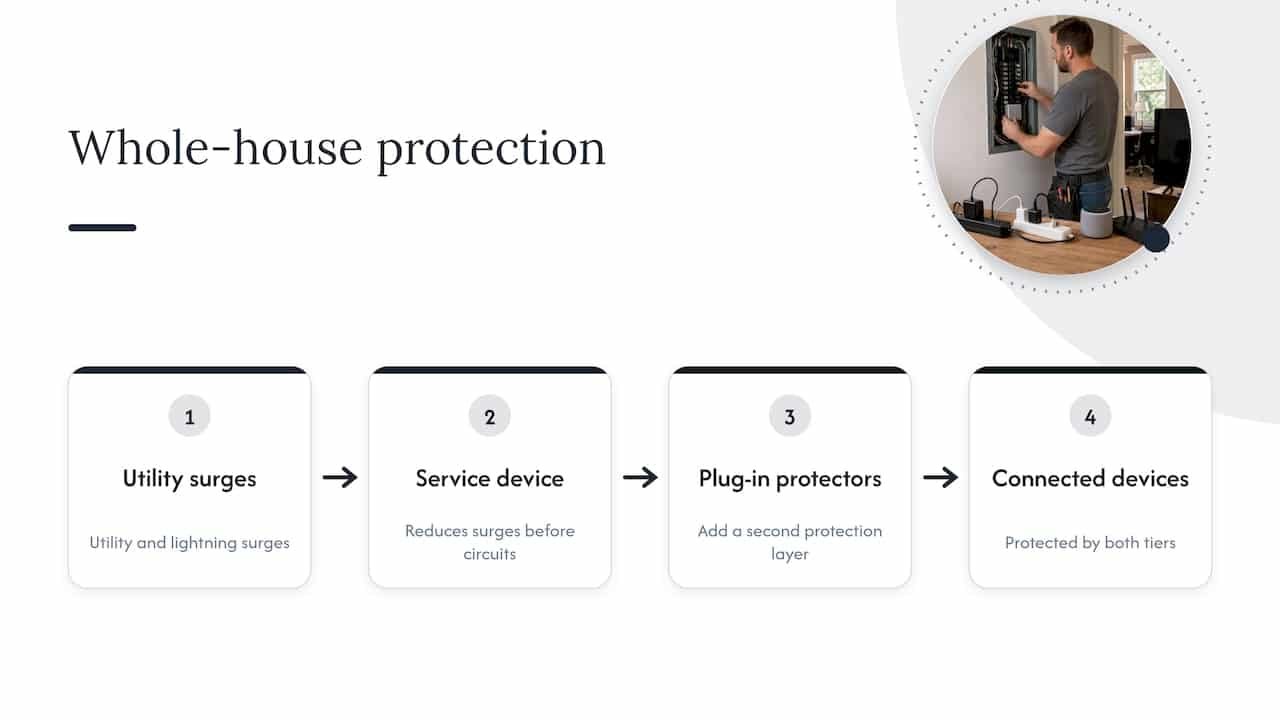
If you shop for one, Breaker Hunters’ buying guide says a Type 2 device on the load side of the main panel is the typical residential approach. It also says the 2023 National Electrical Code requires a nominal discharge rating of at least 10 kA where it applies, and that buyers should check UL 1449 listing and the voltage protection rating. This is work for a licensed electrician, who will confirm that the device matches your panel and your local code.
ESFI also warns that no surge protection can handle a direct lightning strike.
Habits that help
AAA recommends unplugging TVs, computers, gaming systems, microwaves and dryers before a storm, unplugging everything during an outage because surges often occur when power is restored, and having an electrician assess whether your home needs more protection or updates. If you own rental property, a panel and outlet check between tenants is a reasonable time to do that.
Why a repair technician belongs in your plan
Surge damage is hard to diagnose by sight. A board can look fine and still be fried, and an appliance can run for weeks before failing. Someone who repairs these machines every day knows which failures a surge usually causes and which parts are worth replacing.
A technician visit after a surge gives you three things: a working appliance or a clear answer, a written record of what failed for your insurer or utility, and the confidence to plug the unit back in. If you manage rentals, the same visit lets you tell a tenant the cause and the fix.
Our view on surge damage
When a homeowner calls after a storm, the first question we ask is what stopped working and when. The pattern matters. A dead control board in a refrigerator, a dryer that no longer starts and an air conditioner that trips its breaker all point to the same event, and they are worth checking together rather than one at a time.
Our approach is to treat the whole kitchen, laundry and cooling system as one electrical picture. We repair major household appliance brands, including brands that many others refuse, and our technicians are licensed and certified. Our aim is a long-term, warranty-safe fix rather than a quick patch that fails after the next storm.
We also know a surge rarely happens at a convenient time. That is why we offer 24/7 emergency availability and upfront pricing, so you know what to expect before work begins.
MDTECH
Get your appliances checked in Orange County and Los Angeles County
If a surge hit your home or rental property, we can inspect and repair the appliances it affected. Our appliance repair services cover refrigerators, kitchen appliances, washers, dryers and other major household brands, and our air conditioning repair and HVAC repair teams check cooling and heating equipment. You can book online through our site.
We also install new appliances, which is useful when a unit is beyond repair and needs a safe, correct replacement: see our appliance installation services. Start at mdtechservices.com to request an appointment.
FAQ
Can a power surge damage appliances that are turned off?
Yes. Many appliances keep their control boards powered in standby, so a surge can reach them even when they look off. Unplugging an appliance is the only way to isolate it completely. After a surge, inspect appliances that were plugged in, not only those running.
Do appliances need surge protection?
Most appliances with electronic controls benefit from it. The strongest setup is a whole-house device installed by a licensed electrician, plus plug-in protectors for electronics such as TVs and computers. Refrigerators are the exception: GE advises plugging them directly into the wall rather than into a surge protector.
Does homeowners insurance cover power surge damage?
It may. Coverage often applies when the surge comes from lightning or another covered peril, minus your deductible. Surges caused inside the home’s electrical system are often excluded unless you have an endorsement such as equipment breakdown coverage. Your agent can tell you what your own policy says.
Can a power surge damage an electrical outlet?
Yes. The heat from an electrical arc can damage outlets and breakers. If an outlet is scorched, hot, humming or smells of burning, stop using it and call a licensed electrician.
What should I do first if my refrigerator stopped cooling after a surge?
Check that it has power, keep the doors closed to hold the cold, and move perishables to a cooler if the interior keeps warming. Then schedule a repair. Our guide to a GE refrigerator that is not cooling after a power outage walks through the checks.
Sources
- State Farm: Are Power Surges Damaging Your Electronics?
- NIST Special Publication 960-6: Surges Happen!
- AAA Club Alliance: What to Do When Your Home Experiences a Power Surge
- Can a Power Surge Damage Appliances Without Tripping a Breaker?
- GE Appliances: Refrigerator Surge Protectors
- Mister Sparky: Storm Season Safety and Power Surges
- Progressive: Does Homeowners Insurance Cover Power Surges?
- MoneyGeek: What Is Equipment Breakdown Coverage?
- Southern California Edison: Surge and Fluctuations FAQs
- ESFI: Surge Protection, Keeping Your Electronics and Home Safe
- Washington State L&I: Electrical Safety Tips for Your Home
- Breaker Hunters: Whole-Home Surge Protection Buying Guide