
Yes, California law requires residential water heaters to be braced, anchored, or strapped to resist falling or horizontal movement during an earthquake. The practical minimum is two straps, one in the top third of the tank and one in the bottom third, anchored into a stud or concrete, not just drywall. Inspect your water heater now, photograph the straps and anchor points, and call a licensed professional if anything looks uncertain.
TL;DR:
- Standard tanks up to 120 gallons require two straps positioned in the top and bottom thirds, with the lower strap at least four inches above the controls.
- Larger or commercial tanks typically need more straps and may require engineered anchoring rather than pre-made kits.
- Straps must be made of specific metal materials, at least 22 gauge and 3/4 inch wide, with fasteners anchored into studs or concrete, not drywall.
- Inspectors and professionals should verify strap placement, fastener integrity, and platform stability, especially on garage installations, with proper documentation.
- DIY kits suit straightforward installations, but complex setups, larger tanks, or gas line work require licensed professional installation for safety and compliance.
Table of Contents
- What California law requires for water heater strapping
- The exact strap placement, counts, and hardware code requires
- How to check your own water heater for compliance
- DIY kits versus hiring a licensed professional
- What we check first when we arrive at a water heater
- Why this is worth doing now, not later
- Get your water heater inspected and properly strapped
- FAQ
- Sources
What California law requires for water heater strapping
California Health and Safety Code Section 19211 requires that all new, replacement, and existing residential water heaters in the state be braced, anchored, or strapped to resist falling or horizontal displacement from earthquake motion. The law applies statewide and covers standard residential tanks up to 120 gallons, which is the size range where pre-engineered bracing kits are widely available and sufficient on their own.
The statute does more than set an installation standard. It also creates a seller obligation: when a home changes hands, the seller must certify in writing that the water heater is braced, anchored, or strapped in compliance with the law. This certification typically shows up as a line item in real estate disclosure paperwork, and escrow or title companies in many California counties will flag an uncertified unit before closing. Property managers handling tenant turnover face a similar practical expectation, even though the statute’s certification language is written around a sale transaction.
A few scope points matter for homeowners trying to figure out where they stand:
- Standard residential tanks up to 120 gallons are covered by the law and can generally use a pre-engineered bracing kit.
- Larger or commercial-grade units often fall outside what a retail kit is designed for and need engineered anchoring instead.
- Local building departments have authority to require stricter installation standards than the state minimum, so a city or county handout can add detail the statute does not spell out.
- A permit or inspection review may apply depending on your jurisdiction, particularly for new installations or major repairs.
Because HSC 19211 sets a floor rather than a ceiling, the safest approach is to treat the state law as the baseline and check your local building department’s own guidance for anything more specific.
The exact strap placement, counts, and hardware code requires
State law tells you that bracing is mandatory. The California Plumbing Code and guidance from the Division of the State Architect tell you exactly where the straps go and what holds them in place.
One strap belongs in the top third of the tank, and one belongs in the bottom third. CPC Section 507.2 and the DSA’s illustrated guideline both specify that the lower strap must sit at least 4 inches above the gas controls or thermostat, so a technician or inspector can still reach and service those controls without loosening the bracing. The DSA guideline further recommends placing the upper strap roughly 9 inches below the top of the tank, which keeps it clear of the flue or hot water outlet while still catching the tank’s center of mass.
Most residential tanks need two straps, but bigger tanks need more. County and city guidance consistently scales the strap count to tank capacity:
- Smaller tanks typically need two straps (one in the top third and one in the bottom third).
- Medium-sized tanks often require three straps.
- Larger tanks commonly need four straps.
Not every material qualifies as code-compliant strapping. The San Diego County PDS701 handout specifies metal strapping that is not less than 22 gauge and at least 5/8 inch wide, which in practice means 3/4-inch perforated plumber’s tape in the 24 to 28 gauge range, sometimes paired with electrical metallic tubing (EMT) conduit for extra rigidity on larger tanks. Thin, flimsy strapping or anything improvised from non-rated material does not meet the standard even if it is physically holding the tank in place today.
The fasteners matter as much as the strap itself. Acceptable anchoring generally calls for 1/4-inch lag screws with cut washers driven into a wood stud, or, for masonry and concrete walls, a 3/8-inch expansion anchor with at least 2 inches of embedment. A strap that is correctly placed but screwed only into drywall will fail exactly when you need it most, because drywall has no shear strength to resist the tank twisting or pivoting during strong shaking.
Gas water heaters mounted on a garage platform have one more requirement. Code commonly calls for at least an 18-inch platform height to keep the burner above potential floor-level vapor, and the platform itself must be secured to the floor or adjacent wall framing, not just resting in place.
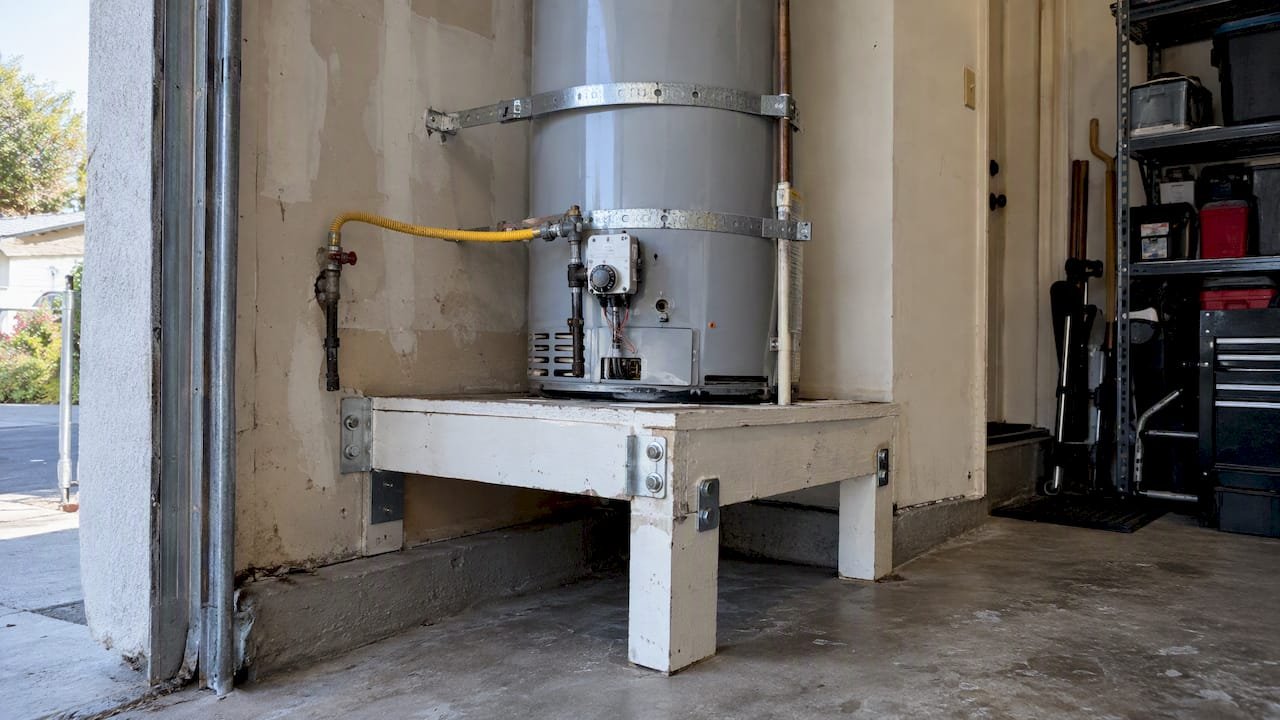
Statistic callout: According to San Diego County’s PDS701 guidance, compliant installations use metal straps meeting minimum gauge and width requirements, with the lower strap positioned above the gas controls for accessibility, allowing inspectors to verify compliance visually.
For your own records, measure and write down four things: the distance from the top of the tank to the upper strap, the distance from the gas controls to the lower strap, whether each fastener penetrates a stud or a rated concrete anchor, and the strap material’s gauge if it is stamped on the tape.
How to check your own water heater for compliance
Before touching anything, take a few safety precautions seriously. If you smell gas near the water heater, leave the area and call your gas utility or a licensed technician immediately rather than inspecting the connections yourself. Routine strap and anchor inspection does not require touching the gas line, but you should never attempt to loosen or reposition a gas connector unless you are licensed to do that work.
Gather a tape measure, a flashlight, your phone camera, and a flathead screwdriver before you start, then work through the inspection in order:
- Locate the two strap positions and confirm one sits in the top third of the tank and the other in the bottom third, at least 4 inches above the controls.
- Check what each strap is screwed into: press gently near each fastener and look for a visible stud edge or a concrete anchor plate, not bare drywall.
- Inspect the strap material itself for rust, fraying, or cracking, especially where it wraps around the tank’s curve.
- Give each strap a light tug to confirm it is snug against the tank with no slack, since a loose strap lets the tank rock before the strap engages.
- If the unit sits on a garage platform, confirm the platform is bolted or screwed to the floor or wall framing and not just set in place.
- Check that the water, gas, and any electrical connections use flexible connectors rather than rigid pipe fittings, since flexible lines reduce the risk of a cracked line during movement.
- Photograph each strap, each fastener point, and the platform (if present) with your phone, and note the date.
A few signs mean you should stop checking boxes and call a licensed professional instead: a single strap positioned in the middle of the tank rather than two straps top and bottom, screws anchored only into drywall, visibly corroded or frayed strapping, or lag screws that wiggle loose when you touch them. Any of these indicates the bracing will likely fail under real seismic load, not just that it looks imperfect.
Pro Tip: Keep your dated photos and any repair receipts in the same folder as your home’s other maintenance records, since sellers need this documentation for the written compliance certification required at closing, and property managers benefit from the same paper trail during tenant turnover.
DIY kits versus hiring a licensed professional
A pre-engineered bracing kit is a reasonable DIY option in a specific, narrow set of conditions: a standard tank sitting flush against a wall, straightforward access to studs for anchoring, and an installer who is comfortable measuring, drilling, and torquing lag screws correctly. Most retail kits are designed around exactly this scenario, and HSC 19211 explicitly contemplates pre-engineered kits for standard tanks up to 120 gallons.
Several situations call for a licensed professional instead of a kit, especially when dealing with less common setups such as horizontal orientations of the unit, where a horizontal water heater may be in use.
- Any work that touches the gas line, including moving or replacing a gas connector near the strapping.
- Tanks larger than 75 gallons, which commonly fall outside what a retail kit is rated to handle.
- A platform installation that needs new anchoring into the garage floor or wall framing.
- Uncertainty about what is actually behind the wall, since guessing wrong on stud location defeats the entire point of strapping.
Beyond the safety case, there is a documentation case for hiring a licensed technician. A professionally installed and documented bracing job gives you a dated receipt and a clear record to hand to an insurer after a claim or to an escrow officer during a sale, which can prevent the kind of back-and-forth that delays closings or complicates claims after water damage. If you are vetting a contractor, ask whether they are licensed for the specific work (plumbing or gas, depending on scope), whether they pull a permit when your jurisdiction requires one, and whether they provide written documentation of strap count, placement, and anchor type once the job is done. For broader gas-safety context, it’s also worth understanding how seismic gas shutoff valves fit into the same earthquake-preparedness picture as strapping.
What we check first when we arrive at a water heater
Water heater bracing is one of the most commonly overlooked safety items during service calls, even on units that are only a few years old.
The mistakes repeat themselves from house to house. We regularly find a single strap wrapped around the middle of the tank instead of two straps at top and bottom third, screws driven into drywall with no stud behind them, anchors that never reached the minimum embedment depth, and straps left loose enough that the tank can rock several inches before the strap takes any load.
An inspection of water heaters typically includes checking stud integrity behind each anchor point, confirming the use of flexible connectors for water and gas connections, verifying venting clearance, and, where applicable, confirming the platform itself is properly secured. If we find a hazard that cannot wait, such as a gas connector showing wear or a tank that could topple with normal foot traffic, we recommend an immediate temporary fix or shutoff rather than leaving the unit as is until a full repair can be scheduled. For homeowners dealing with a related issue, our guide on water heater repair for California homes covers the broader safety checks we run during a typical visit.
Why this is worth doing now, not later
Water heater strapping is one of the cheapest earthquake precautions a homeowner can take, and it is also one of the easiest to let slide for years because an unbraced tank looks perfectly normal until the ground actually moves. A toppled water heater does not just need to be reset. It can tear a gas or water line loose, and the resulting flooding or gas leak turns a small compliance gap into a genuinely dangerous and expensive problem. Inspect your straps this week, photograph what you find, and keep that record with your home’s other paperwork. If anything looks off, a licensed technician can confirm it and fix it faster than most homeowners expect.
— MDTECH
Get your water heater inspected and properly strapped
We handle water heater strapping inspections and corrections as part of our plumbing and appliance work across Orange County and Los Angeles County, and we built our process around exactly the gaps we see most often in the field: missing anchors, loose straps, and connectors that were never upgraded to flexible lines.
When we come out for a strapping check, we cover:
- A full inspection of strap placement, count, and anchor type against current code.
- Correction or replacement of noncompliant strapping, including upgrading fasteners to proper lag screws or concrete anchors.
- A check of gas, water, and electrical connectors for flexible-line compliance.
- Written documentation of what we found and what we corrected, ready for a seller certification, insurer, or property file.
If you are not sure whether your current setup would pass inspection, our appliance repair services page is the fastest way to see what a visit includes and get a technician scheduled.
FAQ
What are the California law requirements for water heater strapping?
California Health and Safety Code Section 19211 requires residential water heaters to be braced, anchored, or strapped to resist earthquake motion, and sellers must certify this in writing at the time of a home sale. The code covers new, replacement, and existing units, and standard tanks up to 120 gallons can typically use a pre-engineered bracing kit.
What states require water heater straps?
California is the state with a specific statute, HSC 19211, mandating water heater bracing for residential units. Other seismically active states and some local jurisdictions outside California have their own building code provisions addressing water heater anchoring, but the details and enforcement vary by location.
What is the code for strapping a water heater?
The governing California statute is Health and Safety Code Section 19211, and the installation specifics come from the California Plumbing Code Section 507.2 along with Division of the State Architect guidance. Together they call for one strap in the top third of the tank and one in the bottom third, with the lower strap positioned at least 4 inches above the controls.
What are the new rules for water heaters in California?
There is no separate new statute beyond HSC 19211, which has long required bracing, anchoring, or strapping for residential units. What has evolved is local enforcement: more counties and cities now publish detailed handouts, like San Diego County’s PDS701, that spell out exact strap gauge, width, and fastener requirements beyond the state’s general language.
How many straps does my water heater need?
Most standard residential tanks up to 52 gallons need two straps, one top and one bottom. Larger tanks typically need more: about three straps for a 75-gallon unit and four for a 100-gallon unit, based on common county and city guidance.
Sources
For homeowners who want the primary language behind these requirements rather than a summary, these documents are the ones worth reading directly:
- California Health and Safety Code Section 19211
- Guidelines for Earthquake Bracing of Residential Water Heaters (Division of the State Architect)
- WATER HEATER STRAPPING REQUIREMENTS (San Diego County PDS701)