
Most Los Angeles homeowners pay between a few hundred dollars and $2,000 or more for gas line work, with contractors in our area commonly pricing jobs at $17 to $28 per linear foot. Your final number depends heavily on permits, trenching, and whether a seismic shutoff valve is part of the scope. The breakdown below walks through real scenarios, the factors that move a quote up or down, and how to get a number you can actually trust.
TL;DR:
- Longer pipe runs, complex routing like in-wall or under-slab installation, and landscape restoration significantly increase overall costs.
- Adding multiple appliances or a seismic shutoff valve pushes the project toward the higher end of the typical $17 to $28 per foot range.
- Permits, pressure tests, and licensed contractor requirements mandated by LADBS are essential steps that can impact project timelines and costs.
- Requesting detailed, itemized bids and verifying licenses helps prevent unexpected charges and ensures code-compliant, safe installation.
- Cost-saving tips include bundling tasks, choosing the right pipe material, and handling landscaping work yourself when feasible.
Table of Contents
- Cost Breakdown: Per-Foot Pricing and Real Project Examples
- What Affects Cost: Distance, Materials, and Appliance Load
- Permits, Inspections, and Code: What LADBS Requires
- Typical Project Timeline From Quote to Final Inspection
- How to Get an Accurate Estimate You Can Trust
- Ways to Reduce Cost Without Cutting Corners
- Why a Licensed Local Team Matters for Gas Work
- Booking a Gas Line Estimate With MDTech Services
- A Straight Answer on Gas Line Budgeting
- FAQ
- Sources
Cost Breakdown: Per-Foot Pricing and Real Project Examples
Pricing for gas line work in Los Angeles is usually quoted two ways: by the linear foot for the pipe run itself, and as a total job price once labor, permits, and finishing work are added in. Local contractors commonly price straightforward runs at $17 to $28 per linear foot, though that range can shift based on how the pipe is routed and what’s in the way.
A few scenarios help put those numbers in context:
- A short hookup for a single appliance, like connecting a new gas dryer near an existing line, tends to land at the lower end of the job-cost range since it involves minimal trenching and a quick permit.
- A kitchen remodel that adds a gas range and reroutes a line to a new island location typically costs more, since it combines longer pipe runs with possible slab penetration.
- A longer exterior run, such as extending a line from the meter to a detached garage or a backyard fire feature, adds cost through extra linear feet, deeper trenching, and landscape restoration.
- A whole-house repipe or a project that also requires a seismic shutoff valve pushes toward the higher end of the typical range, since it layers material, labor, and safety equipment costs together.
A typical itemized quote breaks those totals into recognizable parts: materials (pipe, fittings, and valves), labor hours, excavation or trenching, permit and inspection fees, and any landscape or hardscape repair needed to restore the yard or driveway afterward. Homeowners who only see a single lump-sum number should ask for this breakdown, since it’s the only way to compare two bids fairly.
Where your project falls in these ranges depends less on the pipe itself and more on what surrounds it: concrete, landscaping, appliance count, and how far the gas has to travel from the meter to its destination. We cover those variables next.
What Affects Cost: Distance, Materials, and Appliance Load
Several factors interact to set your final price, and understanding them helps you evaluate whether a quote is reasonable or inflated.
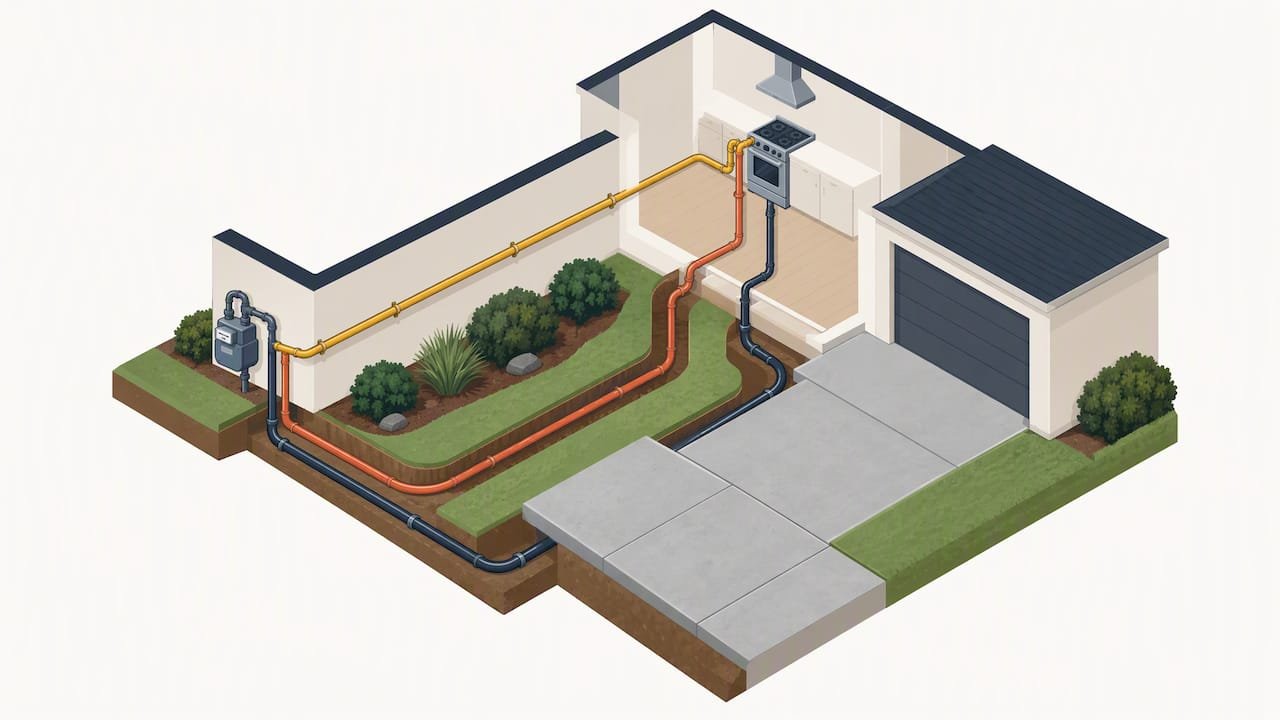
- Linear feet and routing complexity. A short, exposed run along an exterior wall costs far less than a line that has to go under a slab, through a finished wall, or around existing plumbing and electrical. Under-slab and in-wall routing both add labor hours and sometimes require patching or drywall repair afterward.
- Pipe material. Black iron or steel pipe is the traditional choice for exposed runs and is durable but labor-intensive to thread and fit. Corrugated stainless steel tubing (CSST) installs faster in many residential settings and flexes around obstacles, while polyethylene (PE) pipe is used for certain underground runs and requires a tracer wire so the buried line can be located later, a detail confirmed in municipal gas piping guidance for underground installations.
- Appliance count and BTU load. Adding a second or third gas appliance, such as a range, water heater, and dryer all on one line, means the contractor has to calculate total BTU demand. When the existing line can’t handle the added load, upsizing the pipe or running a separate branch becomes necessary, which adds both material and labor cost.
- Excavation and surface restoration. Trenching through dirt is relatively inexpensive, but cutting through concrete, removing hardscape, or replacing landscaping afterward can multiply the labor portion of a bid.
- Safety devices. A seismic gas shutoff valve is a common addition in Southern California and shows up as its own line item rather than being bundled invisibly into labor.
Pro Tip: Ask your contractor to show you the BTU calculation for your appliances before agreeing to a pipe size. It’s a quick way to confirm the quote matches your actual load rather than a generic estimate.
Routing complexity tends to have the biggest swing on price, since a line that has to be bored under a driveway or snaked through a finished ceiling takes far longer than one run through an open crawlspace or exterior wall.
Permits, Inspections, and Code: What LADBS Requires
Gas line work in Los Angeles is not optional paperwork. It is a code-driven process overseen by the Los Angeles Department of Building and Safety, and skipping steps creates real risk to your safety, your insurance coverage, and your home’s resale value.
- LADBS requires a plumbing permit for any installation, alteration, or replacement of gas piping, and projects valued at $501 or more carry explicit licensing and permitting requirements.
- Smaller, low-pressure jobs may qualify for an express permit process, which speeds approval, but every job still requires a pressure test and a final inspection before the gas can be turned on.
- The California Plumbing Code, Chapter 12, governs fuel gas piping and sets minimum standards for materials, burial depth, and testing that Los Angeles has adopted into its own amended code, as reflected in the city’s plumbing code chapter.
- Municipal guidance on gas piping, such as the handout published by the city of Roseville, outlines the same core requirements used across California jurisdictions: 18 inches of earth cover for buried piping, tracer wire for PE pipe, and documented pressure testing before approval.
Before signing a contract, confirm your contractor holds a C-36 plumbing contractor license, since gas work in California falls squarely under that classification, and verify it along with proof of insurance through CSLB resources. A licensed contractor pulls the permit in their name, which protects you if something goes wrong during or after installation.
Typical Project Timeline From Quote to Final Inspection
A small gas line job, like a single appliance hookup, can move from quote to final inspection in about a week once a permit is in hand. Larger projects involving trenching, multiple appliances, or slab work often take two to four weeks.
- Site visit and written quote, usually scheduled within a few days of your call.
- Permit application submitted to LADBS, with express permits approved faster than standard plan-check submissions.
- Utility locate request through Call 811 to mark underground lines before any digging begins.
- Installation, including trenching, pipe placement, and connection to appliances or the meter.
- Pressure test, required before the line is covered or the gas is turned on.
- Final inspection by LADBS to confirm the work meets code before the system is approved for use.
Weather, slab cutting, and landscaping restoration are the most common sources of delay, along with permit backlogs during busy renovation seasons.
How to Get an Accurate Estimate You Can Trust
A reliable quote looks very different from a vague one, and knowing what to ask for protects you from surprise charges later.
- Request an itemized bid that separates materials, labor, excavation, permit fees, pressure testing, and landscape repair into distinct line items.
- Ask for the contractor’s C-36 license number and confirm it’s active through CSLB before any work begins.
- Request a piping schematic along with a full list of appliance BTU ratings so you can see how the contractor arrived at the proposed pipe size.
- Ask for a written pressure test procedure and documentation showing the test was passed before the line is covered or connected.
Pro Tip: A bid that skips permit costs entirely is a red flag, not a bargain. It usually means the work will be done without inspection, which can void your homeowner’s insurance if a gas-related incident occurs later.
Other warning signs include a scope of work that’s described in only a sentence or two, reluctance to provide references, and online reviews that mention unfinished permits or failed inspections.
Ways to Reduce Cost Without Cutting Corners
Lowering your bill doesn’t have to mean lowering your standards. A few strategies keep costs down while staying fully code-compliant.
- Bundle multiple appliance hookups into a single visit to avoid paying separate mobilization and permit fees for each one.
- Ask whether your project qualifies for an express permit, since eligible low-pressure jobs move through approval faster and at lower administrative cost.
- Consider handling landscaping removal and replacement yourself if you’re comfortable with it, but clarify upfront who’s liable if hardscape or irrigation lines are damaged during excavation.
- Talk through material choices with your contractor rather than assuming the most expensive pipe is always the right call. CSST, black iron, and PE each have appropriate uses, and the right one depends on your specific run, not a blanket upgrade.
Why a Licensed Local Team Matters for Gas Work
Gas line work carries real safety stakes, which is why we built our process around licensed technicians, documented testing, and full permit handling rather than shortcuts.
- We handle appliance repair and installation along with gas appliance repairs and LP-to-natural-gas conversions across Los Angeles and Orange County.
- Our technicians follow pressure-testing and permit procedures consistent with LADBS and California Plumbing Code requirements.
- We manage the paperwork side of a gas project, including permit submission and coordinating final inspection, so homeowners aren’t left guessing about compliance.
- Our focus stays on long-term, code-compliant installations rather than the lowest possible bid, since a failed inspection ends up costing more time and money than doing it right the first time.
Booking a Gas Line Estimate With MDTech Services
Getting a number you can plan around starts with a site visit, not a phone guess. When we come out to look at your gas line project, we walk the route, count appliances, calculate BTU load, and give you an itemized quote that separates materials, labor, permits, and testing so you know exactly what you’re paying for.
- We prepare and submit the LADBS permit application for customers as part of our service.
- We perform the required pressure test and coordinate the final inspection to help ensure code-compliant installations.
- We can also handle related work in the same visit, from HVAC services to plumbing repairs, if your project touches more than one system.
| What you get | Details |
|---|---|
| Itemized estimate | Materials, labor, excavation, permits, and testing broken out separately |
| Permit handling | LADBS application and documentation submitted on your behalf |
| Testing and inspection | Pressure test performed and final inspection coordinated |
| Service area | Los Angeles County and Orange County |
Ready to get a precise number for your project. Book an appointment with MDTech Services and we’ll walk you through the scope, the permit path, and the full cost before any work begins.
A Straight Answer on Gas Line Budgeting
In our experience, the homeowners who end up happiest with a gas line project are the ones who prioritize a licensed contractor and documented testing over the lowest bid on the table. A quote that skips permits or pressure-test paperwork might look cheaper today, but it can create real problems at resale or in an insurance claim later. Ask for proof of license, ask for the pressure test documentation in writing, and reach out if your project involves multiple appliances or an unusual routing path. We’re happy to talk through the specifics before you commit to anyone.
— MDTECH
FAQ
How expensive is it to run a gas line?
Running a gas line in Los Angeles typically costs between a few hundred dollars and $2,000 or more depending on length, routing, and whether permits and a seismic valve are included. Local contractors often price straightforward runs at $17 to $28 per linear foot, with longer or more complex runs landing at the higher end.
How much does a foot of gas pipe cost?
Per-foot pricing for gas line installation in Los Angeles commonly falls in the $17 to $28 range, covering materials and labor for a standard run. More complex routing, like under-slab or in-wall work, can push the effective cost per foot higher.
What permits do I need for gas line work in Los Angeles?
LADBS requires a plumbing permit for any gas piping installation, alteration, or replacement, with explicit licensing and permitting rules applying to projects valued at $501 or more. Smaller, low-pressure jobs may qualify for an express permit, but a pressure test and final inspection are always required regardless of job size.
Do I need a licensed contractor for gas line installation?
Yes, gas line work in California should be performed by a contractor holding a C-36 plumbing license, which you can verify through CSLB before hiring. A licensed contractor pulls the permit under their own name, which protects you if issues arise during or after the work.
What adds the most cost to a gas line project?
Routing complexity, such as trenching through concrete or running pipe under a slab, tends to add the most cost, along with the number of appliances and their combined BTU load. Safety equipment like a seismic gas shutoff valve and any necessary landscape or hardscape restoration also add noticeably to the final bill.
Sources
- Los Angeles Department of Building & Safety — Permits and Inspections
- Gas piping information sheet (Roseville)
- Plumbing contractor C-36 license overview
- Los Angeles plumbing code (based on CPC 2025) — Chapter 12 Fuel Gas Piping