
California law requires every dwelling with a fossil fuel-burning appliance, a fireplace, or an attached garage to have a State Fire Marshal-approved carbon monoxide alarm under Health and Safety Code Section 17926. You need alarms outside each sleeping area and on every level of the home, installed and maintained per the manufacturer’s instructions. If you are unsure about hardwiring, venting, or interconnecting multiple units, a licensed professional can get the installation right the first time with guidance from California Media Wall Kits.
TL;DR:
- California law requires approved carbon monoxide alarms outside each sleeping area and on every home level, including basements and garages, with deadlines already passed for compliance.
- Alarms must meet UL 2034 or UL 2075 standards, carry State Fire Marshal approval, and be installed following manufacturer instructions to ensure legal and effective operation.
- Interconnected alarms are highly recommended for multi-level homes to ensure warnings reach all occupants during a CO leak.
- Proper placement means keeping alarms at manufacturer-specified heights and away from steam, cooking, and vents to prevent nuisance triggers.
- Regular maintenance includes weekly testing, monthly cleaning, battery replacements according to the device schedule, and replacing units every five years for continued safety.
Table of Contents
- California Law and Deadlines: HSC 17926 Explained
- Where to Put Your Alarms and How Many You Need
- Choosing a Detector That Meets California Standards
- What to Do When a CO Alarm Sounds
- Landlord and Tenant Responsibilities in California
- A Technician’s View on Lasting CO Protection
- How We Help With Code-Compliant CO Safety
- FAQ
- Sources
California Law and Deadlines: HSC 17926 Explained
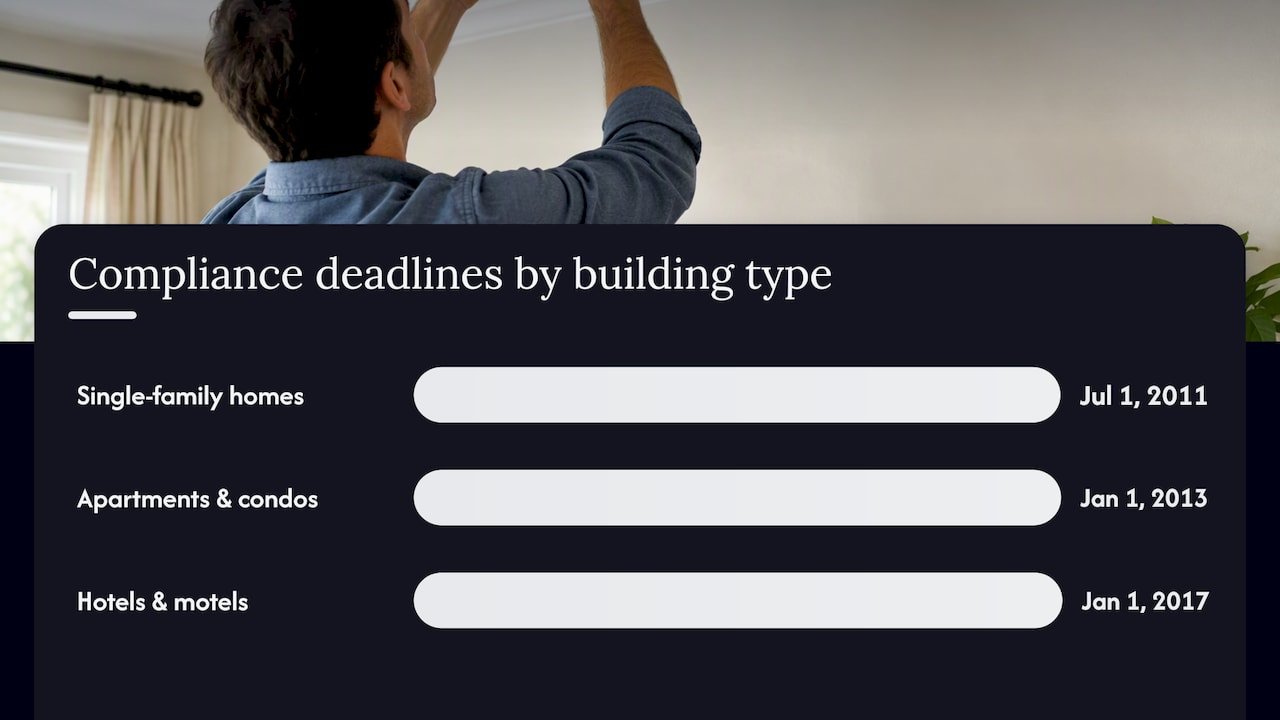
California’s carbon monoxide alarm requirement did not arrive all at once. Health and Safety Code Section 17926 phased in compliance by building type, and all three deadlines have already passed. Every owner of an existing dwelling that falls under the statute should already be compliant.
- Single-family homes needed compliant alarms by July 1, 2011.
- Other dwelling units, including apartments and condos, needed compliance by January 1, 2013.
- Hotels and motels faced a deadline of January 1, 2017.
The law does not accept just any smoke-and-CO combo device off a shelf. Alarms must carry State Fire Marshal approval, which means the manufacturer submitted the device for testing and certification before it could legally be sold or installed in California. This approval process traces back to the Carbon Monoxide Poisoning Prevention Act of 2010, which directed the State Fire Marshal to build a certification and listing system for these devices.
Noncompliance carries a fine of up to $200 per offense under HSC 17926, and local jurisdictions retain authority to layer on their own fire and building ordinances, so a quick check with your city’s fire department never hurts.
Where to Put Your Alarms and How Many You Need
Placement determines whether an alarm actually wakes you up in time. NFPA guidance and local fire departments point to the same basic layout for most homes.
- Install one CO alarm outside each separate sleeping area, close enough that it will wake sleepers.
- Add at least one alarm on every level of the home, including basements.
- Place a unit near any attached garage, since vehicles left running are a common CO source.
- Mount alarms at the height specified by the manufacturer rather than guessing.
- Keep units a reasonable distance from stoves, furnace vents, and bathrooms, where steam and cooking exhaust trigger nuisance alarms.
Interconnected alarms, where one unit sounding triggers every other unit in the home, give you a real advantage in a multi-level house. A San Mateo Consolidated Fire handout echoes the state’s timeline and recommends this layout for exactly that reason: a CO leak in the garage does little good if the alarm is confined to a bedroom upstairs and nobody hears it.
Choosing a Detector That Meets California Standards
Not every carbon monoxide alarm sold online qualifies for use in a California home. The device needs to meet recognized safety standards and carry State Fire Marshal listing before it satisfies HSC 17926.
- Look for compliance with UL 2034, the standard for single- and multiple-station CO alarms, or UL 2075, which covers CO detectors and sensors used in combination products, both referenced in the statute as acceptable benchmarks.
- Combination smoke and CO alarms must meet both sets of standards and clearly distinguish between a smoke alarm pattern and a CO alarm pattern, since confusing the two during an emergency wastes time.
- Check the packaging or included instructions for an explicit State Fire Marshal approval statement and a manufacture date, since older stock sometimes predates current listing requirements.
- The CSFM approved devices list published by the Office of the State Fire Marshal lets you confirm a specific model before you buy.
Consumer Reports testing has found that detector performance varies meaningfully between models, with some units reporting CO concentrations accurately at test points while weaker ones underreport or respond slowly, so sticking to UL-listed, independently tested alarms matters as much as meeting the legal minimum.
What to Do When a CO Alarm Sounds
Treat every CO alarm as real until you know otherwise. The CDC notes that carbon monoxide is colorless and odorless, so the alarm itself is often the only warning you get.
- Get everyone outside into fresh air immediately, including pets.
- Call 911 from outside the home rather than lingering to investigate.
- Stay out until fire department personnel or a qualified technician clears the building.
- Seek medical attention if anyone has symptoms, and mention possible CO exposure to the provider.
Watch for headache, dizziness, nausea, confusion, or weakness, especially when several people in the same house feel sick at once, a pattern the CDC flags as a strong clue of CO exposure rather than a coincidental illness. A standard pulse oximeter cannot detect carbon monoxide poisoning, since it cannot distinguish oxygen-carrying hemoglobin from CO-bound hemoglobin; medical staff instead rely on COHgb blood testing to confirm exposure.
Landlord and Tenant Responsibilities in California
Compliance duties do not fall only on homeowners living in their own house. Under HSC 17926.1, owners of rental property bear responsibility for installing and maintaining required CO alarms, while Civil Code Section 1954 limits when and how a landlord can enter a unit to do that work.
- Owners must install approved alarms before a tenancy begins and keep them in working order.
- Entry for installation, inspection, or repair generally requires reasonable advance notice except in a genuine emergency.
- Tenants are expected to report a nonworking alarm, and once notified, the owner is responsible for the repair or replacement.
- At move-in, test every alarm with the tenant present and document that it works, which protects both sides if a dispute comes up later.
A Technician’s View on Lasting CO Protection
A carbon monoxide alarm only tells half the story. Alarms are most likely to fail when installed without checking whether the furnace, water heater, or fireplace they’re monitoring is venting correctly.
A CO safety visit should include checking appliance venting and combustion alongside alarm placement, since a correctly placed alarm paired with a poorly vented appliance still leaves a gap in protection.
— MDTECH
How We Help With Code-Compliant CO Safety
We offer services related to carbon monoxide safety beyond just alarm installation, including gas appliance repair and safety checks, gas line inspection to confirm venting and combustion equipment operation, hardwired detector installation and interconnection, and LP to natural gas conversions.
Booking takes a few minutes through our site, and we schedule a visit to assess your appliances, venting, and detector placement together rather than treating each as a separate problem. If a gas appliance needs attention before or after you install new CO alarms, start with our gas appliance repair services to get it checked by a licensed technician.
This article is general information, not a substitute for advice from a qualified doctor. Consult a qualified healthcare professional about your own circumstances before acting on anything here.
FAQ
What is the California code requirement for carbon monoxide detectors?
California Health and Safety Code Section 17926 requires State Fire Marshal-approved CO alarms in any dwelling with a fossil fuel-burning appliance, fireplace, or attached garage. Compliance deadlines for existing homes have already passed, so any qualifying home should have working alarms installed now.
Where do carbon monoxide detectors need to be placed in California?
Alarms belong outside each separate sleeping area and on every level of the home, including basements and near attached garages. Local fire departments, following NFPA guidance, also recommend keeping units away from stoves and vents to avoid nuisance alarms.
How many carbon monoxide detectors do you need in a house in California?
The number depends on your home’s layout, since you need at least one outside every sleeping area plus one per level. A two-story home with bedrooms on the second floor and an attached garage typically needs units on both levels and near the garage entry.
What is the most trusted carbon monoxide detector?
Rather than one specific model, look for alarms that meet UL 2034 or UL 2075 standards and carry State Fire Marshal approval, since those are the devices legally recognized in California. Consumer Reports testing also notes that independently tested, UL-listed units perform more consistently than untested alternatives.
Sources
You have three practical choices for powering a CO alarm, and each fits a different kind of home.
- California Health and Safety Code Section 17926
- CDC carbon monoxide information
- NFPA research/reference material on CO alarm thresholds and placement
- Consumer Reports buying guide for smoke and carbon monoxide detectors
- San Mateo Consolidated Fire smoke & CO detector handout
Interconnection can run through hard wiring or through wireless signals between battery-powered units, and either approach means an alarm triggered in the garage also sounds in the bedrooms. NFPA research backs interconnection as a meaningful step up in protection for any home with more than one level.
A basic maintenance routine keeps alarms reliable: test the button weekly, do a visual check and light dusting monthly, swap batteries on the schedule your model specifies, and replace the entire unit roughly every five years or per the manufacturer’s stated lifespan. Combination units and sealed-battery models sometimes carry longer intervals, so check your specific device.
Pro Tip: Mount detectors at least several feet from gas ranges, furnace vents, and bathroom doors to cut down on nuisance alarms while still covering the room where a leak would actually build up.