
An earthquake gas shutoff valve is a mechanical device installed downstream of your gas meter that senses strong shaking, typically around magnitude 5.1 to 5.5, and cuts gas flow to your home automatically. It works without electricity, and it can trip even if no pipe actually breaks. If yours shuts off, the rule is simple: do not reset it until a licensed technician or your utility has checked the system.
TL;DR:
- Installing the valve downstream of the gas meter ensures it is outside utility jurisdiction and appropriately sized for pipe diameter and demand.
- Proper mounting levelness and stabilization are crucial, as tilted or loose brackets can cause false trips during minor vibrations.
- It is essential to verify if local codes mandate a seismic or excess-flow valve, especially in seismically active areas or during major gas line upgrades.
- Homeowners should never reset a tripped valve without a professional inspection to check for leaks or pipe damage, preventing unsafe re-pressurization.
- The total cost of installation includes the valve, labor, permits, and testing, with thorough documentation that supports resale and insurance requirements.
Table of Contents
- What Is an Earthquake Gas Shutoff Valve and How Does It Work?
- Where the Valve Goes and How It Is Sized
- When Does Code Actually Require a Seismic Valve?
- Weighing the Benefits Against the Drawbacks
- What to Do When the Valve Trips After a Quake
- What a Seismic Valve Actually Costs to Buy and Install
- How to Choose a Contractor and What to Ask Before Hiring
- MDTech Field Perspective: What Goes Wrong on Real Installs
- How Mdtechservices Handles Seismic Valve Installation and Testing
- Where to Verify Code and Technical Details
- Sources
What Is an Earthquake Gas Shutoff Valve and How Does It Work?
Two mechanical designs handle the job: ball-and-cup and pendulum. In a ball-and-cup valve, a steel ball rests in a shallow cup above a spring-loaded seat. Strong shaking knocks the ball out of position, and it drops onto the seat to seal the gas line. Pendulum designs work on the same principle with a swinging weight instead of a ball. Both are passive, purely mechanical devices with no batteries or wiring, which means they still work during a power outage.
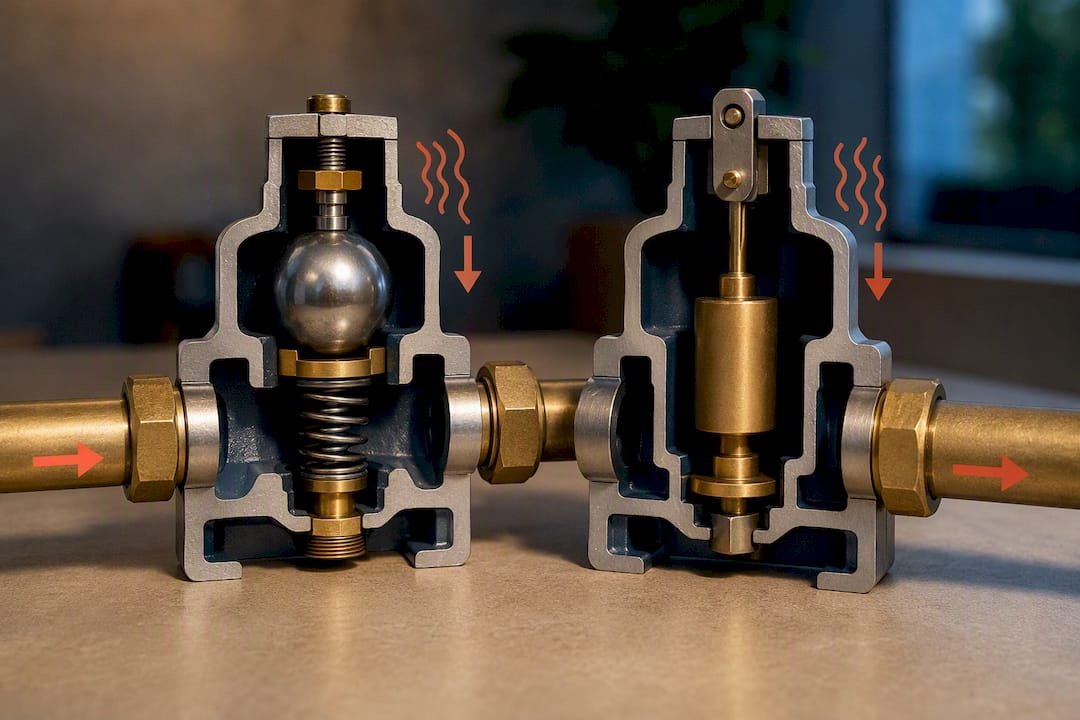
Manufacturers calibrate these valves to trip at a specific level of ground movement, often expressed as an earthquake in the magnitude 5.1 to 5.5 range or an equivalent acceleration threshold. That number matters because the valve reacts to motion, not to a detected leak. It will shut off gas during strong shaking even when every pipe in your house holds up fine, which is exactly the point. It stops fuel supply before a hidden crack somewhere in the system has a chance to leak into a fire-starting spark.
That’s the key difference from an excess-flow valve. An excess-flow valve monitors gas flow rate and closes only when it senses a surge, like the kind caused by a snapped pipe. A seismic valve closes based on shaking alone.
- Seismic valve: Triggered by ground motion, closes regardless of pipe condition.
- Excess-flow valve: Triggered by abnormal flow rate, usually after a break.
Where the Valve Goes and How It Is Sized
Correct placement and sizing determine whether a seismic valve protects your home or becomes a source of constant headaches. Installation follows a fairly predictable pattern, but details vary by property.
- Location. The valve mounts downstream of the utility’s meter, on the customer’s side of the gas line, which keeps it clearly outside the utility’s jurisdiction and inside yours.
- Sizing. Most single-family homes use valves in the 3/4 inch to 1.25 inch range, matched to pipe diameter and total appliance demand. Larger properties or buildings with multiple meters may need a valve at each meter rather than one unit for the whole structure.
- Orientation and mounting. The valve has to sit level and stable. A loose or tilted mount is one of the most common causes of nuisance trips, since even minor vibration can shift an improperly secured ball or pendulum.
- Bracket support. A stabilizing bracket keeps the valve from shifting during normal vibration, like passing trucks or nearby construction.
- Permits and manufacturer instructions. Most jurisdictions expect a permit and a follow-up inspection, and every listed valve model comes with manufacturer specifications that a qualified installer should follow to the letter.
When Does Code Actually Require a Seismic Valve?
Requirements shift by city, county, and insurer, so nothing here should be treated as universal. That said, a few patterns show up often enough to plan around.
- New residential construction in seismically active areas frequently requires a seismic or excess-flow valve as part of the gas system, depending on local jurisdiction.
- Permitted remodels that touch the gas line, especially meter relocations or major system upgrades, can trigger the same requirement in some locations.
- Some municipalities require a valve, or proof of one meeting code, before a property changes hands in escrow, depending on local rules.
- A handful of jurisdictions accept either a seismic valve or an excess-flow valve for compliance, so confirm which one your local authority actually wants before you buy.
- Insurers in earthquake-prone regions sometimes offer premium credits for verified installation, though the discount and the paperwork required to claim it vary by carrier.
Before you spend a dollar, call your local building department and your gas utility. A five-minute phone call beats installing the wrong device or missing a permit step that delays your final inspection.
Weighing the Benefits Against the Drawbacks
A seismic valve does one job well: it cuts fuel supply fast enough to reduce the odds of a post-quake fire, which is historically one of the deadliest secondary effects of a major earthquake. That’s a real safety benefit and the whole reason these devices exist.
It comes with trade-offs, though.
- Nuisance trips. Older valve designs were notorious for triggering on moderate shaking that caused zero damage, leaving homeowners without gas for cooking or hot water until a technician cleared it.
- Restoration delays. Because utilities often require an inspection before restoring service, a trip can mean a day or more without gas, even after a minor quake.
- No pipe protection. The valve stops flow. It does nothing to prevent a pipe from cracking or a flexible connector from working loose during shaking.
- Wear over time. Corrosion, debris buildup, or a shifted bracket can cause a valve to stick or fail to reset cleanly, which is when replacement becomes the right call.
Pro Tip: Pair your seismic valve with flexible gas connectors and secured appliance anchoring. The valve handles the fuel supply; the rest of your gas-safety setup handles the pipes themselves. Our guide to gas safety at home covers both.
What to Do When the Valve Trips After a Quake
Order of operations matters here more than speed. Follow these steps in sequence:
- Check for immediate danger first. If you smell gas, hear hissing, or see anything that suggests a leak beyond the valve itself, evacuate and leave the area immediately before doing anything else.
- Contact your gas utility. In most cases, the utility needs to inspect the meter and line before authorizing restoration, especially after a quake strong enough to trip the valve.
- Hire a licensed contractor for a full check. A qualified technician should run a pressure test and leak check at every joint before anyone touches the reset mechanism.
- Reset only after verification. Never reset the valve on your own the moment shaking stops. A verified, leak-free system is the only safe green light.
Homeowners who reset a tripped valve without inspection are betting that nothing shifted in the piping during the quake. That’s not a bet worth making.
What a Seismic Valve Actually Costs to Buy and Install
Product price and total installed cost are two different numbers, and homeowners who only budget for the valve itself are usually surprised by the final invoice. The device is only one line item.
- Valve itself: Priced by size and brand, with commercial-grade units costing more than standard 3/4 inch to 1.25 inch residential models.
- Labor: Covers removal of any existing shutoff, mounting the new valve, bracket installation, and connection work.
- Permit fees: Vary by city, and some jurisdictions charge separately for the inspection visit.
- Pressure and leak testing: Required after installation, since any gas piping work needs a pressure test and joint-by-joint leak check before the system goes back into service.
Multi-meter properties, oversized pipe runs, or hard-to-access meter locations all push labor costs higher. Get a written quote that separately lists the permit, the labor, and the required testing, so you’re comparing full installed costs between contractors rather than just device prices. For a broader sense of what gas line work runs in your area, our gas line installation cost guide breaks down typical price drivers.
How to Choose a Contractor and What to Ask Before Hiring
The valve is only as good as the install. A licensed, experienced contractor is the difference between a device that works when you need it and one that either fails silently or trips constantly for no reason.
- Confirm the license and insurance. Ask for proof, not just a verbal assurance, and check that the contractor has handled seismic valve installs specifically.
- Ask about permits. A contractor who suggests skipping the permit to save time or money is cutting a corner that could bite you at resale or during an insurance claim.
- Verify the valve model is manufacturer-approved and code-listed for your jurisdiction, not just any seismic valve pulled off a shelf.
- Request sizing documentation. The contractor should show the math behind the size they’re recommending, tied to your pipe diameter and total gas demand.
- Ask for proof of post-install testing. A pressure test and leak check report should come standard, not as an upsell.
Pro Tip: Ask every bidding contractor the same five questions above and compare answers side by side. A contractor who gets vague on sizing or dodges the permit question is a red flag worth walking away from.
MDTech Field Perspective: What Goes Wrong on Real Installs
The gap between a correctly installed seismic valve and a problem waiting to happen usually comes down to three things: sizing, bracketing, and orientation. Technicians in the field see valves sized off a guess rather than an actual gas-demand calculation, brackets skipped to save fifteen minutes, and units mounted slightly off-level in ways that guarantee future nuisance trips.
Documentation matters more than most homeowners realize going into the process. A signed permit, a completed inspection, and a leak-test report turn into leverage during escrow negotiations and insurance discussions later. The valve itself is one component. The paperwork behind it is what proves the job was done right, and it’s the part sizing shortcuts tend to skip first.
— MDTECH
How Mdtechservices Handles Seismic Valve Installation and Testing
We offer a licensed, local alternative to piecing together sizing math, permit paperwork, and testing on your own. We handle gas-line inspection, valve installation, and post-trip restoration work as a coordinated service to simplify the process after a quake trips your line.

A typical service visit can include sizing the valve to pipe diameter and gas demand, obtaining permits, mounting stabilizing brackets, and performing pressure and leak tests as expected before restoring service. You walk away with documentation that holds up for escrow, insurance, or future inspections. If your valve has already tripped, or you’re planning ahead of your next remodel, book an inspection with Mdtechservices and get a written quote before any work begins.
Where to Verify Code and Technical Details
- Building America Solution Center: federal guidance on valve function and installation basics.
- Your local building department: confirms permit and inspection requirements specific to your city.
- Your gas utility: confirms restoration protocol and whether they require inspection before reset.
Sources
- Automatic Gas Shutoff Valves | Building America Solution Center
- Earthquake Gas Shutoff Valves: LA & CA Rules | US Made Supply
- Earthquake Gas Shutoff — Seismic Valve Safety and Code | Jaspector