
Most dryer repairs cost between $100 and $430, with a typical bill landing around $170 to $180 once you add diagnostic fees and labor. As a rule of thumb, if the repair estimate creeps past half the price of a comparable new dryer, or your unit is older than about 10 years, replacement usually makes more financial sense than another repair.
TL;DR:
- Most dryer repairs range from $100 to $430, with an average around $170 to $180 depending on parts and labor complexity.
- Significant repairs like control board or motor replacements can approach a third or more of a new dryer’s price, favoring replacement.
- Gas dryer repairs cost $50 to $100 more than electric models due to additional safety and specialized parts.
- Common small parts, such as thermal fuses and belts, are cheap but labor-intensive, often leading to higher overall costs.
- Routine vent cleaning can prevent expensive repairs, as clogged vents cause overheating and component failure over time.
Table of Contents
- What Is the Average Dryer Repair Cost?
- What Do Common Dryer Repairs Cost by Part?
- What Factors Change the Total Repair Bill?
- When Does It Make Sense to Repair vs Replace a Dryer?
- Should You DIY the Fix or Call a Technician?
- How Does Vent Maintenance Prevent Costly Repairs?
- How Should Homeowners Think About Dryer Repair Costs?
- How to Book MDTech for Dryer Repair or Replacement Guidance
- Where These Dryer Repair Cost Figures Come From
- Sources
What Is the Average Dryer Repair Cost?
Here’s what you’re actually paying for when a technician shows up: a diagnostic fee, an hourly labor rate, and whatever parts your dryer needs. National data puts the typical repair between $100 and $430, with an average close to $180, according to HomeAdvisor. Thumbtack’s industry figures land in a similar range, citing an average dryer repair cost near $170, while broader appliance repairs average closer to $206 across categories, per Thumbtack.
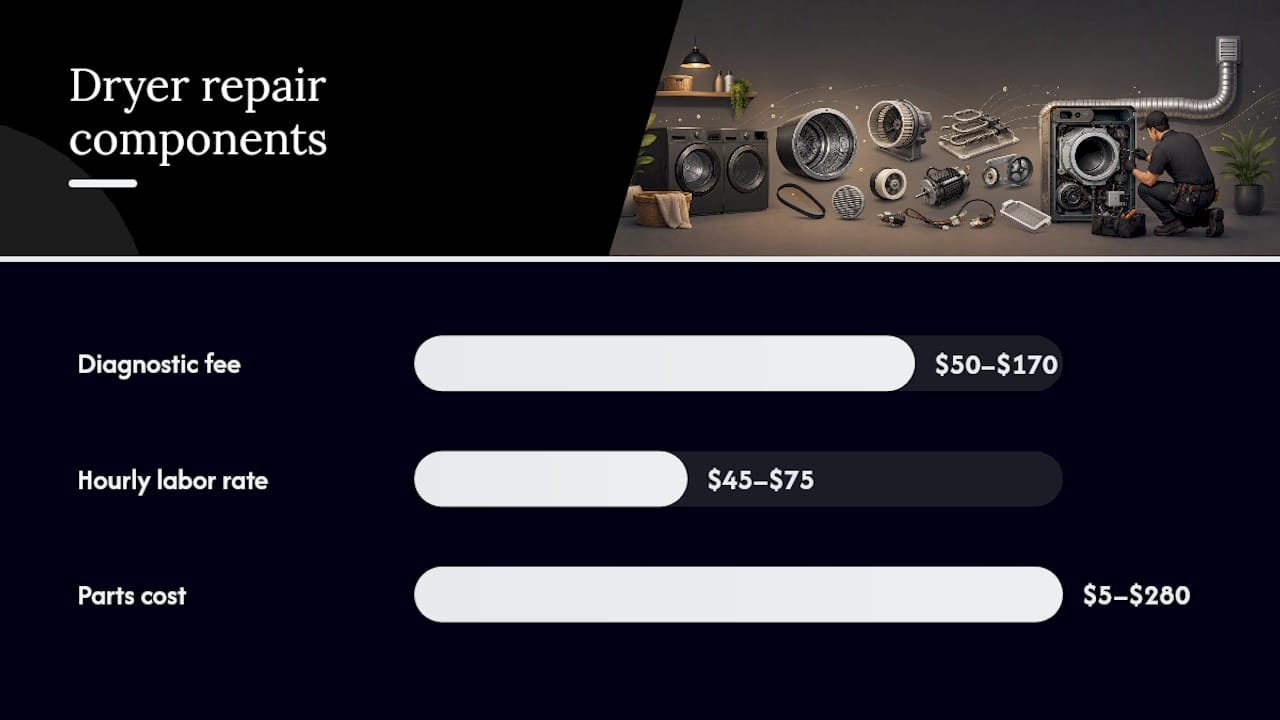
Yelp’s cost data breaks the bill into pieces that are worth understanding before you ever pick up the phone. A diagnostic visit typically runs $50 to $100, hourly labor falls between $45 and $75, and parts alone can range from $5 for a simple thermal fuse to $280 for a full control board, based on figures from Yelp. Add those together and you land close to the $150 to $200 average that most sources converge on.
Pro Tip: Ask upfront whether the diagnostic fee gets credited toward the repair if you approve the work. Many shops waive it, and that single question can save you $50 to $100 before a wrench even comes out.
Fuel type changes the math too. Gas dryers typically cost $50 to $100 more to repair than electric models because of specialized parts, gas-line safety checks, and the licensed labor required to work on them safely, notes HomeAdvisor.
Here’s a quick reference for what homeowners typically pay:
| Cost component | Typical range |
|---|---|
| National repair range | $100–$430 |
| Common median repair | $170–$200 |
| Diagnostic/service fee | $50–$170 |
| Hourly labor rate | $45–$75 |
| Gas dryer premium over electric | $50–$100 extra |
If your quote falls well outside these bands, ask why. A number far above $430 usually signals either a major component failure or a dryer whose parts are getting hard to source, both of which are worth weighing against a replacement.
What Do Common Dryer Repairs Cost by Part?
Not all dryer problems cost the same to fix, and the part failing tells you a lot about where your bill will land. Small mechanical parts are cheap on their own, but labor to access them can still push the total to $150 or more. Bigger electronic or motor failures cost more in parts and usually take longer to diagnose correctly.
| Part | Typical part cost | Labor note |
|---|---|---|
| Thermal fuse | $5 | Quick fix once diagnosed; often bundled with a service call minimum |
| Drum belt | $15–$50 | Requires partial disassembly to access |
| Drum rollers | $10 | Usually replaced in pairs |
| Heating element | $50–$150 | Common failure point in electric dryers |
| Igniter (gas models) | $150 to $200 | Requires gas-safety knowledge to replace |
| Motor | $50 to $100 | Labor-intensive; often the costliest mechanical repair |
| Control board | $280 | Most expensive commonly replaced part |
Control boards and motors sit at the top of the cost ladder, and for good reason. A control board replacement can approach a third or more of a new mid-range dryer’s price once labor is added, since the boards themselves are pricier and diagnosing an electrical fault correctly takes real expertise, according to HomeAdvisor.
A few things worth knowing before your service call:
- Thermal fuse and belt replacements are usually the cheapest fixes, but they still carry a full labor charge.
- Heating element failures are among the most common electric dryer repairs and sit in a moderate cost band.
- Gas igniter repairs require a technician comfortable with gas lines, which adds a safety premium to the labor.
- Motor and control board issues are the two repairs most likely to tip a decision toward replacement.
Here’s the part homeowners underestimate: labor and travel often make up more of a small-part repair bill than the part itself. Reaching a thermal fuse or belt on some models means partially disassembling the cabinet, which is why a $15 belt can still result in a $150 invoice. HomeAdvisor notes that this disassembly complexity, and the risk of damaging clips or wire harnesses along the way, is exactly why professionals charge for the access time, not just the part.
What Factors Change the Total Repair Bill?
Your quote isn’t just the part and a flat labor number. Several variables shift the final price, and knowing them helps you ask better questions when a technician calls with an estimate.
Diagnostic fees vary by company and location, typically running $50 to $170. Many shops credit that fee toward the repair if you move forward, which is worth confirming before the visit, per Yelp. Labor is usually billed hourly ($45 to $75 in most markets) or as a flat rate for common jobs, and travel time can factor into rural or far-flung service calls.
Brand and model matter more than most homeowners expect. Widely sold consumer brands tend to have parts on hand at local suppliers, which keeps repair timelines and costs predictable. Premium or commercial-style units, including heavy-duty models like Speed Queen, often use specialized parts that cost more and may need to be special-ordered, stretching both the wait and the bill.
A few other factors worth flagging:
- Older dryers (10+ years) sometimes have discontinued parts, which pushes technicians toward aftermarket components or higher shipping costs.
- Metro and coastal markets typically run higher on labor rates than smaller inland areas.
- Gas dryers add complexity and safety requirements that electric models don’t carry.
- Multi-story homes or tight laundry closets can add time, and sometimes cost, to the labor portion.
Pro Tip: Have your dryer’s model number ready when you call for a quote. It lets the technician check parts availability in advance, which can shave real time off your service visit.
When Does It Make Sense to Repair vs Replace a Dryer?
The most reliable shortcut here is the 50% rule: if the repair estimate approaches half the cost of a new comparable dryer, replacement is usually the better financial move, a framework Consumer Reports recommends weighing against both the unit’s age and its original purchase price.
Age adjusts that math. A 3 to 5 year old high-end dryer that originally cost $2,000 is worth repairing even at $300 to $400, since you’re likely to get several more years out of it. A 10 to 12 year old budget dryer that cost $600 new tells a different story: a $200 repair on that unit is already one third of its original price, and a second repair within a year or two would tip it firmly toward replacement.
A couple of quick scenarios to make this concrete:
- $200 repair on a 3-year-old $2,000 dryer: repair, since you’re well under the 50% threshold and the unit has years of useful life left.
- $200 repair on a 10-year-old $600 dryer: worth a second look, since that repair already represents roughly a third of the original price and the unit is nearing the end of its typical lifespan.
- Recurring repairs within 12 months, or a major electrical/control failure on an older unit, both favor replacement even when the single repair estimate looks affordable.
Safety should factor in too. A gas dryer with a suspected gas-line or ignition issue always needs a licensed technician, and if that inspection reveals aging components throughout the unit, replacement often becomes the safer long-term call regardless of the immediate repair price.
Should You DIY the Fix or Call a Technician?
Some dryer problems are genuinely safe for homeowners to check before spending a dime on a service call. Others carry real risk, and attempting them yourself can turn a $150 repair into a $400 one.
Here’s what’s reasonably safe to try first:
- Clean the lint trap and check the exterior vent hood for blockages or crushed ducting.
- Reset the breaker if the dryer has no power at all.
- Confirm the cycle and heat settings haven’t been accidentally changed.
- Check that the dryer is fully plugged in and the outlet has power using another device.
Here’s where you should stop and call a licensed technician: any internal electrical work, gas line or igniter components, control board replacement, or motor service. These jobs require disassembly, specialized tools, and in the case of gas dryers, licensing to work safely around gas connections.
Pro Tip: Before your appointment, jot down your dryer’s model number, when the problem started, and any sounds or smells you’ve noticed. This kind of prep routinely cuts diagnostic time, since the technician isn’t starting from zero.
Misdiagnosis is the hidden cost most homeowners don’t budget for. A part swapped that wasn’t actually the problem means paying twice, once for the wrong fix and again for the right one.
How Does Vent Maintenance Prevent Costly Repairs?
Restricted airflow is one of the most common, and most preventable, causes of premature dryer failure. When lint builds up in the vent, the dryer’s heating element and thermal fuse work harder and overheat more often, which shortens their lifespan considerably.
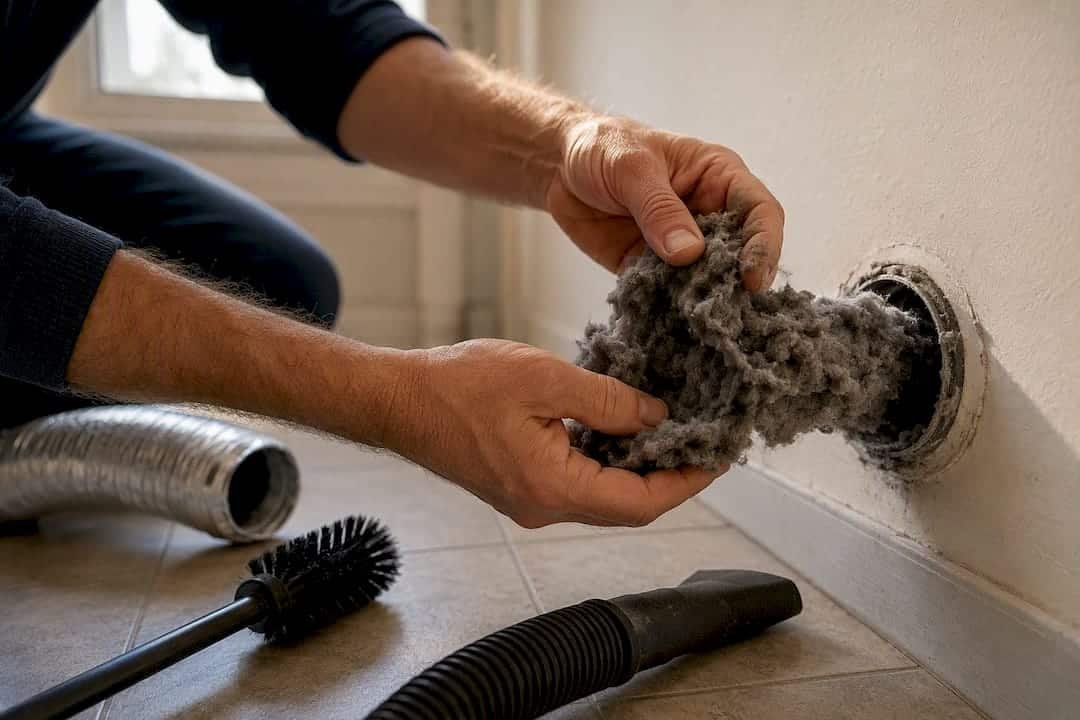
Start with what you can check yourself: clear the lint trap after every load, inspect the exterior vent hood for buildup, and watch for longer-than-normal dry times, which is often the first warning sign. If your dryer vent hasn’t been professionally cleaned in over a year, or you notice a burning smell, it’s time to call a pro.
Professional vent cleaning typically runs $75 to $300 depending on duct length and accessibility, according to Angi, and treating it as routine maintenance is far cheaper than the repairs it prevents.
How Should Homeowners Think About Dryer Repair Costs?
Homeowners consistently underestimate how much airflow problems masquerade as mechanical failures. A dryer that’s taking two cycles to dry a load often gets diagnosed as a heating element issue when the real culprit is a clogged vent that’s been ignored for years.
We’d argue the more useful mental model isn’t “what’s this repair going to cost” but “what did skipping maintenance cost me.” A $150 vent cleaning that gets skipped for three years routinely turns into a $300 heating element replacement, and sometimes both a thermal fuse and a heating element at once. The 50% rule matters, but it only works if your diagnostic is accurate in the first place, which is why we push back against quick phone-based estimates for anything beyond a lint trap check.
— MDTECH
How to Book MDTech for Dryer Repair or Replacement Guidance
Mdtechservices gives Orange County and Los Angeles County homeowners a straightforward alternative to guessing at a quote over the phone: licensed technicians who diagnose the actual problem on-site, price it transparently, and stand behind the repair with a parts and labor warranty.
When you book a visit, expect a clear sequence: a diagnostic check to confirm the actual cause (not just the symptom), a written quote before any work begins, and a conversation about repair versus replacement if your dryer’s age or the estimate points that direction. For gas dryers, our technicians are licensed to handle gas-line and igniter work safely, which matters more than most homeowners realize until they’re comparing quotes from unlicensed handymen. If you’re weighing your options right now, our dryer repair service page covers scheduling and service areas, and our guide on appliance repair versus replacement walks through the same decision framework with local pricing context. Book an appointment online and get a technician out to look at the actual problem instead of guessing from a symptom description.
Where These Dryer Repair Cost Figures Come From
The cost ranges throughout this guide draw from a mix of consumer cost-tracking sites and repair-vs-replace guidance:
- HomeAdvisor for national repair cost ranges and gas-versus-electric pricing differences.
- Consumer Reports for the repair-versus-replace decision framework.
- Yelp and Thumbtack for diagnostic fees, labor rates, and average totals.
- Angi for vent cleaning cost data.
- Mdtechservices’s vent cleaning guide and third-party repair-vs-replacement guide for practical homeowner steps.
Sources
- How Much Do Dryer Repairs Cost? 2026 Data — HomeAdvisor
- Should you repair or replace your broken clothes dryer? — Consumer Reports
- How much does Dryer repair cost? — Yelp Costs
- 2026 Appliance Repair Costs | Get Estimates — Thumbtack
- Dryer repair cost — Angi