
Most washer repair costs land between $150 and $500, with a typical invoice around $200 to $300 once you add labor, parts, and the diagnostic visit. If the estimate creeps past half the price of a new comparable washer, or the machine is older than eight years, replacement usually makes more financial sense. Control boards, motors, and bearing jobs tend to push totals toward the top of that range.
TL;DR:
- Common washer repairs typically cost between $150 and $500, with major part replacements like control boards and motors pushing costs closer to $700.
- When repair estimates exceed half the cost of a new washer or the machine is over eight years old, replacement generally offers better value.
- Labor time, not part cost, mainly drives price differences, with front-loaders and built-in units requiring significantly more disassembly than top-load washers.
- Diagnostic fees are usually credited toward the repair if authorized, and obtaining itemized, multiple quotes helps prevent overpaying on major repairs.
- Diagnosing the problem accurately before parts replacement and addressing small symptoms early can save homeowners hundreds of dollars.
Table of Contents
- How Much Does Washer Repair Cost on Average?
- What Do Common Washer Problems Cost to Fix?
- Does Washer Type Affect Repair Cost?
- What Affects Your Washer Repair Quote?
- Should You Repair or Replace Your Washer?
- What Happens During a Washer Diagnostic Visit?
- MDTech: Technician Tips That Actually Save You Money
- Our Recommendation: Diagnose Before You Decide
- Book a Washer Diagnostic With MDTech Services
- Where These Cost Estimates Come From
- Sources
How Much Does Washer Repair Cost on Average?
A typical washer repair invoice runs $150 to $500, and most homeowners land somewhere in the middle of that range once the technician finishes the job. Consumer Reports puts common minor fixes under $200, with major component work climbing above $300. Separate marketplace data from Yelp shows real customer quotes clustering between $125 and $300, which lines up with what you’ll typically see on a paid invoice rather than an advertised “starting at” price.
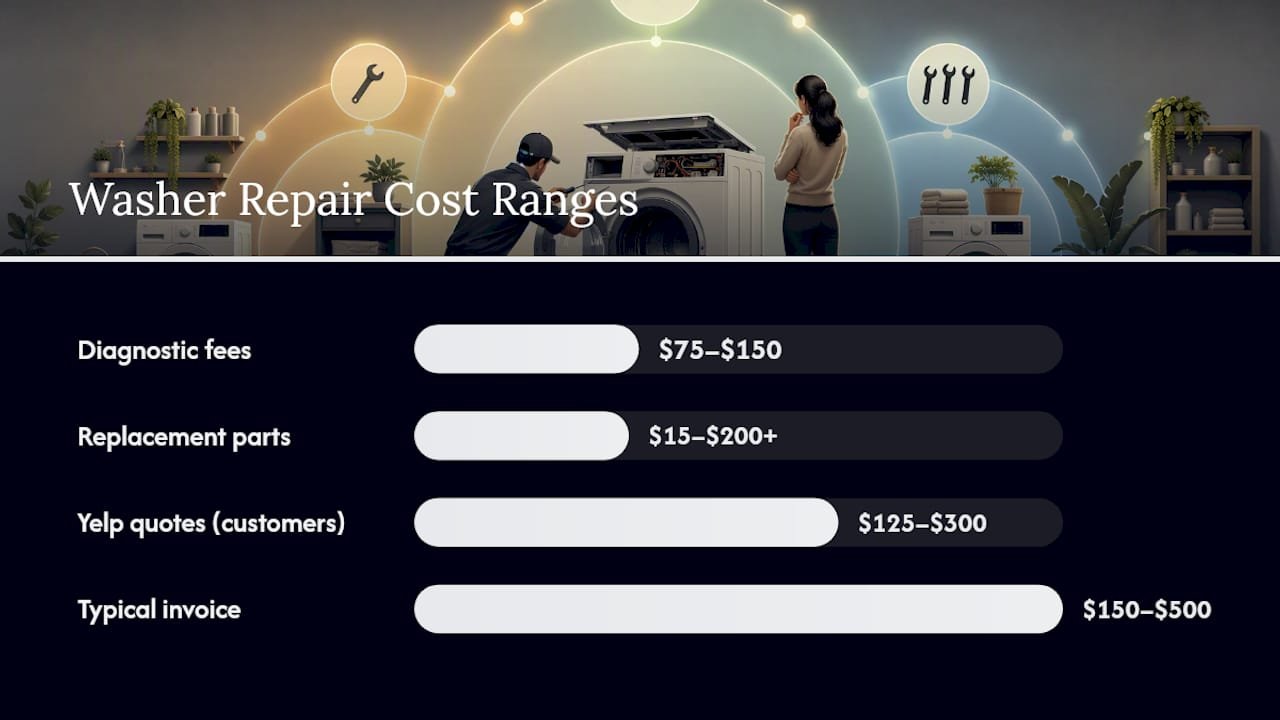
That invoice typically includes diagnostic or service fees, labor charges, replacement parts, and possibly travel or zone fees. Sales tax on parts applies in most states too, and it’s easy to forget when you’re mentally budgeting.
Here’s where the numbers actually come from:
Typical washer repair cost breakdown:
- Diagnostic/service fees are common and often credited toward the final repair cost if you proceed.
- Labor: billed hourly or as a flat job rate, depending on the company
- Parts: ranges wildly by component, from a $15 belt to a $200+ control board
- Travel or zone fee: sometimes bundled into the service call, sometimes billed separately
The outliers that blow past $500 almost always trace back to the same three culprits: a failed control board, a burned-out motor, or bearing damage inside the tub assembly. Those repairs demand more diagnostic time and, in the case of bearings, significant disassembly labor. A washer shaking violently or walking across the floor during the spin cycle is often the first sign one of those bigger components is failing, not just a simple leveling issue.
Pro Tip: Ask upfront whether the diagnostic fee gets applied to the repair cost if you approve the work. Most reputable companies do this, and it can save you $75 to $150 on the final bill.
What Do Common Washer Problems Cost to Fix?
Pinpointing the failed part before the technician arrives won’t get you an exact quote, but it will get you into the right ballpark. Washer repair prices vary dramatically depending on which component failed and how much teardown it takes to reach it.
- Drain pump replacement: roughly $100 to $350, according to FixAppLab’s cost breakdown, with labor typically running 30 to 60 minutes once the pump is confirmed as the culprit. This is one of the most common reasons a washer won’t drain.
- Door latch or lid switch: usually $50 to $200, among the cheapest fixes on this list because the part is inexpensive and access is straightforward.
- Inlet valve: generally falls in a similar low range, often under $200 total including labor.
- Drive belt: a modest parts cost, but labor to access it on some front-load models adds more time than the part itself.
- Motor replacement: commonly $300 to $700, since motors are pricier parts and often require partial disassembly of the cabinet.
- Control board: typically $250 to $900, the widest range on this list because board prices vary enormously by brand and model.
- Bearings/tub assembly: often $350 to $700, driven almost entirely by labor since reaching the bearings usually means pulling the drum.
Combined failures raise totals fast. A washer that’s been shaking violently for weeks before anyone calls a technician has often damaged more than the original bearing. The imbalance from an unbalanced spin cycle can stress the suspension system, the drum, and sometimes the motor mounts, turning what should have been a single-part fix into a multi-part invoice.
Does Washer Type Affect Repair Cost?
Design matters almost as much as the broken part. A basic top-load washer is generally the least expensive machine to repair because most of its guts are accessible from the top or front without pulling the entire cabinet apart. Portable and compact units follow a similar pattern, though parts can occasionally be harder to source depending on the brand.
Front-load washers and integrated (stacked or built-in) units cost more to repair on average. Front-loaders fail differently than top-loaders too, with door seals and drum bearings wearing out more often, and reaching either one requires significantly more teardown time than a comparable top-load repair. That extra labor, not the part itself, is what drives the price gap between washer types.
| Part or Component | Typical Part Cost | Labor Time (Approx.) | Notes |
|---|---|---|---|
| Drain pump | $30 to $100 | 0.5 to 1 hour | Common on both top and front-load models |
| Door gasket/seal | $50 to $150 | 1 to 2 hours | Front-load only; frequent wear item |
| Control panel/board | $150 to $500 | 1 to 2 hours | Price varies heavily by brand and model |
| Drum bearings | $50 to $150 | 2 to 4 hours | Labor dominates the total cost here |
| Inlet valve | $20 to $60 | 0.5 to 1 hour | Low-cost part, quick fix |
Notice how labor time, not part price, is what separates a $150 repair from a $600 one. A $50 bearing kit paired with three hours of disassembly labor easily outprices a $150 control board that swaps in twenty minutes.
What Affects Your Washer Repair Quote?
Several variables move the needle on your final bill beyond just the broken part. Labor rates vary by market and company, contributing significantly to differences in repair quotes. Diagnostic or service fees, typically $75 to $150, get billed separately in most cases, though many companies apply that fee toward the repair cost if you move forward.
Parts availability plays a role too. Older or less common washer models sometimes require ordering a part that isn’t sitting on a truck, which adds days and occasionally a shipping surcharge. Travel or zone fees can apply if you’re outside a technician’s core service area, and sales tax on parts applies almost everywhere.
To compare quotes fairly, follow these steps:
- Request an itemized estimate before agreeing to any work, broken down by parts, labor, and fees.
- Ask for the specific part number being replaced, which helps you verify pricing independently.
- Confirm whether the diagnostic fee is credited toward the repair if you approve the job.
- Ask about warranty terms on both parts and labor, including how long each is covered.
- Get a second quote for anything over $300, since major-component repairs have the widest price spread between companies.
Pro Tip: Two companies quoting the same repair can differ by $100 or more purely based on labor rate and parts markup. Always ask for the itemized breakdown before you agree to anything over a couple hundred dollars.
Should You Repair or Replace Your Washer?
But that rule needs context. A $300 repair on a machine that cost $1,200 new is a completely different decision than the same $300 repair on a machine that cost $500.
Age and repair history matter just as much as the raw percentage. Consider these bands when weighing your options:
- Under 5 years old: Repair almost always makes sense, even for a moderately expensive fix, since the machine has years of useful life left.
- 5 to 8 years old: Repair is still usually worthwhile for parts under $300, but think twice about motor or control board jobs above that.
- 8 to 10+ years old: Lean toward replacement, especially if the repair involves bearings, the transmission, or the main control board.
- Repeat failures: Two or more significant repairs within 12 to 18 months is a strong signal the machine is nearing the end of its useful life regardless of age.
Certain failures tend to force the replacement decision outright. Failed bearings combined with drum damage, a failed transmission, or a control board failure on a machine already past eight years old rarely justifies the investment. If you do replace, factor in operating costs, not just the sticker price. An ENERGY STAR certified washer can meaningfully cut water and energy costs over the life of the machine, which partially offsets the upfront expense of buying new.
What Happens During a Washer Diagnostic Visit?
A diagnostic visit typically follows a predictable pattern, and knowing it in advance helps you avoid surprises on the invoice. The technician will usually run through the same core steps regardless of the brand or symptom you’re dealing with.
- The technician confirms your model number and checks for any stored error codes on machines with electronic displays.
- They run a short test cycle to observe the actual failure, whether that’s an unbalanced spin, a drain issue, or unusual noise.
- Based on that, they isolate the likely part rather than guessing or swapping components blindly.
- If the fix is straightforward and the part is on the truck, many repairs happen same-day.
- If a specialty part needs ordering, expect a return visit, sometimes a few days to a week later depending on availability.
- Common add-on charges include additional labor if teardown reveals a second failed part, or a minor parts markup depending on the company’s pricing structure.
Most technicians, including MDTech Services, credit the diagnostic fee toward the repair when you approve the work on the spot, so ask about that policy before the appointment.
MDTech: Technician Tips That Actually Save You Money
Licensed technicians who book through an online scheduling system check the same things first every time: model number, error history, and how the machine behaves during a short test cycle. That sequence matters because jumping straight to a parts swap without confirming the actual failure is how homeowners end up paying for parts they didn’t need.
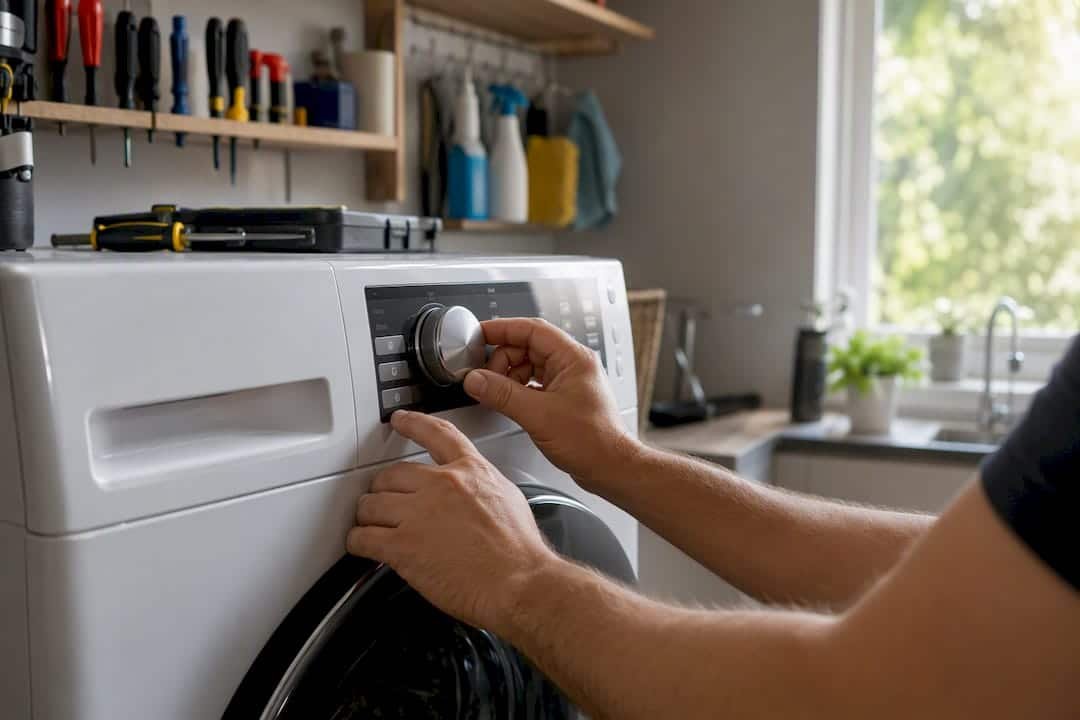
A little prep on your end goes a long way. Have your model number ready, take a couple of photos of the error display or the symptom, and clear the space around the washer before the technician arrives. That alone can shave real time off the visit.
The most common mistake homeowners make? Ignoring a mild symptom, like a washer shaking during spin, until it turns into a bearing failure that costs three times as much to fix.
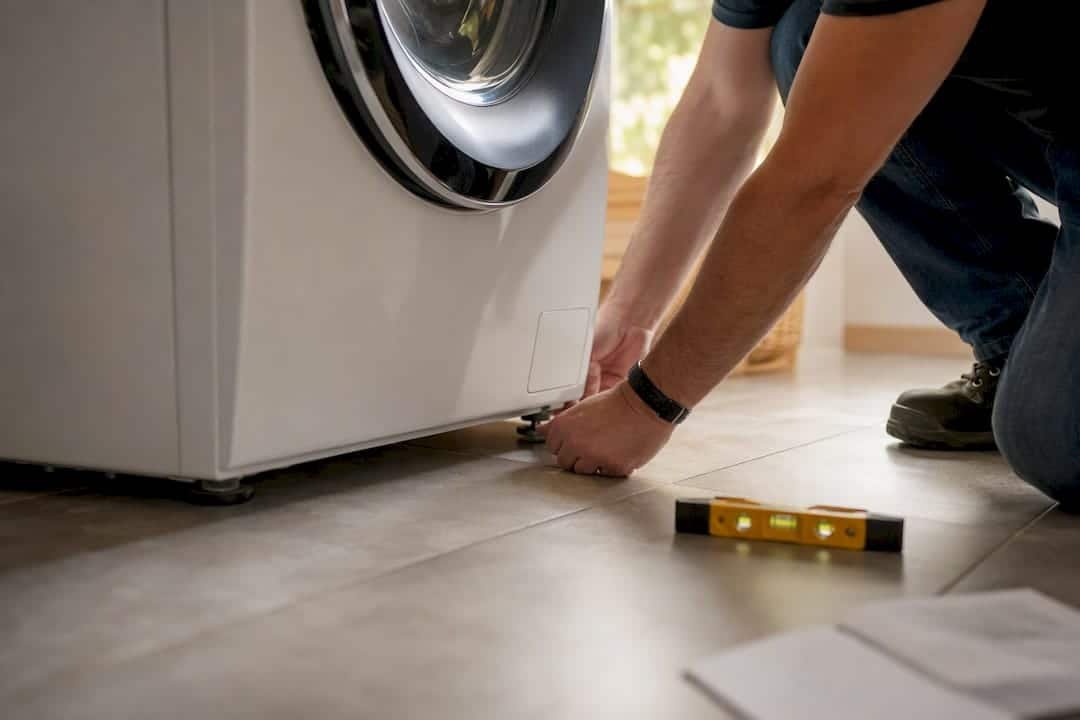
Pro Tip: If your washer is walking across the floor during the spin cycle, check that it’s level and that the shipping bolts were removed if it’s a newer install. That simple fix costs nothing and rules out the cheapest possible cause before you pay for a diagnostic visit.
Our Recommendation: Diagnose Before You Decide
Get a real diagnosis before you spend a dollar on parts. Guessing at a broken washer based on symptoms alone is how homeowners end up replacing a $40 valve twice because the actual problem was a $150 control board.
For anything beyond a minor fix, especially a repair estimate above $300, get two itemized quotes before committing. Compare them on labor rate, part cost, and warranty terms, not just the bottom-line number. Factor in the machine’s age and whether it’s had prior repairs. A young washer with one prior fix is worth saving. An eight-year-old machine on its second major repair usually isn’t.
What we see work well for homeowners time and again: fast, accurate diagnosis that avoids unnecessary parts, transparent part sourcing so you know what you’re paying for, and a clear warranty on both the part and the labor. That combination is what actually protects your wallet, not just the lowest quote on the page.
— MDTECH
Book a Washer Diagnostic With MDTech Services
Mdtechservices gives you a faster path to a fixed washer than calling around for quotes and hoping the estimates line up. We book washer diagnostics online, dispatch licensed technicians across Orange County and Los Angeles County, and credit the diagnostic fee toward your repair when you approve the work on the spot.
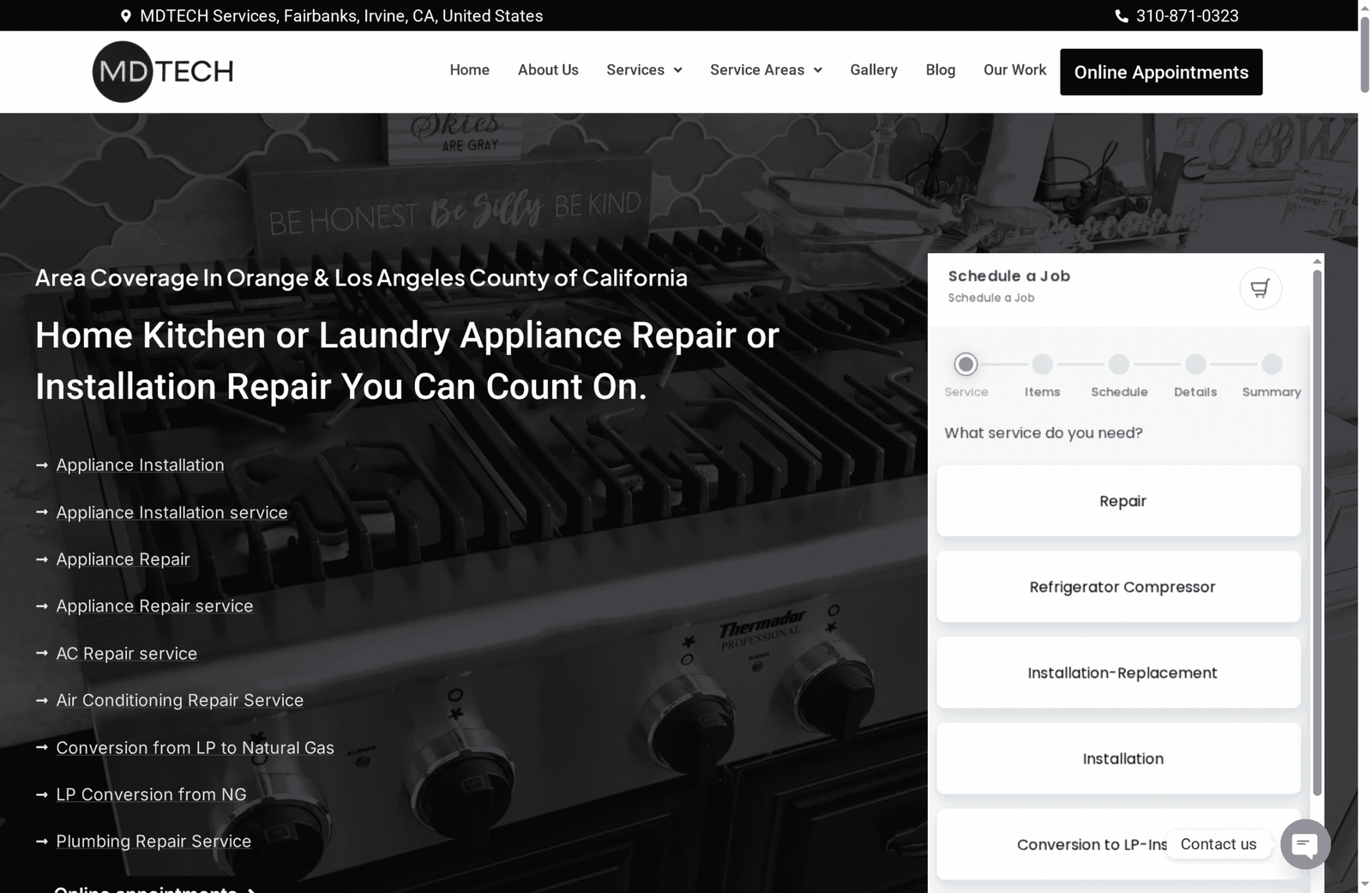
Every estimate comes itemized by parts, labor, and fees, so you know exactly what you’re paying for before a wrench touches the machine. Our technicians carry common parts on the truck for same-day fixes whenever possible, and we back both parts and labor with a clear warranty. If you’re weighing whether to repair or replace, our appliance repair and installation service page walks through the scope of what we cover, and our diagnostic fee explainer breaks down exactly how that first visit is billed. Book your washer diagnostic today and get a straight answer instead of a guess.
Where These Cost Estimates Come From
The ranges in this guide draw from a mix of national data and hands-on repair experience.
- Consumer Reports for repair-versus-replace cost guidance and diagnostic fee norms
- Yelp cost data for real customer quote ranges
- Thumbtack for market-level pricing trends
- ENERGY STAR for efficiency and long-term operating cost context on replacement decisions
Sources
- Should You Repair or Replace Your Broken Washing Machine? – Consumer Reports
- How much does Washer repair cost? – Yelp
- Washing Machine Repair Cost Estimate: 7 Real Costs You Must Know to Save Money (2026 Guide) – FixAppLab
- Appliance repairs cost (Thumbtack)
- ENERGY STAR