
Hiring licensed and insured contractors protects you from most of the financial, legal, and safety risks that come with home repair or renovation work. Three things create that protection: verification through your state licensing board, general liability insurance that covers third-party damage, and workers’ compensation coverage that keeps a jobsite injury from becoming your medical bill. Together, licensing and insurance work as a two-part shield. Licensing confirms the person working in your home actually knows the trade and has passed the exams to prove it. Insurance makes sure that if something still goes wrong, a policy pays for it instead of you.
Here’s what to do before any contractor sets foot on your property:
- Ask for a Certificate of Insurance (COI) sent directly from the insurer or broker, never a copy from the contractor.
- Confirm the license number is active with your state’s licensing board before signing anything.
- Pause the project until both documents check out.
That third step matters more than most homeowners realize. A forged or expired COI looks identical to a real one on paper.
Key Takeaways
Licensed and insured contractors protect homeowners by combining proven trade competency with financial coverage that pays for accidents, damage, and injuries instead of leaving the homeowner exposed.
| Point | Details |
|---|---|
| Verify before work starts | Confirm the COI directly with the insurer or broker, never from a contractor-provided copy. |
| Check both license and insurance | A license confirms competency; insurance transfers financial risk. You need both. |
| Know the coverage minimums | Look for $1M per occurrence / $2M aggregate general liability as a baseline for residential jobs. |
| Ask for additional insured status | This gives you direct coverage rights under the contractor’s policy while work is underway. |
| Choose vetted technicians | Mdtechservices dispatches only licensed, insured technicians and provides documentation before scheduling. |
Table of Contents
- Why Choose Insured Contractors: Licensed vs. Insured vs. Bonded
- Why Licensing Matters for Quality and Legal Protection
- Essential Contractor Insurance Types Homeowners Should Expect to See
- What Can Happen if You Hire an Uninsured Contractor
- How to Verify a Contractor Is Licensed and Insured
- Typical Coverage Amounts and What They Should Cost
- Red Flags and 10 Questions to Ask Before You Hire
- Quick Reference: Essential Policies and Recommended Minimum Limits
- Why MDTech Requires Licensed, Insured Technicians on Every Job
- Get a Licensed, Insured Technician for Your Repair Today
- Frequently Asked Questions
- Sources
Why Choose Insured Contractors: Licensed vs. Insured vs. Bonded
These three words get used interchangeably, and that confusion costs homeowners real money. Each one protects you from a different kind of loss, and none of them substitutes for the other two.
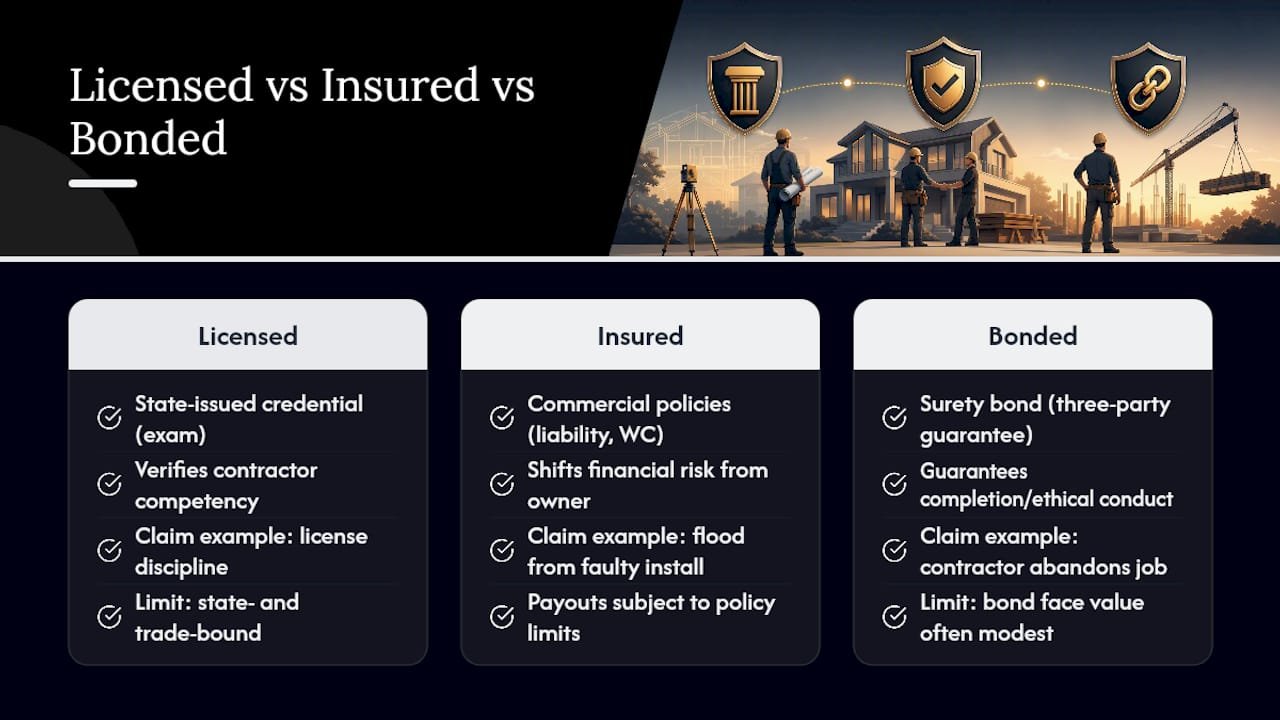
Licensed means the contractor has passed a state-administered competency exam and holds an active credential with a state board, typically tied to a “qualifier” who carries the technical certification for the business. Requirements vary by state and by trade. A plumbing license in one state might not transfer to another, and a general contractor’s license doesn’t automatically cover electrical or gas work.
Insured means the contractor carries policies, usually general liability and workers’ compensation, that transfer financial risk away from you. If a technician damages your flooring or gets hurt on your property, the insurance stack is what pays the claim instead of your homeowner’s policy or your savings account.
Bonded is different from both. A surety bond guarantees performance or ethical conduct. It’s a three-party financial guarantee, not insurance. If a contractor fails to complete a job or violates licensing rules, you can file a claim against the bond, though bond amounts are often modest compared to potential losses.
Here’s how these three play out after something actually goes wrong. If a worker falls off a ladder in your backyard, workers’ compensation insurance pays the medical bills, not you. If that same worker installs a water heater incorrectly and it floods your basement two months later, general liability insurance covers the repair. If the contractor simply walks off the job with your deposit and never finishes, the license bond is your only recourse, and even then, only up to the bond’s face value.

Why Licensing Matters for Quality and Legal Protection
Licensing exists because trades involve real danger. Gas lines, electrical panels, and structural work can injure people or destroy property when done wrong, and a license is the state’s way of confirming the person doing that work has demonstrated minimum competency.
Most state boards require candidates to pass a technical exam covering code requirements, safety standards, and trade-specific practices. Many states also mandate continuing education to keep a license current, which means a licensed contractor is at least nominally staying up to date on changing building codes. That matters directly to you: work performed to code passes inspection, and work that fails inspection can mean tearing out drywall, rerouting plumbing, or redoing electrical runs at your expense.
Licensing also determines what recourse you have if something goes badly. Many states run contractor recovery funds that can reimburse homeowners for losses tied to defective or fraudulent work by a licensed contractor, with payout caps around $25,000 in some states. That fund doesn’t exist for unlicensed work. If your contractor never held a license, you have no state-backed safety net at all, only whatever you can recover in civil court, which is slower, costlier, and far less certain.
One caveat worth repeating: licensing rules are set state by state and sometimes county by county. A contractor licensed correctly in a neighboring state may not be licensed to work legally where you live. Always confirm current requirements directly with your state licensing board rather than assuming a credential transfers.
Essential Contractor Insurance Types Homeowners Should Expect to See
A single liability policy doesn’t cover everything a home project can go wrong. Contractors typically carry a stack of different policies, each addressing a distinct kind of risk.
- General liability (GL): Covers third-party bodily injury and property damage, the policy that pays if a technician’s blowtorch scorches your cabinets or a dropped tool cracks your tile floor.
- Workers’ compensation (WC): Covers medical costs and lost wages if a worker is injured on your property. Without it, that liability can land on you as the homeowner.
- Commercial auto: Covers accidents involving a contractor’s work vehicles, relevant if a delivery truck or work van causes damage on or near your property.
- Inland marine (tools and equipment): Covers the contractor’s tools and materials against theft or damage, which indirectly protects your timeline since a covered contractor can replace stolen equipment fast instead of stalling your project.
- Umbrella coverage: Extends liability limits beyond what a standard GL or auto policy caps, important for larger renovation jobs where potential damages could exceed a base policy’s ceiling.
- License, payment, and performance bonds: Not insurance, but a financial guarantee tied to completing the job and paying subcontractors and suppliers, which protects you from mechanic’s liens if a contractor fails to pay their crew.
Design-build firms or contractors who also offer engineering or design consulting may carry professional liability as well, covering errors in plans or specifications rather than physical damage.
What Can Happen if You Hire an Uninsured Contractor
The risks here aren’t hypothetical. They’re the kind of thing that shows up in real insurance claims and legal disputes every year.
Say a subcontractor with no workers’ compensation coverage gets injured while replacing your water heater. In many states, the law treats the hiring party, meaning you, as a statutory employer when the subcontractor lacks insurance, which can create immediate liability for that worker’s medical bills and lost wages. That’s not a rare technicality. It’s how the law assigns responsibility upstream when nobody along the chain carried proper coverage.
Property damage plays out just as badly without insurance backing it. If an uninsured plumber botches a supply line connection and floods your basement overnight, you’re paying for water extraction, drywall replacement, and mold remediation out of your own pocket, since there’s no GL policy standing behind the work. Your homeowner’s insurance may deny the claim entirely once it discovers the damage traces back to unlicensed or uninsured labor.
There’s also a slower, less visible risk. If you regularly hire subcontractors and one turns out to be uninsured, an insurance audit can retroactively add that subcontractor’s payroll to your own policy, spiking your premium. A single claim tied to uninsured work can raise your rates for years afterward, well beyond the cost of the original repair.
Unlicensed work carries its own separate tangle. Permits often get denied or flagged when the applicant can’t produce a valid license number, which can lead to stop-work orders mid-project. And insurers frequently deny claims outright once they discover the work was performed by someone unlicensed, leaving you to cover repairs that a valid claim would otherwise have paid for.
How to Verify a Contractor Is Licensed and Insured
This is the part homeowners skip, and it’s the part that actually prevents the scenarios above. Treat it as a five-step process, not a single phone call.
- Request insurer details up front. Ask for the name of the contractor’s insurance company and the policy numbers for both general liability and workers’ comp, and ask that their broker send the certificate directly to you.
- Call the insurer to confirm the policy is active. Verify the policy number, effective and expiration dates, and coverage limits directly with the insurance company, never through a number the contractor gives you.
- Check the license with your state board. Confirm the license is active, tied to the correct qualifier, and covers the trade scope of your project (a general license doesn’t always cover gas or electrical subcontracting).
- Ask about additional insured status. For larger projects, request to be named as an additional insured or certificate holder, and ask about a waiver of subrogation on the workers’ comp policy so the insurer can’t come after you if a claim arises.
- Track expiration dates through the project. Policies can lapse mid-job. Set a calendar reminder near the COI’s expiration date and request an updated certificate before it lapses.
Pro Tip: Never accept a COI as a PDF or photo sent by the contractor. Contact the insurer or broker directly and ask them to send the certificate to your email. A forged or expired document looks exactly like a real one until someone at the insurance company confirms it.
A genuine COI is typically an ACORD-format document showing the insurer’s name, policy numbers, coverage types, policy limits, and effective and expiration dates, along with the named insured matching the contractor’s business name. If any of those fields look blank, outdated, or mismatched from the company you’re hiring, that’s your signal to stop and call the insurer before signing anything.
Typical Coverage Amounts and What They Should Cost
Homeowners often have no benchmark for what “enough coverage” looks like, which makes it easy for a low-ball or underinsured contractor to slide through unnoticed.
For residential work, a general liability policy with a million-dollar per occurrence and multi-million aggregate is a common minimum that reputable contractors carry. Larger renovation or structural projects sometimes warrant higher limits, particularly if the work involves multiple trades or extended timelines where cumulative exposure may grow.
Workers’ compensation is legally required in nearly every state once a contractor employs staff, with Texas standing out as the notable exception that allows employers to opt out. That patchwork matters to you directly: in a state requiring workers’ comp, an employer skipping it is already operating outside the law, which should raise real doubt about their overall business practices.
Cost benchmarks help you judge whether a quote reflects a properly insured operation or a corner-cutting one. The average monthly cost for general liability alone runs around $142 for a typical contractor, though that number shifts significantly by trade hazard level. Factor in the full policy stack, general liability, workers’ comp, commercial auto, and tools coverage, and total annual insurance costs for small contractors commonly land between $1,800 and $8,500 depending on payroll size, vehicle count, and how hazardous the trade is. A quote priced dramatically below that range, especially for a crew running multiple vehicles and employees, is worth questioning.
License bond amounts also vary by state and trade, generally functioning as a smaller financial cushion against non-performance rather than a substitute for liability coverage. Since these figures shift by state and by trade, confirm current norms with your local licensing board or the contractor’s insurer rather than treating any single number as universal.
Red Flags and 10 Questions to Ask Before You Hire
Certain warning signs show up again and again in contractor fraud cases. Watch for a large cash deposit demanded up front, reluctance to provide a verifiable COI, no local references you can actually call, resistance to pulling permits, or a work vehicle with no visible business name or license number.
Asking the right questions at the bid stage filters out most of these problems before you ever sign a contract.
- What’s your license number, and which board issued it?
- Who’s your insurance carrier, and what are your policy numbers?
- Can your broker send the COI directly to me rather than through you?
- Will you add me as an additional insured for the duration of this project?
- Does your policy include completed operations coverage after the job ends?
- Are you bonded, and what’s the bond’s face value?
- Do you carry workers’ compensation for every worker on-site, including subcontractors?
- Can you provide three local references from projects similar to mine?
- Will you provide a written contract detailing scope of work and payment schedule?
- Who’s responsible for pulling permits, and what’s the expected project timeline?
Question four matters more than homeowners tend to assume. Additional insured status gives you direct coverage rights under the contractor’s own policy while work is underway, rather than leaving you to chase a claim after the fact. It’s one sentence in an email to their broker, and it closes a real gap most homeowners never think to ask about.
Quick Reference: Essential Policies and Recommended Minimum Limits
Comparing bids gets easier once you know what each policy is supposed to cover and what a reasonable floor looks like for a typical residential job.
| Policy Type | What It Covers | Recommended Minimum | Raise the Limit When |
|---|---|---|---|
| General liability | Third-party injury and property damage | $1M per occurrence / $2M aggregate | Project involves multiple trades or structural work |
| Workers’ compensation | Medical costs and lost wages for injured workers | State-mandated statutory limits | Any project involving on-site labor beyond a single technician |
| Commercial auto | Damage from contractor vehicles on your property | Matches state minimum liability requirements | Large crews with multiple vehicles on-site regularly |
| Inland marine | Contractor’s tools and equipment | Enough to cover replacement cost of core tools | High-value specialty equipment is involved |
| Umbrella | Extends liability beyond base policy limits | $1M in excess coverage | Renovation scope or property value is significant |
| License bond | Financial guarantee against non-performance | Varies by state and trade | Larger contracts with substantial upfront deposits |
Pro Tip: When comparing two bids with similar pricing, ask each contractor for their GL policy limits side by side. A contractor quoting the industry-standard $1M/$2M limits is usually a more established operation than one who hesitates to answer or names a much lower figure.
Use this table as a screening tool during the bid process, not just after you’ve already chosen someone. A contractor who can’t produce these figures on request, before you’ve committed to anything, is telling you something important about how they run their business.
Why MDTech Requires Licensed, Insured Technicians on Every Job
We built our dispatch policy around a simple rule: every technician we send into a customer’s home carries an active license and current insurance, full stop. That isn’t a marketing line. It’s a practical response to what actually happens when things go wrong on a jobsite, because someone eventually has to pay for a mistake, and we’d rather that be an insurer than a homeowner.
Requiring insurance also changes how claims get handled when a rare accident does occur. Because our technicians carry verified coverage, a damaged appliance or an unexpected leak during a repair becomes a straightforward insurance matter rather than a dispute over who’s financially responsible. We verify certificates of insurance directly with carriers rather than accepting a technician’s own paperwork, and we keep records of active licenses on file so a customer can confirm credentials before work begins.
The bigger reason is simpler than any policy document: homeowners deserve to know the person working on their gas line or electrical panel has actually proven they know what they’re doing, and that if something still goes sideways, they aren’t the one left holding the bill.
Get a Licensed, Insured Technician for Your Repair Today
You don’t have to run the entire verification checklist yourself. Mdtechservices dispatches only licensed, insured technicians for appliance repair, HVAC service, and plumbing work across Orange County and Los Angeles County, which means the vetting work described above is already done before a technician arrives at your door.

When you request service, we’ll provide the technician’s license number and confirm current general liability and workers’ compensation coverage before scheduling, along with a written scope of work outlining the job and payment terms. If your request involves gas appliance conversion or complex installation work, mention that upfront so we can match you with a technician credentialed for that specific scope. To speed things along, have your appliance model number, a description of the issue, and your preferred appointment window ready when you reach out.
Ready to book? Visit our appliance repair services page to schedule a licensed technician and request your documentation in the same conversation.
Frequently Asked Questions
Why choose insured contractors over one without coverage?
Insured contractors transfer financial risk away from you. If an accident, injury, or property damage happens during the project, the contractor’s policy pays for it instead of your savings or homeowner’s insurance.
What’s the difference between a licensed contractor and a bonded one?
A license confirms technical competency verified by a state board. A bond is a financial guarantee that compensates you if the contractor fails to complete the job or violates licensing terms, separate from any insurance policy.
How do I know if a contractor’s insurance is real?
Call the insurer or broker listed on the certificate directly and ask them to confirm the policy is active and matches the coverage limits shown. Never rely solely on a document the contractor hands you.
What happens if an uninsured contractor damages my property?
You’re typically responsible for repair costs out of pocket, since there’s no general liability policy to file a claim against, and your own homeowner’s insurance may deny coverage once it learns the work was done by an uninsured party.
Do I need to worry about workers’ compensation if I’m just hiring one person?
Yes. If that person gets injured on your property and carries no coverage, state law can assign the medical and wage liability to you as the hiring party, regardless of crew size.
This article is general information, not a substitute for advice from a qualified lawyer. Consult a qualified legal professional about your own circumstances before acting on anything here.
Sources
Start with your state’s licensing board website to confirm an active license and check for any disciplinary history tied to the contractor’s name or business. For insurance verification, call the carrier listed on the COI directly rather than a number provided by the contractor, and ask specifically about policy status, limits, and expiration dates.
The Minnesota Department of Labor and Industry’s contractor hiring guide and New Hampshire Insurance Department’s verification guide both offer practical, state-level frameworks that translate well regardless of where you live, since the underlying verification logic — confirm with the source, not the contractor — holds everywhere. For a broader look at how coverage types stack together, MoneyGeek’s contractor insurance breakdown explains each policy type in plain language.
Call the insurer when you need to confirm a policy is active or check specific limits. Call the licensing board when you need to confirm a credential is valid or check for prior complaints. Both calls take a few minutes and cost you nothing, which makes skipping them one of the more expensive shortcuts a homeowner can take.
- Tips for hiring a contractor
- Contractor insurance: requirements and needs
- How to verify if your contractor has the right insurance
- Contractor insurance guide: cost by trade
- Subcontractor has no insurance — essential guide