
TL;DR:
- Property managers handle tenant repair requests, assign work orders, manage vendors, and document all maintenance actions. Owners still retain legal responsibility for habitability and must actively oversee and audit maintenance records to protect their investment. Effective maintenance systems reduce costs, tenant disputes, and vacancies by prioritizing preventive upkeep and professional response.
Property managers are defined as the operational coordinators responsible for receiving tenant repair requests, assigning work orders, managing vendors, and documenting every maintenance action on behalf of property owners. The role of property managers in maintenance is far more structured than most landlords realize. Platforms like Buildium categorize multifamily maintenance into four distinct types: routine repairs, preventive inspections, emergency response, and cosmetic upkeep. Understanding exactly what your property manager handles, and what legal responsibility stays with you, is the clearest way to protect your investment and keep tenants satisfied.
What specific maintenance responsibilities do property managers handle?

Property managers coordinate tenant service requests, assign work orders, track completion, and verify safety compliance on behalf of landlords. This is not a passive role. It requires daily operational decisions that directly affect your property’s condition and your tenants’ experience.
The core maintenance duties of managers include:
- Receiving and triaging repair requests. Managers assess urgency, categorize the issue, and decide whether it requires an emergency response or a scheduled repair.
- Issuing and tracking work orders. Every repair gets a documented work order with a vendor assignment, timeline, and completion record.
- Scheduling preventive inspections. Seasonal HVAC checks, gutter cleaning, and appliance inspections are planned in advance, not handled after something breaks.
- Managing emergency repairs. Burst pipes, heating failures, and electrical hazards require immediate escalation. Managers maintain on-call vendor lists for exactly these situations.
- Vendor qualification and onboarding. Managers act as the maintenance workflow control plane, qualifying contractors, setting service-level agreements, and managing payment timelines.
- Maintaining compliance records. Every repair, inspection, and safety check gets documented. This paper trail protects you legally and operationally.
Property management platforms like Buildium and AppFolio give managers a centralized system to coordinate all of these tasks. Without that structure, repairs fall through the cracks and tenant disputes follow.
Pro Tip: Ask your property manager to share a monthly work order summary. If they cannot produce one, your maintenance documentation is likely incomplete.
The Indeed job description for property managers lists maintenance coordination and tenant communication as two of the most time-intensive core duties. These are not administrative add-ons. They are the job.
How do property managers balance preventive vs. reactive maintenance?
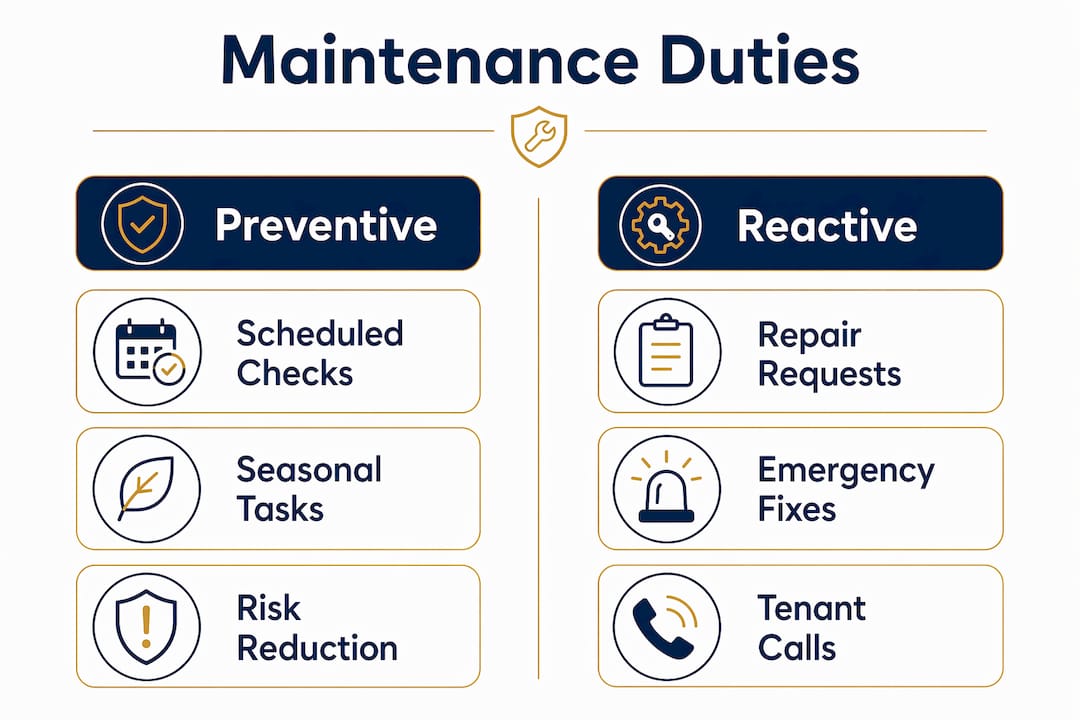
Preventive maintenance is scheduled upkeep performed before a system fails. Reactive maintenance is a repair triggered after something breaks. The difference in cost and tenant impact between the two is significant.
Effective maintenance management shifts from reactive repairs to preventive upkeep and quick responsive workflows. Property managers who invest in prevention reduce the frequency of emergency calls, lower repair costs over time, and keep tenants from experiencing disruptive failures.
| Maintenance Type | Trigger | Example | Risk if Skipped |
|---|---|---|---|
| Preventive | Scheduled calendar | Seasonal HVAC tune-up | System failure in peak season |
| Reactive | Tenant complaint or failure | Replacing a broken water heater | Tenant displacement, legal exposure |
| Emergency | Immediate safety risk | Burst pipe, gas leak | Habitability violation, liability |
| Cosmetic | Owner or lease renewal | Repainting, carpet replacement | Tenant dissatisfaction, lower rent |
Preventive maintenance success requires operational discipline using seasonal calendars and computerized maintenance management system (CMMS) schedules rather than ad-hoc spreadsheets. Missed preventive maintenance consistently leads to larger corrective work. A skipped HVAC filter change in spring becomes a full compressor replacement by august.
Understanding home preventive maintenance at the property level helps landlords set realistic expectations for what a well-run maintenance program actually covers.
Pro Tip: Require your property manager to provide a written preventive maintenance calendar at the start of each year. It should include HVAC, plumbing, roofing, and appliance checks with assigned dates and responsible vendors.
What legal responsibilities stay with property owners despite manager involvement?
Landlords retain ultimate legal responsibility for property condition and habitability even when a property manager handles daily maintenance. This is the most misunderstood aspect of the landlord-manager relationship.
The implied warranty of habitability is a legal standard that requires landlords to maintain rental properties in a livable condition. It covers functioning heat, safe electrical systems, weatherproofing, and working plumbing. A property manager executes the coordination, but the legal obligation belongs to you as the owner.
Key legal and financial points every landlord must understand:
- The manager is your agent, not your legal substitute. If a repair is missed and a tenant is harmed, you face the liability, not the manager.
- Habitability violations can trigger tenant remedies. Depending on the state, tenants may withhold rent, repair and deduct costs, or terminate the lease if habitability standards are not met.
- Documentation gaps create legal exposure. Without complete work order records, photos, and completion notes, you cannot defend against a tenant dispute or regulatory complaint.
- Owner oversight is not optional. Owners must audit maintenance logs, work order evidence, and compliance documents routinely rather than trusting invoices alone.
- Safety compliance is your responsibility. Smoke detectors, carbon monoxide alarms, and structural safety are habitability requirements, not optional upgrades.
Working with a professional property management firm like Sagareus in markets like Seattle demonstrates how organized workflow documentation reduces legal risk for owners. The principle applies regardless of your market.
The takeaway is direct: delegate the execution, but never delegate the oversight.
How does effective maintenance coordination improve tenant satisfaction?
Tenant satisfaction is strongly affected by whether maintenance runs as a structured system rather than a repair queue. Systems featuring prevention and fast response reduce incidents and waiting times for tenants. The property manager is the primary point of contact for every repair concern, and how they handle that communication shapes whether tenants renew or leave.
A well-run maintenance workflow follows a clear sequence:
- Tenant submits a repair request. The manager acknowledges receipt within a defined timeframe, typically 24 hours for non-emergency issues.
- Manager triages the request. Urgency is assessed, and the repair is categorized as emergency, routine, or scheduled.
- Work order is issued to a qualified vendor. The vendor receives clear scope, access instructions, and a completion deadline.
- Unit access is coordinated with the tenant. Proper notice is given, and the tenant is informed of the scheduled repair window.
- Repair is completed and documented. A complete evidence trail with photos and completion notes closes the work order. Without this, repairs appear incomplete and repeat calls follow.
- Tenant receives confirmation. A follow-up message confirms the repair is done and invites feedback.
Communication is inseparable from maintenance. Property managers who resolve maintenance concerns professionally and promptly build tenant trust. That trust directly reduces turnover, which is one of the most expensive costs a landlord faces.
Improving how your team handles repair requests reduces both tenant frustration and the volume of repeat calls for the same issue.
Key Takeaways
Property managers execute maintenance coordination on behalf of landlords, but owners retain full legal responsibility for habitability and must actively audit their manager’s work.
| Point | Details |
|---|---|
| Manager as operational coordinator | Property managers triage requests, issue work orders, manage vendors, and document every repair. |
| Preventive beats reactive | Scheduled maintenance using CMMS tools reduces emergency repairs and protects asset value. |
| Owner legal liability remains | Landlords are legally responsible for habitability even when a manager handles daily maintenance. |
| Documentation protects everyone | Complete work order records with photos and completion notes prevent tenant disputes and legal exposure. |
| Communication drives retention | Fast, professional maintenance responses reduce tenant turnover and conflict. |
What I have learned from watching maintenance programs succeed and fail
After working with landlords and property owners across Orange County and Los Angeles County, the pattern is consistent. The properties with the fewest tenant disputes and the lowest repair costs are not the newest buildings. They are the ones where the property manager treats maintenance as a system, not a to-do list.
The most common mistake I see is landlords who assume that hiring a property manager means they can stop paying attention to maintenance entirely. That assumption is expensive. A manager who does not use a structured work order system, does not maintain vendor SLAs, and does not produce monthly documentation summaries is creating liability for you, not reducing it.
The second mistake is underinvesting in preventive maintenance. Landlords who push back on seasonal HVAC checks or annual plumbing inspections almost always end up paying far more for emergency repairs within two to three years. The math is not complicated. Prevention costs less than correction.
My honest advice: treat your property manager’s maintenance program the way you would treat a financial audit. Review work order logs quarterly. Verify that vendor qualifications are current. Confirm that preventive schedules are being followed, not just promised. The landlords who do this consistently face fewer legal problems, retain tenants longer, and spend less on repairs overall.
Trust your manager to execute. Verify that they actually did.
— MDTECH
Mdtechservices supports landlords with reliable repair services
When your property manager schedules an appliance or HVAC repair, the quality of the service provider determines whether the problem is actually solved. Mdtechservices serves landlords and property managers across Orange County and Los Angeles County with licensed appliance repair, HVAC repair, and plumbing services.

Fast, professional repairs reduce tenant downtime and protect your property’s condition between major maintenance cycles. Whether your manager has flagged an HVAC issue or a tenant has reported a failing appliance, Mdtechservices provides the responsive, documented service that fits a well-run maintenance workflow. Learn more about HVAC repair for residential properties or review our appliance repair services to see how we support property maintenance operations directly.
FAQ
What is the role of property managers in maintenance?
Property managers coordinate all maintenance activity including tenant repair requests, vendor assignments, work order tracking, and preventive scheduling on behalf of the property owner. They are the operational point of contact for every maintenance issue.
Are landlords still liable for maintenance when they hire a property manager?
Yes. Landlords retain legal responsibility for habitability under the implied warranty of habitability regardless of management delegation. The manager executes; the owner remains legally accountable.
What is the difference between preventive and reactive maintenance?
Preventive maintenance is scheduled upkeep performed before a failure occurs, such as seasonal HVAC inspections. Reactive maintenance is a repair triggered after a system breaks down, and it consistently costs more and disrupts tenants longer.
How should landlords oversee their property manager’s maintenance work?
Landlords should review work order logs, vendor qualifications, and compliance documents on a regular basis rather than relying on invoices alone. Quarterly audits of maintenance records are the minimum standard for responsible ownership.
How does maintenance quality affect tenant retention?
Tenants who experience fast, professional maintenance responses are significantly more likely to renew their leases. Poor maintenance communication is one of the leading causes of tenant turnover and lease disputes.