
TL;DR:
- Regular water heater maintenance in Southern California prevents costly energy waste and premature equipment failure.
- Annual checks of safety components, sediment flushing, and inspections extend tank lifespan and protect family safety.
- Consistent professional support and adherence to local codes ensure reliable, efficient hot water systems year-round.
Your water heater works every single day, and most homeowners in Orange County and Los Angeles County never think about it until cold water shows up in the shower. That is a costly mistake. Neglecting routine maintenance quietly raises your monthly energy bills, creates real safety risks, and can cut years off your tank’s life. Southern California’s notoriously hard water makes this even more urgent, because sediment reduces efficiency and increases energy use far faster than most people realize. This guide walks you through exactly why maintenance matters, what tasks to prioritize, and how to protect your home and family year after year.
Table of Contents
- The hidden costs of skipping water heater maintenance
- How water heater maintenance protects your home and family
- What tasks matter most: A practical maintenance checklist
- What’s different in California? Local regulations and home realities
- Tailoring your water heater maintenance to your home
- The uncomfortable truth about water heater maintenance
- Protect your home with expert support
- Frequently asked questions
Key Takeaways
| Point | Details |
|---|---|
| Boosts efficiency | Regular maintenance removes sediment, improving heating speed and lowering energy costs. |
| Prevents safety hazards | Annual checks keep the pressure relief valve working and reduce the risk of dangerous pressure buildup. |
| Saves money long term | Proper upkeep extends equipment life and reduces surprise repair bills. |
| Local water quality matters | Hard water in Southern California means you may need to service your water heater more frequently. |
| Know when to call a pro | Some repairs and inspections require a licensed expert for safety and compliance. |
The hidden costs of skipping water heater maintenance
Most homeowners think of their water heater as a set-it-and-forget-it appliance. The reality is very different, and the financial impact of neglect adds up faster than you might expect.
Water in the Los Angeles and Orange County areas is classified as hard, meaning it carries elevated levels of dissolved calcium and magnesium. Every time your heater warms water, these minerals separate out and sink to the bottom of the tank as sediment. Over time, that layer of sediment acts as insulation between the burner and the water, so sediment forces the system to work harder and drives up your utility costs month after month.
Beyond energy waste, sediment buildup causes other problems. The tank has to cycle on more often, which stresses the heating element or burner. That extra stress shortens the equipment’s usable life. A well-maintained water heater typically lasts 10 to 15 years. Skip maintenance consistently, and you may find yourself replacing the unit several years early, at a cost of $900 to $1,800 or more depending on the model and installation fees.
“A neglected water heater is not just an inefficient appliance. It is a ticking expense that grows quietly in your utility closet.”
Parts like the anode rod and the temperature-and-pressure (T&P) relief valve also degrade without attention. The anode rod is a sacrificial metal rod that prevents tank corrosion. When it is fully depleted and not replaced, the tank itself begins to corrode from the inside out. By the time you notice rust-colored water or a leak, the damage is already significant. Exploring water heater repair solutions early almost always costs less than waiting for a failure.
Common consequences of skipping maintenance:
- Monthly energy bills that climb 10 to 20 percent higher than necessary
- Premature tank failure requiring full replacement
- Corroded internal parts that fail silently and cause leaks
- Safety risks from components that are no longer functioning correctly
- Water damage to floors, walls, and cabinetry from slow or sudden leaks
| Maintenance status | Average energy impact | Estimated tank lifespan | Typical repair frequency |
|---|---|---|---|
| Regular annual maintenance | Baseline efficiency | 12 to 15 years | Low |
| Skipped for 3 to 5 years | 10 to 20% higher costs | 8 to 10 years | Moderate |
| Never maintained | 25%+ higher costs | 5 to 7 years | High |
Understanding these plumbing maintenance basics gives you a clear picture of why a small annual investment protects a much larger one.
How water heater maintenance protects your home and family
Efficiency matters, but safety matters more. The most important safety component on any water heater is the T&P valve. This valve is designed to open automatically if pressure or temperature inside the tank rises to dangerous levels. If it fails, pressure can build until the tank ruptures, causing serious property damage or personal injury.
Regular maintenance keeps the T&P valve functioning correctly and is one of the most important safety practices you can follow as a homeowner. The valve can become stuck in the closed position due to corrosion or mineral deposits, especially in areas with hard water. A stuck valve provides no protection at all, even though it looks fine from the outside.
Annual maintenance also reveals problems with water supply hoses, connections, and fittings. A slow drip from a worn hose fitting can go unnoticed for months, quietly causing water damage inside walls or under flooring. Staying on top of water hose repair tips and checking connections during your annual inspection prevents these slow disasters before they start.
Key safety checks every homeowner should do annually:
- Test the T&P valve by lifting the lever briefly and confirming water discharges, then stops when released
- Inspect all visible connections and hoses for signs of moisture, rust, or mineral staining
- Check the area around the base of the tank for any evidence of pooled water or staining
- Confirm the temperature setting is at 120 degrees Fahrenheit to reduce scalding risk and energy use
- Look for signs of flue damage or blockage on gas-powered units
“If you have never tested your T&P valve, you are relying on a safety device you have never confirmed actually works.”
Pro Tip: If your T&P valve discharges water and does not stop, or if it is visibly corroded, do not attempt to repair it yourself. This is a job for a licensed technician, and the cost of replacement is minimal compared to the risk of ignoring a faulty valve.
What tasks matter most: A practical maintenance checklist
Knowing that maintenance is important is one thing. Knowing exactly what to do is another. Here is a practical checklist organized by priority that applies to most homes in the Los Angeles and Orange County area.
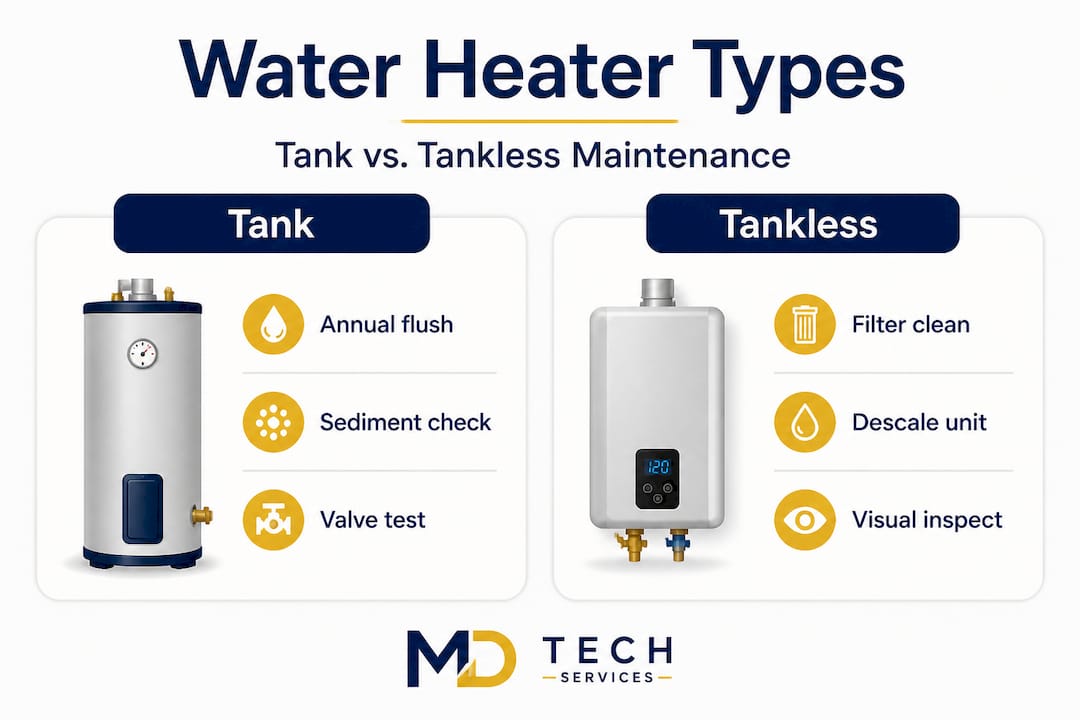
- Flush the tank annually. Sediment flushing is a standard annual task, and homes with hard water may need to do this every six months. Attach a garden hose to the drain valve, run it to a safe drainage point, and open the valve until the water runs clear.
- Inspect the anode rod every two to three years. If the rod is less than half an inch thick or heavily coated in calcium, replace it. This step alone can add years to your tank’s life.
- Test the T&P valve. Lift the lever for three seconds, confirm it releases water, and confirm it reseats when you let go. If it leaks or stays open, call a professional immediately.
- Check the temperature setting. The Department of Energy recommends 120 degrees Fahrenheit for most households. Higher settings waste energy and increase scalding risk.
- Inspect insulation on the first six feet of hot water pipes. Pipe insulation reduces standby heat loss and keeps hot water at the faucet faster.
- Look for visible leaks, rust, or corrosion around fittings, valves, and the tank body.
- For tankless units, descale the heat exchanger using a vinegar flush kit according to the manufacturer’s schedule.
For safety-related components, especially T&P valve replacement or any gas-side work, always use a licensed professional. This is not the area to experiment with DIY fixes.
| Task | Tank water heater | Tankless water heater |
|---|---|---|
| Flush sediment | Annually (or every 6 months for hard water) | Descale annually |
| Inspect anode rod | Every 2 to 3 years | Not applicable |
| Test T&P valve | Annually | Annually |
| Check connections | Annually | Annually |
| Professional inspection | Every 2 years or as needed | Every 2 years or as needed |
Connecting basic plumbing maintenance habits with a consistent schedule is the most reliable way to cut repairs with routine upkeep over the long term.

Pro Tip: Mark your calendar with a recurring annual reminder right after the summer season. Fall is an ideal time to flush your tank, because hot water demand typically increases in winter and you want your system performing at its best.
What’s different in California? Local regulations and home realities
California has specific requirements that affect how water heaters must be installed and maintained. The California Energy Commission provides guidance that ties domestic hot water compliance directly to proper servicing practices and equipment standards.
State code requires that water heaters have accessible isolation valves, which allow the unit to be shut off quickly without cutting water to the whole house. These valves make maintenance and emergency shutoff far simpler. California also has insulation requirements for water heater tanks and the first several feet of connecting pipes, which directly supports energy efficiency and lowers your monthly costs.
What makes Southern California homes different:
- Water hardness levels in many parts of Los Angeles and Orange County exceed 200 parts per million, which is classified as very hard. This level of hardness means sediment accumulates roughly twice as fast as in areas with soft water.
- Many older homes in the region have aging water heaters that were never maintained, creating compounding problems as original parts degrade.
- California’s seismic activity means water heaters must be properly strapped to the wall with approved brackets, and this strapping should be inspected during annual maintenance.
- Local utility programs sometimes offer rebates for efficient water heaters, and staying compliant with maintenance standards can support eligibility.
| Local factor | Impact on maintenance frequency | Recommended action |
|---|---|---|
| Very hard water (200+ ppm) | Flush every 6 months | More frequent sediment checks |
| Older home with aging unit | Higher risk of corroded parts | Annual professional inspection |
| High daily hot water demand | Faster sediment and wear | More frequent anode rod checks |
| Post-earthquake check | Risk of loosened connections | Inspect strapping and fittings |
Getting licensed water heater repair from technicians who know local code requirements ensures your system meets California standards and runs safely year-round.
Tailoring your water heater maintenance to your home
Not every home has the same maintenance needs. A household of two adults with a newer tankless unit has very different requirements than a family of five with a 10-year-old tank-style heater drawing from a hard-water supply.
The first step is knowing what type of unit you have and reading the manufacturer’s maintenance schedule in your manual. Gas water heaters require attention to the burner assembly, pilot light, and flue connections in addition to the standard checks. Electric models require inspection of the heating elements and thermostat settings. Both types share the need for anode rod inspections and sediment management, but the details differ.
Adjust your maintenance frequency based on your water quality and how much hot water your household uses each day. High-demand households tend to cycle the heater more often, accelerating both sediment buildup and wear on heating components.
Signs that you need a professional right away:
- Visible rust or corrosion on the tank body, fittings, or valves
- Recurring leaks that return after you tighten connections
- The T&P valve discharges frequently or will not reseat properly
- Popping, banging, or rumbling sounds during heating cycles, which indicate heavy sediment buildup
- Inconsistent water temperature or water that takes much longer than usual to heat
Checking water hose installation advice is also worthwhile when you update connections or notice any wear on supply lines during your inspection.
Pro Tip: If your water heater is making loud popping sounds, that noise is sediment cracking and shifting under heat. It is a clear signal that your tank needs an immediate flush and possibly a professional assessment to confirm no damage has occurred.
The uncomfortable truth about water heater maintenance
Here is something most guides will not say directly. The majority of homeowners only think about their water heater after something goes wrong. A cold shower, a visible leak, or a noticeably high utility bill prompts the call. By that point, the damage is already done and the cost is significantly higher than it needed to be.
We see this pattern regularly in homes across Los Angeles and Orange County. A homeowner calls because their 12-year-old water heater stopped working. When we inspect it, the anode rod dissolved years ago, the tank interior is heavily corroded, and the T&P valve has never been tested. What could have been a $150 to $300 maintenance visit over the years turns into a $1,200 or more emergency replacement.
The “out of sight, out of mind” approach is understandable. Water heaters sit in closets, garages, or utility rooms and quietly do their job. But that invisibility is exactly why they get neglected, and in a region where hard water accelerates every problem, the consequences of that neglect arrive faster than in most other parts of the country.
Treating your water heater the way you treat your car changes the outcome dramatically. You would not drive for 12 years without an oil change and expect the engine to run fine. The same logic applies here. A consistent schedule of annual flushes, periodic anode rod checks, and simple visual inspections keeps the system running efficiently and safely for its full expected lifespan.
Learning how to reduce plumbing repairs through proactive habits is one of the most practical things you can do as a homeowner in this region. The investment in time and money is small. The protection it provides is significant.
Protect your home with expert support
Knowing what to do is a great first step. Having the right support makes it easy to follow through.

At MDTech Services, we work with homeowners throughout Orange County and Los Angeles County to keep water heaters and home systems running safely and efficiently. Whether you need an appliance troubleshooting guide to identify what is wrong before you call, or you are ready to book a visit from one of our licensed technicians for professional water heater repair, we make it simple. You can also schedule a plumbing inspection to catch problems early and protect your home before a small issue becomes a costly emergency. Our team is responsive, experienced, and ready to help.
Frequently asked questions
How often should I flush my water heater in Los Angeles or Orange County?
Most homes should flush their water heater once a year, but hard water areas require more frequent flushing, sometimes every six months, to prevent excessive sediment buildup.
What happens if I never maintain my water heater?
Neglect causes sediment to reduce efficiency, drives up energy costs, and shortens tank life. It also puts safety at risk if the T&P valve stops functioning properly.
Can I perform all maintenance tasks myself?
Basic flushing and visual checks are DIY-friendly, but T&P valve replacement and gas-side work require a licensed professional to ensure safe, code-compliant results.
How does hard water in Southern California affect my water heater?
Southern California’s hard water increases sediment buildup significantly, requiring more frequent flushing and accelerating wear on internal components compared to soft-water regions.
Are there local codes or requirements for water heater maintenance in California?
Yes. California requires compliance with insulation standards and accessible isolation valves, and the California Energy Commission links proper servicing to meeting those requirements.