
If your GE refrigerator stopped cooling after the power came back, start with three checks: whether the light comes on, whether the outlet has power, and whether the temperature controls are still set correctly. Most outages do not damage a refrigerator, and GE says electronic models return to their selected settings when power is restored. If the checks below do not bring the cold back, the cause is usually a protective shutdown, a control board problem or a sealed-system issue that needs a licensed technician.
This guide walks you through the checks in the order that saves the most time, explains what to do with your food, and shows when it is time to stop troubleshooting. We repair GE and other major brands across Orange County and Los Angeles County, so we also cover what we typically look at once we arrive.
TL;DR
- Open the door and look for the interior light. No light means checking the plug, the outlet and the breaker first.
- If the light is on, confirm the temperature controls were not switched off or changed during the outage.
- You do not need to unplug a GE refrigerator when power returns, and a surge can stop the compressor from restarting.
- Refrigerated perishables are safe for up to 4 hours without power. Discard meat, poultry, fish, eggs and leftovers held longer than that.
- If the unit is still warm after you have checked the basics, book a repair visit before more food is at risk.
Table of Contents
- Start with the light, the outlet and the breaker
- Is there a reset button on a GE refrigerator?
- Why a surge can keep your fridge from restarting
- Check the basics that cause warm temperatures
- Freezer cold but fridge warm after an outage
- What to do with the food
- When to stop troubleshooting and call a technician
- Our perspective on post-outage refrigerator failures
- GE refrigerator repair in Orange County and Los Angeles County
- What to expect during a repair visit
- FAQ
- Sources
Start with the light, the outlet and the breaker
GE’s own troubleshooting guide for a refrigerator that does not run or cool begins with a simple observation. Open the refrigerator and look for light in the fresh-food section. The answer tells you which branch of the problem you are on.
If there is no light
The refrigerator is probably not receiving power. GE says to check that the refrigerator is plugged into the wall outlet and that the outlet itself has power. After an outage, work through this short list:
- Push the plug fully into the outlet. Pulled cords and loose plugs are common when a fridge has been moved or bumped.
- Test the outlet with a small lamp or phone charger. If it does not work, the problem is the outlet or circuit, not the refrigerator.
- Check your electrical panel. A breaker that tripped during the outage or a surge can be reset by switching it fully off and then on.
- Look for a GFCI outlet nearby, in a garage for example. These have a small reset button and can trip when power fails and returns.
If the outlet is live, the plug is secure and the refrigerator still shows no light and no display, the power-entry components or the main control board may have failed. That is a job for a technician, not a reset.
If the light is on
Power is reaching the refrigerator, so the question becomes why it is not cooling. GE’s guide says to make sure the controls were not turned off by accident. Check your owner’s manual for the correct setting on your model, because GE refrigerators use different control styles. Some have a dial, others have a digital display or a touch panel, and a few have a separate cooling on/off setting.
While you are at it, look at the display. A blank screen, a flashing temperature, an error code or a mode that was not there before the outage all point to the control board or a sensor rather than a simple setting.
Is there a reset button on a GE refrigerator?
GE refrigerators do not have a dedicated reset button you can press to fix a cooling problem. What many people try instead is unplugging the unit and plugging it back in. According to GE, it is not necessary to unplug the refrigerator when power is restored, because electronic models go back to the temperature settings you selected.
There is one case where a power reset is the right step. GE says that if the refrigerator is in diagnostic mode after service, you should disconnect power for 30 seconds to reset the control panel so it cools normally. If that describes your situation, unplug the refrigerator, wait the full 30 seconds, and plug it back in.
A few practical notes on resetting:
- Do not unplug and replug repeatedly. Each restart asks the compressor to start again, and repeated attempts do not fix a failed part.
- Give the unit time after a restart. A refrigerator that has just been reconnected needs hours, not minutes, to bring the compartments back down to temperature.
- If a restart changes nothing, note what the display shows and whether you hear the compressor or fan running. Those details help a technician diagnose the problem faster.
Why a surge can keep your fridge from restarting
If the light and display work but the refrigerator is warm and silent, the sealed system may be protecting itself. GE’s support page explains that the compressor is sensitive to temperature and current overloads and shuts itself down during a power surge. This is a built-in protection system, and it is designed to prevent damage to the compressor.
The same page notes that a surge protector can override that protection, and that after a surge the refrigerator may not restart when it is connected to one, which could lead to food spoilage. In practical terms:
- If you plugged the refrigerator into a plug-in surge protector or power strip, try plugging it directly into a grounded wall outlet instead.
- Wait a few minutes after reconnecting, then listen for the compressor and the fans.
- If it still does not start, stop and avoid repeated attempts. A compressor that will not start, or that clicks on and off, needs a professional inspection.
A surge can also damage the electronic control board or the start components that help the compressor run. These are the parts that most often fail after storms and utility restorations, and they are far cheaper to replace than a refrigerator.
Check the basics that cause warm temperatures
Sometimes the outage is a coincidence or only a trigger, and an ordinary cooling issue shows up once you start looking. Before you decide the refrigerator has failed, run through these items.
Allow recovery time
After a long outage, the compartments are warm and the doors have probably been opened several times. GE notes that a newly installed refrigerator needs about 24 hours to cool down and stabilize, and if the controls are set properly and it is still warm after that, you should schedule service. A refrigerator that is running after an outage will often take many hours to recover, but it should be steadily getting colder. If it is not improving by the end of a day, treat that as a sign of a fault.
Keep the doors closed
Every door opening lets warm air in and makes the system work harder. Limit openings while the refrigerator recovers, and make sure the doors seal fully. Check that no bins, shelves or packages are holding a door slightly ajar.
Look at the condenser coils
Dust on the condenser coils makes it harder for the refrigerator to shed heat, and a unit under strain after an outage may struggle more. GE’s guide cautions that to minimize the risk of electric shock, you should unplug the appliance before cleaning or maintaining the condenser coils. Unplug first, clean carefully, and reconnect. If you are not comfortable reaching the coils on your model, a technician can do it during a service visit.
Listen for the fans and compressor
A low hum from the back of the unit and the sound of fans moving air inside are good signs. Silence with a lit display suggests the compressor is not running. A running compressor with a warm fresh-food section can point to an airflow or defrost problem, which we cover next.
Freezer cold but fridge warm after an outage
This is one of the most common complaints, and it often has a different cause from a complete shutdown. If the freezer is still making ice and staying frozen but the fresh-food section is warm, cold air is probably not moving between the compartments as it should.
GE’s technical service guide explains how the Adaptive Defrost system works. An electronic control decides when a defrost cycle is necessary by monitoring door-open time, compressor run time and defrost heater duration. If the doors are not opened, the compressor can run up to 60 hours between defrosts, and frequent door openings can shorten that to as little as 8 hours. This is an older model-era guide, so the details vary by refrigerator, but the principle holds: a power interruption plus frequent door openings can disturb the defrost pattern, and a defrost system that is not working properly can leave the evaporator iced over and block airflow to the fresh-food side.
Typical signs include:
- A freezer that is cold or frosty while the refrigerator section is warm.
- Frost built up on the back wall of the freezer.
- Water pooling or ice forming at the bottom of the freezer.
- A fan that is silent or noisy when you open the freezer door.
We explain this symptom in more detail in our guide on why a fridge can be warm while the freezer stays cold. Fixing it usually means testing the defrost components, the evaporator fan and the control board. A temporary manual defrost may help the fridge cool for a short time, but if the cause is a failed part, the problem will come back.
What to do with the food
Food safety comes first when the refrigerator is warm, and the rules are firm. FoodSafety.gov says a refrigerator keeps food safe for up to 4 hours during an outage, provided the doors stay closed. After 4 hours without power, discard perishable foods such as meat, poultry, fish, eggs and leftovers.
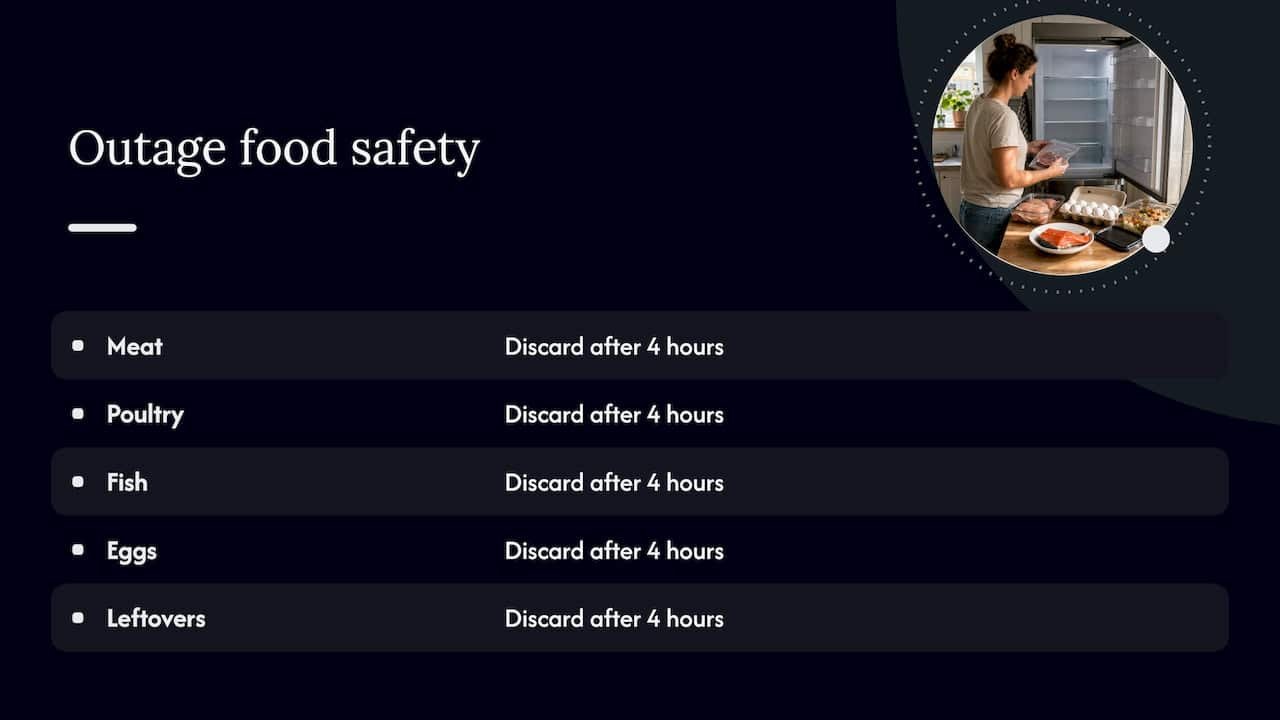
The same page gives a rule worth remembering: never taste food to decide whether it is safe. Evaluate each item separately, use the chart as a guide, and when in doubt, throw it out.
GE’s own outage guidance adds a realistic caveat. It is not possible to give an exact storage time because freshness, door openings and room temperature all affect the result. Treat the 4-hour figure as a firm ceiling for perishables rather than a target.
If the outage or the repair wait is long
- Move perishables to a cooler. USDA guidance says you can keep food at 40°F or below in a cooler using ice, adding more as it melts.
- Keep the freezer closed. USDA says a full freezer holds its temperature for approximately 48 hours, and 24 hours if it is half full.
- Use an appliance thermometer if you have one, so you are checking the temperature rather than guessing.
Medications that need refrigeration, such as insulin, should be checked against the instructions from your pharmacist or doctor, because their limits differ from food rules.
When to stop troubleshooting and call a technician
Home checks are worth doing, but they have a clear limit. Stop and book a visit if any of these apply:
- The outlet has power, the controls are correct, and the refrigerator still shows no light or display.
- The display works but the compressor never starts, or it clicks on and off.
- The refrigerator has been running for a full day and is still warm. GE’s guidance is to schedule service in this situation.
- The freezer is cold but the fresh-food section stays warm.
- You see error codes, a flashing display or frost buildup that was not there before.
- You smell burning, see scorch marks on the plug or outlet, or hear buzzing from the electrical area. Unplug the refrigerator and call for service.
Waiting often costs more than the repair. Food losses add up quickly, and a compressor that keeps trying to start under a fault can take on more damage. If you want a deeper checklist before you call, our step-by-step refrigerator fix guide and our refrigerator troubleshooting tips for homeowners cover the checks in more detail.
Our perspective on post-outage refrigerator failures
After an outage, most homeowners tell us the same thing: the refrigerator was working fine until the power came back. That sequence is not a coincidence. Power interruptions and surges put stress on the control board, the start components and the compressor, and those are the parts we test first.
Our approach is to diagnose before replacing anything. We check the incoming power, the control board, the fans, the defrost system and the sealed system in order, so you pay to fix the actual fault and not a guess. We aim to give you upfront pricing once we know what is wrong, and we focus on long-term, warranty-safe repairs instead of quick patches that fail again next month.
We work on GE refrigerators, including Profile and Monogram models, along with many other brands, and our technicians are licensed. Because we serve Orange County and Los Angeles County, we can usually respond quickly, and we offer 24/7 emergency availability for situations where food and time are both at risk.
The most useful thing you can do before we arrive is keep the doors closed, note what the display shows, and move perishables to a cooler if the refrigerator is warm. That information and a few minutes of preparation help us arrive with the right parts and finish the repair in one visit wherever possible.
MDTECH
GE refrigerator repair in Orange County and Los Angeles County
If your refrigerator is still warm after the checks above, our team can come to your home, find the cause and repair it. Our appliance repair services cover major household brands, and we have dedicated pages for GE refrigerator repair and Monogram freezer repair.

You can book online through our site, and we serve homeowners, landlords and property managers. If you manage a rental, we can coordinate access and work with your maintenance process. Our kitchen appliance repair page covers the other appliances that may have been affected by the same surge, such as ovens and dishwashers, and you can reach us through our main site any time.
What to expect during a repair visit
Knowing the process helps you prepare, and it keeps the visit short.
- Symptoms and history. We ask when the outage happened, what you have already tried and whether the refrigerator was plugged into a surge protector.
- Power and controls. We confirm that the refrigerator is receiving correct voltage and check the control board and display for faults.
- Cooling components. We test the compressor and its start components, the condenser and evaporator fans, and the defrost system.
- Explanation and quote. We explain what failed and why, and give you the cost before starting the repair.
- Repair and test. We replace or repair the failed part and confirm the refrigerator is running and cooling as it should before we leave.
To make the visit faster, clear the area in front of the refrigerator, have the model number ready (it is usually on a label inside the fresh-food section), and move food into coolers if the unit has been warm for more than a few hours.
It also helps to protect the refrigerator after the repair. Plug it directly into a grounded wall outlet unless a surge device is designed for refrigerators and compatible with your model, and keep the area behind and under it free of dust.
FAQ
How much does a new compressor cost for a GE refrigerator?
The cost depends on your model, the compressor type and the labor involved, and a failed compressor is not always the actual problem. Start components and control boards often cause the same symptoms at a lower cost. We diagnose first and give you a price before work begins, so you can decide with the facts in front of you.
How long does food last in the fridge without power?
FoodSafety.gov says a closed refrigerator keeps food safe for up to 4 hours. After that, discard perishable foods such as meat, poultry, fish, eggs and leftovers. Never taste food to check it, and when in doubt, throw it out.
Why is my GE fridge not cold but the freezer is?
The freezer is usually cooled directly, while the fresh-food section depends on airflow and the defrost system. If a fan, a defrost component or the control fails, or the evaporator ices over, the freezer stays cold while the fridge warms up. A technician can test those parts and restore normal airflow.
Is there a reset button for a GE refrigerator?
There is no dedicated reset button for cooling problems. GE says you do not need to unplug the unit when power returns. If the refrigerator is in diagnostic mode after service, disconnecting power for 30 seconds resets the control panel.
Sources
- GE Appliances: Refrigerator, Does Not Run or Cool
- GE Appliances: Refrigerator, Not Cooling Enough
- GE Appliances: Refrigerator, Power Outage Tips
- GE Appliances: Refrigerator, Surge Protectors
- GE Technical Service Guide, Adaptive Defrost
- FoodSafety.gov: Food Safety During Power Outage
- USDA FSIS: Keep Your Food Safe During Emergencies, Power Outages