
When hot water takes a long time to arrive, the cause is almost always one of three things: the length and size of the pipe run between the heater and the faucet, a restriction that slows the flow, or a water heater that is losing capacity. You can sort out which one you have in about ten minutes with a stopwatch and a few faucets. Some fixes are simple. Others involve gas, pipe work or a failing heater, and those are jobs for a licensed professional. If you live in Orange County or Los Angeles County, our plumbing repair team can take it from there.
TL;DR
- A reasonable wait is under 10 seconds. Between 11 and 30 seconds is marginal, and beyond 30 seconds is considered unacceptable by national laboratory guidance.
- Most of the wait is cold water sitting in the pipes. Longer, wider and uninsulated runs make it worse.
- If only one faucet is slow, look at that fixture. If every hot tap is slow, look at the water heater and the pipe route.
- Insulating pipes, clearing aerators and flushing sediment help. A recirculation pump or point-of-use heater is the lasting fix for a distant bathroom or kitchen.
- Gas water heater problems, leaks and old tanks should be handled by a licensed technician, not by trial and error.
Table of Contents
- What counts as a normal wait for hot water
- Why hot water takes so long to reach the faucet
- Is it the fixture, the pipes or the water heater?
- Quick diagnosis table
- Fixes you can try yourself
- When to call a licensed technician
- Permanent ways to shorten the wait
- Property managers and landlords
- How we handle slow hot water
- Perspective
- FAQ
- Sources
What counts as a normal wait for hot water
Before you decide something is wrong, measure it. Turn the faucet to full hot after the water has been off for a few hours, start a stopwatch, and stop it when the water feels hot.
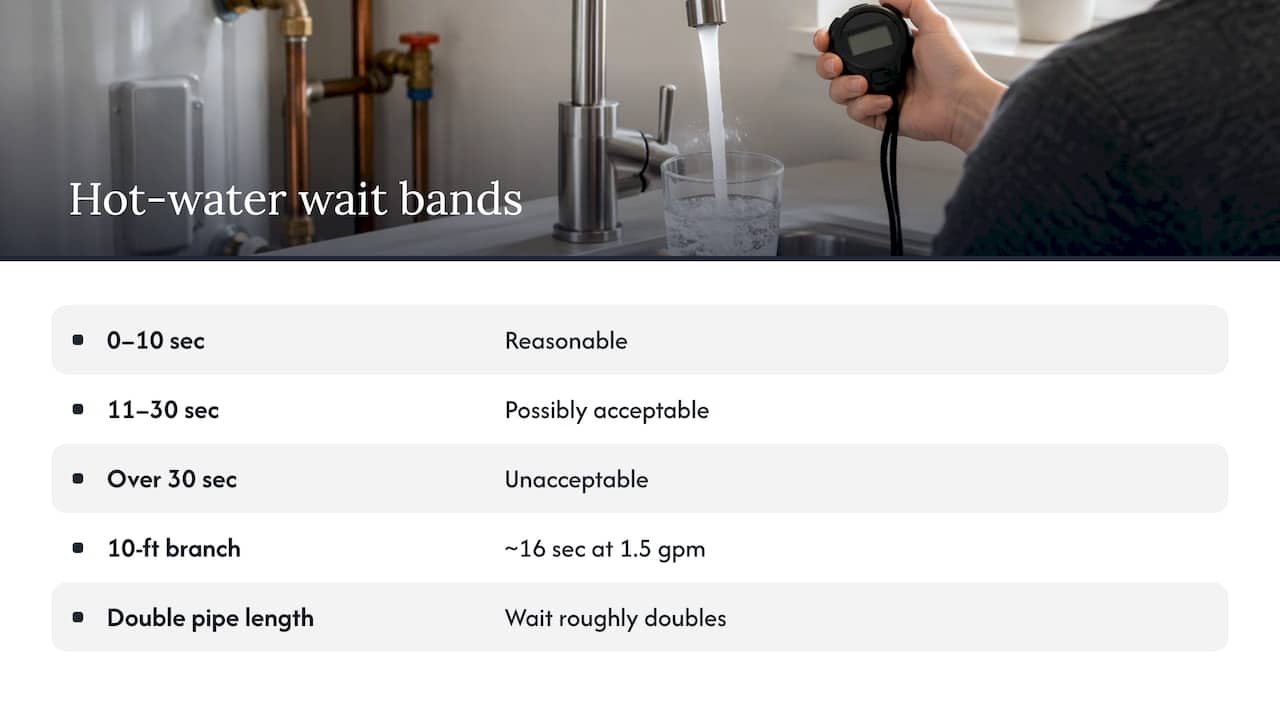
A Pacific Northwest National Laboratory review of hot water delivery treats 0 to 10 seconds as reasonable, 11 to 30 seconds as possibly acceptable and anything over 30 seconds as unacceptable. The Housing Consortium’s 2022 guidelines cite the same bands from the plumbing engineers’ society (ASPE).
The same laboratory gives a sense of why the wait varies. A fixture running at 1.5 gallons per minute, fed by a 10-foot, 3/4-inch branch pipe, takes about 16 seconds to deliver hot water. Double the pipe length and the wait roughly doubles. A shower at the far end of a two-story house or a long single-story ranch can easily land past 30 seconds even when nothing is broken.
So you have two questions to answer. Is this wait longer than it used to be, which points to a developing problem? Or has it always been long, which points to how the house was plumbed?
Why hot water takes so long to reach the faucet
Hot water does not travel instantly. When you open a hot tap, the water sitting in the pipe has cooled, and it has to leave the pipe before heated water from the water heater arrives. This is true whether you have a storage tank or a tankless unit. A tankless heater only fires when water flows, so it adds a short start-up delay at the unit, but the longer wait is still the cold water in the line, as a plumbing industry explainer on hot water delays notes.
Three things set the length of the wait:
- Distance. The farther the fixture from the heater, the more cold water has to clear.
- Pipe volume. Wider pipes hold more water per foot. A 3/4-inch main takes longer to purge than a 1/2-inch line.
- Flow rate. A low-flow aerator or showerhead saves water, but it also moves the cold water out more slowly, so the wait stretches. The laboratory review specifically notes that low-flow aerators can increase delivery time.
Poor insulation adds to it. The pipe loses heat to the wall cavity or crawlspace between uses, so each time you ask for hot water, the first slug is colder than it needs to be.
Is it the fixture, the pipes or the water heater?
The fastest way to narrow the cause is to compare faucets. Run hot at the kitchen sink, a bathroom sink and the shower, one at a time, and time each.
Only one faucet is slow
If the delay or weak flow shows up at one fixture and the others behave normally, the problem is local. Portland’s water bureau advises that when some faucets run normally and others run low, the cause is a plumbing issue at those faucets. Its first steps:
- Unscrew the aerator (the small screen at the spout tip) and check for debris or mineral buildup.
- Make sure the shut-off valves under the sink are fully open.
- Listen for running water when everything is off, which can point to a leak.
A clogged aerator or a worn shower cartridge restricts flow, and a restricted flow means the cold water leaves the pipe slowly. If you have a clear fixture problem that cleaning does not solve, our guide to low shower water pressure walks through the pressure range to look for and the point where a plumber should step in.
Every hot tap is slow
If the wait is long everywhere, but cold water comes out strong, the issue sits at the water heater or in the main hot water lines. Cold water reaches a fixture without passing through the heater, while hot water travels through the tank or heat exchanger and then the hot branch, so a hot-only complaint points to that path.
Here is what to look at:
- Thermostat setting. If the heater was bumped down or reset, water leaves the tank lukewarm, and the delay feels longer because the water never gets truly hot. Our article on a lukewarm water heater lists the safe checks.
- Sediment in the tank. Minerals settle at the bottom of a storage tank, particularly in areas with hard water, and reduce how well the heater transfers heat. Realtor.com’s reporting on slow hot water lists sediment buildup among the factors, along with the heater’s age.
- Age. The same article puts a typical heater lifespan at 8 to 10 years. If yours is in that range and is slow, it is losing capacity more than it is misbehaving.
- Depleted supply. After a heavy use period, an 80-gallon heater can take up to an hour to recover, per the same report. If the slow heating only happens after back-to-back showers or laundry, you may simply be asking more of the tank than it holds.
Both hot and cold are weak
If cold water is also slow or weak at several fixtures, the problem is upstream of the water heater: a partly closed main shut-off, a failing pressure regulator, a clogged whole-house filter or corroded older pipes. Older galvanized steel plumbing can restrict flow as the inside of the pipe corrodes, a point Portland’s guidance raises as well. This needs a plumber to confirm.
Quick diagnosis table
| What you notice | Most likely cause | Who should handle it |
|---|---|---|
| One faucet slow, others fine | Clogged aerator, worn cartridge or half-closed valve | You can check the aerator and valve; call a plumber for cartridge or valve work |
| Long wait at the farthest bathroom only | Long pipe run, uninsulated line, low-flow fixture | Plumber, for recirculation or a point-of-use heater |
| Every hot tap slow and water only lukewarm | Thermostat setting, sediment, failing element or burner | Licensed technician |
| Hot runs out fast, then slow to recover | Sediment, undersized or aging tank | Licensed technician |
| Hot and cold both weak | Main valve, regulator, filter or corroded pipe | Plumber |
Fixes you can try yourself
These are the low-risk steps for a homeowner. Stop at any point where you smell gas, see water around the heater or find the unit hot to the touch in an unusual place.
Clean the aerators and showerheads
Unscrew each aerator or showerhead and rinse out the debris. Mineral deposits can be soaked in white vinegar. This is the cheapest fix and it restores flow, which clears the cold water faster.
Check that every valve is fully open
The shut-off valve at the heater and the ones under the sinks should be fully open. A valve left half-turned after a repair is a common cause of weak flow. If a valve drips or will not turn, see our page on a leaking shut-off valve before forcing it.
Insulate the hot water pipes you can reach
The U.S. Department of Energy’s job aid for insulating domestic hot water pipes calls for pipe insulation rated at least R-3, applied continuously with no gaps on the first six feet of pipe from the heater. Realtor.com, citing Energy.gov, reports that pipe insulation raises water temperature by 2 to 4 degrees compared with bare pipe, and that a tank blanket can cut standby heat loss by 25% to 45%. The pipe gains are modest, but they mean the first water to reach you is warmer. We cover where insulation helps and where it does not in the real role of pipe insulation.
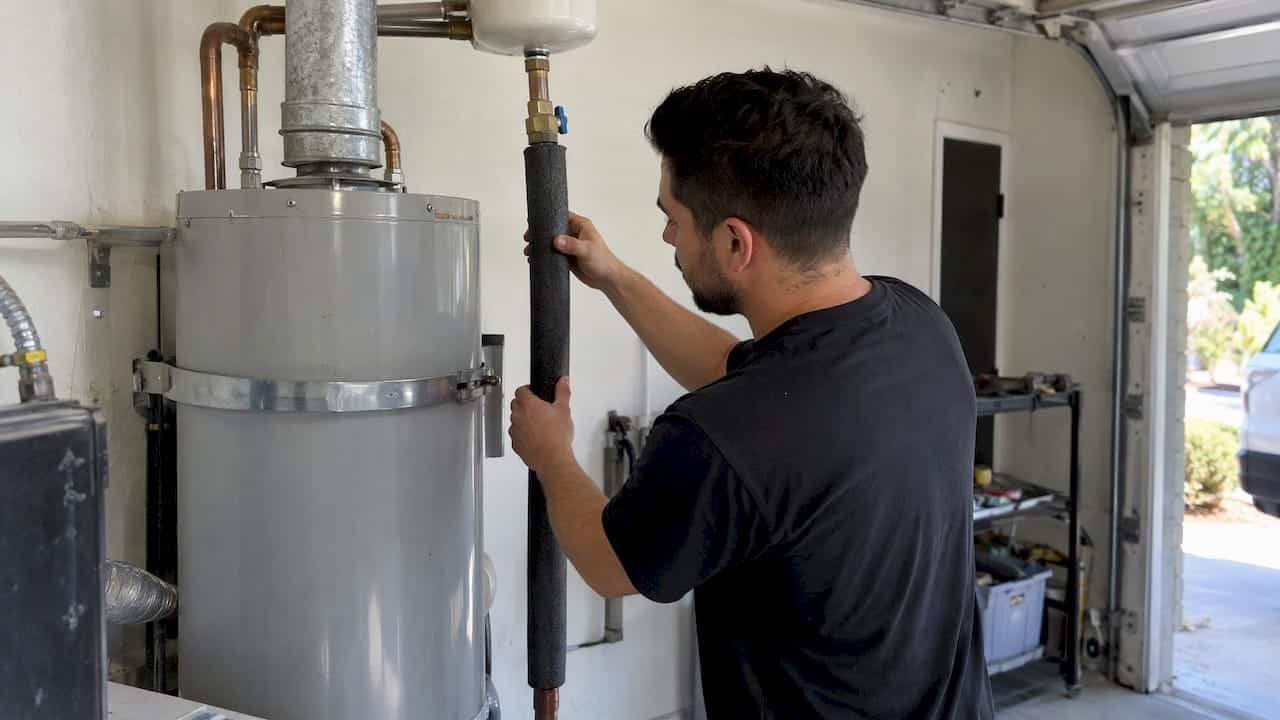
On gas units, insulation has to keep clear of the flue and the burner area, so do not wrap a gas heater yourself without confirming where it is safe.
Let the heater recover
If the problem only appears after heavy use, spread out showers and laundry for a few days. If the slow recovery goes away, capacity is the issue and not a fault.
When to call a licensed technician
Some symptoms are not do-it-yourself territory:
- You smell gas or see a pilot or burner that will not stay lit. Leave the area and call your gas utility or 911 if the smell is strong.
- There is water pooling around the base of the heater or on the ceiling below it.
- The heater is 8 to 10 years old or more and the problem keeps coming back.
- Water is lukewarm everywhere and the thermostat is set correctly.
- Water takes over 30 seconds at several fixtures and insulation made no difference.
- You suspect corroded pipes, a failing regulator or pressure trouble at the main.
In Orange County and Los Angeles County, where mineral-rich water is common, sediment can build up faster than homeowners expect, and an annual look at the heater is cheap compared with a failed tank. Our guide to common household plumbing issues shows how to tell a quick fix from a job for a pro.
Permanent ways to shorten the wait
If your plumbing is simply long, no tuning of the heater will cut the wait. The real options are:
- Recirculating pump. It keeps hot water moving through a loop, so hot water is close to the tap. Realtor.com cites reductions in wait time of up to 80%. The trade-off is operating cost, and manufacturers advise using a timer or an aquastat (a temperature switch) so the pump does not run all day.
- Point-of-use heater. A small heater installed near a distant sink or bathroom serves that fixture without waiting on the main system. The laboratory review recommends this approach for distant, rarely used fixtures.
- Pipe re-route or resizing. In remodels, shorter runs and narrower pipe reduce the volume of water that has to clear.
- Replacing an aging heater. If sediment, failing elements or a worn burner are cutting capacity, replacement is the repair that holds.
Each of these changes the plumbing and, for gas units, the venting and gas connections. A licensed technician should size and install them so the work is safe and the equipment stays within its warranty.
Property managers and landlords
If you manage rentals, track the complaint by unit. A single unit with a slow shower is likely a fixture or a valve. A building where several units report slow hot water points to the central heater, a failing recirculation pump or sediment. The 10-second, 30-second benchmarks give you a neutral number to put in a work order. Tenants cannot authorize repairs to the system, so the owner or manager books the visit.
How we handle slow hot water
We provide plumbing repair and heating and cooling services across Orange County and Los Angeles County, with licensed technicians and 24/7 emergency availability. When you book, tell us the stopwatch time, which faucets are slow, how old the heater is and whether it is gas or electric. That lets us arrive prepared.
You can book a plumbing repair visit online, or review our HVAC services if your home comfort equipment also needs attention.
If you are comparing the cost of a repair against a replacement, ask for upfront pricing before work starts. It is part of how we work.
Perspective
Most slow hot water calls come down to a simple question: is the water slow because of how the house is plumbed, or because something has changed? Homeowners often assume the heater is failing when the pipe run is simply long, and they replace equipment that did not need replacing. Others live for years with a half-working heater because the wait “has always been like that.”
Our approach is to measure first. A stopwatch, a comparison between faucets and a look at the heater’s age and setting tell us most of what we need. Then we recommend the repair that fits the cause: a fixture repair, a flush, a pipe fix, a recirculation solution or a heater replacement. We want long-term, warranty-safe solutions, not a patch that returns in a month.
Because we work only in Orange County and Los Angeles County, we know the homes and the water here, from older plumbing in established neighborhoods to newer builds with long runs to a second-story bath. Our technicians are licensed, and we are available around the clock when a heater problem cannot wait.
MDTECH
FAQ
Why is my water taking longer to get hot than it used to?
A change usually means a restriction or a loss of heater capacity. Clogged aerators, a partly closed valve, sediment in the tank, a lowered thermostat or an aging heater can all lengthen the wait. Time the wait at several faucets to see whether it is local or system-wide.
How long should it take for hot water to reach my shower?
Under 10 seconds is considered reasonable, 11 to 30 seconds is marginal and over 30 seconds is too long, according to national laboratory guidance. Distance from the heater and pipe size are the biggest factors, so a far bathroom will always wait longer than a kitchen next to the heater.
Will insulating my pipes fix a long wait for hot water?
It helps, but it is not a cure for a long run. Insulation raises water temperature by 2 to 4 degrees and keeps heat in between uses. For a distant fixture, a recirculation pump or a point-of-use heater shortens the wait far more.
Can low water pressure make hot water slow?
Yes. Lower flow means the cold water in the pipe clears more slowly. Cleaning aerators and showerheads and opening all valves fully are the first checks. If pressure is low at every fixture, have a plumber inspect the main, the regulator and the pipes.
Is it safe to flush a water heater myself?
Flushing involves hot water and, on gas units, a burner and gas connection. If you are not sure how to turn off the fuel or power and drain the tank safely, have a licensed technician do it, and call immediately if you ever smell gas.
Sources
- Domestic Hot Water Temperature Maintenance Technology Review, Pacific Northwest National Laboratory
- Guidelines for Domestic Water Heating, Distribution and Use, The Housing Consortium
- Why Does It Take So Long to Get Hot Water? 8 Causes
- Troubleshooting water pressure and flow, Portland.gov
- Why Hot Water Takes So Long to Reach Your Faucets, Realtor.com
- Insulate Domestic Hot Water Pipes, U.S. Department of Energy