
TL;DR:
- Proper diagnostics prevent unnecessary part replacements and ensure lasting appliance repairs.
- Modern appliances include built-in diagnostic tools and sensors for faster, more accurate fault detection.
- Professional diagnostics leverage structured methods and advanced technology to extend appliance lifespan.
Most homeowners assume a quick YouTube search and a replacement part will fix any appliance problem. That assumption costs real money. Skipping proper diagnostics means you might replace a perfectly good component while the actual fault keeps running in the background, causing repeat failures and shorter appliance lifespans. Accurate diagnostics are the foundation of every successful repair, and understanding how they work puts you in a much stronger position, whether you call a professional or attempt a fix yourself. This guide covers the full diagnostic process, the technology behind it, the tricky edge cases that trip people up, and what all of it means for your home.
Table of Contents
- Why diagnostics matter in appliance repairs
- How modern diagnostic tools and technology are changing repairs
- Common diagnostic methods and what they reveal
- What most homeowners miss: tricky edge cases and common misdiagnoses
- Why the future of appliance repair depends on diagnostics, not guesswork
- Get expert diagnostics for fast, reliable repairs
- Frequently asked questions
Key Takeaways
| Point | Details |
|---|---|
| Diagnostics are essential | Relying on structured diagnostics avoids guesswork, saving money and preventing repeat repairs. |
| Technology aids prevention | Modern diagnostic tools and IoT devices help catch problems early and improve repair accuracy. |
| DIY risks misdiagnosis | Homeowners often miss hidden issues, making professional diagnostics a smarter choice. |
| Edge cases need expertise | Tricky faults and misdiagnosis are avoided when pros follow thorough investigative steps. |
Why diagnostics matter in appliance repairs
Replacing parts without a confirmed diagnosis is one of the most expensive habits in home repair. You spend money on a new component, install it, and the appliance still fails because the root cause was never identified. Worse, repeated incorrect fixes can void manufacturer warranties and create safety risks that were never there to begin with.
Proper identifying appliance issues starts with understanding that most appliance failures have a chain of causes. A refrigerator that stops cooling might have a failed compressor, a blocked condenser coil, a faulty thermostat, or a simple door seal problem. Without diagnostics, you are guessing at which link in that chain broke.
Here are common scenarios where diagnostics make a real difference:
- Refrigerator not cooling: Could be a compressor issue, low refrigerant, a blocked fan, or a defrost failure
- Washer not draining: May point to a clogged pump filter, a failed drain pump motor, or a control board error
- Dryer not heating: Often confused with a bad heating element when the real cause is restricted airflow or a tripped thermal fuse
- Dishwasher leaving residue: Could be a spray arm blockage, water temperature issue, or a failing wash motor
- Oven not reaching temperature: May involve a faulty igniter, a failed bake element, or a miscalibrated sensor
Appliance troubleshooting tips consistently show that a structured approach outperforms guesswork every time. The diagnostic process involves structured methodologies starting with customer symptom gathering, visual inspections, electrical testing with multimeters, accessing built-in diagnostic modes for error codes, and logical component sequencing based on appliance design.
A professional technician never assumes. Every repair begins with a confirmed diagnosis, not a best guess. That discipline is what separates a lasting fix from a temporary patch.
Pro Tip: Before calling a technician or opening up any appliance, check the power supply, circuit breaker, and installation connections first. A surprising number of service calls trace back to a tripped breaker or a loose power connection, and catching that early saves you time and money.
How modern diagnostic tools and technology are changing repairs
Appliance diagnostics looked very different twenty years ago. Technicians relied on manual inspection, basic voltage meters, and printed wiring diagrams. Today, the tools are far more precise, and the appliances themselves are designed to help with their own diagnosis.
Over half of major appliances released in the past five years now include built-in diagnostic features, from self-test modes to app-based error reporting. That shift changes what a repair visit looks like and how quickly a technician can confirm a fault.
Modern appliances use embedded sensors, microcontrollers, diagnostic software and apps, and IoT for remote diagnostics, enabling predictive maintenance that prolongs lifespan and reduces costs. That means your refrigerator or washing machine can flag a developing problem before it becomes a full breakdown.
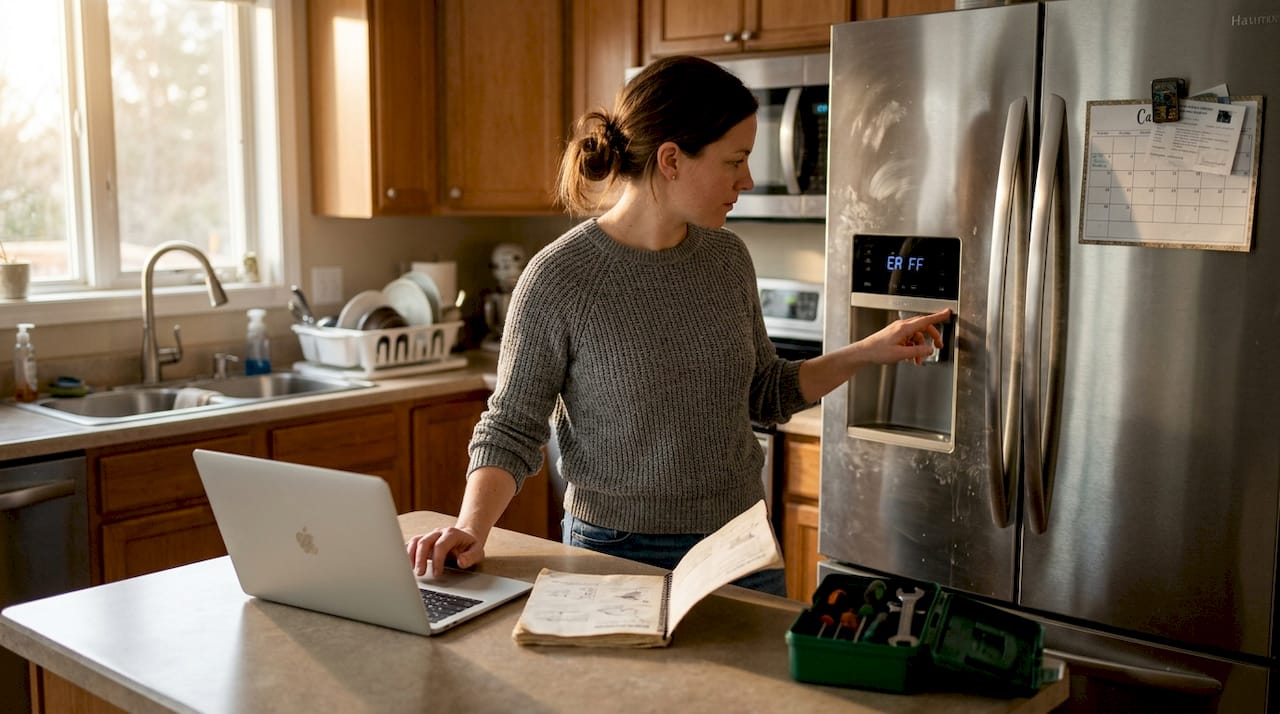
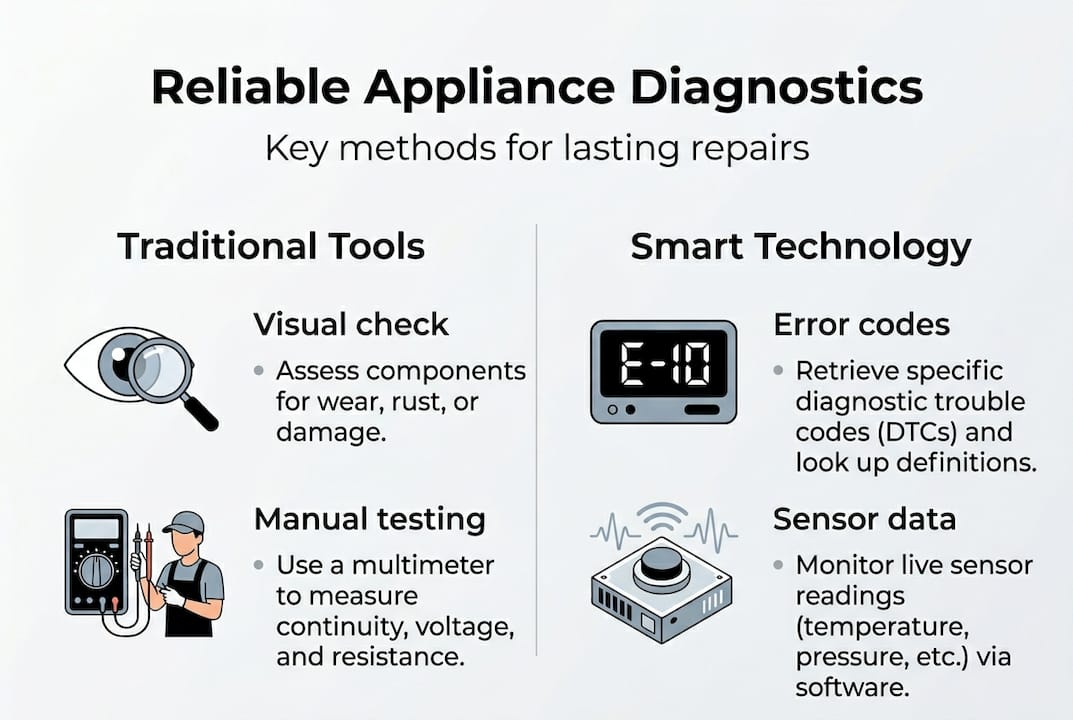
| Tool | Era | What it does |
|---|---|---|
| Manual visual inspection | Traditional | Identifies obvious physical damage or wear |
| Basic multimeter | Traditional | Measures voltage, resistance, and continuity |
| Smart sensors | Modern | Monitors temperature, pressure, and performance in real time |
| App-based diagnostics | Modern | Reads error codes and logs fault history via smartphone |
| IoT remote alerts | Modern | Sends alerts to technicians or homeowners before failure occurs |
For homeowners, this technology means faster service visits, fewer unnecessary part replacements, and the ability to share diagnostic data with a technician before they even arrive. Your homeowner troubleshooting guide can now include steps like running your appliance’s built-in diagnostic cycle and reading the resulting error code.
Smart appliance features that directly support diagnostics include:
- Error code displays that pinpoint the failing component
- Wi-Fi connectivity that allows remote monitoring and software updates
- Usage tracking that identifies abnormal patterns before they cause damage
- Self-cleaning and self-test cycles that verify component function
- App notifications that alert you when performance drops below normal thresholds
Understanding appliance noise diagnosis is also easier now because smart sensors can detect vibration patterns and flag unusual sounds as part of a broader performance log, giving technicians a fuller picture before they open the unit.
Common diagnostic methods and what they reveal
Every thorough diagnostic follows a logical sequence. Skipping steps is where most errors happen, both for DIYers and for less experienced technicians. Here is how the process typically unfolds:
- Customer interview: You describe what the appliance is doing, when it started, and whether anything unusual happened. This step can reveal patterns that no test can catch, like a problem that only occurs on cold mornings or after a specific wash cycle.
- Visual inspection: The technician checks for obvious damage, burn marks, water stains, disconnected wires, or blocked vents. Many faults are visible before any tool is used.
- Functional tests: The appliance is run through its normal cycles while the technician observes performance, listens for unusual sounds, and checks temperatures or pressures.
- Electrical and mechanical tests: A multimeter checks voltage, resistance, and continuity across components. Mechanical parts are tested for proper movement and wear.
- Error code and app-based data review: Built-in diagnostic modes are accessed to read stored fault codes. App-connected appliances provide a fault history that shows how long a problem has been developing.
Each stage informs the next. The structured diagnostic approach involves logical component sequencing based on appliance design, which means a technician does not test every part randomly but follows the most likely fault path based on what earlier steps revealed.
This sequencing is what prevents “part swapping,” the costly habit of replacing components one by one until the appliance works. A proper step-by-step repair guide always starts with diagnosis, not parts. Skipping to parts first is how a $40 fix turns into a $400 repair bill.
For safety, appliance safety inspections are part of the diagnostic process too, especially for gas appliances and high-voltage units where a missed fault can create a fire or shock hazard.
Pro Tip: Before you reset or unplug a malfunctioning appliance, write down every error code displayed and note the exact symptoms. That history is valuable data for a technician and can cut diagnostic time significantly. Resetting clears the fault log and makes the job harder.
Check out these appliance repair steps for a practical overview of how each diagnostic stage connects to the repair that follows.
What most homeowners miss: tricky edge cases and common misdiagnoses
Even experienced DIYers get tripped up by faults that do not behave the way you expect. Intermittent problems are the hardest to catch because they do not show up consistently during testing. A wiring fault that only triggers under load, or a control board glitch that appears randomly, can pass every standard test and still cause repeated failures.
Common diagnostic pitfalls include:
- Assuming a heating element is bad when the real problem is restricted airflow causing the thermal fuse to trip repeatedly
- Replacing a compressor when a blocked condenser coil is the actual cause of poor cooling
- Blaming a control board when a faulty door switch sends incorrect signals to the board
- Ignoring intermittent wiring faults that only show up under vibration or heat
- Overlooking installation errors like improper venting or incorrect voltage supply
Intermittent faults involving wiring and control boards, defrost system failures causing temporary airflow blocks, and overloaded circuits are among the most frequently misdiagnosed issues, and the consistent advice is to always rule out installation and power issues first.
| Factor | DIY repair | Professional repair |
|---|---|---|
| Diagnostic accuracy | Variable, often incomplete | Structured, tool-assisted |
| Risk of misdiagnosis | High, especially for intermittent faults | Low with proper testing |
| Time investment | Often longer due to trial and error | Faster with experience and tools |
| Cost in complex cases | Can exceed professional cost | Predictable with upfront diagnosis |
| Warranty impact | May void coverage | Preserves warranty with licensed work |
The refrigerator diagnostic guide is a good example of how layered fridge problems can be. What looks like a compressor failure might be a defrost timer issue that clears itself temporarily, making the fridge appear to work again before failing a few days later.
Always rule out installation and power issues first. That single habit eliminates the most common misdiagnoses before any component testing begins.
Understanding the benefits of professional repair becomes clear in these complex cases. A licensed technician with the right tools and experience will catch what a YouTube tutorial cannot prepare you for.
Why the future of appliance repair depends on diagnostics, not guesswork
Here is our honest take: modern appliances are significantly more complex than they were a decade ago, and that complexity raises the cost of getting a diagnosis wrong. A misdiagnosed fault on a smart refrigerator or an IoT-connected washer can mean a voided warranty, a damaged control board, or a safety risk that was entirely avoidable.
The shift toward predictive maintenance driven by IoT and AI-based monitoring is genuinely exciting, but it also requires trained technicians who understand how to interpret sensor data and fault histories, not just swap parts. The repair industry is moving from reactive to proactive, and that is a good thing for homeowners who want their appliances to last.
Older, simpler appliances were more forgiving of guesswork. New ones are not. A YouTube tutorial can teach you to replace a door gasket, but it cannot prepare you for a control board fault that mimics three different component failures. Trusting professional repair benefits in these situations is not a lack of skill. It is a smart decision based on the actual complexity of the job.
Get expert diagnostics for fast, reliable repairs
Now that you understand how diagnostics work and why they matter, the next step is making sure your appliances get the precise attention they deserve.

At MDTech Services, our licensed technicians use up-to-date diagnostic tools and structured testing methods to find the real cause of your appliance problem, fast. We serve homeowners across Orange County and Los Angeles County with responsive, reliable service that gets it right the first time. Whether you need appliance repair services or want to follow a step-by-step repair guide before calling us, we are here to support you. Book a diagnostic visit today and reduce appliance downtime with a repair that actually sticks.
Frequently asked questions
What are the first steps a technician takes in appliance diagnostics?
A technician gathers detailed symptoms from you, checks power and installation connections, visually inspects the unit for obvious damage, and then uses testing tools or built-in diagnostic modes to read error codes and confirm the fault.
How does technology help prevent appliance breakdowns?
Modern sensors and IoT can detect performance issues early, enabling predictive maintenance that addresses developing faults before they cause a full breakdown and extends your appliance’s useful life.
Why is misdiagnosis common in do-it-yourself repairs?
DIYers often skip structured testing steps or miss installation and power issues that are the actual root cause, leading to incorrect part replacements and the same failure happening again shortly after.
Can professional diagnostics really extend appliance lifespan?
Yes. Accurate diagnostics combined with predictive technology allow technicians to catch and address issues early, reducing long-term wear on components and preventing the major failures that shorten an appliance’s lifespan.