
TL;DR:
- Verifying licenses, insurance, and certifications is essential to ensure safe and compliant home repair work. Homeowners should obtain multiple quotes, compare detailed scope and guarantees, and rely on community referrals while always confirming credentials independently. Prioritizing licensed, insured local technicians with clear contracts and proper EPA certifications reduces risks and guarantees quality service.
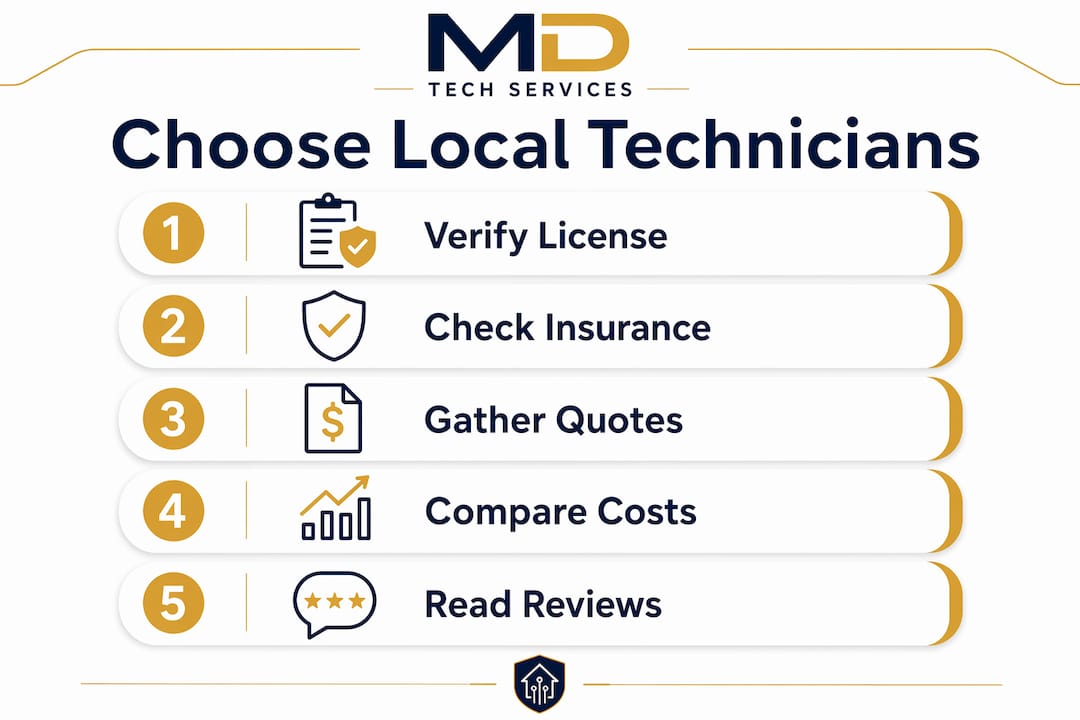
Choosing local technicians is defined as the process of verifying credentials, comparing quotes, and confirming insurance before allowing anyone to work on your home’s appliances, HVAC, or plumbing systems. For homeowners and renters in Orange County and Los Angeles County, this process carries real financial and safety stakes. A licensed technician with the right California Contractor State License Board (CSLB) classification protects you from liability and substandard work. The core steps include checking CSLB license status, confirming EPA Section 608 certification for HVAC work, and requiring proof of workers’ compensation insurance before any job begins.
How to verify technician credentials and licensing in California
License verification is the single most important step when finding local technicians, and California makes it straightforward. The CSLB provides a free online lookup tool where you can confirm any contractor’s license status, bond, and disciplinary history in minutes. CSLB license lookup reveals expired licenses, missing bonds, and open complaints that a technician will never volunteer on their own. That transparency is your first line of defense.
California uses specific classification codes to define what each licensed contractor is legally permitted to do. The codes you need to know are:
- C-36 for plumbing contractors
- C-20 for HVAC and refrigeration contractors
- C-10 for electrical contractors
A license must be active and match the exact type of work being performed. A C-10 electrician cannot legally perform HVAC repairs, even if they claim experience in both trades. Always ask for the license number upfront, then verify it yourself through the CSLB database. Never accept a verbal confirmation as sufficient proof.
Pro Tip: When you run a CSLB lookup, check the “Disciplinary Actions” tab specifically. A single resolved complaint is not disqualifying, but a pattern of complaints about incomplete work or billing disputes is a clear warning sign.
Beyond the license number itself, confirm that the bond is current. A lapsed bond means the contractor’s financial guarantee to complete work properly has expired. The CSLB database shows bonding status alongside license status, so one search covers both checks.
What certifications and insurance you should require
Certifications and insurance are separate from licensing, and many homeowners make the mistake of assuming one covers the other. Insurance must be verified independently from the CSLB license check, because a license can be active while insurance has lapsed.
For HVAC work specifically, EPA Section 608 certification is federally required for any technician handling refrigerants. The certification comes in four types: Type I covers small appliances, Type II covers high-pressure systems, Type III covers low-pressure systems, and Universal covers all categories. Ask the technician which type they hold and confirm it matches your equipment. A technician with only Type I certification cannot legally service a central air conditioning system, which falls under Type II.
“Checking the correct credential for the specific technician task is the most crucial hiring step, especially for refrigerant-handling HVAC work.” — Angi HVAC Hiring Guide
For insurance, require two separate documents before work begins:
- Workers’ compensation insurance: Covers the technician if they are injured on your property. California plumbing contractors are required to carry this as a condition of licensure, but workers’ comp documentation must still be requested and reviewed directly.
- General liability insurance: Covers damage to your property caused by the technician’s work. A dropped tool that cracks a tile or a misconnected pipe that causes water damage falls under this coverage.
Any technician who hesitates or refuses to provide certificates of insurance is a red flag. Reputable professionals carry these documents and share them without resistance.
How to gather and compare multiple quotes effectively
Contacting at least three professionals for quotes is the standard recommendation, and it serves two purposes: it gives you a realistic price range and it reveals how each technician communicates and presents their work. A quote is not just a number. It is a preview of how organized and transparent a technician will be throughout the job.

When comparing quotes, evaluate these five components side by side:
| Component | What to look for |
|---|---|
| Scope of work | Detailed description of exactly what will be repaired or replaced |
| Timeline | Specific start and completion dates, not vague estimates |
| Cost breakdown | Labor and parts listed separately, not bundled into one figure |
| Warranty terms | Duration and what is covered for both parts and labor |
| Payment schedule | Deposit upfront with balance due on completion |
A written contract with all five components protects you from scope drift, surprise charges, and disputes about what was agreed. Standard practice is a deposit upfront with the remainder due upon completion. Any contractor requesting full payment before work begins is operating outside normal professional standards.
Bids that come in significantly lower than the others usually signal one of three things: unlicensed work, inferior parts, or a plan to add charges once the job is underway. Bids that come in significantly higher without a clear explanation of added value deserve the same scrutiny.
Pro Tip: Online matching platforms like Angi can generate up to three matched quotes by zip code quickly, which is useful for establishing a price baseline. Use them as a starting point, not a replacement for direct license and insurance verification.
For appliance repairs specifically, comparing local appliance repair services across multiple providers helps you spot which technicians specialize in your appliance brand versus those offering generic repair services.
How to use community recommendations and online reviews
Community referrals remain one of the most reliable ways to start the process of choosing the right technician, because they come with firsthand accountability. Ask neighbors, friends, and local community groups on platforms like Nextdoor for names of technicians they have personally used for appliance, HVAC, or plumbing work. A referral from someone in your ZIP code carries more weight than a five-star review from an unknown location.
When reviewing online feedback on Google, Yelp, and the Better Business Bureau, look for these specific patterns rather than just the star rating:
- Consistency over volume: Ten detailed reviews mentioning punctuality and clear communication are more meaningful than fifty generic five-star ratings.
- Response to negative reviews: A technician who responds professionally to criticism demonstrates accountability.
- Specificity of praise: Reviews that name the technician, describe the exact repair, and mention follow-up contact are harder to fabricate.
- Recency: Reviews from the past twelve months reflect current service quality. A company that was excellent three years ago may have changed staff or ownership.
Regional experience matters more than many homeowners realize. A technician who regularly works in Orange County or Los Angeles County understands local permit requirements, common appliance brands in the area, and typical response windows. For emergency plumbing situations, local familiarity directly affects how quickly the right technician with the right tools reaches your door.
What questions to ask technicians before and during service
Asking direct questions before hiring is the most practical local technician selection guide you can follow, because evasive or vague answers are themselves diagnostic. A qualified professional answers these questions without hesitation.
Ask every technician these questions before scheduling:
- What is your CSLB license number, and can I verify it? Any resistance here ends the conversation.
- Do you carry workers’ compensation and general liability insurance? Request certificates, not verbal confirmation.
- Which EPA 608 certification type do you hold? For HVAC work, confirm the type matches your system.
- Will you personally perform the work, or will it be subcontracted? Subcontracting is not automatically a problem, but you need to know so you can verify the subcontractor’s credentials as well.
- What warranty do you offer on parts and labor? Reputable technicians typically offer at least a 30-day labor warranty, with parts warranties tied to the manufacturer.
- Can you provide references from similar jobs in this area? Local references confirm regional experience and follow-through.
- What are your payment terms, and do you require a deposit? A deposit of 10 to 30 percent is reasonable. Full payment upfront is not.
Written scopes and contracts prevent scope drift and give you enforceable documentation if disputes arise. If a technician is unwilling to put the scope of work in writing, that unwillingness tells you everything you need to know about how they handle accountability.
For guidance on what licensed technicians are legally required to do versus what they offer as a professional courtesy, reviewing California-specific licensing standards helps you set accurate expectations before the first call.
Key takeaways
Choosing reliable local technicians requires verifying CSLB license classifications, confirming EPA certifications, requiring insurance documentation, and securing a written contract before any work begins.
| Point | Details |
|---|---|
| Verify CSLB license classification | Confirm the license code matches the trade: C-36 for plumbing, C-20 for HVAC, C-10 for electrical. |
| Require insurance separately | Workers’ comp and general liability must be verified independently from the license check. |
| Get at least three quotes | Compare scope, timeline, cost breakdown, warranty, and payment terms across multiple bids. |
| Use community referrals as a starting point | Nextdoor and neighbor recommendations provide accountability, but always follow up with credential checks. |
| Demand a written contract | A signed scope of work with payment terms protects you from surprise charges and incomplete jobs. |
What we have learned from years of local service calls
After years of working with homeowners across Orange and Los Angeles County, the pattern is consistent. The calls that turn into costly problems almost always share one trait: the homeowner skipped the verification step because they were in a hurry or trusted a low price.
License and insurance verification takes about ten minutes using the CSLB online tool and a quick request for insurance certificates. Those ten minutes have saved our customers from situations where an unlicensed technician caused additional damage and then disappeared, leaving the homeowner with no recourse. The CSLB database is public precisely because California recognizes that homeowners need that protection.
Community recommendations are genuinely valuable, and we encourage you to ask your neighbors. But a referral is a starting point, not a finish line. The technician your neighbor loved for a refrigerator repair may not hold the right EPA 608 certification type for your central air system. Verify credentials for every job, regardless of how the referral came.
The one piece of advice that most articles skip: do not let urgency override your process. Even in a plumbing emergency, you have time to ask for a license number and confirm it while the technician is in transit. A reputable company will not object to that request. One that does is telling you something important.
Local technicians with established reputations in a specific service area tend to offer better follow-up service because their business depends on repeat customers and word-of-mouth in a defined geography. That accountability is a real advantage, and it is worth prioritizing over a lower bid from someone with no local track record.
— MDTECH
Schedule reliable local service with Mdtechservices
Mdtechservices provides licensed and certified technicians for residential appliance repair, HVAC repair, and plumbing services across Orange County and Los Angeles County. Every technician carries verified credentials, and every job starts with a transparent quote and a written work order.

Whether you need appliance repair for a refrigerator or ice machine, an HVAC system inspection, or a plumbing fix, Mdtechservices offers online appointment booking with fast local response times. You can also review HVAC repair options and plumbing maintenance services directly on the site. Call or book online today to connect with a technician who is licensed, insured, and ready to work.
FAQ
How do I verify a local technician’s license in California?
Use the California Contractor State License Board (CSLB) free online lookup tool to confirm the license is active, properly classified, and free of disciplinary actions. Always verify the license number yourself rather than relying on the technician’s verbal claim.
What insurance should a local technician carry?
A qualified local technician should carry both workers’ compensation insurance and general liability insurance. These are separate documents and must be verified independently from the CSLB license check.
What is EPA Section 608 certification and why does it matter?
EPA Section 608 certification is a federal requirement for any HVAC technician who handles refrigerants. It comes in four types (I, II, III, Universal), and the type must match the specific equipment being serviced.
How many quotes should I get before hiring a technician?
Contact at least three licensed and insured professionals before making a decision. Comparing quotes reveals the realistic price range and shows you how each technician communicates and documents their work.
What should a written contract from a technician include?
A written contract should include the scope of work, timeline, itemized cost breakdown, warranty terms, and payment schedule. Standard practice is a deposit upfront with the balance due upon job completion.