
If your dryer smells like burning, stop the cycle, unplug the machine and do not run it again until the cause is found. The most common culprit is lint trapped in the dryer or the vent. Worn parts and electrical faults can also produce the smell, and those need a technician. The only normal exception is a brand-new dryer that gives off a faint odor during its first few loads.
Below you will find what to do in the first five minutes, how to read the type of smell, what is normal in a new dryer, and what it means when a heater or furnace smells like burning too. If you live in Orange County or Los Angeles County, we explain when to bring in a licensed technician.
TL;DR
- Stop the dryer, unplug it and keep it off. The National Park Service advises calling a service technician before using a malfunctioning dryer again.
- Lint buildup in the machine or the vent is the most common cause, and failing parts such as belts, motors and thermostats are next.
- A faint, short-lived odor in a new dryer can be normal. A smell that persists, or that smells like hot plastic, rubber or electrical wiring, is not.
- A heater or furnace that smells like burning after months off is often burning off dust. Large, yellow, unsteady flames or any sign of carbon monoxide are an emergency.
- If there is smoke or fire, get everyone out and call 911.
Table of Contents
- What to do right now if your dryer smells like burning
- What the smell tells you
- The most common causes, one by one
- Is a burning smell normal in a new dryer?
- Can you keep using a dryer that smells burnt?
- When your heater or furnace smells like burning
- How to tell dust, lint, a worn part or an electrical fault apart
- Our perspective
- Dryer or heating smell in Orange County or Los Angeles County?
- Prevent the smell from coming back
- FAQ
- Sources
What to do right now if your dryer smells like burning
Treat the smell as a warning, not a quirk. Work through these steps in order:
- Stop the cycle and open the door. Let the heat out of the drum. If you see smoke or flames, do not open the door wide. Leave the home and call 911.
- Unplug the dryer. For a gas dryer, shut the gas valve if you can reach it safely. If the smell is strong, you can also turn the dryer off at the circuit breaker, which is what Samsung’s support guidance suggests when the smell continues.
- Remove the clothes. Take out the load and check whether anything in it is the source: a rubber-backed mat, a foam item, or fabric stained with oil.
- Clean the lint screen. Check it for heavy buildup, but do not reach into the machine or take it apart.
- Leave it off. Do not run another cycle “to see if it goes away.”
The National Park Service’s dryer fire guidance is direct: if a residential dryer malfunctions, call a service technician before continued use. If there is a fire, evacuate and call 911.
Why this deserves a quick response
Dryer fires are common enough to take seriously. The NFPA estimated an average of 13,820 home structure fires a year involving dryers in 2014 to 2018, with seven civilian deaths, 344 injuries and $233 million in direct property damage per year. In the same analysis, failure to clean was behind 32% of home dryer fires, mechanical failure or malfunction 27% and electrical failure or malfunction 16%.
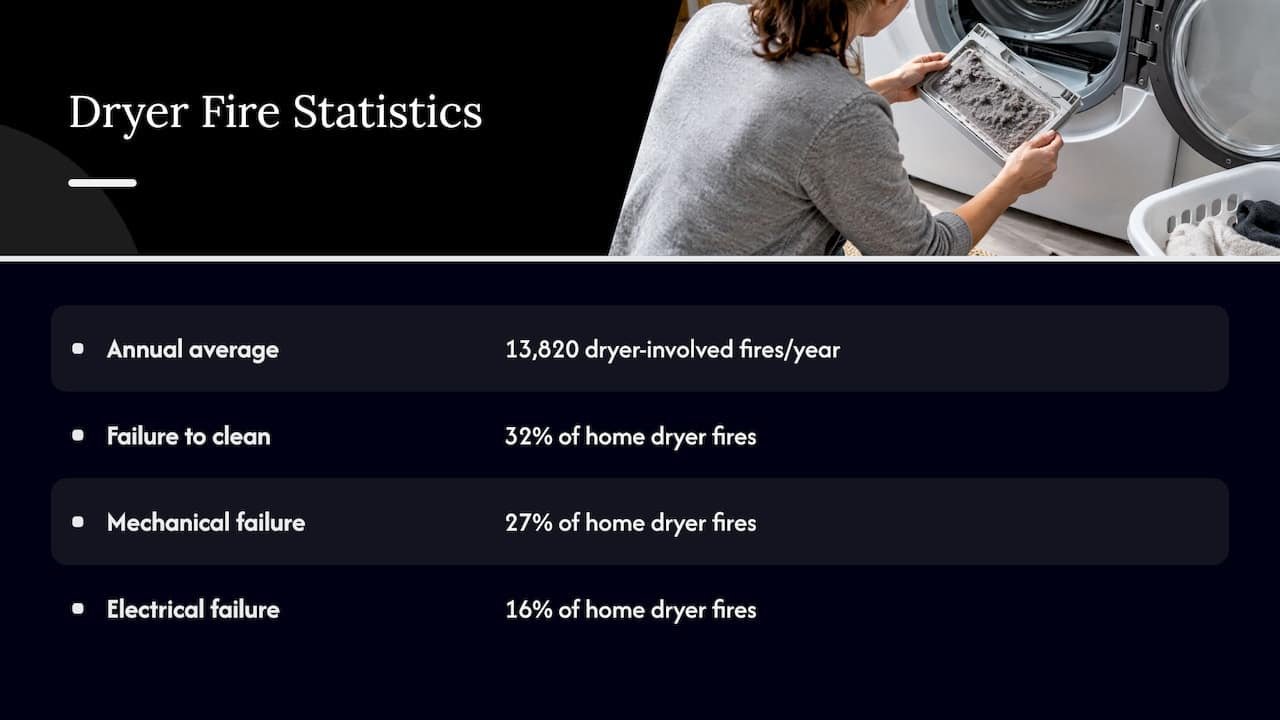
Those three causes line up closely with the reasons a dryer smells like burning. A smell is often the first sign that one of them is in progress.
What the smell tells you
The type of smell helps narrow down the cause. This table is a general guide to what technicians commonly look for. It is not a diagnosis, because several faults can smell alike.
| What you smell | Common cause | What to do |
|---|---|---|
| Dusty, like a hot toaster, mostly at the start of a cycle | Lint or dust touching the heating element | Stop, unplug, have the dryer and vent inspected |
| Hot rubber | Worn or slipping drive belt, or a rubber item in the load | Stop and call a technician |
| Hot plastic or sharp electrical odor | Failing motor, wiring or terminal connection | Unplug at once, turn off the breaker, call a technician |
| Smoky, like burnt toast, with clothes running hot | Restricted airflow and overheating | Stop, check vent, call for vent service |
| Oily or chemical | Residue from detergent or a spill, or new-machine oils | Check the load; if it persists, call a technician |
| Gas odor (rotten eggs) | Gas leak, not a burning smell | Leave the home and call your gas utility from outside |
If you cannot tell which smell you have, treat it as the more serious one.
The most common causes, one by one
Lint buildup in the dryer or vent
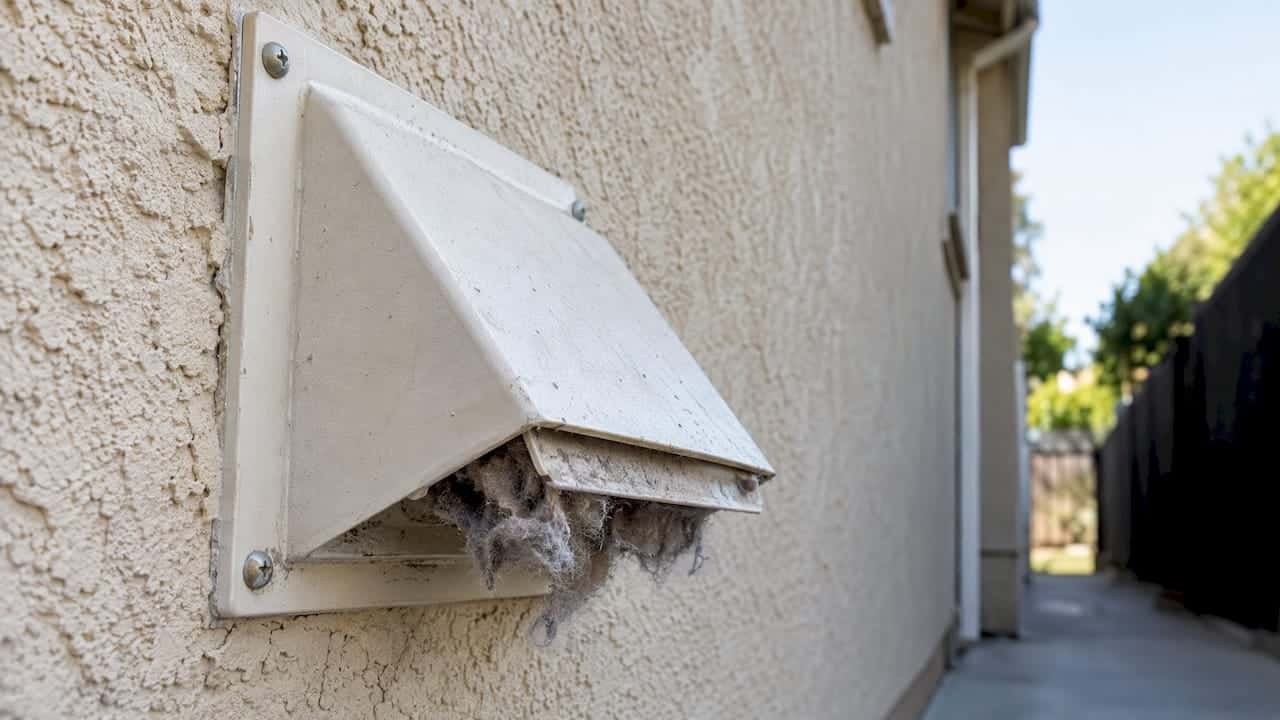
Lint is the cause most people find. The National Park Service says lint buildup inside the dryer and the vent reduces airflow, can cause overheating and can result in a fire. Even when you clean the screen every load, fine lint passes through and collects in the cabinet, around the heating element and in the duct that carries air outside.
Signs the vent is the problem:
- Clothes take more than one cycle to dry.
- The outside of the dryer feels very hot.
- The laundry room is humid or smells warm.
- The flap on the outside vent barely moves while the dryer runs.
Our dryer vent cleaning guide covers how cleaning works, and why clean dryer vents matter for home safety explains the risk in more detail. If the duct is crushed, disconnected or the wrong material, dryer vent repair is the fix, not just cleaning.
Restricted airflow from poor venting
The National Park Service advises using rigid or flexible metal venting, not overloading the dryer and keeping the area around it clear. Plastic or foil accordion duct, a long run with many bends or a vent hood clogged with lint all hold heat inside. Gas dryers have additional venting requirements, which we explain in our gas dryer venting code article.
A worn belt, motor or thermostat
When the drive belt slips or frays, friction can produce a hot rubber smell, often with a thumping or squealing sound. A failing motor can smell hot and may stop mid-cycle. A thermostat or thermal fuse that no longer controls temperature lets the dryer overheat. These parts are inside the cabinet and are best handled by a trained technician who can replace them and check what else was stressed.
If your dryer also stopped heating, our article on why a dryer is not heating lists related causes.
Items that should not go in the dryer
The National Park Service advises against drying foam, rubber or plastic items. It also says never to dry fabric contaminated with gasoline, cooking oil, grease or other flammable substances. Kitchen towels with cooking oil, gym rags with oils, and rubber-backed rugs are typical examples. If your load had something like this, remove it and do not run the dryer again until it has been inspected.
Detergent residue and stray objects
LG notes that dust, lint or other substances in the dryer, and detergent residue on laundry, can cause a burning smell. A coin, a pen or a piece of a garment that slipped behind the drum can also burn or melt. If the smell stops after you remove an obvious cause, still have the machine checked if you saw smoke or the dryer ran hot.
Electrical problems
An electrical smell is sharp and plastic-like. It can come from a loose power cord connection, a damaged terminal block or a failing motor. Do not keep using a dryer that smells like this, and do not reset the breaker repeatedly. Unplug it and call a licensed technician.
Is a burning smell normal in a new dryer?
Sometimes, briefly. Manufacturers describe it the same way:
- LG says a temporary odor can occur during a new dryer’s first cycles and should dissipate with use.
- Samsung says a new dryer may smell like burning from shipping-related oil residue and suggests an empty run of about 15 minutes.
- GE Appliances says an oily or burning odor in a new gas or electric dryer can come from assembly oils or dust burning off, and recommends running the empty dryer for 20 minutes. For an installed dryer, it advises checking the venting for lint buildup.
So a faint odor that fades after the first run is expected. If the smell is strong, gets worse, comes with smoke, or does not go away after a couple of cycles, switch the dryer off and request service. Samsung’s guidance says the same.
A new smell can also point to the installation rather than the dryer. A kinked duct, wrong vent material or an improper gas or electrical connection causes trouble from day one. Professional appliance installation covers these details so the machine is set up to vent properly from the first load.
Can you keep using a dryer that smells burnt?
No. The National Park Service’s advice is to call a service technician before continued use. The reason is practical: you cannot see inside the cabinet or the duct, and a smell means something is getting hotter than it should.
Signs that a dryer fire may be developing include:
- Smoke from the dryer, the vent or the laundry room
- Clothes that come out unusually hot or still damp after a full cycle
- A burning smell that returns every time you run the machine
- Tripped breakers when the dryer starts
- Visible scorch marks or melted plastic on the door, the wall or the duct
If you see smoke or flames, get everyone out and call 911. Do not stay to fight a dryer fire.
When your heater or furnace smells like burning
Many people who search for a burning dryer smell are also noticing a similar odor from heating vents, especially at the start of the cooler season. The two situations have different causes, so here is how to separate them.
The first-use dust smell
After months of sitting idle, heating equipment collects dust. The Spokane Fire Department says dust and particles burning off when a heater is first used after warm-weather inactivity usually cause an odor that fades within about 45 minutes. In Southern California, where heating may sit unused through long warm stretches, this is a common experience on the first cool evening.
If the smell is dusty, light and fading, ventilate the room and watch it. If it persists beyond the first hour, grows stronger or returns, have the system inspected.
Signs of trouble
The same Spokane guidance says large, yellow, unsteady flames in a furnace are a sign of trouble, and that you should call the utility company immediately. Other reasons to stop and call:
- A burning plastic or electrical odor from vents
- Smoke from a register or the furnace cabinet
- Soot around the furnace or vents
- Headaches, nausea or dizziness while the heat runs, which can signal carbon monoxide
The EPA explains that cracked heat exchangers and blocked, leaking or damaged chimneys or flues can release combustion pollutants, including potentially fatal concentrations of carbon monoxide. The CPSC says fuel-burning systems can cause carbon monoxide poisoning when they are improperly installed, poorly maintained, defectively vented, blocked or misused. It recommends CO alarms that meet UL 2034 on every level of the home and outside sleeping areas, as described in its carbon monoxide fact sheet. Our own article on carbon monoxide detectors covers placement and what to do when an alarm sounds.
If a CO alarm sounds or anyone feels ill, go outside into fresh air and call 911.
Space heaters and clearances
Portable heaters can also give off a burning smell, often from dust on the element or from something sitting too close. The U.S. Fire Administration advises keeping anything that can burn at least three feet from heat sources and turning space heaters off when you leave the room or go to bed. The CPSC estimates portable heaters were involved in an average of 1,700 fires a year in 2017 to 2019. The City of San José Fire Department adds that heating equipment should be plugged directly into a wall outlet and that damaged cords should be replaced, not repaired by the homeowner.
The USFA and San José both recommend that heating equipment and chimneys be cleaned and inspected annually by a qualified professional. Doing that before the heating season is the simplest way to avoid an alarming smell on a cold night.
How to tell dust, lint, a worn part or an electrical fault apart
You cannot confirm the cause from the smell alone, but these questions help you describe the problem accurately when you call:
- When does it start? At the beginning of the cycle suggests dust on a heating element. After 15 to 20 minutes suggests heat building up from restricted airflow.
- Does it come with a sound? Squealing or thumping points toward a belt, roller or motor issue.
- Are clothes drying normally? Long drying times point to a clogged vent or a heating problem.
- Is the dryer gas or electric? A gas dryer adds combustion and venting concerns, so gas odors always come first.
- Has the smell ever been sharp or like melted plastic? That raises the chance of an electrical cause.
- Did you recently clean the vent, move the dryer or install a new one? A kinked duct after a move is common.
A technician combines your answers with inspection of the lint path, the venting, the belt, the motor, the thermostats and the electrical connections. If you want a wider view of when a household appliance has moved from annoying to risky, see 7 telltale signs you need appliance repair.
Our perspective
At MDTech Services, we treat a burning smell from a dryer as a safety call first and a repair call second. Our licensed technicians look at the whole system, not just the part that smells: the lint path inside the machine, the vent run to the outside, the gas or electrical connection and the parts that control heat.
We do this because the cause is rarely the one that looks obvious. A dryer that smells hot because of lint may also have a crushed duct behind the wall, and cleaning the drum alone will not solve it. Our approach is to find the source, explain it plainly and recommend a long-term, warranty-safe solution.
We also work on gas appliances, including LP to natural gas conversions, so a gas dryer is not a reason to wait. When you call, we give upfront pricing before work begins, and we offer 24/7 emergency availability for urgent situations across Orange County and Los Angeles County.
MDTECH
Dryer or heating smell in Orange County or Los Angeles County?
If your dryer, heater or furnace smells like burning, we can help. We repair and install residential appliances, handle gas appliance repairs and work on HVAC systems for homeowners, landlords and property managers in Orange County and Los Angeles County.
Start with appliance repair services for a dryer, or HVAC repair for a furnace or vent smell. You can book online, and we will ask about the smell, the age of the machine and whether it is gas or electric so the right technician arrives prepared.

For gas dryers and other gas appliances, see our gas appliance repairs page. If you want to understand what drives the cost of a dryer visit and how to prepare for it, our guide to dryer repair cost and vent maintenance walks through it.
Prevent the smell from coming back
The National Park Service’s prevention advice is simple, and it matches what we see in homes:
- Clean the lint screen before or after every load.
- Have the vent and exhaust duct cleaned periodically, not only when something goes wrong.
- Use rigid or flexible metal venting.
- Do not overload the dryer.
- Keep the area around the dryer clear of boxes, detergent and laundry piles.
- Do not dry foam, rubber or plastic items, or fabric that has gasoline, cooking oil or grease on it.
Add annual professional inspection of your heating system before the cold season, and keep working CO alarms on every level of the home.
FAQ
Can I still use my dryer if it smells burnt?
No. Stop the cycle, unplug the dryer and leave it off. The National Park Service advises calling a service technician before using a malfunctioning dryer again. A new dryer with a faint odor that fades after an empty run is the exception.
Do dryers normally smell burnt?
A used dryer should not. Light dust odors can appear after long periods of disuse, but a repeated burning smell means lint, a worn part or an electrical issue. A new dryer may smell for the first few loads because of oils from manufacturing and shipping, and manufacturers say this should fade.
Should I call a repairman for a burnt dryer smell?
Yes, if the smell is strong, comes back, smells like rubber, plastic or wiring, or comes with smoke, heat or long drying times. A technician can inspect the lint path, vent, belt, motor, thermostats and wiring. Call 911 first if you see smoke or fire.
Why does my heater smell like burning when I first turn it on?
Dust that settled on the heating components burns off when the heater runs after months of rest. Fire department guidance says this odor usually fades within about 45 minutes. If it lasts longer, smells like plastic or comes with smoke, turn the heater off and have it inspected.
What are the signs of a dryer fire?
Warning signs include smoke from the dryer or vent, clothes that are very hot or still wet after a full cycle, scorch marks, melted plastic and a burning smell that returns. If you see flames or smoke, leave the home and call 911.
Sources
- Fire Prevention 52: Dryer Fires, U.S. National Park Service
- Home Dryer Fires, NFPA
- LG Dryer: burning smell during drying
- Samsung dryer smells or smokes
- GE Appliances: Dryer odor
- Ooh That Smell?!? City of Spokane Fire Department
- Heating Safety, City of San José
- Heating Fire Safety, U.S. Fire Administration
- CPSC warning on space heaters, furnaces and fireplaces
- Carbon Monoxide Fact Sheet, CPSC
- Sources of Combustion Products, US EPA