
If your air conditioner is turning on and off every few minutes instead of running a full cycle, it is almost certainly short cycling. The most likely culprits are a dirty air filter, a thermostat that is misplaced or set with too narrow a differential, or a blocked outdoor condenser. Swap the filter and clear debris from the condenser first. If you see ice on the coil, smell anything burning, or hear the breaker tripping repeatedly, shut the system down and call a licensed technician right away.
TL;DR:
- Replacing a dirty air filter or clearing debris from the outdoor condenser often resolves short cycling caused by airflow restrictions.
- Proper system sizing, as per Manual J guidance, prevents oversized units from cooling too rapidly and causing frequent short cycles.
- Diagnosing low refrigerant levels requires licensed technicians, since leaks need EPA-certified handling and cannot be temporarily fixed by just recharging.
- Short cycling that includes ice formation or burning smells warrants immediate system shutdown and professional inspection to prevent equipment damage.
- Routine homeowner checks such as thermostat placement, battery status, and vent openings can prevent most mild short cycling issues without costly repairs.
Table of Contents
- What AC Short Cycling Actually Looks Like
- Common Causes of AC Short Cycling at a Glance
- The Detailed Causes Behind Air Conditioning Short Cycles
- Why Short Cycling Is More Than an Annoyance
- Homeowner Troubleshooting Steps That Are Actually Safe to Try
- What Our Technicians Actually Check On a Diagnostic Visit
- Get Your AC Short Cycling Diagnosed and Fixed
- Sources
- FAQ
What AC Short Cycling Actually Looks Like
A healthy residential air conditioner runs in cycles built to remove both heat and humidity, and that takes time. Manufacturer guidance built around the Copeland and Honeywell cycle-rate conventions points to roughly 3 cycles per hour for most residential high-efficiency systems, with each run lasting at minimum around 3 minutes. Short cycling means the compressor kicks on, runs for a short time, then shuts off, then restarts again within minutes.
You will usually notice it before you diagnose it. Rooms never quite cool down. Humidity stays sticky even when the air feels cold. The breaker trips more than it used to, or you spot ice forming on the indoor coil or refrigerant lines. Runs under 3 to 5 minutes are the real warning threshold, not just an annoyance, because that is where mechanical damage starts to accumulate.
Common Causes of AC Short Cycling at a Glance
Before calling anyone, it helps to know what usually triggers this problem. Most cases trace back to one of these:
- Clogged air filter restricting airflow across the evaporator coil
- Blocked or dirty outdoor condenser raising head pressure
- Low refrigerant or a leak dropping suction pressure below the safe range
- Frozen evaporator coil from restricted airflow or low refrigerant
- Thermostat problems, including poor placement, weak batteries, or an aggressive cycles-per-hour setting
- Failing electrical components, like a weak capacitor or a chattering contactor
- Blocked vents, closed registers, or duct leaks starving the system of airflow
- Oversized equipment that cools the thermostat’s zone faster than it can remove humidity
Most of these are inexpensive to fix. A few, especially anything electrical or refrigerant related, call for a licensed technician rather than a DIY attempt.
The Detailed Causes Behind Air Conditioning Short Cycles
Each item on that checklist has its own mechanism, and understanding it changes how you troubleshoot.
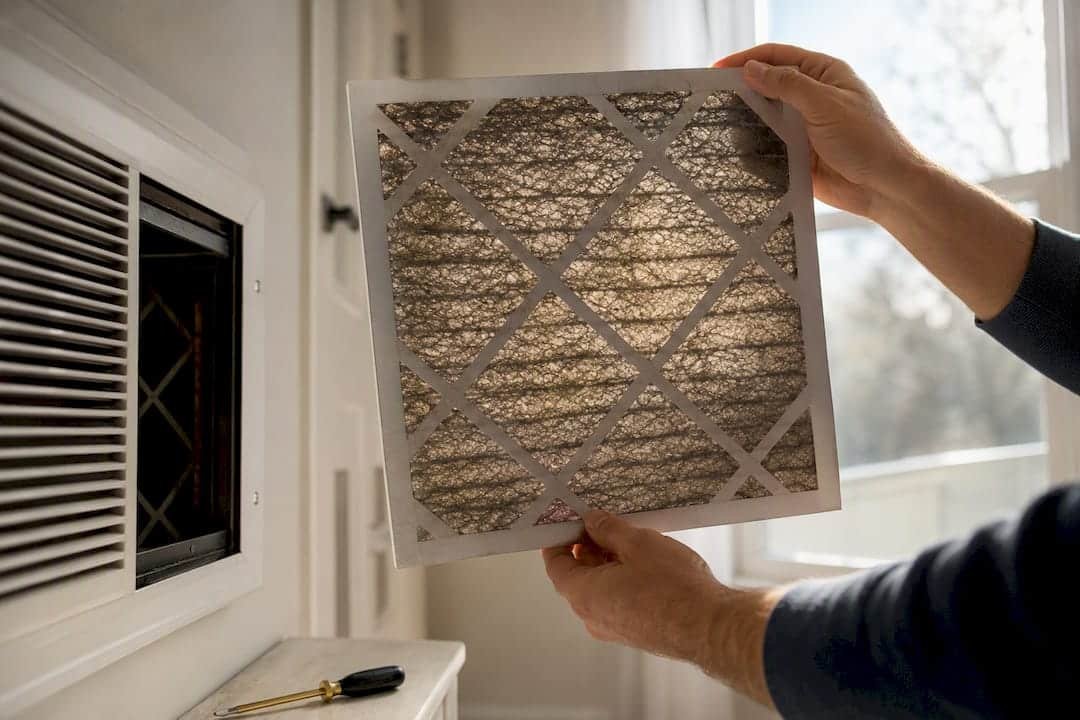
A dirty filter starves the coil. Airflow drops, the evaporator coil gets too cold, and ice starts forming on it. That ice further restricts airflow, and the system can trip a low-pressure switch meant to protect the compressor. Dirty filters are the single most common homeowner-level cause of short cycling, and replacing a filter that has not been changed in two or three months often resolves the issue outright. Pull the filter, hold it up to a light source, and if you cannot see light through it clearly, replace it.
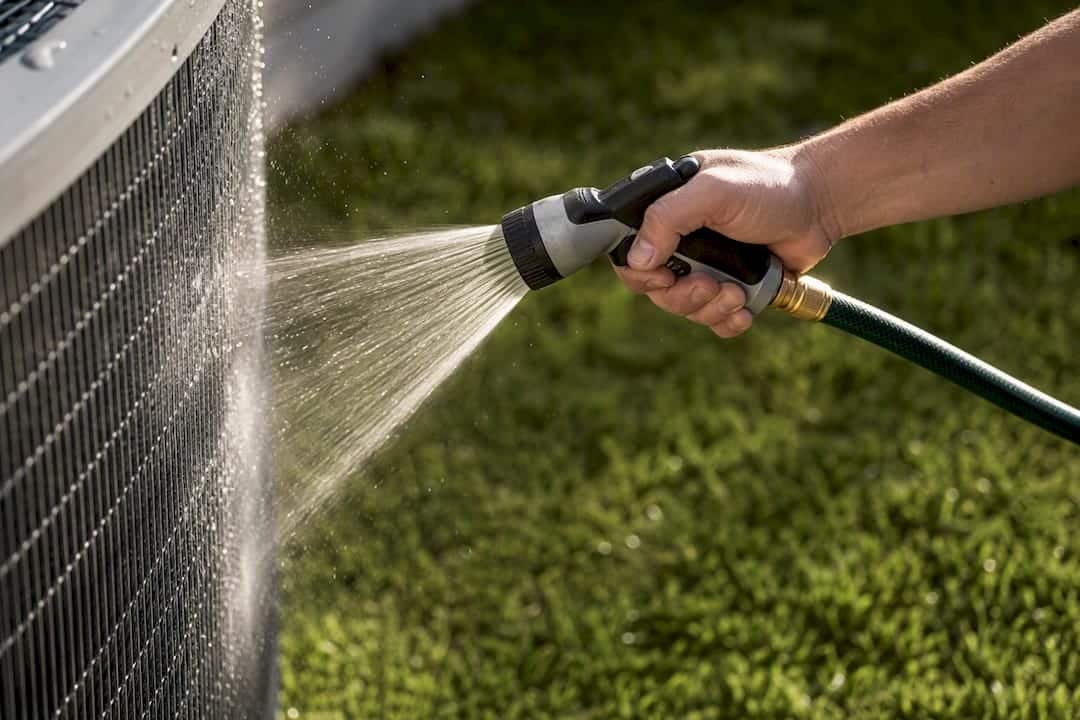
A blocked condenser raises pressure on the other end. Grass clippings, leaves, and dust cake onto the outdoor unit’s coil and reduce its ability to reject heat. That drives head pressure up, and the system’s high-pressure safety switch shuts the compressor off to protect it. Keeping roughly two feet of clearance around the condenser and gently rinsing the coil with the power off is a homeowner-safe fix that solves this in minutes.
Low refrigerant points to a leak, not just a top-off job. A system running low on refrigerant sees suction pressure drop, ice can form on the refrigerant lines, and vents blow warm air intermittently. Diagnosing this correctly requires gauges and EPA-certified refrigerant handling under Section 608, since simply recharging a leaking system is a temporary patch that leaves the underlying leak untouched.
A frozen evaporator coil needs a slow thaw, not a hammer. If you find ice on the indoor coil, set the thermostat fan to “on” and turn the cooling off entirely, then let the coil thaw for several hours. Restarting a frozen system can flood the compressor with liquid refrigerant, which is a fast way to destroy it. Once thawed, figure out whether a dirty filter, closed vents, or low refrigerant caused the freeze in the first place, or it will happen again.
Thermostat issues are the cheapest fix on this list. Placement near a supply vent, direct sunlight, or a kitchen, along with weak batteries or an overly narrow cycles-per-hour setting, can cause rapid cycling even when the rest of the system is fine. Check this before assuming anything mechanical is wrong.
Electrical components are not a DIY project. A weakening run capacitor or a contactor that chatters instead of closing cleanly can cause the compressor to start and stop erratically. These components carry high voltage even when the unit is off, and diagnosing them correctly requires a licensed electrician’s tools and training.
Oversized equipment cycles by design. An AC sized larger than the home needs will blast cold air fast enough to satisfy the thermostat before it has run long enough to pull humidity out of the air. Proper equipment sizing, following ACCA Manual J guidance, is the only real fix, whether that means a variable-speed replacement or a full system swap.
Ductwork problems starve the system from the return side. Blocked returns, undersized ducts, or leaky duct joints raise static pressure and choke airflow before it ever reaches the coil. A technician checks this with a total external static pressure (TESP) test, something homeowners cannot replicate without specialized gauges.
Pro Tip: If replacing the filter and clearing the condenser does not stop the short cycling within a day, stop troubleshooting further on your own. Repeated cycling wears on the compressor faster than most people realize, and delaying a professional diagnosis rarely saves money.
Why Short Cycling Is More Than an Annoyance
Every time a compressor starts, it draws a surge of current several times higher than its normal running amperage. That startup current, known as locked rotor amperage, runs 4 to 6 times higher than steady-state operation, and each surge adds thermal stress to the motor windings. Short cycling multiplies how often that stress happens in a given day.
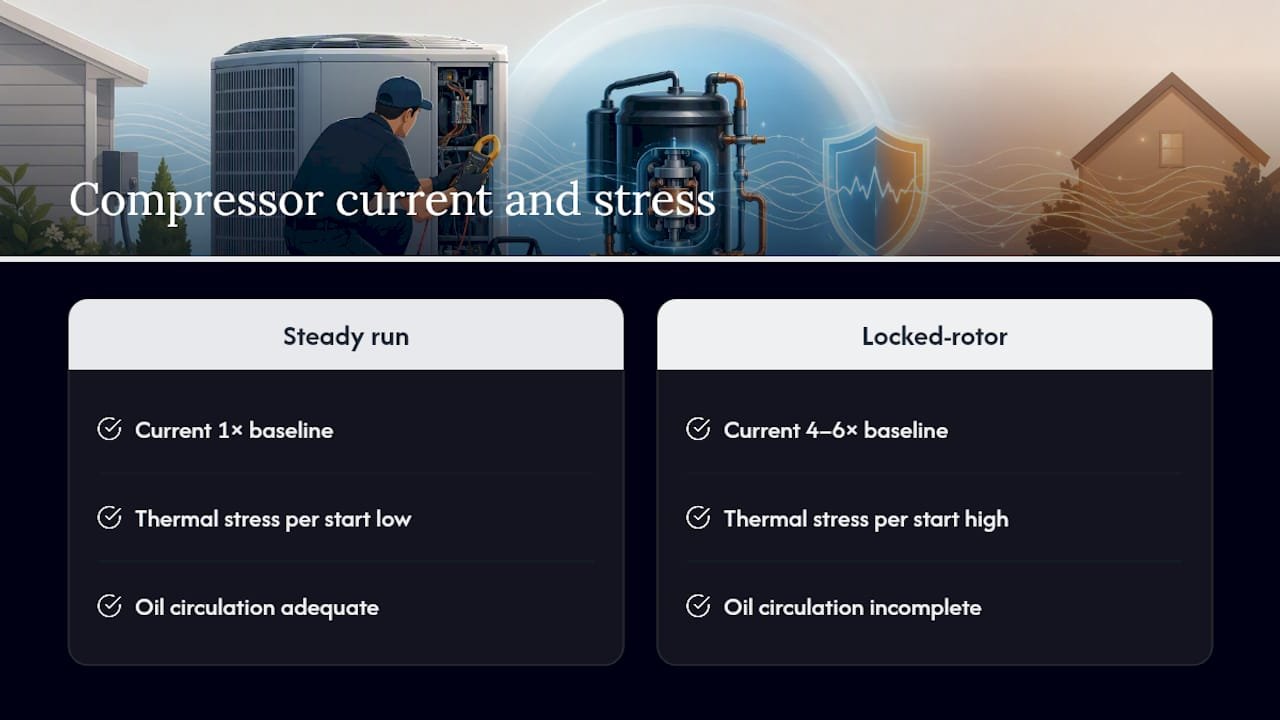
There is a quieter risk too: oil migration. Compressors rely on refrigerant flow to circulate lubricating oil back into the crankcase, and runs that end too quickly do not give the system enough time to complete that return trip. Over weeks of continuous short cycling, HVAC practitioners report that this combination of oil starvation and startup stress can markedly shorten a compressor’s remaining life, sometimes turning a repairable issue into a full compressor failure within a season.
There is also a bill you will feel sooner. Systems that cycle constantly waste energy without fully removing humidity, so the house feels clammy even as the meter spins faster. Poorly maintained HVAC equipment consistently underperforms on efficiency, and short cycling is one of the more expensive ways a system can run inefficiently.
Homeowner Troubleshooting Steps That Are Actually Safe to Try
Here is the order that makes sense before anyone touches wiring or refrigerant:
- Set the thermostat fan to “on” if you see ice anywhere on the coil, and turn cooling off to let it thaw.
- Replace the air filter if it has not been changed recently, checking it against a light source.
- Open all supply registers and make sure furniture or curtains are not blocking them.
- Walk outside and clear debris from around the condenser, keeping about two feet of clearance.
- Gently rinse the outdoor coil with a garden hose, power off, if it looks caked with dust or grass clippings.
- Check thermostat placement and batteries, and avoid an aggressive cycles-per-hour setting if you can adjust it.
What you should not do: add refrigerant yourself, touch a capacitor or any electrical terminal, or keep running a unit that smells like burning plastic or shows visible smoke. Those are jobs for a licensed technician, full stop.
Pro Tip: Before you call for service, write down when the short cycling started, whether it followed a storm or power outage, and roughly how long each run lasts. That timeline often points a technician straight to the cause. For a broader maintenance rhythm that helps prevent this from recurring, a step-by-step seasonal HVAC maintenance routine covers filter schedules, coil cleaning, and thermostat checks in one place. If the problem persists after these steps, our HVAC troubleshooting process for homeowners walks through what a technician checks next.
What Our Technicians Actually Check On a Diagnostic Visit
Short cycling rarely has one clean cause, which is why guessing tends to waste both time and money. On a diagnostic visit, our technicians check filter condition and coil cleanliness first, then move to refrigerant pressures, electrical components like capacitors and contactors, and a total external static pressure reading to rule out duct restrictions. Thermostat calibration and placement get verified too, since that is an easy miss that mimics a bigger problem.
Refrigerant work falls under EPA Section 608 certification, and anything involving line voltage gets handled to code, not guessed at. If equipment sizing looks off, we flag it against Manual J guidance rather than recommending a replacement without justification. You get a written diagnosis and a straight comparison between repair and replacement, so the decision is yours to make with real numbers in front of you, not a sales pitch dressed up as a repair recommendation.
— MDTECH
Get Your AC Short Cycling Diagnosed and Fixed
There are local alternatives to guesswork and repeat service calls for AC short cycling in Orange County and Los Angeles County. Where a generic checklist stops at “check your filter,” our licensed technicians actually pressure-test the refrigerant circuit, inspect capacitors and contactors, and run a Manual J review when sizing looks off, so you get a real fix instead of a temporary patch.

Whether the issue turns out to be a simple airflow fix or a failing capacitor that needs replacement, our air conditioning repair service covers the diagnosis and repair in one visit. For systems showing broader wear, our HVAC services team can also evaluate whether a repair or a sizing correction makes more financial sense long term. Book a diagnostic visit online or call our team directly, and have your symptom timeline ready so we can start troubleshooting the moment we arrive.
Sources
For deeper technical background, the U.S. Department of Energy’s residential HVAC literature review covers efficiency and performance context, while HVAC School’s compressor damage guide details startup stress. ACCA Manual J remains the standard for correct equipment sizing.
- AC Compressor Short Cycling: Causes & Fixes (Home + Car)
- AC short cycling: why it happens and costs — HVAC Pricing Guide
- HVAC short cycling causes fixes & proper AC sizing guide 2026 — Alternative Aire
- Residential HVAC literature review — U.S. Department of Energy
FAQ
What Is the Most Common Cause of AC Short Cycling?
A dirty air filter is the most frequently cited cause because it restricts airflow across the evaporator coil, which can lead to freezing and low-pressure trips. Checking and replacing the filter is the first step most technicians recommend before anything else.
Should I Turn My AC Off If It’s Short Cycling?
If you see ice on the coil, smell burning, or hear repeated breaker trips, turn the system off immediately and call a licensed technician. For milder cases, set the thermostat fan to “on” and cooling to “off” long enough to thaw any ice, then try basic checks like the filter and condenser clearance before running it again.
Why Is My AC Short Cycling in My Car?
Automotive AC short cycling shares the same core logic as home systems: low refrigerant, a failing pressure switch, or a clogged condenser can all cause rapid on and off cycling. Since vehicle AC systems use sealed refrigerant circuits and specialized fittings, diagnosing the exact cause typically requires a shop with automotive-specific gauges rather than a home HVAC technician.
Can an Oversized AC Unit Cause Short Cycling?
Yes. An oversized system cools the thermostat’s sensor fast enough to shut off before it has run long enough to remove humidity from the air, which shows up as frequent short cycles even though nothing is technically broken. The fix usually involves correcting equipment sizing according to Manual J standards, sometimes through a variable-speed replacement rather than a simple repair.
How Much Does It Cost to Fix AC Short Cycling?
Cost depends entirely on the cause, since a filter change costs almost nothing while a capacitor replacement or refrigerant leak repair runs higher. Mdtechservices provides a written diagnosis and quote before any repair work begins, and current service pricing is available through our air conditioning repair page.