
A freezer that keeps icing up is almost always letting in warm, moist air or failing to melt frost the way it should. The first is usually a door, gasket or airflow problem you can check yourself in about fifteen minutes. The second points to a defrost system fault that needs a technician. This guide shows you how to tell which one you have, how to defrost safely and what to do next.
TL;DR
- Frost forms when warm, humid air gets into the freezer and freezes, so start with the door, the gasket and how the freezer is packed.
- Keep the temperature at or below 0°F, and change the setting only in small steps, waiting at least 24 hours between changes.
- Where the ice appears matters: frost around the door points to the seal, while ice bulging on the back wall points to the defrost system.
- Frost-free models should not build up thick ice at all. If yours does after the basics are fixed, the repair is usually a part, not a setting.
- If ice returns within days of a defrost, book a repair before the food spoils.
Table of Contents
- Why a freezer ices up
- Where the ice forms tells you the cause
- Quick checks you can do in 15 minutes
- How to defrost a freezer safely
- Habits that keep frost down
- When recurring ice means it is time for a repair
- Our perspective: fix the cause, not the frost
- Need a technician in Orange County or Los Angeles County?
- FAQ
- Sources
Why a freezer ices up
Cold air holds very little moisture. Each time warm room air enters the freezer, its moisture condenses on the coldest surfaces and freezes. A thin layer of frost is normal. Whirlpool’s product help says a small amount of condensation or ice droplets can be normal, especially in high humidity, while heavy frost is associated with doors left open, frequent openings, a poor gasket seal or blocked air vents.
Appliance expert Matt Ayres describes the same pattern: a rush of warm, humid air gets in and freezes. He also notes that a faulty thermostat can keep the freezer cooling when it does not need to, which adds to the ice.
In practice, the causes fall into five groups:
- Air leaks. A worn, warped or dirty gasket, a door that does not close fully, or an ice-chute flap that stays open.
- Habits. Long door openings, hot food going in, or a door left ajar by a bag or a box.
- Blocked airflow. Overpacked shelves or food pushed against vents, so cold air cannot circulate.
- Temperature settings. A setting colder than needed, or a thermostat that no longer shuts off the cooling.
- Defrost failure. In a frost-free model, a part in the automatic defrost system has stopped working, so frost is never cleared from the evaporator.
The first three you can usually fix without tools. The last two often cannot be fixed at home.
Where the ice forms tells you the cause
Before you touch anything, look at the freezer and note where the frost is heaviest. This single observation saves a lot of guessing.
| Where you see frost or ice | Most likely cause | What to do first |
|---|---|---|
| Around the door opening, on the gasket or the first shelf near the door | Worn or dirty gasket, door not closing fully | Clean the gasket, check closure, test the seal |
| Evenly on food and container surfaces | Frequent door openings, humid air, temperature set too cold | Reduce openings, check the setting |
| Around vents or on the shelves in front of them | Blocked airflow or overpacking | Move food away from vents |
| Bulging on the back wall or panel in a frost-free freezer | Defrost system failure | Defrost fully, then call a technician if it returns |
| Under or around the ice chute or ice maker | Chute flap not closing, ice maker leak | Check the flap, then look at the ice maker |
| Ice on the refrigerator floor or back wall in a combination unit | Blocked drain or blocked vents between sections | Clear the vents, check the drain |
Heavy frost on the back wall deserves particular attention. The iFixit-style rule of thumb is that an evaporator cover coated in ice means the defrost system is not doing its job, and an open door is not the explanation. That points to a heater, sensor or control board rather than a habit.
First, confirm your freezer is meant to be frost-free
Most modern upright freezers and refrigerator-freezers run an automatic defrost cycle. Many chest freezers and some older uprights are manual defrost. A manual-defrost model will build frost over time by design. ENERGY STAR advises defrosting a manual-defrost freezer before frost passes 1/4 inch to keep it efficient. If yours is manual, steady frost is normal and you simply need to defrost on a schedule. If yours is frost-free, thick ice is a sign something is wrong.
Quick checks you can do in 15 minutes
Work through these in order. They go from the easiest and most common fixes to the ones that tell you a repair is needed.
1. Check that the door closes fully
Open the door and look for items sticking out of a drawer or shelf. A bag of frozen vegetables or a pizza box is enough to hold a door open a quarter inch. Frigidaire’s support page lists a warped door or gasket and an ice-chute flap that does not close among the causes of frost, so check those closures too. Hotpoint’s refrigeration lead Nevin Melcok warns that even a slightly open door can cause frost on basket fronts and make drawers hard to open.
2. Test the gasket
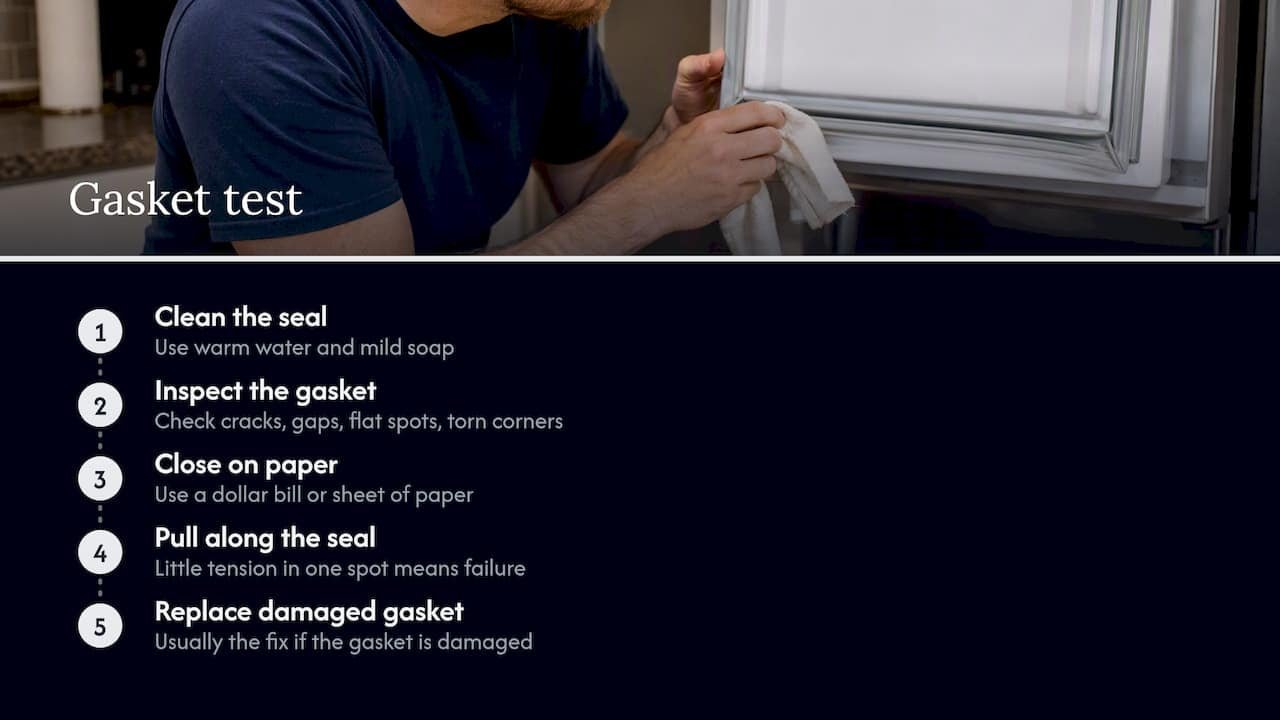
Wipe the rubber seal with warm water and mild soap. Sticky residue stops it from sealing. Look for cracks, gaps, flat spots and torn corners. Then try the paper test. Whirlpool’s chest-freezer guidance recommends closing the lid on a dollar bill or a sheet of paper and pulling it out along the entire seal. You should feel resistance everywhere. If it slides out with little or no tension in one spot, the seal is failing there. The same test works on an upright freezer door.
If the gasket is damaged, replacing it is usually the fix. We cover this in more detail on our pages about freezer gasket repair and freezer door seal repair.
3. Check the temperature
A colder freezer is not a better freezer once it passes the recommended point. Whirlpool recommends a freezer temperature at or below 0°F (-18°C) and advises small adjustments, with at least 24 hours between changes so the unit can settle. Frigidaire also lists temperatures below the recommended 0°F as a possible cause of frost. Use an appliance thermometer rather than relying on the dial numbers, which differ between brands.
If the thermometer reads well below where you set the dial, the thermostat or control may be at fault.
4. Look at the airflow
Frost forms where cold air stalls. Whirlpool states that blocked vents between the freezer and refrigerator sections restrict circulation and can lead to moisture and excess frost. Pull food away from the vents and the back wall, and leave a little space between packages. Whirlpool’s freezer guidance also names overpacking that obstructs airflow as a cause.
5. Check the back wall and the ice chute
With the freezer empty or partly emptied, look at the back panel. A thin, even frost is fine. A thick sheet of ice, or a panel that looks warped and bulging, means the evaporator is not defrosting. This is the point where home fixes stop working for most households.
If the ice is near the ice maker, our guides on a Samsung ice maker that keeps freezing and how to repair an ice maker cover that specific problem.
How to defrost a freezer safely
A full defrost clears the ice, resets the freezer and shows you whether the problem returns. Plan for several hours, and pick a day when you can keep food cold.
- Move the food. GE Appliances’ manual says to remove all food and keep it in an insulated cooler. Add ice packs if the defrost will take a while.
- Unplug the freezer. Turn the control off or unplug the unit before you start.
- Collect the water. Put towels or a shallow tray at the base to catch melting water. The same manual suggests pans of hot tap water inside the freezer to speed things up.
- Use air, not electrical devices. GE says a fan directed at the open freezer is acceptable, as long as no electrical device is placed inside the unit. Do not use a hair dryer inside the cabinet, and never chip ice with a knife or screwdriver. You can puncture the evaporator or the liner.
- Dry and clean. Wipe the interior, and clean the gasket while you are there.
- Restart and reload. Plug it in, set it to 0°F, and let it cool before returning food. Place items so air can move around them.
A freezer that was frost-free should now stay clear for weeks. Mark the date, then check the back wall and door area after three or four days. If frost is already coming back quickly, you have found a problem that defrosting will not solve.
Habits that keep frost down
Once the cause is fixed, a few habits reduce how much moisture gets in. This Old House lists limiting how long the door is open, cooling hot food before storing it, organizing the freezer and cleaning it regularly as the main prevention steps. In a humid kitchen or garage, these matter even more.
- Decide what you need before you open the door.
- Let cooked food cool, then cover it tightly before it goes in.
- Wrap or seal items so their own moisture does not freeze on the surface.
- Keep vents and the back wall clear.
- Wipe the gasket every few months.
- Keep the unit level and slightly away from the wall for ventilation.
The same This Old House article advises cleaning the condenser coils, since dust and dirt build up around them. Dirty coils make the compressor work harder and can affect temperature control. Our articles on why refrigerator coils need maintenance and how a condenser coil works explain what to clean and why.
When recurring ice means it is time for a repair
Some signs mean the problem is inside the appliance, not in how it is used. Call a technician if you see any of these:
- Ice returns within days of a full defrost, with the door closing properly and the gasket in good shape.
- A thick sheet of ice on the back wall or over the evaporator cover of a frost-free freezer.
- The freezer is cold but the refrigerator is warm, which can mean airflow is blocked by ice at the evaporator. Our guide to a warm fridge with a cold freezer explains why.
- Food is softening or thawing and refreezing, with ice crystals on packaging and changes in texture.
- The temperature does not match the dial, even after small adjustments and 24 hours of waiting.
- Water pooling under the unit or inside the refrigerator section.
- Unusual noises or a compressor that runs constantly.
In a frost-free freezer, the parts behind recurring ice are typically the defrost heater, the defrost thermostat or sensor, the control board and sometimes the door gasket or evaporator fan. Diagnosing which one has failed takes testing with a meter, and replacing the wrong part wastes money. A brand-specific page can help if you own one: we have more on Frigidaire freezer repair.
For a general walk through of what to try yourself first, see our step by step refrigerator fix guide.
Time matters here. A freezer with a failing defrost system loses cooling capacity as ice builds, and food at the back or top can warm up before you notice. If you are unsure whether food is still safe, discard anything that has thawed and sat above freezing for an extended time, and check USDA guidance for specifics.
Our perspective: fix the cause, not the frost
Most calls we get about freezer ice start the same way. The homeowner has defrosted the unit more than once, and the frost returns each time. Defrosting treats the symptom. The cause is either an air leak that can be sealed or a defrost component that has failed.

We approach it in that order. We check the door closure and the gasket, then airflow and the temperature reading, and only then test the defrost system. That sequence avoids replacing parts that were never broken. When a part has failed, we explain what it is, why it failed and what the repair involves before any work starts, and we favor lasting, warranty-safe repairs over quick patches that bring the ice back in a month.
We also see how often a simple habit or a worn gasket is the whole story. If that is what we find, we tell you so. If your unit is a brand other shops turn away, ask us anyway. Our licensed technicians work on major household appliance brands across Orange County and Los Angeles County.
— MDTECH
Need a technician in Orange County or Los Angeles County?
If your freezer keeps icing up after you have sealed the door, cleared the vents and defrosted it, we can diagnose the cause and repair it. Our appliance repair services cover freezers, refrigerators, ice machines and other major household appliances, and you can book online or call us. We handle refrigeration repair for homeowners, landlords and property managers.

If you manage rental property, tell us when you book so we can coordinate access and approvals.
FAQ
Why is my freezer icing over even though the door is closed?
A closed door can still leak air if the gasket is worn, dirty or warped. Test the seal with a dollar bill along its full length, and wipe the gasket clean. If the seal is good, check for blocked vents, an ice-chute flap that does not close and a temperature colder than 0°F. If none of those apply and the unit is frost-free, the defrost system is the likely cause.
How often should I defrost my freezer?
It depends on the type. A manual-defrost freezer needs defrosting before frost builds past about 1/4 inch, according to ENERGY STAR. A frost-free freezer should not need manual defrosting. If you have to defrost one regularly, something is wrong and it should be inspected.
Is a little frost in the freezer normal?
Yes. Some frost or small ice droplets can form, especially in humid weather or after the door has been opened often. It becomes a problem when ice covers the walls, blocks vents, glues packages together or keeps returning after you defrost.
Why is the bottom of my refrigerator freezing?
Ice on the refrigerator floor usually comes from a blocked drain or a temperature set too cold, and sometimes from blocked vents between the freezer and refrigerator sections. Check the vents and the setting first. If ice keeps forming, a technician should check the drain and the air path from the freezer.
Can I fix a freezer icing up myself?
You can fix the common causes: a door that does not close, a dirty gasket, blocked vents and the wrong temperature. Do not chip at ice or use sharp tools. If a thick sheet of ice returns after a full defrost, the repair involves electrical components, so it is best left to a licensed technician.
Sources
- How to Help Eliminate Condensation and Frost, Whirlpool Product Help
- Why is ice building up in my freezer?, Ideal Home
- Freezers, ENERGY STAR
- Refrigerators / Freezer – Frost Build Up, Frigidaire
- Freezer Lid is Sealing – Forming Frost, Whirlpool Product Help
- What’s the Best Freezer Temperature?, Whirlpool
- Condensation in the Refrigerator Section, Whirlpool Product Help
- How to Avoid Frost Build Up, Whirlpool Product Help
- Owner’s Manual and Installation Instructions, GE Appliances
- Frost in Your Freezer: Causes, Fixes, and Prevention, This Old House