
TL;DR:
- The tenant maintenance request process should follow a single, documented workflow from submission to closure. Proper classification, clear communication, and thorough record-keeping help ensure legal compliance and efficient repairs. Mdtechservices provides licensed technicians in Orange and Los Angeles Counties to support compliant maintenance operations.
The tenant maintenance request process is a single, auditable workflow that begins with a written tenant submission and ends with documented closure. Under California habitability rules, landlords must keep gas, electricity, and plumbing in good working order, and tenants must provide written notice before legal timelines begin. For property managers and homeowners in Orange and Los Angeles Counties, the core timelines are:
- Emergency requests (gas leak, major flooding, total HVAC failure): acknowledge within 1 hour, begin work within 24 hours
- Routine requests (minor appliance faults, non-habitability issues): respond and resolve within 3–5 business days
- Written notice from the tenant is required before either clock starts
Mdtechservices supports property managers and homeowners across Orange and Los Angeles Counties with licensed technicians for appliance repair, HVAC, plumbing, and gas conversions.
Table of Contents
- What does a step-by-step tenant maintenance request workflow look like?
- Emergency vs. routine requests: how do you classify them correctly?
- How should tenants submit a maintenance request?
- What are a landlord’s legal duties under California habitability rules?
- How do you triage maintenance requests without guesswork?
- What records should you keep for every repair?
- How do you build a vendor roster that prevents emergency calls?
- What should you do when a repair isn’t completed?
- Mdtechservices supports your maintenance workflow in Orange and Los Angeles Counties
- Key Takeaways
- Why the standard maintenance process fails — and what actually fixes it
- Sources and further reading
What does a step-by-step tenant maintenance request workflow look like?
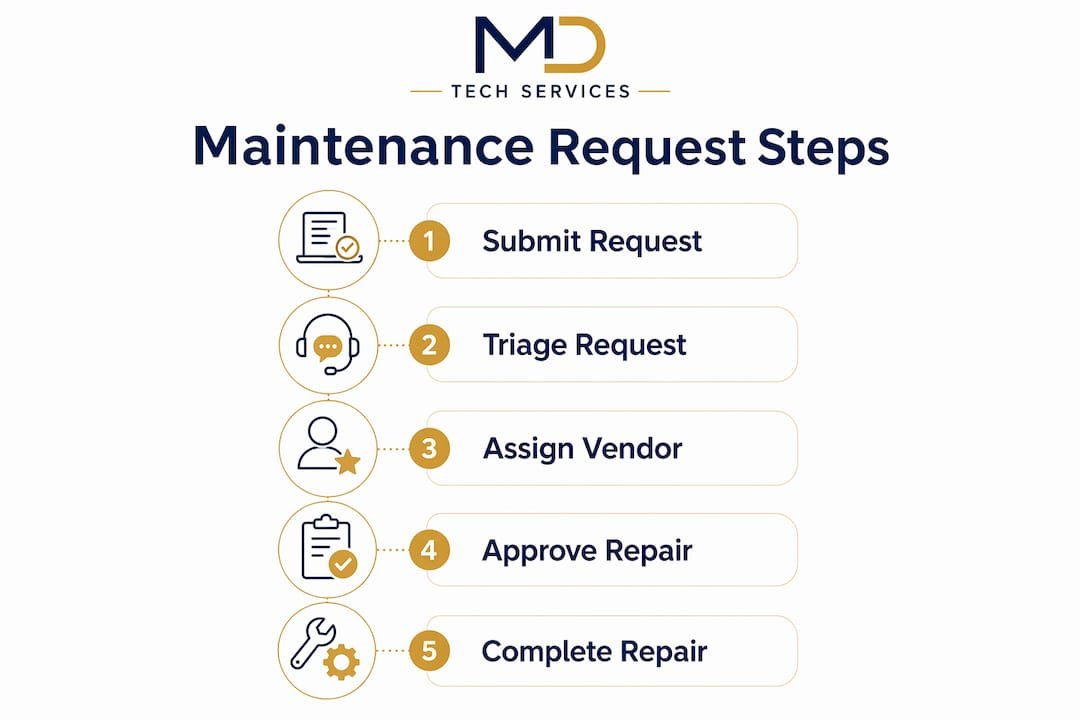
A structured maintenance workflow reduces mistakes, creates an audit trail, and keeps every request moving from submission to close without gaps.
- Intake — Accept requests through one channel only (tenant portal or standardized form). Reject verbal-only reports.
- Acknowledge — Confirm receipt immediately, ideally automated, so the tenant knows the request is logged.
- Triage — Classify as emergency (P1), urgent (P2), or routine (P3) using objective criteria (see Section 6).
- Work order creation — Record unit number, problem category, photos, tenant availability, and NTE (not-to-exceed) limit.
- Vendor assignment — Match trade to your pre-vetted roster. Confirm insurance and licensing before dispatch.
- Schedule — Confirm appointment window with both vendor and tenant. Provide 24-hour written notice before entry per California law.
- Perform work — Vendor completes repair, takes before-and-after photos, and notes any scope changes.
- Tenant sign-off — Collect written or digital confirmation that the issue is resolved.
- Invoice and close — Process payment, attach invoice to the work order record.
- Archive — File all records (photos, invoice, timestamps, sign-off) linked to the unit file.
Owner approval is required when a repair exceeds your pre-set NTE threshold. Setting those thresholds in advance prevents stuck tickets mid-job. A vendor who arrives knowing the NTE limit can bring the right parts and avoid a second visit.
Pro Tip: Set automated status messages at intake, vendor assignment, appointment confirmation, and completion. This single change cuts tenant status-check calls significantly without adding manual work for your team.

Emergency vs. routine requests: how do you classify them correctly?
Correct classification keeps emergency resources available for real emergencies and protects you legally if a dispute arises.
Priority 1 — Emergency (respond within 1 hour, begin work within 24 hours):
- Active gas leak or carbon monoxide alarm
- Major flooding or sewage backup
- Total loss of heat during extreme cold or AC failure during a heat advisory
- Complete electrical failure affecting habitability
- Broken exterior door lock or security breach
Priority 2 — Urgent (respond within 24 hours, resolve within 2–3 business days):
- Partial plumbing failure (one fixture out, others functional)
- HVAC underperforming but not failed
- Refrigerator not cooling (food safety risk)
Priority 3 — Routine (resolve within 3–5 business days):
- Minor appliance faults (dishwasher cycle error, ice maker not producing)
- Cosmetic damage with no habitability impact
- Non-urgent fixture replacements
A common edge case: a tenant reports “no heat” in October when the outdoor temperature is 65°F in Los Angeles. That is a P2, not a P1, unless a vulnerable occupant is present. Document your reasoning. For plumbing emergency definitions, a burst pipe with active water flow is always P1; a slow drain is P3.
Timeline rule: Emergency requests require a prompt acknowledgment and work starting as soon as possible, often within the same day. Routine repairs target resolution within a few business days. These windows align with California habitability guidance and industry standards.
How should tenants submit a maintenance request?
Requests submitted through informal channels — text, voicemail, verbal — lack audit trails and create liability gaps. A standardized maintenance request form solves this on first touch.
Required fields in every submission:
- Property address and unit number
- Problem category (plumbing / HVAC / electrical / appliances / other)
- Date the issue was first noticed
- Clear written description of the problem
- Photos or short video attached
- Tenant availability for access
- Any access instructions (gate code, pet in unit, etc.)
Copy-paste tenant template:
Post this template in your tenant portal, your welcome packet, and any property-specific communication hub. When tenants know exactly what to include, faster vendor dispatch follows naturally.
Pro Tip: If a tenant submits by text or phone call, have your team log it into the formal system immediately and send the tenant a portal confirmation. The informal message alone is not a legal record.
For communication strategies that speed repairs, consistent channel discipline is the single highest-leverage habit a property manager can build.
What are a landlord’s legal duties under California habitability rules?
California law requires landlords to maintain gas, electricity, and plumbing in good working order. Tenants must use systems correctly and provide written notice before legal repair timelines begin.
“If you believe that your rental unit needs repairs and the landlord is responsible under the implied warranty of habitability, you should notify the landlord in writing and retain a copy for your records.” — California DRE, Dealing with Problems in Your Rental Unit
Practical compliance checklist for property managers:
- Acknowledge every written repair request with a timestamped response
- For emergencies, dispatch a licensed vendor within 24 hours and document the dispatch
- Provide 24-hour written notice before entering a unit to make repairs
- Keep all response timestamps, vendor dispatch records, and before-and-after photos
- When a repair is delayed beyond the target window, document the reason in writing
Tenants who feel ignored have legal options including repair-and-deduct (limited to twice in any 12-month period under California law) and, as a last resort, rent withholding. Both carry legal risk for the tenant, but they also expose the landlord to disputes. Staying within your response windows is the most reliable way to avoid both. For a deeper look at handling tenant maintenance complaints, proactive documentation is your first line of defense.
Pro Tip: Send a written entry notice even when a tenant verbally agrees to access. A text confirmation from the tenant does not satisfy California’s 24-hour written-notice requirement.
How do you triage maintenance requests without guesswork?
Automated triage rules that evaluate safety risk, habitability impact, and asset-damage potential remove subjective urgency claims and route resources correctly.
Decision tree:
- Does the issue pose an immediate safety or health risk? → P1 Emergency. Dispatch now.
- Does it affect habitability (no heat, no water, sewage) but no immediate danger? → P2 Urgent. Respond within 24 hours.
- Does it risk significant asset damage if left 48 hours? → P2 Urgent. Respond within 24 hours.
- Is it a functional inconvenience with no safety or habitability impact? → P3 Routine. Schedule within 3–5 business days.
- Is it cosmetic only? → P3 Routine. Batch with next scheduled visit.
Override conditions:
- After-hours P2 issues: notify on-call vendor; do not wait until morning
- Extreme weather (heat advisory, freeze warning): elevate HVAC failures to P1 regardless of season
- Third-party constraints (HOA access, elevator restrictions): document delay reason and notify tenant
Pro Tip: Write your triage rules into your intake form as a dropdown or checkbox set. Review the rules monthly for the first quarter, then quarterly after that. Misclassification almost always traces back to rules that were never written down.
| Criteria | P1 Emergency | P2 Urgent | P3 Routine |
|---|---|---|---|
| Safety / health risk | Yes | No | No |
| Habitability impact | Yes | Yes | No |
| Asset damage risk (48 hrs) | High | Moderate | Low |
| Response target | 1 hour | 24 hours | 3–5 business days |
| Owner approval required | Post-dispatch | Pre-dispatch if over NTE | Pre-dispatch |
What records should you keep for every repair?
Before-and-after photos for every repair are the strongest protection in owner disputes and support warranty claims. Pair them with a consistent repair log and you have a defensible record for any audit.
Mandatory records per work order:
- Intake record with submission timestamp and channel
- Status-change timestamps (acknowledged, assigned, scheduled, completed)
- Vendor name, license number, and insurance confirmation
- Before-and-after photos (labeled with date and unit)
- Invoice and payment confirmation
- Warranty or parts documentation
- Tenant sign-off (written or digital)
Repair log layout (copy into a spreadsheet or property management system):
| Field | Example |
|---|---|
| Work Order # | WO-2026-— |
| Unit / Property | — / — Main St |
| Date Submitted | March 3, 2026 |
| Category | HVAC |
| Priority | P2 |
| Vendor Assigned | ABC HVAC, Lic. #— |
| Date Completed | March 5, 2026 |
| Invoice # / Amount | INV-— / $— |
| Photos Filed | Yes |
| Tenant Sign-Off | Yes |
Retain records for at least four years and link each file to the unit record, not just the work order. When a tenant disputes a repair two years later, a unit-linked file is far easier to locate than a standalone work order.
How do you build a vendor roster that prevents emergency calls?
Coordinated vendor networks resolve tickets faster than self-managed workflows. The goal is a roster deep enough that one vendor’s unavailability never stalls a repair.
Vendor roster rules:
- Keep 2–3 vendors per trade (HVAC, plumbing, appliance repair, electrical)
- Record trade specialty, service area, typical response time, and license/insurance expiration
- Confirm insurance and licensing annually; remove expired vendors immediately
- Track three metrics per vendor: response time, job completion rate, and rework frequency
SLA examples to set in writing:
- Emergency: on-site within 4 hours of dispatch confirmation
- Urgent: on-site within 24 hours
- Routine: scheduled within 3 business days, completed within 5
Preventive maintenance reduces emergency calls more than any other single practice. Seasonal HVAC tune-ups, filter replacements, and annual appliance inspections catch failures before they become P1 events. For HVAC preventive practices specific to California climates, a pre-summer tune-up is the highest-return single task on any property manager’s calendar.
Pro Tip: Run quarterly vendor performance reviews using your three tracked metrics. Rotate on-call schedules across your roster so no single vendor carries all after-hours load. A vendor who burns out or raises rates without notice is a single-vendor failure waiting to happen.
What should you do when a repair isn’t completed?
Internal escalation should happen before any external action. Work through the steps in order and document every one.
Internal escalation sequence:
- Re-dispatch the original vendor with a firm deadline and written confirmation
- If the vendor cannot meet the deadline, assign to your backup vendor for that trade
- Escalate to the property owner with a written summary: issue, timeline, vendor history, and recommended next step
- If owner approval is the bottleneck, send a written request with a cost estimate and a response deadline
External escalation (when internal steps fail):
- Send the tenant a written status update explaining the delay and the revised timeline
- If the unit is uninhabitable, refer the tenant to LA County DCBA guidance for their options
- For persistent non-compliance, local code enforcement is the appropriate next step before legal action
- Small claims court or legal counsel is a last resort for unresolved habitability disputes
Sample escalation notice to owner:
“Unit [#], [Address]: [Issue description] was reported on [date]. Vendor [Name] was dispatched on [date] but has not completed the repair. Estimated cost to resolve: $[NTE amount]. Please confirm approval by [date] so we can reassign to [Backup Vendor]. Delay beyond this date may create habitability liability.”
Caution: advise tenants in writing that repair-and-deduct carries legal risk and is limited under California law. Never encourage a tenant to withhold rent — that path creates eviction exposure for the tenant and dispute exposure for you.
Mdtechservices supports your maintenance workflow in Orange and Los Angeles Counties
When a tenant request lands in your queue for appliance repair, HVAC, plumbing, or a gas conversion, you need a licensed, insured technician who shows up on time and documents the work. That is exactly what Mdtechservices delivers across Orange and Los Angeles Counties.
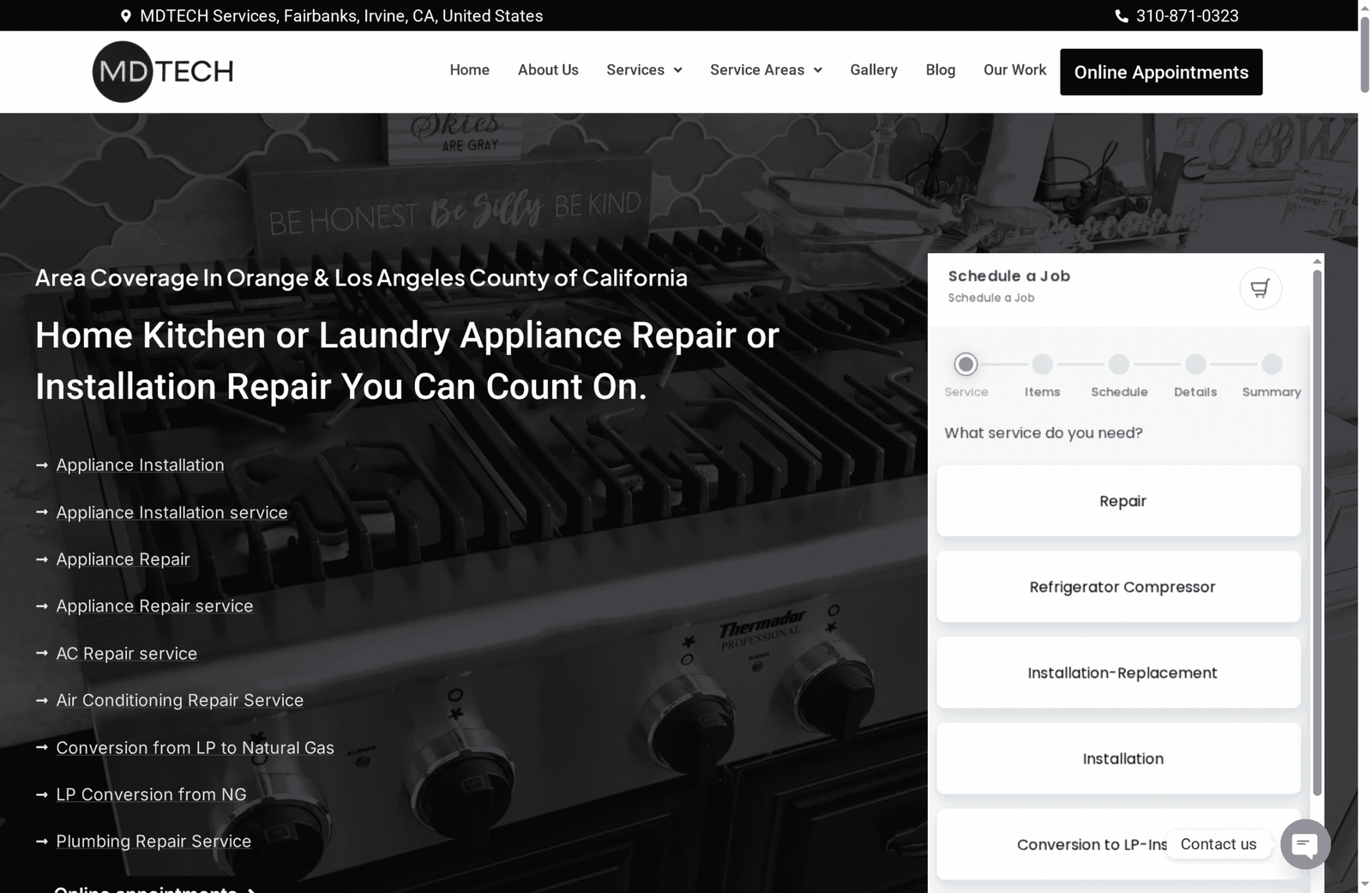
Mdtechservices provides emergency dispatch and scheduled preventive service for all major appliance brands, HVAC repair and tune-ups, plumbing, and LP-to-natural-gas conversions. Every job includes before-and-after documentation you can drop directly into your repair log. For appliance issues, the appliance repair service overview covers what to expect from diagnosis through completion. For plumbing prep, the plumbing checklist walks you through what to have ready before a technician arrives. Book your service appointment online or call to schedule preventive maintenance before the next peak season.
Key Takeaways
A reliable tenant maintenance request process depends on written submissions, clear priority rules, and documented closure at every step.
| Point | Details |
|---|---|
| Single intake channel | All requests must go through one formal channel to create an audit trail and prevent lost tickets. |
| Emergency timelines | Acknowledge within 1 hour and begin work within 24 hours; routine repairs target 3–5 business days. |
| Written tenant notice | California law requires written notice from the tenant before legal repair timelines begin. |
| Two-vendor rule | Keep 2–3 vendors per trade so one vendor’s absence never stalls a repair. |
| Mdtechservices | Licensed technicians for appliance, HVAC, plumbing, and gas conversions across Orange and Los Angeles Counties, with job documentation included. |
Why the standard maintenance process fails — and what actually fixes it
Most maintenance breakdowns don’t come from bad vendors or unresponsive landlords. They come from three process gaps: no single intake channel, no written triage rules, and no automated status updates. Each gap seems minor until a dispute lands in your lap and you have no timestamps to show.
The fix is simpler than most managers expect. In the first week, post a standard maintenance request form and make it the only accepted submission method. Set up automated confirmation messages for intake and vendor assignment. Add a second vendor to each trade on your roster. Those three changes alone close the most common failure points.
Here’s a real pattern we see repeatedly: a manager receives a “no heat” call by phone, dispatches a vendor informally, the vendor fixes the issue, but there’s no written record. Six months later, the tenant claims the repair was never completed. Without a timestamped work order, photos, and sign-off, the manager has no defense. The same repair, handled through a formal workflow, would have taken the same time and cost nothing extra — but it would have produced a complete, defensible record.
The role of property managers in maintenance is fundamentally about creating systems, not just responding to calls. Build the system once, and it protects you every time.
Sources and further reading
The following resources were used in preparing this article and are worth bookmarking for ongoing reference:
- LA County DCBA — Repairing Your Rental Unit: The authoritative local source for California landlord habitability duties and tenant written-notice requirements in Los Angeles County.
- Buildium — Maintenance Request Systems: Practical guidance on emergency vs. routine timelines and intake form best practices.
- RIOO — How to Manage Maintenance Requests: Workflow stages, single-channel intake rationale, and documentation templates.
- US Tech Automations — 25-Step Processing Checklist: Phased automation rollout, triage rule configuration, and automated notification setup.
- Hemlane — What 193,000+ Tenant Requests Reveal: Data on coordinated vs. self-managed maintenance resolution speed.
- California DRE — Dealing with Problems in Your Rental Unit: Primary state-level reference for habitability obligations, written notice requirements, and tenant remedies.
- Nolo — California Tenant Rights: Repair and Deduct: Clear explanation of repair-and-deduct limits and rent-withholding risk for California tenants.
- Mdtechservices — Book a Service Appointment: Local licensed technicians for appliance, HVAC, plumbing, and gas conversion work in Orange and Los Angeles Counties.