
TL;DR:
- Heat pumps transfer heat efficiently in mild Southern California climates, reducing energy costs.
- Air-source heat pumps are ideal for SoCal homes due to affordability and high performance.
- Proper home insulation enhances heat pump efficiency and long-term savings.
Most homeowners in Orange County and Los Angeles County assume heat pumps are designed for cold, snowy climates. That assumption costs them money. A heat pump is actually a device that transfers heat from one place to another rather than generating it from scratch, which means Southern California’s mild weather is nearly ideal for this technology. In this guide, you’ll learn exactly what a heat pump is, how it works, which types suit SoCal homes best, how efficiency is measured, and how it stacks up against a traditional gas furnace on cost and comfort.
Table of Contents
- What is a heat pump? The basics explained
- Types of heat pumps and which work best in SoCal
- How heat pump efficiency is measured (and why it matters in California)
- Heat pumps vs. gas furnaces: Cost, comfort, and the California equation
- Installation, maintenance, and edge cases: What Orange and LA homeowners need to know
- The heat pump advantage: Why SoCal homes are ahead of the curve
- Your next step: Expert help for home comfort upgrades
- Frequently asked questions
Key Takeaways
| Point | Details |
|---|---|
| Heat pumps move—not create—heat | They efficiently provide both heating and cooling by transferring heat rather than generating it directly. |
| Air-source heat pumps ideal for SoCal | Mild local climate means efficient performance and energy savings for most homes in Orange and LA County. |
| Understand efficiency ratings | Metrics like COP, HSPF2, and SEER2 translate directly to comfort and energy savings. |
| Upfront investment pays off | Although installation costs are higher than for furnaces, annual cost savings and comfort gains add up over time. |
| Proper maintenance is essential | Regular upkeep ensures your heat pump system operates efficiently year-round and lasts longer. |
What is a heat pump? The basics explained
A heat pump is a single system that handles both heating and cooling for your home. Unlike a furnace that burns fuel to create warmth, a heat pump uses a refrigeration cycle to move existing heat from one location to another. In winter, it pulls heat from outdoor air and moves it inside. In summer, it reverses that process and pushes heat out of your home.
The system relies on four main components working together:
- Compressor: Pressurizes the refrigerant to raise its temperature
- Condenser: Releases heat to the target location (inside in winter, outside in summer)
- Evaporator: Absorbs heat from the source location
- Expansion valve: Drops refrigerant pressure so it can absorb heat again
The reversing valve is what makes a heat pump different from a standard air conditioner. It switches the direction of refrigerant flow, turning one system into both a heater and a cooler. You can learn more about common HVAC terms if some of this language is new to you.
A common misconception is that heat pumps struggle in mild climates. In reality, they perform best when outdoor temperatures stay above freezing, which is almost always the case in Orange and LA Counties. The heat pump overview by NREL confirms that moderate climates allow these systems to run at peak efficiency year-round.
Pro Tip: Look for a model with a variable-speed compressor. It adjusts output continuously rather than cycling on and off, which improves both temperature consistency and humidity control inside your home.
Types of heat pumps and which work best in SoCal
Not all heat pumps are the same. Choosing the right type for your home depends on your budget, lot size, and local climate. Here are the main options available to SoCal homeowners.
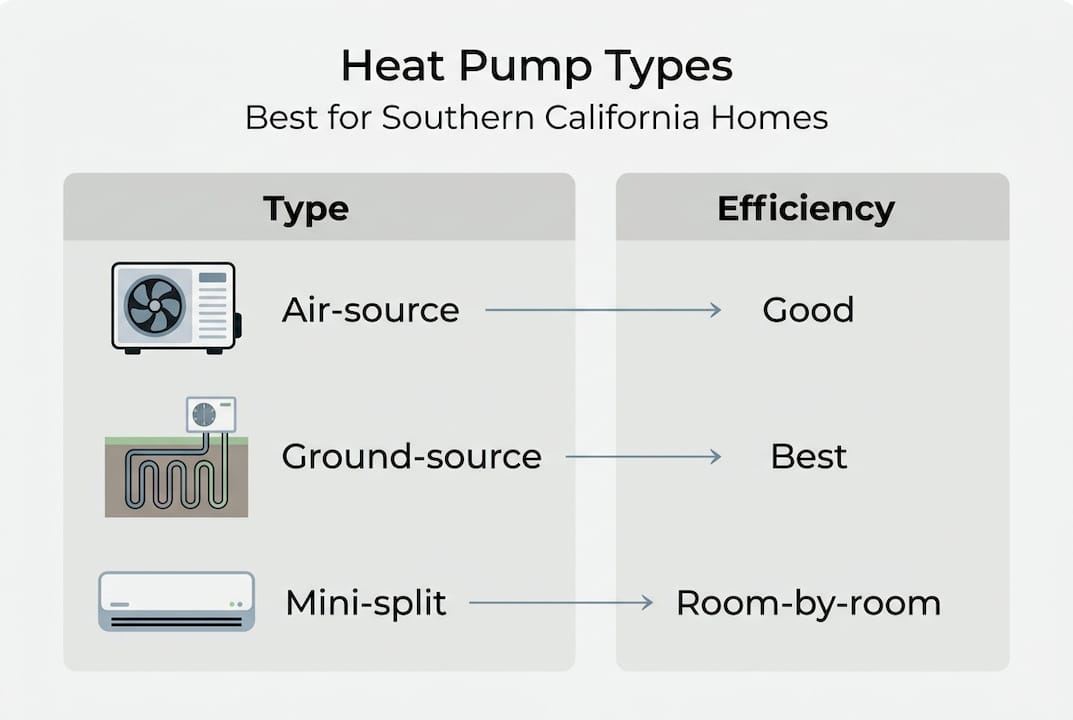
Air-source heat pumps (ASHP) are the most common choice for residential use. They extract heat from outdoor air and are relatively affordable to install. For most homes in Orange and LA Counties, this is the practical and cost-effective option.
Ground-source (geothermal) heat pumps (GHP) use the stable temperature of the earth a few feet underground. They are more efficient than air-source models, but ground-source systems cost between $10,000 and $30,000 to install due to the drilling and excavation required. You can explore ground-source heat pump alternatives if you want to compare options.
Mini-split ductless systems are a type of air-source heat pump that skips the ductwork entirely. They work well for room additions, older homes without ducts, or targeted comfort zones.
| Type | Upfront cost | Efficiency | SoCal suitability | Install difficulty |
|---|---|---|---|---|
| Air-source (ASHP) | $8,000–$18,000 | High | Excellent | Moderate |
| Ground-source (GHP) | $10,000–$30,000 | Very high | Good | High |
| Mini-split ductless | $3,000–$10,000 | High | Excellent | Low to moderate |
For most homeowners in Southern California, an air-source heat pump offers the best balance of upfront cost and long-term performance. Mild winters mean the system rarely faces the cold-weather efficiency drop that affects these units in northern states. If you are also evaluating energy efficient home cooling options, a heat pump may replace your AC entirely.
How heat pump efficiency is measured (and why it matters in California)
Understanding efficiency ratings helps you compare products accurately and predict your actual energy savings. Three key metrics apply to heat pumps.
- COP (Coefficient of Performance): Measures heating output per unit of electricity used. A COP of 3 means you get 3 units of heat for every 1 unit of electricity consumed. Typical range: 2 to 4.
- HSPF2 (Heating Seasonal Performance Factor 2): Measures seasonal heating efficiency. Higher is better. Typical range: 8 to 13.
- SEER2 (Seasonal Energy Efficiency Ratio 2): Measures seasonal cooling efficiency. Title 24 requires 15.2 SEER2 as the minimum for new installations in California.
| System | COP | HSPF2 | SEER2 |
|---|---|---|---|
| Standard AC + gas furnace | N/A | N/A | 13–15 |
| Entry-level heat pump | 2.5 | 8 | 15 |
| High-efficiency heat pump | 3.5–4 | 11–13 | 18–22 |
In California’s climate zones 9 through 11, which cover most of Orange and LA Counties, heat pumps can reduce site energy use by 31% compared to conventional systems. That translates to real savings. Most well-insulated homes in the area can expect to save $200 to $300 per year on energy bills after switching from an older system. For more strategies, review these HVAC efficiency tips and learn about improving HVAC efficiency with insulation.
For additional context on local standards, the efficiency ratings in Los Angeles resource covers what to expect from permitted installations.
Pro Tip: Upgrading your attic insulation before installing a heat pump can increase your annual savings significantly. A well-sealed home lets a smaller, less expensive unit do the same job.
Heat pumps vs. gas furnaces: Cost, comfort, and the California equation
You’ve seen how efficiency stacks up. Now let’s put heat pumps head-to-head with gas furnaces so you can make a fully informed decision.
- Upfront cost: Heat pumps run $8,000 to $18,000 installed; gas furnaces typically cost $4,000 to $9,000
- Annual operating cost: Depends on electricity vs. gas rates; California’s higher electricity prices are a real factor
- Year-round comfort: Heat pumps handle both heating and cooling; a furnace needs a separate AC unit
- Greenhouse gas impact: Heat pumps produce 36 to 64% fewer emissions than gas furnaces when powered by California’s grid
- Efficiency rating: Heat pumps operate at 200 to 450% efficiency (COP-based); gas furnaces top out at 98% AFUE
Proponents highlight significant greenhouse gas reductions and long-term energy savings. Critics note that California’s high electricity rates can narrow the financial advantage, especially in larger or poorly insulated homes. The right answer depends on your specific home, usage, and local utility rates.
For smaller, well-insulated homes in coastal cities like Irvine, Santa Monica, or Long Beach, heat pumps are a clear winner on both cost and comfort. Larger inland homes with high cooling loads should run the numbers carefully. Understanding the AC vs. HVAC differences can also help you frame this decision. Pairing a heat pump with a smart thermostat further improves your return on investment.
Installation, maintenance, and edge cases: What Orange and LA homeowners need to know
Once you’ve decided a heat pump is right for your home, it helps to know what’s actually involved in installation, ongoing maintenance, and edge-case scenarios.
Installation steps to expect:
- Site survey and load calculation to size the system correctly
- Ductwork inspection or mini-split placement planning
- Electrical panel upgrade if needed (most heat pumps require 240V)
- Equipment installation and refrigerant charging
- Permit filing and city inspection
Routine maintenance tasks:
- Change or clean air filters every 1 to 3 months
- Clean indoor and outdoor coils annually
- Check refrigerant levels and inspect defrost cycle function
- Clear debris from the outdoor unit regularly
- Schedule a professional HVAC inspection once a year
For a full breakdown, follow this step-by-step HVAC maintenance guide. The common maintenance needs outlined by NREL also apply to SoCal systems.
Extreme cold is rarely an issue here, but insulation still matters. A poorly sealed home forces the heat pump to work harder, which raises your bills and shortens the system’s life. California has set a goal of 6 million heat pumps installed statewide by 2030, and state and utility incentives are available now to help offset costs.
Pro Tip: Always have a load calculation done before sizing your new heat pump. Bigger is not always better. An oversized unit short-cycles, wears out faster, and controls humidity poorly.
The heat pump advantage: Why SoCal homes are ahead of the curve
Here’s what most guides skip over. Southern California homeowners are not just early adopters of heat pump technology. They are in the best possible position to benefit from it, right now.
SoCal’s mild climate means a heat pump runs at a high COP almost every day of the year. There are no brutal winters forcing the system into emergency heat mode. That alone puts local homeowners ahead of most of the country in terms of real-world performance.
What most buyers and even some contractors underestimate is the role of insulation in heat pump success. Insulation is the force multiplier. A high-efficiency unit in a leaky home will underperform a mid-range unit in a well-sealed one. Prioritize the building envelope first.
California’s policy momentum and available incentives also give local homeowners a real financial edge over other US regions. The environmental benefits are genuine, but watch your electricity rate tier. If you are on a time-of-use plan, running the heat pump during off-peak hours makes a measurable difference in operating costs.
Your next step: Expert help for home comfort upgrades
Ready to put this knowledge to work? Whether you are planning a heat pump installation, need a repair on your existing HVAC system, or want to make sure your home appliances are running at their best, MDTech Services is here to help.

Our licensed technicians serve homeowners across Orange County and Los Angeles County with responsive, reliable service. From reviewing your current setup to recommending the right system for your home, we make the process straightforward. Start with our HVAC repair guide to understand your options, or explore our appliance repair steps for related home systems. You can also learn more about appliance repair explained and how professional service extends the life of your investment. Contact us today to schedule a consultation.
Frequently asked questions
How does a heat pump provide both heating and cooling?
A heat pump uses a reversing valve to change the direction of refrigerant flow, allowing it to move heat into your home in winter and push it out in summer. One system handles both functions year-round.
Are heat pumps effective in Orange County and Los Angeles?
Yes. SoCal’s mild climate means heat pumps operate with high COP and rarely face the performance drops that affect these systems in colder regions. They are well suited to local conditions.
How much can I save by switching to a heat pump?
Most Orange and LA homeowners can save $200 to $300 per year on energy bills compared to older systems, provided the home is well insulated.
What maintenance do heat pumps need?
Basic maintenance includes changing filters, cleaning coils, and scheduling annual HVAC inspections to keep the system running efficiently and extend its lifespan.
Do heat pumps work during power outages?
No HVAC system can operate without power, so having backup options like a generator is recommended for extended outages in your area.