
Most homeowners worry about fires or break-ins, but plumbing leaks cause 45% of all homeowner water damage claims. That single fact should shift how you think about home safety. In Orange County and Los Angeles County, the combination of hard water, coastal conditions, and seismic activity makes plumbing failures even more likely and more costly. This article gives you practical, expert-backed strategies to protect your home, recognize warning signs early, and respond confidently when something goes wrong.
Table of Contents
- Why plumbing is critical for home safety
- Region-specific threats in Orange and Los Angeles Counties
- The most common plumbing hazards, and how to spot them early
- Emergency plumbing: What to do in a crisis
- Proactive plumbing maintenance: Preventing hazards before they start
- Where to find trusted plumbing and home safety help
- Frequently asked questions
Key Takeaways
| Point | Details |
|---|---|
| Plumbing failures carry real risks | Leaking or burst pipes are behind nearly half of all costly home water damage claims. |
| Southern California homes have unique vulnerabilities | Local climate, water quality, and seismic threats make proactive plumbing safety even more important. |
| Early detection prevents disasters | Recognizing warning signs and scheduling routine inspections can keep minor issues from becoming emergencies. |
| Maintenance saves money and stress | Regular plumbing checks can reduce unexpected incidents and expensive repairs by up to 75%. |
Why plumbing is critical for home safety
Plumbing rarely gets the attention it deserves until something breaks. Yet it sits behind your walls, under your floors, and inside your appliances every single day. When it fails, the consequences go far beyond a wet floor.
Water damage claims average between $10,500 and $13,954 per incident, and plumbing leaks are responsible for nearly half of all such claims. That is not a minor inconvenience. That is a serious financial hit that many homeowners are not prepared for.
Beyond the cost, plumbing failures create real health and structural risks:
- Mold growth can begin within 24 to 48 hours of water exposure, creating respiratory hazards
- Structural damage from prolonged leaks weakens floors, walls, and foundations
- Sanitation issues from sewage backups pose direct health threats to your family
- Electrical hazards arise when water reaches wiring or panels
“Most homeowners significantly underestimate plumbing risk compared to fire or theft, yet water damage is statistically far more common and often just as costly.”
Understanding basic plumbing terms explained helps you communicate clearly with technicians and catch problems sooner. And the data is clear: investing in plumbing maintenance benefits your home’s long-term value and your family’s safety.
Region-specific threats in Orange and Los Angeles Counties
Southern California presents a unique set of plumbing challenges that homeowners in other parts of the country simply do not face. Understanding these local risks helps you prioritize the right protections.
Supply-line failures in Orange County are driven by temperature swings, coastal corrosion, and high holiday water use. Hard water also accelerates pipe clogs and reduces water pressure over time. These are not rare edge cases. They are everyday realities for homeowners across the region.
| Local risk factor | Impact on plumbing | What to watch for |
|---|---|---|
| Hard water mineral buildup | Clogs, reduced pressure, pipe corrosion | White scale on fixtures, slow drains |
| Coastal salt air | Accelerated corrosion on exposed pipes | Rust stains, visible pipe deterioration |
| Temperature swings | Supply-line stress and cracking | Dripping faucets after cold nights |
| Seismic activity | Water heater movement, joint stress | Loose connections, water heater leaks |
| Holiday peak water use | Increased pressure on aging systems | Sudden drops in pressure, slow drains |
California also has some of the strictest plumbing codes in the country. The California Plumbing Code mandates low-flow fixtures (1.28 gpf toilets, 1.8 gpm showers), lead-free materials, backflow prevention devices, and seismic strapping on water heaters. These requirements exist for good reason, but they also mean that non-compliant repairs can create liability for homeowners.
Key local risks to keep on your radar:
- Seismic retrofits for water heaters are mandatory in California, not optional
- Backflow prevention protects your drinking water from contamination
- Hard water softeners extend the life of pipes and appliances significantly
- Coastal homes need more frequent inspections due to accelerated corrosion
Pro Tip: If you are not sure whether your water heater has a seismic strap, check the top and bottom of the unit for metal bands secured to the wall. If they are missing, contact a licensed plumber before your next inspection.
Knowing what counts as a true plumbing emergency versus a manageable repair helps you respond appropriately. You can also review emergency repair examples specific to Orange County homeowners to better understand what local professionals see most often. For issues involving fixtures, sink repair and installation is one of the most common service calls in the region.
The most common plumbing hazards, and how to spot them early
Most plumbing emergencies do not happen without warning. They build slowly, and the signs are there if you know what to look for.
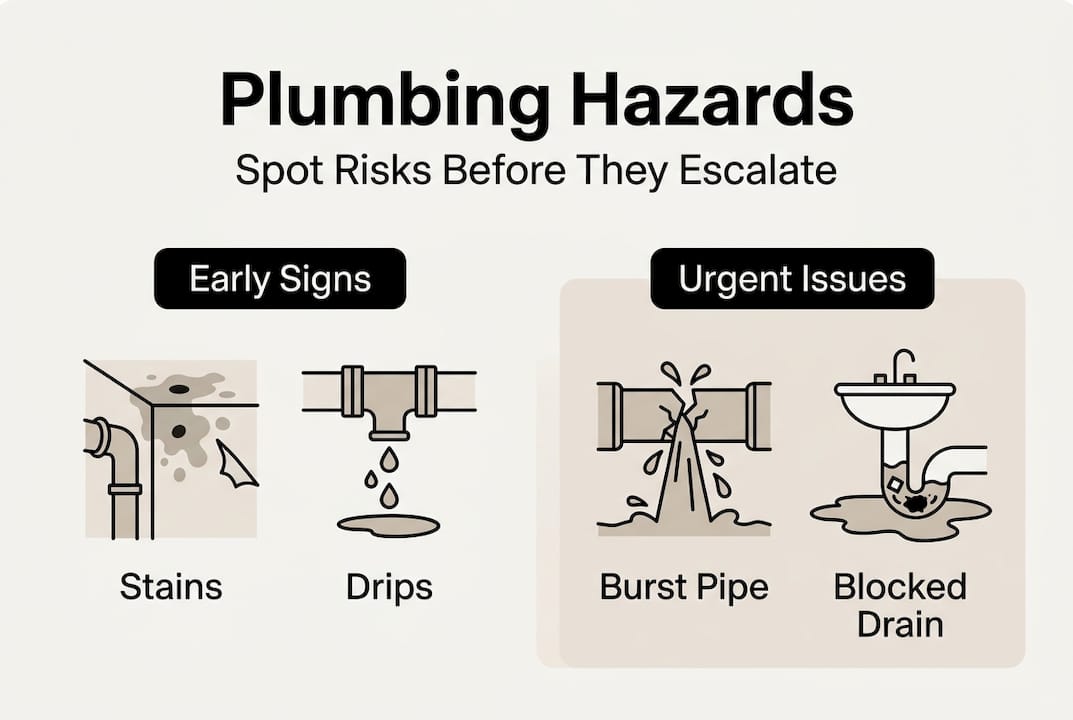
| Hazard type | Early warning signs | Urgency level |
|---|---|---|
| Slow leak | Water stains, musty smell, peeling paint | Moderate, act within days |
| Supply-line failure | Sudden pressure drop, water pooling | High, act immediately |
| Pipe clog | Slow drains, gurgling sounds | Moderate, act within days |
| Burst pipe | No water flow, flooding, loud bang | Critical, shut off water now |
| Backflow event | Discolored water, unusual taste or smell | Critical, stop use immediately |
A burst line releases 50 to 100 gallons per minute. At that rate, serious structural damage can occur in minutes, not hours. That number alone makes the case for early detection.
Here are the top warning signs every homeowner should watch for:
- Unexplained spikes in your water bill without a change in usage habits
- Persistent low water pressure throughout the home, not just one fixture
- Visible corrosion or rust on exposed pipes, especially under sinks
- Musty or sewage odors coming from drains or walls
- Sounds of running water when all fixtures are turned off
- Discolored water that appears brown, yellow, or cloudy
- Slow drains in multiple locations at the same time
Pro Tip: Check your water meter before and after a two-hour period when no water is being used. If the meter moves, you likely have a hidden leak somewhere in your system.
Scheduling common plumbing services on a regular basis is the most reliable way to catch these issues before they escalate. You should also watch for appliance failure warning signs since appliances like dishwashers and washing machines are frequent sources of water damage. For water heater concerns specifically, safe water heater repair in California requires licensed professionals due to seismic and code requirements.
Emergency plumbing: What to do in a crisis
Even with the best prevention, emergencies can strike. Knowing exactly what to do in the first few minutes can mean the difference between a manageable repair and a major renovation.
Burst pipes, sewage backups, and complete water loss all require immediate action. The steps you take before a plumber arrives matter enormously.
Follow these steps in order:
- Shut off the main water supply immediately. Know where your shutoff valve is before an emergency happens.
- Turn off electricity to affected areas if water is near outlets, panels, or appliances.
- Move valuables and furniture away from the water source to limit damage.
- Contain the water using towels, buckets, or plastic sheeting if possible.
- Document the damage with photos before cleanup begins, for insurance purposes.
- Call a licensed plumber right away. Do not wait to see if the problem resolves on its own.
- Ventilate the area by opening windows and doors to reduce moisture and slow mold growth.
“Mold can begin developing in as little as 24 to 48 hours after water exposure. Every hour you wait increases both the health risk and the repair cost.”
Delaying professional help is one of the most expensive mistakes homeowners make. A small leak that gets addressed within hours may cost a few hundred dollars to fix. The same leak ignored for two days can result in mold remediation, drywall replacement, and flooring repairs that cost thousands. Review the full emergency plumbing repair steps so you are prepared before a crisis occurs.
Proactive plumbing maintenance: Preventing hazards before they start
The most effective way to protect your home is to prevent problems from developing in the first place. Routine maintenance is not just a good idea. It is a proven strategy backed by real numbers.
Annual maintenance cuts emergencies by 30 to 75 percent. That is a significant reduction in both risk and cost for homeowners who commit to a regular schedule.
California-specific benchmarks for plumbing health include maintaining water pressure between 40 and 60 PSI, using water softeners in hard water areas, and ensuring seismic retrofits are in place and up to code. These are not optional extras. They are the baseline for a safe, functional plumbing system in Southern California.
Here is a practical annual maintenance checklist for homeowners:
- Test water pressure with an inexpensive gauge from any hardware store
- Inspect visible pipes under sinks, in the garage, and near the water heater for corrosion or moisture
- Check all supply lines to toilets, sinks, and appliances for cracks or bulging
- Flush your water heater to remove sediment buildup, which reduces efficiency and lifespan
- Test your main shutoff valve to confirm it opens and closes smoothly
- Look for slow drains throughout the home and address them before they become full clogs
- Schedule a professional inspection every one to two years, or annually for older homes
Pro Tip: Hard water is common throughout Orange County and Los Angeles County. Installing a whole-home water softener reduces mineral buildup in pipes and extends the life of your water heater, dishwasher, and washing machine significantly.
Reviewing plumbing maintenance basics gives you a solid foundation for what to check and when. Committing to regular plumbing maintenance is one of the highest-return investments you can make as a homeowner. The importance of regular maintenance extends across all home systems, and plumbing is no exception.
Where to find trusted plumbing and home safety help
You now have a clear picture of the risks, the warning signs, and the steps to take when something goes wrong. The next step is making sure you have a reliable professional in your corner before an emergency forces the decision.

MDTech Services provides licensed, experienced plumbing support for homeowners across Orange County and Los Angeles County. Whether you need a routine inspection, a fast response to a burst pipe, or help getting your home up to California code, our team is ready to help. We understand the local risks, the regional codes, and what it takes to protect your home for the long term. Our plumbing repair service covers everything from minor leaks to full system assessments, and we make it easy to streamline plumbing repair so your home gets back to normal quickly. Call us today to schedule your inspection or book online in minutes.
Frequently asked questions
How often should I have my home plumbing inspected in Orange or Los Angeles County?
A full inspection every one to two years is recommended for most homes, or annually if your home is older or you notice any warning signs.
What are the most common signs that my plumbing needs immediate attention?
Unexplained high water bills, persistent dripping, discolored water, and sudden drops in pressure often signal critical issues, especially in areas where hard water accelerates failures.
Does California law require specific plumbing safety features?
Yes, the California Plumbing Code mandates low-flow fixtures, backflow prevention devices, lead-free materials, and seismic straps on all water heaters.
How quickly can water damage escalate from a burst pipe?
A burst line releases 50 to 100 gallons per minute, and mold can start growing in as little as 24 to 48 hours after water exposure.
Will regular plumbing maintenance actually save me money as a homeowner?
Yes. Annual maintenance cuts emergency incidents and repair costs by 30 to 75 percent, making it one of the most cost-effective investments for any homeowner.