
Your thermostat controls more than just comfort. Programmable and smart thermostats can slash HVAC energy use by 10 to 30%, yet many homeowners barely scratch the surface of their device’s potential. Understanding how your thermostat communicates with your HVAC system, what settings truly matter, and which common habits waste energy can transform your monthly bills and home comfort. This guide reveals practical strategies tailored for Southern California climates to help you maximize savings and efficiency.
Table of Contents
- Introduction To Thermostats In HVAC Systems
- Types Of Thermostats And Their Impact On Energy Efficiency
- How Thermostats Control HVAC: Mechanisms And Placement Importance
- Common Misconceptions About Thermostat Use And HVAC Performance
- Practical Thermostat Strategies For Southern California Homes
- Thermostat Maintenance And Troubleshooting Tips
- Optimize Your HVAC System With Expert Support From MDTech Services
- Frequently Asked Questions
Key takeaways
| Point | Details |
|---|---|
| Temperature control mechanism | Thermostats sense indoor temperature and trigger HVAC cycles to maintain your set comfort level. |
| Energy savings potential | Smart and programmable models reduce energy consumption by automating temperature adjustments during unoccupied hours. |
| Placement affects accuracy | Installing thermostats near heat sources or drafts causes false readings and wastes up to 12% more energy. |
| Misconceptions cost money | Lowering settings doesn’t speed cooling, and frequent manual changes reduce efficiency instead of improving it. |
| Local optimization strategies | Southern California’s mild climate allows wider temperature setbacks and seasonal programming for maximum savings. |
Introduction to thermostats in HVAC systems
A thermostat acts as your HVAC system’s brain, measuring indoor temperature and deciding when to activate heating or cooling equipment. This small device performs three critical functions: sensing the current room temperature, comparing it against your desired setpoint, and sending control signals to your furnace, air conditioner, or heat pump.
When indoor temperature drifts from your setpoint, the thermostat triggers an HVAC cycle. Typical home thermostats cycle 5 to 7 times per hour depending on system capacity, outdoor conditions, and temperature differential. Each cycle affects both comfort consistency and energy consumption, making thermostat performance crucial to household efficiency.
The sensing function relies on temperature sensors positioned inside the thermostat housing. These sensors continuously monitor air temperature and feed data to the decision circuit. The control function then activates relays or sends electronic signals through your home’s wiring to turn HVAC components on or off. This constant communication loop maintains your desired indoor climate while managing energy use.
Understanding how thermostats work helps you recognize why proper setup matters:
- Accurate temperature sensing prevents unnecessary HVAC operation
- Appropriate cycle timing balances comfort with equipment longevity
- Smart control logic reduces energy waste during predictable periods
- Proper calibration ensures the displayed temperature matches actual room conditions
HVAC cycles that run too frequently waste energy and accelerate wear on mechanical components. Cycles that run too infrequently create temperature swings that compromise comfort. Your thermostat’s job is finding the sweet spot that delivers consistent climate control without excessive energy consumption.
Types of thermostats and their impact on energy efficiency
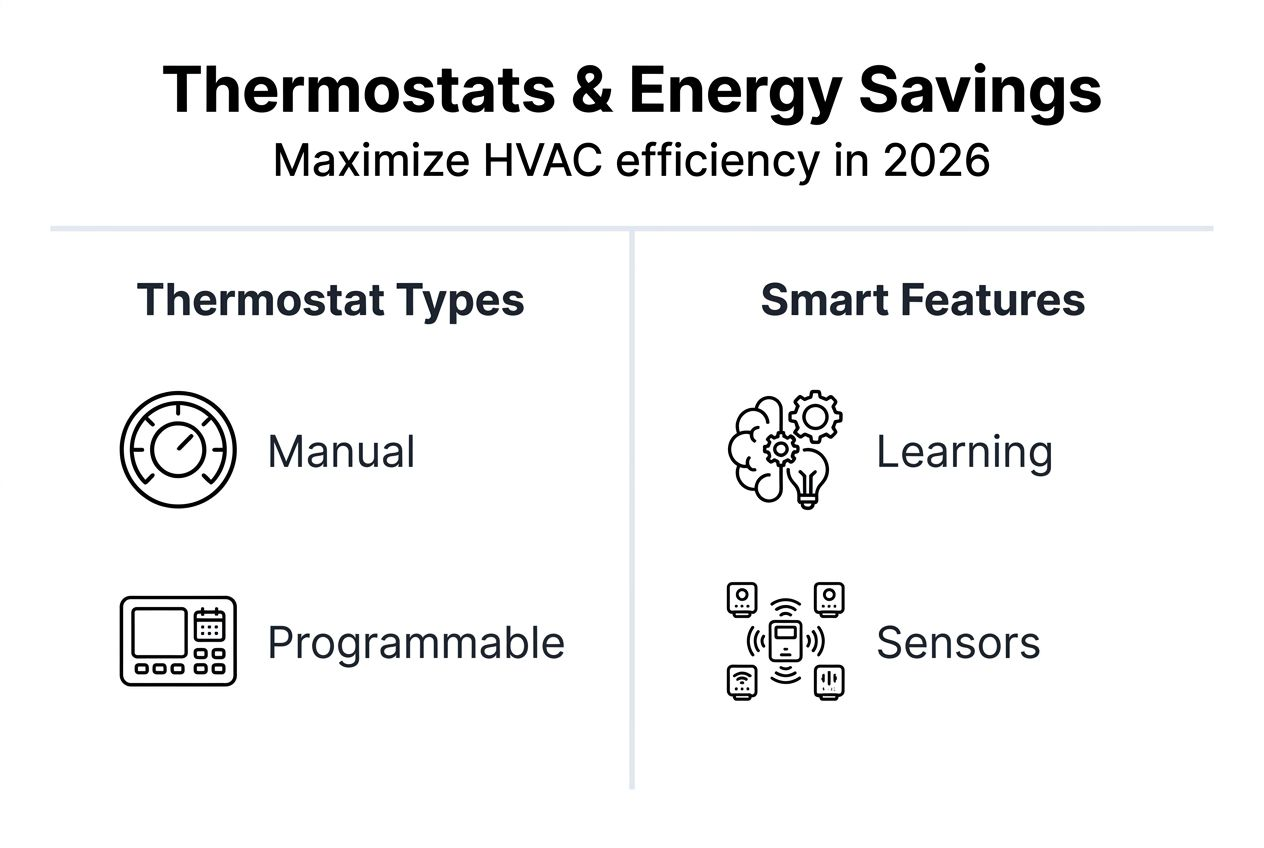
Three main thermostat categories serve residential HVAC systems, each offering different capabilities and energy saving potential. Manual thermostats require you to physically adjust settings whenever you want temperature changes. They cost less upfront but offer minimal automation, making consistent energy savings difficult for busy households.
Programmable thermostats let you schedule temperature changes throughout the day and week. These devices save 10 to 30% on heating and cooling bills by automatically reducing HVAC operation during work hours, sleep periods, or vacations. Success depends on correct programming and whether household schedules remain consistent enough to benefit from preset patterns.
Smart thermostats represent the latest evolution, combining programmable features with learning algorithms, occupancy sensors, and remote smartphone control. These units analyze your behavior patterns, adjust to weather forecasts, and optimize temperature schedules automatically. Average savings exceed 20% because the thermostat adapts without requiring constant manual intervention.

| Thermostat Type | Key Features | Energy Savings | Initial Cost | Best For |
|---|---|---|---|---|
| Manual | Basic temperature control, manual adjustments only | Minimal (0 to 5%) | $20 to $50 | Renters, tight budgets |
| Programmable | Scheduled temperature changes, multiple daily programs | Moderate to high (10 to 30%) | $50 to $150 | Consistent schedules |
| Smart | Learning algorithms, remote control, weather integration | High (20%+) | $150 to $300 | Variable schedules, tech comfort |
User discipline heavily influences actual savings with programmable units. Many homeowners set schedules initially but override them frequently, negating potential benefits. Smart thermostats reduce this problem by learning from overrides and adjusting base programs accordingly.
Your lifestyle determines which type delivers best value:
- Predictable work schedules favor programmable thermostats with consistent weekday programs
- Variable routines benefit from smart models that adapt to changing patterns
- Minimal budgets work with manual units if you remember to adjust settings religiously
- Tech enthusiasts appreciate smart features like voice control and energy reports
Consider total cost of ownership beyond purchase price. A smart thermostat costing $250 that saves 23% annually pays for itself faster than a $100 programmable unit saving only 12% in a home with high HVAC usage.
How thermostats control HVAC: mechanisms and placement importance
Thermostats communicate with HVAC equipment through low voltage wiring that carries control signals. When the sensed temperature drops below your heating setpoint, the thermostat closes electrical contacts that send power to your furnace or heat pump. For cooling, the same process activates your air conditioner when indoor temperature rises above the cooling setpoint.
This electrical signaling happens through color coded wires: red typically carries 24 volt power, white controls heating, yellow manages cooling, and green operates the fan. Smart thermostats use these same wire connections but add microprocessors that make more sophisticated decisions about when to activate each component.
Physical placement dramatically affects thermostat accuracy and system efficiency. Incorrect thermostat placement wastes up to 12% energy because false temperature readings trigger unnecessary HVAC cycles or leave you uncomfortable. A thermostat mounted near a sunny window may read 78°F while the actual room temperature sits at 72°F, causing your air conditioner to run when cooling isn’t needed.
Calibration ensures the temperature displayed on your thermostat matches true room conditions. Over time, sensor drift or dust accumulation can create discrepancies between indicated and actual temperatures. A thermostat reading 2°F high in cooling mode wastes energy by running your system less than needed, while a 2°F low reading causes overcooling and higher bills.
Optimal thermostat placement follows these guidelines:
- Mount on interior walls away from exterior doors and windows
- Avoid locations near heat generating appliances or direct sunlight
- Keep distance from supply vents that blow conditioned air directly on sensors
- Choose areas with good air circulation representing average home temperature
- Install at standard height (52 to 60 inches) for accurate air sampling
Pro Tip: Before finalizing thermostat placement during installation or replacement, use a portable thermometer to measure temperature variations across potential mounting locations. Choose the spot with readings closest to your home’s average temperature and minimal fluctuation throughout the day.
Reviewing your HVAC efficiency checklist helps identify whether thermostat placement contributes to system performance issues. Relocating a poorly positioned unit often delivers immediate comfort improvements and energy savings without equipment replacement costs.
Common misconceptions about thermostat use and HVAC performance
Many homeowners believe lowering the thermostat to 65°F on a hot day cools their home faster than setting it to 72°F. This myth persists despite HVAC systems operating at fixed capacity regardless of setpoint. Your air conditioner removes heat at the same rate whether you set the thermostat to 60°F or 75°F. The only difference is how long the system runs, not how quickly it cools.
Another widespread belief suggests thermostats alone solve all comfort problems. Reality proves different. A perfectly functioning thermostat cannot compensate for undersized equipment, refrigerant leaks, or blocked airflow. These issues require professional diagnosis, which is why recognizing 7 signs your HVAC needs repair matters as much as thermostat management.
Frequent manual adjustments throughout the day seem logical for maintaining comfort, but this habit often backfires. Constantly changing setpoints prevents your HVAC system from establishing efficient operation patterns. Each adjustment triggers a new cycle, and excessive cycling increases energy consumption while accelerating component wear. Stable programming with reasonable temperature ranges delivers better results.
Setting realistic expectations about thermostat capabilities helps avoid frustration:
- Thermostats control when systems run, not how powerfully they operate
- Temperature sensors measure air at one location, not whole house average
- Old thermostats lose calibration accuracy over 5 to 10 years
- Programmable features only save energy when schedules match actual occupancy
The belief that closing vents in unused rooms improves efficiency also misleads homeowners. Most residential HVAC systems balance airflow across the entire house. Closing vents increases pressure in ductwork, reducing overall system efficiency and potentially damaging equipment. Your thermostat cannot compensate for this airflow disruption.
Understanding common HVAC issues and how to fix them reveals that many comfort complaints trace to maintenance neglect rather than thermostat settings. Dirty filters, blocked condensers, or low refrigerant create problems no amount of thermostat adjustment can resolve. Addressing root causes delivers lasting improvements.
Practical thermostat strategies for Southern California homes
Southern California’s mild climate allows aggressive temperature setbacks that would feel uncomfortable in extreme climates. Orange and Los Angeles Counties rarely experience the temperature extremes that make wide setpoint ranges impractical. You can program larger differentials between occupied and unoccupied temperatures without sacrificing comfort during transition periods.
Programming thermostats around known absence patterns maximizes savings. If your household empties between 8 AM and 5 PM on weekdays, set cooling temperatures 4 to 6°F higher during those hours. The moderate outdoor temperatures common in Southern California mean your home won’t become unbearably hot, and the HVAC system quickly recovers comfort when occupants return.
Smart thermostats that integrate local weather data provide particular value in coastal microclimates. These devices adjust operation based on forecasted temperature swings, humidity levels, and cooling degree days specific to your zip code. A smart thermostat in Anaheim might pre cool before an predicted afternoon heat spike, while one in coastal Long Beach reduces cooling anticipating marine layer fog.
Five specific programming tips optimize energy use for Southern California conditions:
- Set cooling temperatures to 78°F when home and 84°F when away during summer months
- Use 68°F for heating when occupied and 62°F during sleep or absence in winter
- Program wider setbacks during shoulder seasons when outdoor temperatures stay mild
- Enable adaptive recovery features that learn how long your home takes to reach target temperatures
- Schedule vacation modes during trips to maintain minimal conditioning that prevents extreme indoor temperatures
Pro Tip: Combine thermostat programming with ceiling fan use during occupied hours. Fans create perceived cooling through air movement, letting you raise thermostat settings 2 to 3°F without comfort loss. This strategy works particularly well in Southern California’s low humidity climate where evaporative cooling feels more effective.
Upgrading to newer thermostat technology pairs well with professional air conditioning installation when replacing aging HVAC equipment. Modern systems communicate with compatible smart thermostats to optimize compressor staging, fan speeds, and defrost cycles beyond what standalone thermostats achieve with older equipment.
Consulting professional HVAC technicians about optimal programming for your specific home layout and usage patterns often reveals opportunities generic advice misses. Factors like home orientation, insulation quality, and window placement affect ideal setpoint strategies.
Thermostat maintenance and troubleshooting tips
Regular maintenance and recalibration every 1 to 2 years improves efficiency by up to 8% by ensuring accurate temperature sensing. Sensor drift accumulates gradually, creating discrepancies between displayed and actual temperatures that waste energy through unnecessary HVAC operation or inadequate conditioning.
Environmental factors often cause thermostat performance degradation. Dust accumulation on sensors creates insulating layers that slow temperature response. Drafts from nearby doors or windows cause rapid temperature fluctuations that trigger excessive cycling. Direct sunlight heating the thermostat housing creates false high temperature readings that prevent proper cooling activation.
Recognizing malfunction signs helps you address problems before they escalate into major comfort issues or equipment damage. Temperature displays that freeze, unresponsive buttons, blank screens, or HVAC systems that ignore thermostat commands all indicate replacement or professional service needs.
Maintenance steps and troubleshooting tips for sustained performance include:
- Clean thermostat exterior and exposed sensors annually using compressed air or soft brush
- Replace batteries in battery powered units before low battery warnings appear
- Verify thermostat remains level on wall, as tilting affects mercury switch operation in older models
- Check wire connections for corrosion or looseness that disrupts control signals
- Test accuracy by comparing thermostat reading against portable thermometer placed nearby
- Recalibrate digital models according to manufacturer instructions when readings drift
- Update smart thermostat firmware to access improved algorithms and bug fixes
Following a systematic HVAC troubleshooting process helps isolate whether comfort problems originate from thermostat issues or broader system faults. Simple tests like manually forcing a cooling cycle reveal whether thermostats successfully communicate with equipment.
Scheduling step by step HVAC maintenance creates opportunities to verify thermostat calibration alongside filter changes, coil cleaning, and refrigerant checks. Technicians can spot placement problems or configuration errors during routine service visits.
Thermostat lifespan varies by type. Mechanical units with mercury switches last 20 to 30 years but lose accuracy over time. Digital programmable thermostats function reliably for 10 to 15 years before displays fade or buttons wear out. Smart thermostats with embedded computers may require replacement every 8 to 12 years as software support ends and hardware becomes obsolete.
Optimize your HVAC system with expert support from MDTech Services
Even perfectly programmed thermostats cannot overcome underlying HVAC system inefficiencies. Refrigerant leaks, worn compressors, or blocked ductwork sabotage energy savings regardless of smart technology.

MDTech Services brings decades of residential HVAC expertise to Orange and Los Angeles County homeowners seeking maximum system performance. Their certified technicians diagnose thermostat calibration issues, recommend optimal placement, and integrate new smart devices with existing equipment. Professional HVAC repair addresses mechanical problems that no thermostat adjustment can fix, while comprehensive tune ups ensure your entire climate control system operates in harmony. Whether you need help implementing the HVAC troubleshooting process or want to explore system upgrades, MDTech Services delivers reliable solutions that transform energy bills and home comfort.
Frequently asked questions
How often should I recalibrate my thermostat for best performance?
Recalibrate every 1 to 2 years to maintain accuracy within 1°F of actual room temperature. Professional calibration during annual HVAC maintenance ensures sensors remain precise and energy waste stays minimal.
Can thermostat placement really affect my energy bills?
Yes, improper placement near heat sources or direct sunlight causes up to 12% energy waste. Thermostats reading false temperatures trigger unnecessary HVAC cycles that inflate bills without improving comfort.
Do smart thermostats actually save more energy than programmable models?
Smart thermostats typically save 20% or more because they adapt automatically to changing schedules and weather. Programmable units require consistent manual programming that many homeowners abandon over time, reducing actual savings.
Will lowering my thermostat setting cool my home faster?
No, HVAC systems cool at fixed capacity regardless of setpoint. Setting your thermostat to 65°F instead of 72°F just makes the system run longer, not faster, potentially overcooling your home and wasting energy.
Why does regular thermostat maintenance matter for HVAC performance?
Maintenance prevents sensor drift, removes dust that affects accuracy, and catches calibration errors before they waste significant energy. Clean, accurate thermostats reduce unnecessary HVAC runtime and extend equipment lifespan through optimized cycling.