
You walk into the kitchen and find a puddle spreading across the floor under your dishwasher. Your first thought is probably the worst-case scenario, but take a breath. Most dishwasher leaks come down to a handful of fixable problems, and many homeowners in Orange County and Los Angeles County handle them without ever calling a technician. This guide walks you through identifying the cause, gathering the right tools, and following clear repair steps. You’ll also learn when a leak signals something beyond DIY territory and when it’s time to bring in a licensed professional.
Table of Contents
- What causes a dishwasher to leak?
- Tools and materials needed for a DIY dishwasher leak fix
- Step-by-step guide: How to fix a leaking dishwasher
- Troubleshooting and preventing future dishwasher leaks
- When to call a professional for your leaking dishwasher
- The truth about dishwasher leaks: What most guides won’t tell you
- Do you need expert help? Trusted appliance repair for Orange & LA County
- Frequently asked questions
Key Takeaways
| Point | Details |
|---|---|
| Diagnose the leak source | Most dishwasher leaks can be traced to a faulty seal or clogged filter, so start your inspection there. |
| Have the right tools | A few basic hand tools and a new gasket or hose clamp are often all you need for a DIY dishwasher repair. |
| Follow step-by-step repairs | Carefully follow safety steps and common repair sequences for the best chance at a leak-free result. |
| Know your limits | If repairs involve internal pumps or wiring, or leaks persist, it’s wise to call a local professional. |
| Prevent future leaks | Monthly cleaning of seals and filters prevents most dishwasher leaks before they start. |
What causes a dishwasher to leak?
Now that we’ve recognized your dishwasher leak isn’t unique, let’s identify what’s most likely causing it. Understanding the key causes of appliance leaks puts you ahead of the problem before you even open the door panel.
According to Whirlpool’s product help resources, the door seal accounts for 40% of dishwasher leaks, while clogged filters or drainage issues account for another 35%. That means nearly three-quarters of all leaks trace back to just two sources you can inspect yourself in under 15 minutes.
| Cause | Estimated share | DIY fixable? |
|---|---|---|
| Door gasket or seal failure | 40% | Yes |
| Clogged filter or drain | 35% | Yes |
| Loose supply or drain hose | 10% | Yes |
| Cracked or blocked spray arm | 7% | Yes |
| Wrong detergent, over-sudsing | 5% | Yes |
| Faulty pump or motor | 2% | Usually no |
| Water inlet valve failure | 1% | Usually no |
Beyond the two main culprits, loose hose connections are a frequent and easy fix. Cracked spray arms can cause water to spray in the wrong direction and escape through the door. Using a regular dish soap instead of a dishwasher-specific detergent creates excess suds that push water out of the machine. Pump and motor failures are less common but more serious, and detecting appliance leaks early is the best way to avoid those costly repairs.
Here’s a quick list of things to check first:
- Visible cracks or debris on the door rubber seal
- Standing water at the bottom of the tub after a cycle
- Loose or disconnected hoses at the back of the unit
- Suds overflowing during the wash cycle
- Water pooling directly under the center of the machine
A Consumer Reports review of DIY appliance repairs confirms that 32% of homeowners have dealt with a dishwasher leak, making it one of the most common appliance complaints in American homes.
Tools and materials needed for a DIY dishwasher leak fix
Before you start fixing, gather a few key tools. It’ll make repairs faster and less stressful, and you won’t have to stop mid-job to run to the hardware store.

As Consumer Reports notes, gasket replacement is model-specific and straightforward for most homeowners. Before ordering parts, locate your dishwasher’s model number, usually printed inside the door frame, so you get the exact replacement.
| Item | Basic toolkit | Complete toolkit |
|---|---|---|
| Flathead and Phillips screwdrivers | ✓ | ✓ |
| Adjustable wrench | ✓ | ✓ |
| Bucket and old towels | ✓ | ✓ |
| Flashlight | ✓ | ✓ |
| Replacement door gasket | ✓ | |
| Hose clamps | ✓ | |
| Teflon tape (plumber’s tape) | ✓ | |
| Soft brush and white vinegar | ✓ | |
| Rubber gloves | ✓ |
For most repairs, the basic toolkit gets you through inspection and minor fixes. If you’re replacing the door seal or tightening hose connections, add the complete toolkit items. Teflon tape is especially useful for sealing threaded hose connections without tools.
Pro Tip: Lay old towels around your worksite before you start. Water will drip when you disconnect hoses, and protecting your flooring from the start saves you a second cleanup job.
If you’re also planning to install a dishwasher efficiently after a repair, having the complete toolkit on hand will cover both jobs in one trip.
Step-by-step guide: How to fix a leaking dishwasher
Once you’re equipped, follow these steps to fix most leaks, even if this is your first repair.
Safety first: Always disconnect power at the circuit breaker and shut off the water supply valve under the sink before working on your dishwasher.
Here are the steps to follow:
- Shut off power and water. Turn off the circuit breaker for the dishwasher and close the water supply valve under the sink. This protects you from electrical hazards and prevents more water from entering the unit.
- Inspect the door gasket. Open the door and run your fingers along the full length of the rubber seal. Look for cracks, stiffness, or sections that have pulled away from the channel. Clean off any food debris with a damp cloth. If the seal is damaged, pull it free and press in the replacement, starting at the top center and working outward.
- Check the hose connections. Pull the dishwasher forward slightly and use a flashlight to inspect the drain hose and water supply line at the back. Tighten any loose clamps with your screwdriver. Wrap threaded fittings with Teflon tape if you see moisture around the joints.
- Clean the filter and spray arms. Remove the bottom rack, unscrew the filter assembly, and rinse it under warm water with a soft brush. Check the spray arm holes for blockages and clear them with a toothpick. A clogged filter forces water to back up and find an exit point.
- Run a test cycle. Restore power and water, then run a short wash cycle. Stay nearby and watch for drips under the door, along the sides, and under the unit. Run a second empty cycle to confirm the repair held.
Whirlpool’s repair guidance recommends testing under load and empty to catch leaks that only appear under water pressure. Note that Bosch models have a sealed base tray that can trap water and trigger a flood sensor, making them harder to diagnose without removing the unit. For those, professional dishwasher repair is often the safer path.
Pro Tip: If you see a lot of suds inside the tub, add two tablespoons of cooking oil and run a short rinse cycle. The oil breaks down the soap foam quickly without leaving residue.
Troubleshooting and preventing future dishwasher leaks
After repair, keep issues from returning and learn the warning signals so you aren’t caught off-guard in the future.
Some leaks persist even after a repair. Hard water mineral buildup stiffens door seals faster than normal wear. Overloading the dishwasher pushes dishes against the door and breaks the seal’s contact. Hidden leaks inside the door panel can drip down and appear to come from the bottom of the unit, making the source hard to trace.
Here are the most common recurring issues and their fixes:
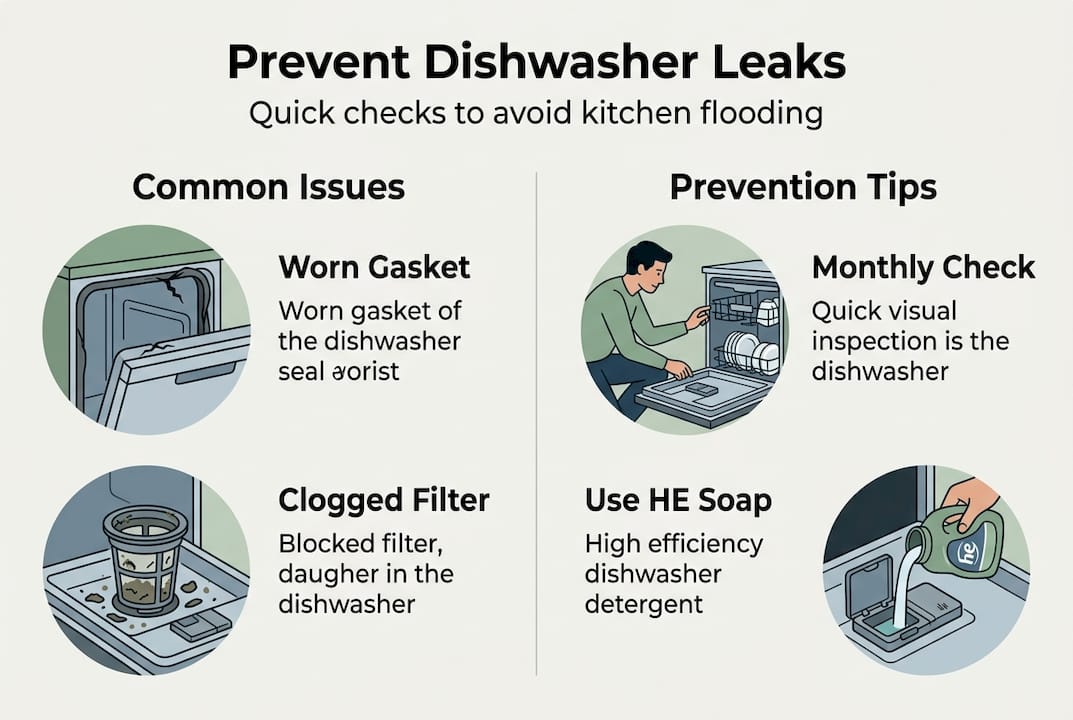
- Seal stiffness from hard water: Wipe the gasket monthly with white vinegar to keep it flexible.
- Leaks after loading: Check that no tall items are blocking the door from closing fully.
- Persistent bottom leaks: Inspect the pump housing for hairline cracks, which are easy to miss.
- Intermittent leaks: These often trace back to pressure-related issues that only show up mid-cycle.
Consumer Reports data shows that regular seal and filter checks prevent up to 75% of leaks. That’s a significant number for a task that takes less than five minutes.
| Scenario | DIY fix | Call a pro |
|---|---|---|
| Torn or stiff door gasket | Replace seal | If channel is damaged |
| Clogged filter or spray arm | Clean and clear | Not needed |
| Loose hose connection | Tighten or re-tape | If fitting is cracked |
| Pump or motor leak | No | Yes |
| Water inlet valve failure | No | Yes |
| Bosch flood sensor triggered | No | Yes |
Pro Tip: Run an empty high-heat cycle with one cup of white vinegar placed in the bottom rack once a month. This dissolves mineral deposits, keeps seals supple, and clears the drain line before buildup becomes a problem.
Knowing the signs of faulty appliances early gives you the best chance of a simple fix rather than a costly replacement.
When to call a professional for your leaking dishwasher
Even experienced DIYers need to know when to put the screwdriver down and bring in a pro.
Some dishwasher problems are simply outside the safe scope of home repair. Attempting them without the right training can cause more damage or create a safety hazard.
Call a professional if you notice any of the following:
- Water continues to appear under the dishwasher after two or more repair attempts
- You smell burning or notice scorch marks near the control panel
- The leak only appears mid-cycle with no visible external source
- The unit is still under warranty and DIY work would void it
- You see water inside the door panel or coming from the motor area
- The dishwasher trips the circuit breaker when it runs
Know your limits: Pumps and motors cause a significant share of internal leaks and usually require full unit removal to access. This work is best left to a licensed technician.
Consumer Reports confirms that pump and motor leaks account for a significant portion of cases that require professional service. Attempting these repairs without experience risks damaging the unit further or creating an electrical hazard. For Orange County and Los Angeles County homeowners, expert dishwasher repair from a licensed local technician is the safest and most reliable option when DIY isn’t enough.
The truth about dishwasher leaks: What most guides won’t tell you
You’ve seen the how-to steps, but here’s the real-world insight most articles leave out.
The vast majority of dishwasher leaks we see at MDTech Services were preventable. A cracked seal that gets replaced early costs almost nothing. The same seal ignored for six months leads to warped flooring, mold under the cabinet, and a repair bill that’s ten times higher. Small problems don’t stay small.
Most DIY guides focus on the repair and skip the honest conversation about maintenance. Monthly seal and filter checks take five minutes and prevent most of the calls we receive. Yet most homeowners only look at the dishwasher when something goes wrong.
Here’s the part that surprises people: even confident DIY homeowners miss things. Hidden cracks in pump housings, slow inlet valve failures, and pressure-related leaks don’t show up during a visual inspection. A professional appliance repair check every two to three years catches the problems you can’t see. The best approach isn’t choosing between DIY and professional service. It’s using both, each where it works best.
Do you need expert help? Trusted appliance repair for Orange & LA County
If you’ve reached the point where professional service is the smartest move, here’s where to get reliable help fast.
At MDTech Services, our licensed technicians serve homeowners across Orange County and Los Angeles County with fast, dependable appliance repair and installation. Whether your dishwasher needs a gasket swap or a full pump replacement, we bring the right tools and experience to get it done correctly the first time.

Explore our appliance repair services or read our homeowner appliance repair guide to understand your options before booking. When you’re ready to stop the leak for good, our team is one call away. We also offer tips to reduce appliance downtime so your household stays running smoothly. Book your appointment online today.
Frequently asked questions
What is the fastest way to stop a dishwasher leak?
Shut off the dishwasher water supply and power immediately, then dry spilled water to prevent floor damage. Acting fast limits the risk of water seeping under flooring or into cabinets.
How can I tell if my dishwasher leak is from the door seal or another source?
Check for water pooling at the front and visible cracks or debris on the rubber seal. Leaks under the unit often suggest hoses or pump issues rather than the door gasket, which accounts for 40% of cases.
Why does my dishwasher only leak sometimes or only while running?
Hidden leaks, worn seals, and internal pressure-related issues can cause intermittent leaking during cycles. Some leaks only appear when water pressure builds mid-cycle, making them hard to catch during a visual inspection.
Is using the wrong detergent a common cause of leaks?
Yes, non-HE detergents can create excess suds, leading to water escaping from the door or vent. Over-sudsing from wrong detergent is a well-documented and easily avoidable cause of dishwasher leaks.
How often should I check my dishwasher seals and filters?
Inspect seals and clean filters monthly to prevent up to 75% of leaks and keep your machine running smoothly. This simple habit takes less than five minutes and saves you from most common repair calls.