
Mini split repair costs typically range from a basic service call of about $100 to a compressor replacement that can reach $800 to $1,500 or more. Any job that touches the refrigerant circuit must go to an EPA 608-certified technician.
TL;DR:
- Diagnostic visits often cost $75 to $150, and companies may credit that fee toward approved work, so confirm the policy before booking.
- Repair quotes vary sharply: drain or coil cleaning costs $100 to $300, while a compressor replacement can reach $1,500 or more.
- Multiply the system’s age by the repair quote; if the result exceeds $5,000, replacement usually makes more financial sense, especially after repeated costly repairs.
- Rinse or replace filters every one to three months, clear debris around the outdoor unit, and arrange professional checks before each heating and cooling season.
- Call immediately for refrigerant leaks, burning odors, or lost heating or cooling; schedule service soon for weak airflow, uneven temperatures, or error codes.
Table of Contents
- Signs your mini split needs a repair call
- What happens during a mini split diagnostic visit
- Mini split repair costs by job, and when to replace instead
- Maintenance that keeps repair costs down
- Questions to ask before hiring a mini split technician
- Why MDTech Services is a trusted choice for mini split repair
- Our take on repair versus replace
- Book a mini split diagnostic with MDTech Services
- FAQ
- Sources
Signs your mini split needs a repair call
Not every hiccup means an expensive fix, but some symptoms should send you straight to the phone. A few problems are urgent enough that waiting even a day can make things worse or more costly.
- Call immediately: a refrigerant leak (hissing, ice on the lines, or a sweet chemical smell), a burning odor, or a complete loss of heating or cooling.
- Schedule soon: weak airflow, uneven temperatures between rooms, or an error code flashing on the indoor unit.
- Watch your bill: a sudden jump in electricity use often points to a failing component working harder than it should.
Before you book anyone, there are a few things you can safely check yourself. Swap the remote batteries, look at the breaker panel, rinse or replace the filter, and check whether the condensate pan is full or clogged. What you should never touch is the refrigerant circuit itself. Opening sealed lines or adding refrigerant without proper certification is not just risky, it is restricted by federal law.
What happens during a mini split diagnostic visit
A good technician does not guess. Diagnosis follows a sequence designed to catch the real problem instead of just masking symptoms, and Energy reflects the same approach.
- Visual inspection of the indoor and outdoor units, including coils, lines, and mounting.
- Electrical checks on the compressor, capacitors, and control board.
- Refrigerant pressure testing to confirm charge levels and spot leaks.
- Airflow measurement at the vents to catch blower or duct restrictions.
- Error-code readout from the unit’s diagnostic display, when available.
Most companies charge a diagnostic or service-call fee, often in the range of $75 to $150, and many credit that fee toward the repair if you move forward. Always ask about this policy before the technician arrives, since some diagnostic fees are non-refundable if you decline the work. Common root causes include refrigerant leaks, failed electrical components, clogged condensate drains, and faulty control boards. Be cautious of anyone who offers to simply “add refrigerant” without finding and sealing the leak first, since that only buys a few months before the same problem returns. Insist on a written estimate that names the specific part being replaced and why.
Mini split repair costs by job, and when to replace instead
Repair prices vary by the part involved and how hard it is to access. A basic tune-up or service call typically runs $100 to $250, while clearing a clogged condensate drain or cleaning the coils falls in the $100 to $300 range. Refrigerant leak detection and repair is pricier and more variable, generally $200 to $1,200 or more depending on the refrigerant type and how accessible the line set is, a range reflected in local refrigerant leak repair pricing.
- Control board (PCB) replacement: $200 to $800
- Fan motor or blower replacement: $200 to $700
- Compressor replacement: $800 to $1,500 or more
Diagnostic fees usually get folded into these totals once you approve the repair, so the number on your final invoice should reflect the diagnostic charge already applied, not stacked on top.
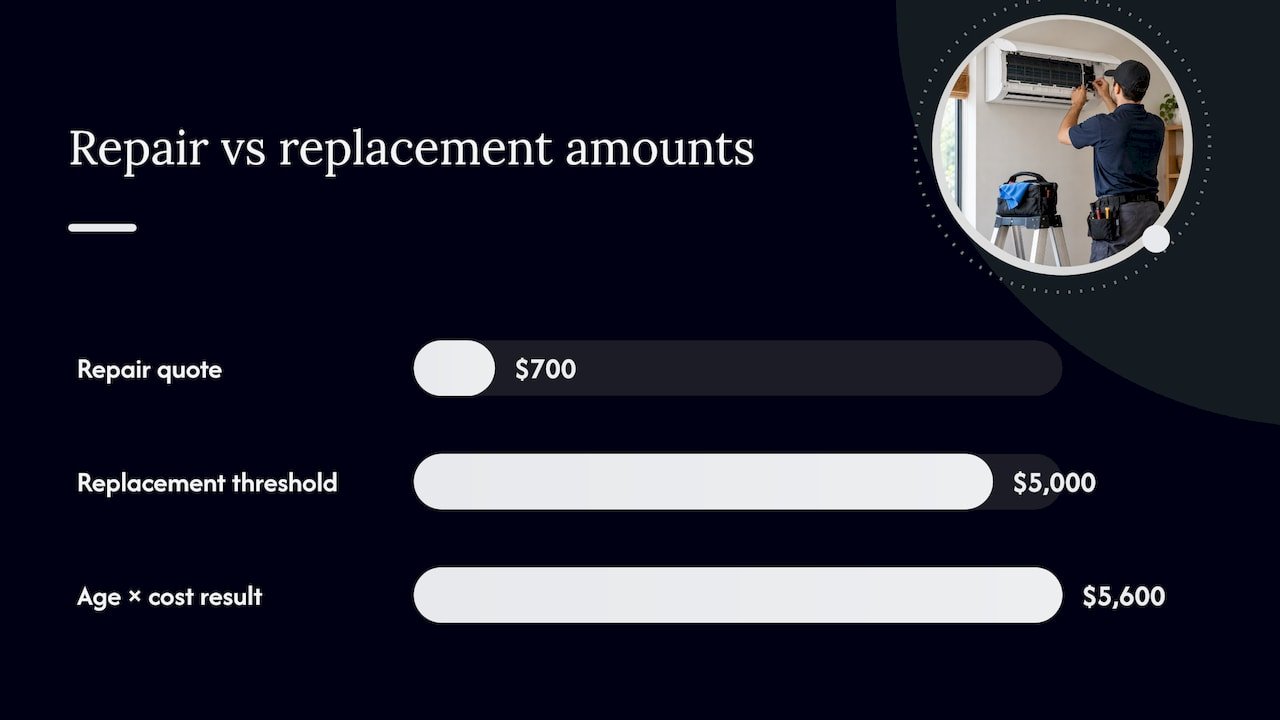
ENERGY STAR’s Replace or Repair guidance lays out age and service-history thresholds homeowners should weigh before approving a major repair, which is where the $5,000 rule comes in: multiply your system’s age by the repair cost, and if that number passes $5,000, replacement usually makes more financial sense than repair. Our $5,000 rule breakdown walks through the math with real examples. Say your mini split is 8 years old and the repair quote is $700: 8 times $700 is $5,600, which crosses the threshold and points toward replacement.
Replacing an aging unit can also open the door to federal incentives. ENERGY STAR documents federal tax credits for qualifying air-source heat pumps, capped at $2,000 and subject to annual aggregate limits, which can meaningfully offset a new installation’s cost.
A newer system with a single failed capacitor or a one-time refrigerant leak is usually worth repairing. A ten-year-old unit on its third compressor-related visit, with a repair quote near or above that $5,000 threshold, is the clearer case for replacement.
Maintenance that keeps repair costs down
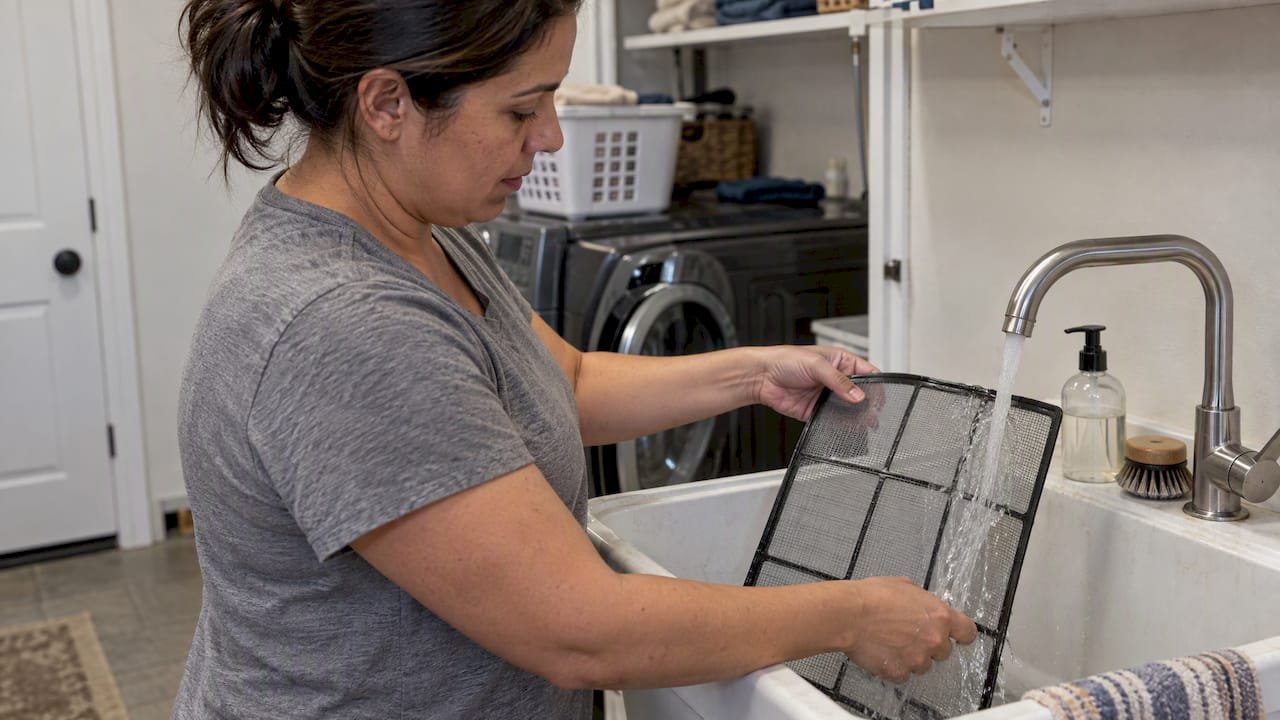
Routine care is the cheapest repair you will ever make, because it is the one you avoid entirely. Filters are the single biggest factor in everyday performance: a dirty filter restricts airflow, forces the compressor to work harder, and drives up your electric bill.
- Rinse or replace filters every one to three months, more often if you have pets.
- Clear leaves, debris, and vegetation from around the outdoor condenser unit.
- Check the condensate drain line for clogs that can cause water backup.
- Dust accessible indoor coils and replace remote batteries as needed.
Leave refrigerant work, compressor service, and electrical repairs to a certified professional. EPA Section 608 requires certification for anyone who adds, removes, or otherwise handles refrigerant, and opening that circuit yourself risks both safety and warranty consequences. Schedule a professional check before each cooling and heating season to catch small issues early, a cadence our seasonal maintenance guide covers in more detail.
Pro Tip: Set a recurring phone reminder for filter cleaning. It takes less than five minutes and prevents the single most common cause of reduced mini split efficiency.
Questions to ask before hiring a mini split technician
A strong estimate tells you exactly what you are paying for and why. Before you approve any work, confirm these points.
- Ask whether the technician holds EPA Section 608 certification for refrigerant handling.
- Ask for the diagnostic fee amount and whether it applies toward the repair cost.
- Request a written, itemized estimate listing parts, labor, and total price.
- Ask what warranty covers the parts and labor, and for how long.
- Get a timeline for the repair, including part availability if a component needs ordering.
Red flags include pressure to add refrigerant without a leak repair, refusal to put the estimate in writing, and no proof of proper credentials. When comparing two quotes, look past the bottom-line number: check expected part lifespan, labor hours, how clearly each technician explains the recommendation, and what you would pay to replace the unit entirely if the repair does not hold.
Why MDTech Services is a trusted choice for mini split repair
We bring licensed, EPA 608-certified technicians and local responsiveness to every mini split repair across Orange County and Los Angeles County. Our pricing stays transparent from the diagnostic visit through the final invoice, and we explain every part replacement before you approve the work. Booking happens online, with the same upfront pricing and warranty-backed repairs we apply to every appliance and HVAC job we take on.
Our take on repair versus replace
We generally favor repair for a mini split under eight years old with a single, isolated failure. Past that age, or after two costly repairs, the math usually favors a new, efficient heat pump, especially with tax credits narrowing the price gap. Weigh your plans to stay in the home before committing either way.
— MDTECH
Book a mini split diagnostic with MDTech Services
If your mini split is acting up, we make booking simple and the pricing clear from the start. Our technicians arrive ready to diagnose the issue, hand you a written estimate, and get to work only once you approve it.
- Diagnostic visits with EPA 608-certified technicians who handle refrigerant safely and correctly.
- Transparent, itemized pricing before any repair begins.
- Warranty-backed parts and labor on completed repairs.
Ready to get your system checked? Book through our air conditioning repair page or explore our full HVAC services for ongoing support.
FAQ
Are mini splits worth repairing?
Repairing a mini split is usually worth it when the system is under eight years old and the repair cost stays well below the replacement price. Once repair costs climb and the $5,000 rule points toward replacement, a new unit typically offers better long-term value.
How much does it cost to get a mini split serviced?
A basic mini split tune-up or service call generally falls between $100 and $250, covering filter checks, coil cleaning, and a general inspection. More involved service work, like condensate drain cleaning, can run up to $300.
How many years do mini splits last?
Mini split lifespan varies by usage and maintenance, and ENERGY STAR’s replace-or-repair guidance uses system age as one of the key factors in deciding whether a repair still makes sense. Systems nearing the upper end of their expected lifespan are better candidates for replacement than repeated repair.
What is the $5,000 rule in HVAC?
The $5,000 rule multiplies your system’s age in years by the estimated repair cost, and if the result exceeds $5,000, replacement typically makes more financial sense than repair. Our repair-or-replace breakdown walks through the calculation with real examples.
Sources
These government and program resources back the figures and rules referenced throughout this guide.