
If your gas furnace clicks but doesn’t ignite, the most likely cause is a power or thermostat issue, an interrupted fuel supply, or a failed ignitor or flame sensor. Check the simple items first, and if you smell gas or suspect carbon monoxide, leave the house immediately and call for help before doing anything else. Once you’re sure it’s safe, a few basic checks can tell you whether this is a quick fix or a job for a licensed technician.
TL;DR:
- Start with the thermostat set to HEAT, the furnace switch and breaker, any error code, the filter, and open vents; these checks take 5 to 10 minutes.
- Note any control board code, then power cycle the furnace by switching it off, waiting 30 seconds, and restarting the thermostat’s call for heat.
- Never adjust gas valves, work on burners, or test control board parts yourself; repeated ignition lockouts after a reset require a licensed technician.
- If a carbon monoxide alarm sounds or anyone develops headache, dizziness, or nausea, evacuate, call emergency services, and stay outside until responders approve reentry.
- Test alarms certified to UL 2034 monthly, install them on every level and outside sleeping areas, and schedule an annual professional furnace inspection.
Table of Contents
- Five quick, safe checks you can do in 5 to 10 minutes
- Why furnaces fail to ignite: the mechanics behind it
- Safe procedures you can follow at home
- When it’s time to call a licensed technician
- Carbon monoxide: what an ignition failure can signal
- Our take on diagnosing ignition failures safely
- Book a furnace diagnostic with MDTech Services
- FAQ
- Sources
Five quick, safe checks you can do in 5 to 10 minutes
Before touching anything near the burners or gas line, run through these checks. They cover the most common, safest causes and take less time than waiting for a technician callback.
- Confirm the thermostat is set to HEAT with the setpoint above room temperature, and swap in fresh batteries if it uses them.
- Check the power switch next to the furnace and your home’s circuit breaker for a trip or a blown fuse.
- Look for a blinking status light or error code on the furnace control board and follow the manufacturer’s listed reset sequence if one is printed on the panel. For more detailed homeowner troubleshooting, see the guide on 3 homeowner checks when furnace won’t turn on and the LED code to note.
- Pull the air filter and hold it up to light. If you can’t see light through it, replace it, and make sure nearby vents and returns aren’t blocked.
- If you smell gas or anyone in the home has a headache, dizziness, or nausea, evacuate and call emergency services before doing anything else.
Why furnaces fail to ignite: the mechanics behind it
A furnace that won’t ignite is almost always a safety system doing exactly what it’s designed to do: shutting down rather than risking an unsafe burn. According to CPSC guidance, a furnace failing to start can actually be a safety control intervening to prevent carbon monoxide from entering the home. Understanding what triggers that shutdown helps you know which checks are safe to make yourself.
- Thermostat and control failures: dead batteries, an incorrect setting, loose wiring, or a stat that’s simply worn out can all stop the call for heat before it reaches the furnace.
- Electrical and power problems: low voltage at the control board, a tripped safety switch, or a blown fuse can prevent the ignition sequence from ever starting.
- Airflow safety devices: a clogged filter or blocked return can trigger a high-limit switch that shuts the system down before ignition, a built-in protection against overheating.
- Fuel supply issues: a closed gas valve, a utility service interruption, or a piping problem anywhere upstream of the furnace will stop ignition cold.
- Ignitor or pilot problems: a hot-surface ignitor that’s cracked or weak, or a pilot light that’s gone out on an older model, is one of the most common reasons a furnace clicks without lighting.
- Flame sensor and control logic: a dirty flame sensor can fail to detect a flame that’s actually burning, causing the control board to cut fuel as a precaution.
- Burner and vent problems: dirty burners, a blocked chimney, or poor combustion airflow can trip the same safety shutdowns, and these conditions tie directly into carbon monoxide risk.
Routine maintenance addresses a surprising share of these triggers before they cause a lockout. Energy notes that keeping up with annual maintenance can lower heating and cooling costs by 5% to 10%, while also preventing the airflow and installation issues that lead to ignition failures in the first place.
Safe procedures you can follow at home
Once you’ve ruled out the obvious, a few more deliberate steps can resolve a lockout without opening up anything gas-related.
- Test your carbon monoxide alarm and do a quick sniff check for a rotten-egg gas odor near the furnace; if you detect either, leave and ventilate before doing anything else.
- Power-cycle the furnace by switching it off at the dedicated switch, waiting 30 seconds, then switching it back on and resetting the thermostat call for heat.
- Replace the air filter if it’s dirty and confirm supply and return vents throughout the house are open and unobstructed.
- Look (without touching) at the ignitor through the furnace’s viewing window for visible cracks or a dull glow instead of a bright orange one; the ignitor runs at high heat and touching it can cause burns or breakage.
- On high-efficiency furnaces, check whether the condensate trap has dried out after a long idle period; priming it with a small amount of water can close the pressure switch and allow the system to start again.
Pro Tip: Keep a note of any error code or flashing light sequence before you reset the furnace. That sequence tells a technician exactly where the control board stopped, which can shorten the diagnostic visit.
What you should not attempt: adjusting a gas valve, cleaning burners beyond removing loose surface debris, or testing control-board components. Combustion safety testing inside the combustion appliance zone must be performed by a certified technician, since it involves confirming the furnace is venting correctly and not spilling exhaust gases back into the home.
When it’s time to call a licensed technician
Some signs mean you stop troubleshooting and call for help right away: a persistent gas smell, a sounding CO alarm, repeated ignition lockouts after a reset, or any concern about the heat exchanger.
- A technician will check gas pressure, control board voltage, ignitor condition, flame sensor response, and overall combustion performance.
- Common repairs include ignitor replacement, cleaning or replacing a flame sensor, and, less often, a gas valve or control board swap, most of which are completed in a single visit.
- Expect a diagnostic fee plus parts and labor, and know that Energy.gov ties routine fall maintenance checks to fewer unexpected mid-season breakdowns, since pricing and part availability vary by region and furnace model.
Carbon monoxide: what an ignition failure can signal
Carbon monoxide has no smell and no color, which is exactly why a furnace safety shutdown deserves to be taken seriously rather than just reset and forgotten. CPSC data lists headache, fatigue, nausea, dizziness, and confusion as the common symptoms of exposure, and none of them announce themselves the way a gas odor does.
If your CO alarm sounds, or anyone in the home shows these symptoms, evacuate immediately, call 911 or your local emergency number, and do not go back inside until responders say it’s safe.
That guidance comes directly from CPSC’s carbon monoxide Q&A, which also recommends installing alarms on every level of the home and outside sleeping areas, interconnected where possible.
- Choose alarms certified to the UL 2034 standard and test them monthly.
- Replace batteries on the schedule the manufacturer lists, even in hardwired units with battery backup.
- Book an annual professional inspection that includes combustion appliance zone testing, which only a certified technician is equipped to perform correctly.
Our guide on carbon monoxide detector placement and testing covers alarm positioning in more detail if you want to double-check your current setup.
Our take on diagnosing ignition failures safely
The instinct to keep resetting a locked-out furnace is understandable, but repeated resets without understanding why it tripped can mask a real combustion-safety problem. We’d rather see a homeowner run the simple checks, stop at the first sign of gas or CO symptoms, and let a licensed technician handle anything involving the gas valve, burners, or control board.
— MDTECH
Book a furnace diagnostic with MDTech Services
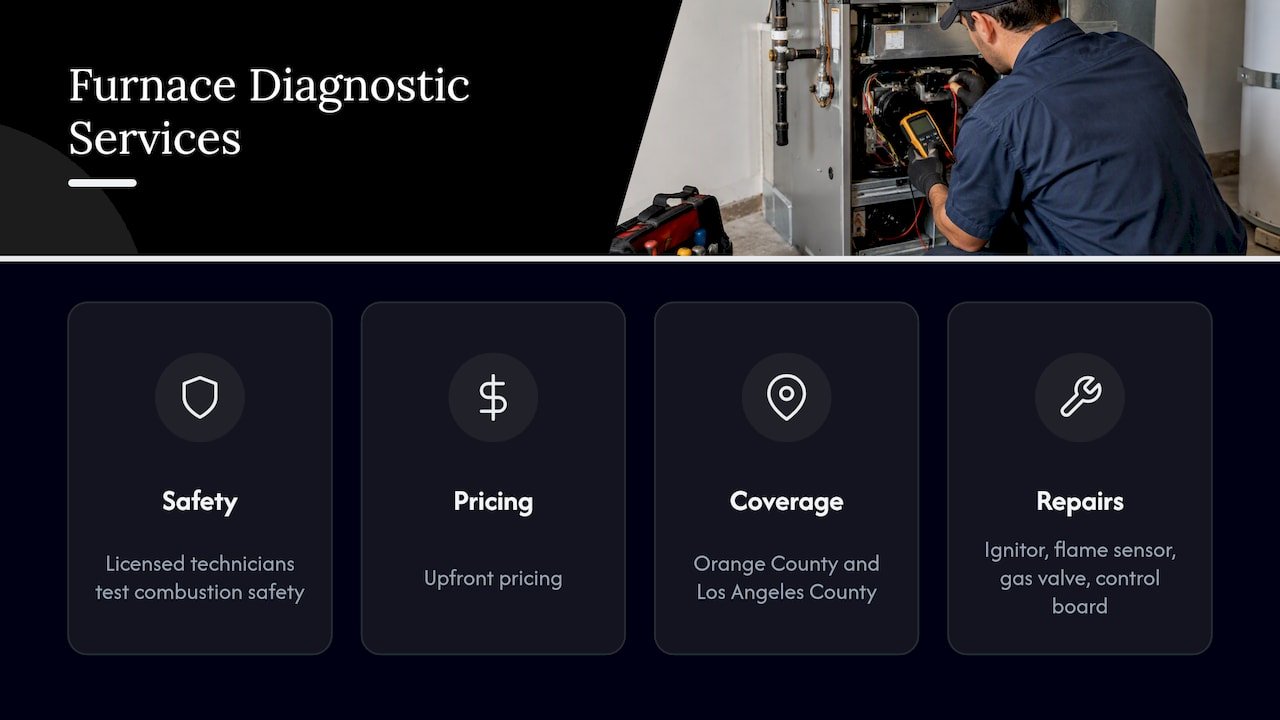
We handle furnace ignition problems with the same safety-first approach outlined above: controlled diagnostics, upfront pricing, and licensed technicians who test combustion safety properly instead of guessing. Our HVAC Services and Gas Appliance Repairs teams cover ignitor, flame sensor, gas valve, and control board issues across Orange County and Los Angeles County.
When you book, have your furnace’s model number, any error codes you noted, and a quick description of the symptoms ready. It speeds up the visit and helps us arrive with the right parts on hand, backed by warranty-safe repairs from the start.
This article is general information, not a substitute for advice from a qualified doctor. Consult a qualified healthcare professional about your own circumstances before acting on anything here.
FAQ
Why is my furnace running but not igniting?
A furnace that runs but won’t ignite usually has a gas supply interruption, a failed ignitor, or a flame sensor that’s too dirty to detect a flame. The blower and control board can have power while the actual combustion sequence stalls out at one of these points, triggering a safety lockout.
How do I reset my furnace ignitor?
Most furnaces reset through a power cycle: switch off the furnace at its dedicated switch, wait about 30 seconds, then switch it back on and reset the thermostat call for heat. If the system locks out again right away, the ignitor itself likely needs inspection by a technician rather than another reset.
How to tell if an ignitor on a furnace is bad?
A healthy hot-surface ignitor glows a bright, steady orange when the furnace calls for heat; a cracked ignitor or one that glows weakly or not at all is a strong sign of failure. Visual inspection through the furnace’s viewing window is safe, but the ignitor itself should never be touched since it operates at very high temperatures.
How do I force my furnace to start?
Don’t try to force a furnace to ignite by overriding safety switches or adjusting the gas valve yourself, since these controls exist specifically to stop unsafe combustion. Work through the basic checks (thermostat, power, filter, condensate trap on high-efficiency units) first, and call a licensed technician if the furnace still won’t start.