
If your Bosch dishwasher has standing water, the most likely cause is a clogged filter or pump. Turn off power, remove the filter, and check the pump for debris before you try anything else. If the pump hums but water still won’t move, that points to a mechanical or electrical fault, and it’s time to schedule professional service rather than keep forcing cycles.
TL;DR:
- Cut power before opening the pump, sponge out standing water, and use pliers rather than bare hands because glass and bone fragments can hide inside.
- If cleaning does not restore drainage, inspect the air gap, hose, and disposal connection; a recently installed disposal may still have its knockout plug.
- A pump that hums without moving water, a returning error code, or an electrical smell calls for professional service, not repeated reset attempts.
- Clean the filter every one to two months, inspect the drain hose once or twice yearly, and check warranty coverage before opening anything further.
- Diagnostic fees are typically $50 to $100, while repairs can approach the appliance’s value; check warranty coverage before deeper work.
Table of Contents
- Common causes a Bosch dishwasher won’t drain
- How to clear the filter and pump: a step-by-step fix
- Check the drain hose, air gap, and garbage disposal connection
- Error codes and what they tell you
- When to call a professional
- Preventive maintenance that reduces future clogs
- What we check on a service call that homeowners miss
- DIY first, but know when to stop
- How MDTech Services can help with a Bosch that won’t drain
- FAQ
- Sources
Common causes a Bosch dishwasher won’t drain
Most Bosch drainage complaints trace back to one of four problems, and the order you check them in matters. Start with the simplest, cheapest fix and work outward.
- Clogged filter or pump debris: food scraps, glass shards, or small utensils caught in the filter basket or pump housing block water from leaving the tub.
- Blocked drain path: a kinked drain hose, a clogged air gap, or a garbage disposal knockout plug that was never removed can trap water even when the dishwasher itself is clean.
- Pump failure: a worn motor, a jammed impeller, or a failed electrical connection stops the pump from pushing water out at all.
- Flow or fill issues: a faulty flow meter or a disposal installed recently without clearing the connector can mimic a drain problem.
Bosch’s own troubleshooting guidance states that food debris lodged in the filter or water pump is the most common reason a dishwasher stops draining, and that clearing it resolves the issue in most cases without tools or parts.
The pump area often hides sharp debris you can’t see from above. Broken glass, bone fragments, and twist-tie wire collect at the bottom of the pump housing, which is why we never recommend reaching in with bare hands.
How to clear the filter and pump: a step-by-step fix
This sequence follows the same order our technicians use on service calls, starting with the safest, least invasive steps.
Before you touch anything inside the tub, cut power at the breaker or unplug the unit. Keep a bucket, towels, and a flashlight nearby since there will be standing water to remove.
- Remove the bottom rack to expose the filter assembly and spray arm.
- Twist and lift the manual filter (usually a quarter-turn counterclockwise) and set it aside for rinsing.
- Sponge out remaining water from the tub floor so you can see the pump housing clearly.
- Locate the pump cover near the center of the tub floor and pry it gently with a spoon handle until it releases, following the release pattern Bosch documents for its pump-cleaning steps.
- Inspect the impeller and cavity for glass, bones, or plastic fragments, and use needle-nose pliers to extract anything sharp or wedged in tight.
- Rinse the filter under running water and clear any buildup from the mesh screen.
- Reseat the pump cover until it clicks fully into place, since a loose cover prevents the pump from building pressure.
- Replace the filter and bottom rack, then restore power.
- Run a short rinse cycle to confirm water drains completely at the end.
- Check underneath the unit for leaks once the cycle finishes.
Pro Tip: Keep an old sponge dedicated to this job. It makes scooping out standing water faster and spares your good dish sponge from pump grime.
Consumer Reports’ cleaning guide recommends this kind of filter and pump inspection every couple of months as routine maintenance, not just as a reaction to a clog. Doing it on a schedule catches small debris before it jams the impeller.
If the test cycle still ends with water pooled at the bottom, the blockage likely sits downstream of the pump rather than inside it, which means the next step is checking the hose and disposal connection.
Check the drain hose, air gap, and garbage disposal connection
Water has to travel from the pump through a hose, sometimes through an air gap, and often into a garbage disposal before it’s truly gone. A clog anywhere in that path produces the same symptom as a dirty filter.
- Inspect the air gap (the small chrome cylinder on your sink deck, if your installation has one) and clear any visible buildup from its cap and underside.
- Disconnect the drain hose at the disposal or under-sink connection, checking for kinks, flattened sections, or a solid clog you can push through with a flexible brush; for thorough pest-related inspection and treatment of biofilm buildup often causing blockages, consider professional drain fly treatment.
- Confirm the disposal knockout plug was removed. If a disposal was installed or replaced recently, a leftover plug blocks the dishwasher inlet entirely, a cause commonly reported in Bosch troubleshooting communities.
- Listen and smell for disposal backup: gurgling from the sink drain or a sour odor often means the clog is in the disposal or household line, not the dishwasher.
If you recently had a dishwasher installed alongside a new disposal, this knockout plug is worth checking first since it’s a one-minute fix that’s easy to overlook.
Error codes and what they tell you
Bosch assigns specific codes to drain-related faults, and matching the code to a check saves time.
- E24 or a drain-related code: usually points to a blocked pump or filter, so start with the cleaning steps above.
- A code paired with a humming sound and no water movement: suggests a jammed impeller or a failing pump motor, which typically requires a technician to repair or replace.
- A code that returns immediately after a reset: often signals an electrical connection issue at the pump, not a clog.
Bosch’s error code reference ties drain faults to checking the pump cover seating, the hose, the air gap, and the disposal knockout plug, in that order. A pump that hums but doesn’t move water has power reaching it but can’t turn, which is a mechanical sign rather than a clog you can clear by hand.
When to call a professional
Some symptoms are worth stopping for rather than pushing through.
- A pump that hums steadily with no water movement after you’ve cleared visible debris.
- The same error code returning after a successful reset and test cycle.
- Any burning or electrical smell near the control panel or pump area.
Consumer Reports notes that diagnostic fees typically run about $50 to $100, and that repair costs can sometimes approach the value of the appliance itself, which is worth weighing before booking a visit. Have your model number, a short description of recent behavior, and photos of the pump area ready when you call. This is also a moment where warranty status matters: attempting a deeper repair on a unit still under coverage can affect that coverage, so it’s worth checking before opening anything beyond the filter and pump cover.
Preventive maintenance that reduces future clogs
A few habits go a long way toward keeping the pump clear between service calls.
- Clean the filter every one to two months, more often if you run the dishwasher daily or wash cookware with heavy food residue.
- Scrape large food scraps before loading, but skip pre-rinsing under the tap since Energy Star’s guidance notes that modern dishwashers are built to clean lightly soiled dishes without it.
- Inspect spray arm holes for clogs during filter cleaning, clearing any blocked jets with a toothpick.
- Check the drain hose and clamps once or twice a year for cracks, looseness, or kinks that develop as the unit shifts over time.
What we check on a service call that homeowners miss
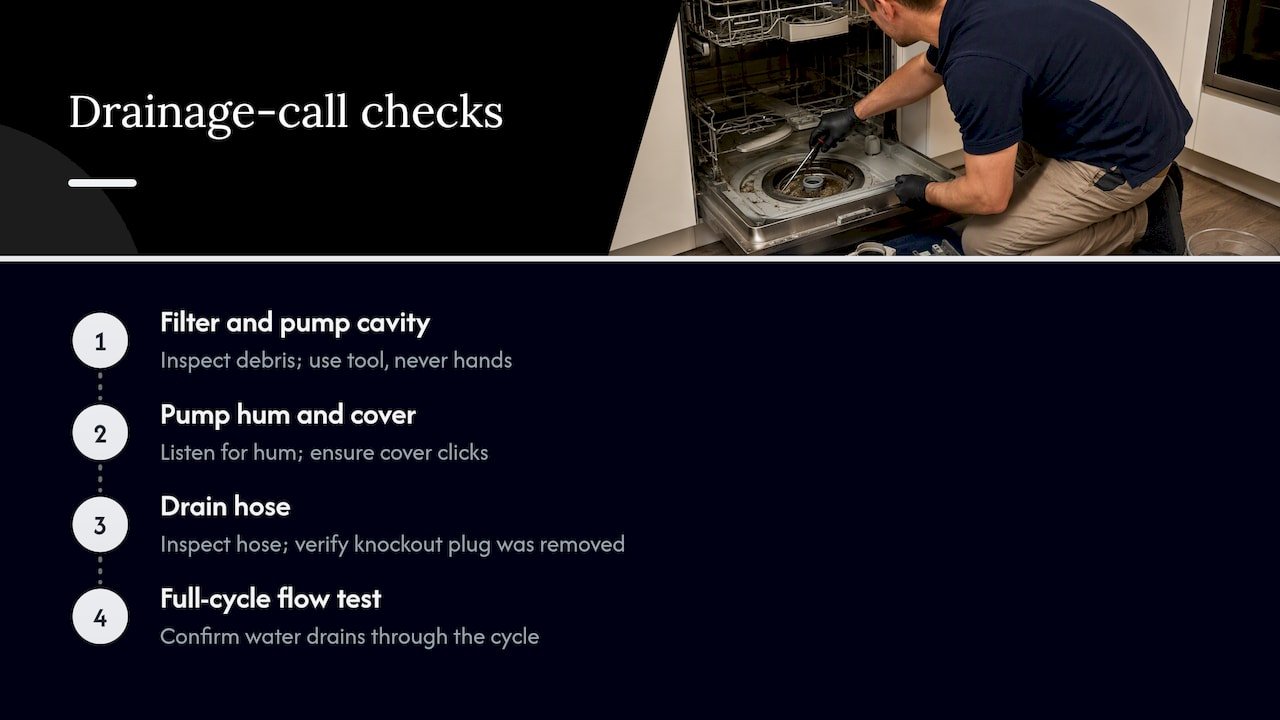
Our quick-scan checklist on a drainage call starts with a visual check of the filter and pump cavity, then a listen for pump hum character, a hose inspection, and a flow test through a full cycle. We use a sponge or tool rather than bare hands in the pump area, since broken glass and bone fragments collect there more often than people expect. Two things homeowners consistently miss: whether the pump cover is fully seated and clicked, and whether a disposal knockout plug was ever removed during a prior installation.
DIY first, but know when to stop
Debris clogs are worth clearing yourself since they’re common, cheap to fix, and low risk. A pump that hums without moving water, or a code that won’t clear, is a different situation: those usually mean a motor or electrical fault that a licensed technician should handle to avoid damaging the unit further. We believe in transparent pricing and warranty-safe repairs, which is why we’d rather suggest trying the filter first before scheduling a service visit.
— MDTECH
How MDTech Services can help with a Bosch that won’t drain
If you’ve cleared the filter and the pump still won’t move water, we handle the rest. Our technicians troubleshoot Bosch dishwashers on-site and work to diagnose and fix the pump or electrical fault efficiently.

A typical diagnostic visit includes:
- Model and error code check against your dishwasher’s service history.
- Pump and impeller inspection for mechanical wear or obstruction.
- Hose and disposal connection check to rule out downstream blockages.
- A written estimate before any repair work begins.
Have your model number ready when you call, and browse our Bosch appliance repair page or book directly through our appliance repair services page to get a technician scheduled.
FAQ
How do I force my Bosch dishwasher to drain?
Run a rinse-only cycle after clearing the filter and pump of debris, which triggers the drain pump without a full wash. If water still doesn’t move, the pump itself may be obstructed or failing and needs inspection rather than another forced cycle.
Why is there standing water at the bottom of my Bosch dishwasher?
Standing water almost always means the filter or pump is clogged with food debris, which Bosch identifies as the most common cause of drainage failure. A blocked drain hose, air gap, or disposal knockout plug can cause the same symptom even when the filter is clean.
How do I reset my Bosch dishwasher not draining?
Turn off power at the breaker for a few minutes, then restart the unit and run a short rinse cycle to see if it drains normally. A reset only helps with minor electrical glitches, so if the same error code returns, the problem is likely mechanical.
How do I force my dishwasher to drain cycle?
Select a rinse or drain-only setting if your model has one, or start a normal cycle and cancel it after the initial fill to trigger the drain pump. If no water leaves the tub during this test, clear the filter and pump first before trying again.
Sources
- Dishwasher Troubleshooting: Dishwasher is not draining | Bosch
- How to clean a dishwasher | Consumer Reports