
When a water heater delivers lukewarm water, the cause is usually one of a short list: a low temperature setting, a failed heating element or thermostat, a damaged dip tube, sediment in the tank, a tankless unit running past its flow capacity, or a plumbing problem that mixes cold water into the hot line. Some of these take two minutes to check. Others involve gas, electrical or combustion parts that belong to a licensed technician. This guide shows you which is which, so you can work out the likely cause and decide whether to repair or replace.
TL;DR
- Start with the simple checks: the temperature setting (120°F is the target for most homes), whether other people are using hot water at the same time, and whether any hot faucet is open or leaking.
- If water starts hot and then turns lukewarm, a tank heater may be running out of hot water, or a lower element or dip tube may be failing. A tankless unit may be exceeding its flow capacity.
- Turn off power at the breaker before you touch any electric heater component. If you smell gas, shut off the gas supply and call a professional right away.
- Scale, sediment, element, thermostat, gas valve and venting problems need diagnosis, not a higher setpoint.
- Repair or replace depends on age, the part that failed and how often it has happened. We can inspect and tell you honestly which makes sense.
Table of Contents
- Why your water heater is only lukewarm
- Start with the temperature setting
- Hot at first, then lukewarm
- Electric tank heaters: what to check
- Gas tank heaters: what to check
- Tankless water heater not heating enough
- Lukewarm water in winter
- Repair or replace a lukewarm water heater
- Perspective: why we diagnose before we replace
- When to stop and call a licensed technician
- Book an inspection in Orange County or Los Angeles County
- FAQ
- Sources
Why your water heater is only lukewarm
A heater that is working, but not working well, is different from one that is dead. Lukewarm water means the unit is heating something, or hot water is being diluted on its way to you. GE Appliances’ troubleshooting list for not enough hot water names several common causes: a low temperature setting, colder winter inlet water, open or leaking hot faucets, exposed hot-water piping, a damaged dip tube, electrical supply problems, reversed water connections and recirculation-system interference.
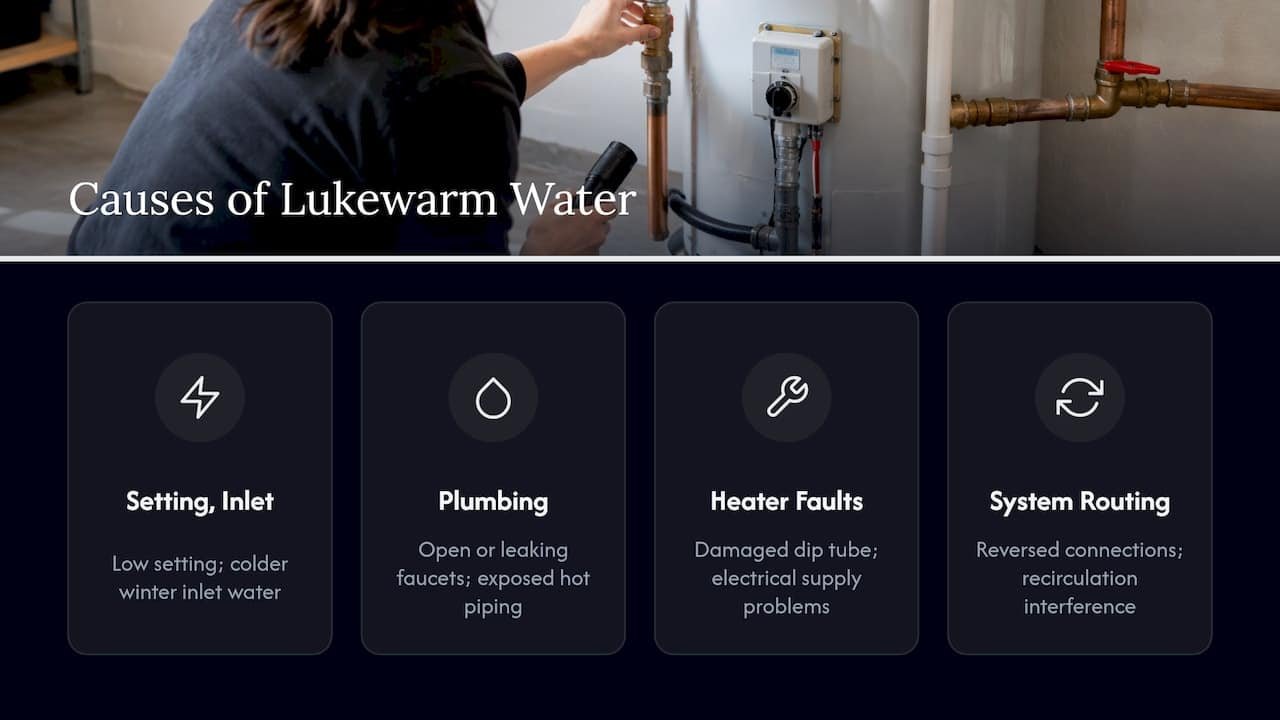
That list matters because it shows the heater is not always the culprit. Plumbing losses, crossed connections and a recirculation loop can all produce lukewarm water from a heater that is heating perfectly well. A useful diagnosis looks at the whole system, from the cold inlet to the faucet.
Quick match: symptom to likely cause
| What you notice | Likely causes | Who handles it |
|---|---|---|
| Lukewarm all the time, tank unit | Low setpoint, failed thermostat or element, dip tube, reversed connections | You can check the setpoint; the rest is a technician’s job |
| Hot at first, then lukewarm | Tank depleted or undersized, lower element, dip tube, sediment | Technician if it persists |
| Lukewarm only in one fixture | Mixing valve, faucet cartridge, shower scald-control valve | Plumber |
| Tankless unit, lukewarm or cold | Flow too low or too high, scale, inlet filter, gas supply, venting, error code | Safe external checks, then a technician |
| Lukewarm after a new install | Reversed connections, unit not full before power-up, breaker or thermostat issue | The installer or a technician |
Start with the temperature setting
The easiest cause is also the most overlooked. For most homes, the recommended setting is 120°F. Someone may have lowered it to save energy, or a power surge or a service visit may have changed it.
To see what you are really getting, use the method from the U.S. Building America Solution Center: run the nearest hot faucet for about three minutes, collect the water in a mug and measure it right away with a meat thermometer. A reading well below 120°F with the dial at 120°F points to a heating or mixing problem rather than a setting problem.
Adjusting it safely
Do not raise the setpoint to “fix” lukewarm water. A.O. Smith warns that water above 120°F can cause severe burns within seconds, and that 140°F can cause a serious burn in about one second. If your heater cannot hold 120°F, something is wrong, and a higher dial setting only hides it.
For an electric heater, GE Appliances’ instructions are to turn off power, remove the jacket panels and insulation without removing the thermostat protective covers, set both thermostats to the same temperature, replace the insulation and panels, and restore power. Verify that power is truly off before reaching inside. For a gas heater, follow your model’s manual for the gas control.
Hot at first, then lukewarm
This is the most common complaint, and it has several causes.
The tank ran out. A storage heater holds a fixed amount of hot water. Back-to-back showers, a dishwasher and a laundry load can drain it faster than it recovers. If your household has grown or your habits have changed, the tank may simply be too small for the demand.
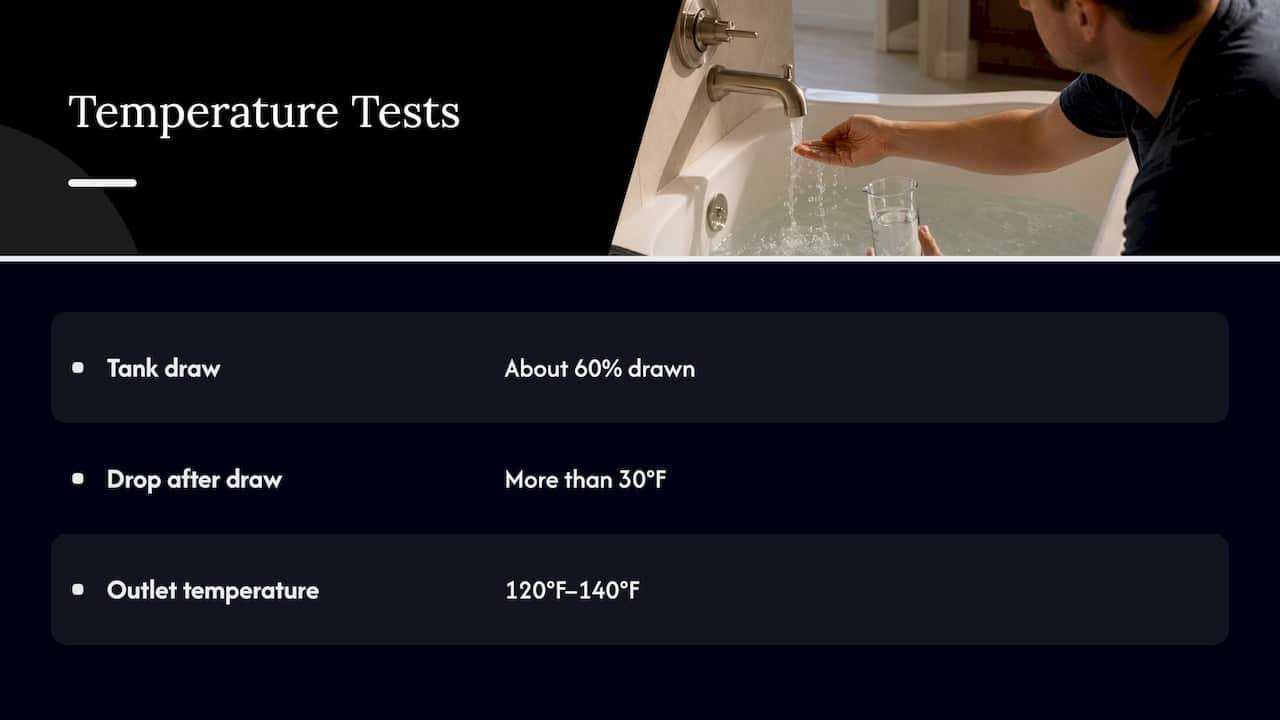
A lower element or dip tube is failing. The dip tube carries incoming cold water to the bottom of the tank. If it is damaged, cold water can mix into the hot upper portion of the tank, which produces lukewarm water. A.O. Smith’s technical bulletin gives a test: after about 60% of the tank has been drawn, a temperature drop of more than 30°F means you should check the lower element and dip tube. The same bulletin says the outlet temperature test should read between 120°F and 140°F.
Sediment has built up. Minerals settle at the bottom of a tank and reduce how efficiently it heats and recovers. If you are in a hard-water area, which includes much of Southern California, a regular maintenance routine helps. Our water heater maintenance checklist walks through what to schedule and when.
If the symptom persists, diagnosis is the right next step, not a higher setpoint. Forbes Home notes that reducing simultaneous demand and insulating accessible hot-water pipes can help in the meantime, and that a recirculation system is worth considering if hot water takes a long time to arrive.
Electric tank heaters: what to check
Electric units heat with two elements, each controlled by a thermostat. If one element or thermostat fails, you often still get warm water, just not enough of it or not hot enough. That is why lukewarm output is a classic electric-heater symptom.
Safe things you can do:
- Check that the breaker has not tripped and is fully on.
- Confirm that nobody has left a hot faucet running or dripping.
- Check the temperature setting as described above, with the power off.
- If the heater is newly installed, make sure it was completely full before it was powered. Whirlpool says to open a hot faucet for at least three minutes to purge air before you restore power.
What to leave alone: testing or replacing elements and thermostats means working around live electrical connections. A.O. Smith says to turn off power before touching electric water-heater components. If you are not certain the power is off, stop and call a licensed professional.
Gas tank heaters: what to check
On a gas unit, lukewarm water can come from a faulty gas control valve, a weak pilot or burner, a thermostat problem or restricted venting, in addition to the causes above. Most of those are not homeowner adjustments.
If you smell gas, do not keep troubleshooting. A.O. Smith’s guidance is to turn off the gas supply immediately and call a professional. Leave the home if the smell is strong. Do not touch the pressure-relief valve while the heater is running, either. If that valve is dripping, see our guide on a leaking TPR valve.
Tankless water heater not heating enough
Tankless units heat water as it flows, so lukewarm output follows a different logic. The common patterns are flow, scale, supply and plumbing.
Flow and demand
Two opposite flow problems cause trouble. Too little flow: Bosch’s U.S. bulletin says flow below 0.8 gallons per minute may prevent a unit from firing or staying fired. It recommends checking for restrictions such as the inlet filter, faucet aerators, showerheads and a whole-house filter. Too much flow: if several fixtures run at once, the unit may not be able to heat all of it, and the water comes out lukewarm.
The cold-water sandwich
If you get a burst of hot, then a short blast of cold, then hot again, that is the cold-water sandwich. Forbes Home says to wait briefly because hot water is on its way. If it keeps happening or lasts long, have the unit evaluated.
Scale on the heat exchanger
Takagi’s troubleshooting guide lists a low setpoint, plumbing crossover, hard-water scale on the heat exchanger, inadequate gas supply, restricted airflow, a blocked inlet filter, flow-control problems and error code 101 among the causes of lukewarm water. Scale acts like insulation on the heat exchanger, and the manufacturer says scaled units should go to a service agent, not be treated as a simple homeowner adjustment.
Safe checks for a tankless unit
- Look at the display for an error code and look it up in your model’s manual.
- Confirm the unit has power and that the cold-water inlet valve is fully open.
- Check the setpoint on the controller.
- Clean faucet aerators and showerheads, and check the inlet filter if your manual describes how.
- Do not open gas, combustion or electrical compartments. Those are for a qualified technician.
Is it crossover?
Bosch describes a plumbing test for crossover: isolate the heater’s cold supply, open hot fixtures and wait five minutes. If water keeps flowing, cold and hot lines are cross-connected somewhere, or a shower scald-control valve is misadjusted. That needs plumbing attention. It is also worth knowing for a tankless heater that shows “cold water only” or no hot water at all. For related shower symptoms, read no hot water in the shower.
Lukewarm water in winter
If the problem shows up only in cold months, colder inlet water is a documented cause, because the heater has to raise the temperature further. Exposed hot-water piping in a garage, crawl space or exterior wall loses more heat on its way to the tap. Insulating accessible pipes and reducing simultaneous use can help. If the water is still lukewarm after those steps, the heater may be undersized or have a component problem that cold weather exposed.
Repair or replace a lukewarm water heater
The decision comes down to four things: age, the failed part, the pattern and the cost of the fix compared with the cost of a new unit.
Age. One summary of Department of Energy figures puts a storage tank at 10 to 15 years of expected life and a tankless unit at about 20, and notes ENERGY STAR advises replacing a tank unit proactively past 10 years. A heater inside that window with a clear, single fault is usually a repair candidate.
The part. A thermostat, element or dip tube is a contained repair. Leaking from the tank itself is different. If water is pooling, see our steps for securing a leaking water heater.
The pattern. One failure on a mid-life unit is a repair. Repeated failures, rust-colored water, or a tank that cannot keep up with a household that has grown point toward replacement or a different size or type.
The cost comparison. Ask for a written explanation of what failed, what the repair covers and what a replacement would involve, so you can compare. We give upfront pricing, and we will tell you which route fits your unit.
| Situation | Usually points to |
|---|---|
| Unit under about 10 years, one failed thermostat, element or dip tube | Repair |
| Setpoint or connection problem | Adjustment, no parts |
| Tankless with scale or a clogged filter | Service |
| Tank older than 10 years with repeated faults | Replacement worth pricing |
| Household demand has outgrown the tank | Replacement with a larger or different unit |
For the details of what a repair visit involves in our area, see water heater repair for California homes.
Perspective: why we diagnose before we replace
Most lukewarm-water calls we get are not what the homeowner expects. People assume the heater is finished, and often it is a failed element, a dip tube, a setting, or a mixing problem in the plumbing.
That is why we look at the whole system first: the heater, the connections, the fixtures and how your household actually uses hot water. Our licensed technicians handle gas appliances, plumbing and HVAC, so one visit can cover the heater and the lines around it.
When a repair is the right call, we fix it and aim for a long-term, warranty-safe result. When a replacement is the better choice, we explain why and what the options are, with upfront pricing, before any work begins.
MDTECH
When to stop and call a licensed technician
Call a professional the same day if any of these apply:
- You smell gas. Shut off the gas supply first, then call.
- You need to open an electric heater’s wiring compartment and are not certain the power is off.
- The tankless unit shows an error code that persists after the safe checks.
- There is scale, restricted venting, a gas supply issue or a suspected crossover.
- Water is leaking from the tank or the pressure-relief valve.
- The heater is old and the problem keeps coming back.
Book an inspection in Orange County or Los Angeles County
We serve homeowners, landlords and property managers across Orange County and Los Angeles County. If your water is lukewarm, our technicians can diagnose the cause, repair what is repairable and install a replacement if that is the better answer. Gas appliance questions are covered too, through our gas appliance repairs service. You can book online or reach us from our plumbing repair services page.
If the lukewarm water is part of a wider heating or cooling issue in the house, our HVAC repair team can look at that on the same visit.
FAQ
How warm should my water heater be?
For most homes, 120°F is the recommended setting. Hotter water raises scald risk and uses more energy. The Building America Solution Center says each 10°F reduction can save about 5% in energy use. If you cannot reach 120°F at the faucet, have the heater checked.
How do I get my water heater to heat up faster?
Reduce simultaneous hot-water use, insulate accessible hot pipes and check that the setpoint is 120°F. If recovery is still slow, a failed element, sediment or a damaged dip tube may be the cause. Raising the setpoint is not a safe fix, so book a diagnosis.
Why does my tankless water heater only give cold water?
Common causes are low flow that stops the unit firing, a closed inlet valve, a blocked filter or aerator, scale, a gas supply problem or an error code. Check the display, the inlet valve and the aerators first. If the code stays, call a technician, since gas and combustion parts are not for homeowners.
Is it safe to reset my electric water heater myself?
Only the outside steps are safe: confirm the breaker is on and the heater is full of water. Turn off power at the breaker before opening any panel, and verify it is off. If a reset does not hold, a thermostat or element has probably failed and needs a licensed professional.
Sources
- GE Appliances: Water Heater, Not Enough or No Hot Water
- GE Appliances: How to Adjust Temperature Setpoint
- A.O. Smith: Water Heater Temperature Setting
- A.O. Smith: Technical Bulletin 36, Not Enough Hot Water
- A.O. Smith: Is Your Hot Water Not Getting Hot?
- Building America Solution Center: Check Water Heater Temperature
- Home Inspection Insider: Bad Water Heater Dip Tube
- Whirlpool: Electric Water Heater Troubleshooting
- Forbes Home: Tankless Water Heater Isn’t Working
- Bosch: Temperature Fluctuation Troubleshooting
- Takagi: Tankless Troubleshooting Guide
- HVACBase: How Long Does a Water Heater Last