
HEPA and MERV are not two competing brands of the same product. MERV is a rating scale for HVAC filters, while HEPA is a performance standard: a true HEPA filter captures at least 99.97% of 0.3-micron particles. For most homes with ducted heating and cooling, the practical answer is a MERV 13 filter, or the highest MERV your system can handle, plus a portable HEPA air cleaner in rooms where you want more. A true HEPA filter in a standard residential duct system usually restricts airflow too much.
Below, we explain what each term means, how they compare on particle capture, why your furnace or air handler decides the outcome, and how to choose.
TL;DR
- MERV is a rating (1 to 20) for how well a filter captures particles. HEPA is a standard: at least 99.97% capture of 0.3-micron particles.
- A MERV 13 filter typically removes at least 50% of particles in the 0.3 to 1.0 micron range. HEPA is far more efficient at that size.
- Most residential duct systems are not built for HEPA-level resistance. Higher-MERV filters already push on the blower, so check compatibility first.
- The EPA suggests at least MERV 13, or as high as your system can accommodate, and a HEPA-based portable air cleaner for rooms that need more.
- If you are unsure what your system can take, a licensed HVAC technician can measure it before you buy.
Table of Contents
- What MERV and HEPA actually mean
- HEPA vs. MERV 13: how they compare
- The real limit: what your HVAC system can handle
- So which should you choose?
- Our perspective: fit first, rating second
- Get your system checked before you upgrade
- FAQ
- Sources
What MERV and HEPA actually mean
MERV: a rating scale for HVAC filters
MERV stands for Minimum Efficiency Reporting Value. It is a rating system derived from ASHRAE Standard 52.2 that reports a filter’s ability to capture particles between 0.3 and 10 microns. The higher the number, the more of those particles the filter is designed to catch. Typical residential filters sit somewhere between MERV 6 and MERV 13.
The number is a minimum. It tells you the filter performs at least that well across defined particle size ranges in a lab test, not that every filter with the same number behaves identically. One study of HVAC filters found that fine-particle efficiency generally rises with MERV rating, but performance can vary significantly between makes and models within the same MERV class.
HEPA: a capture standard, not a MERV number
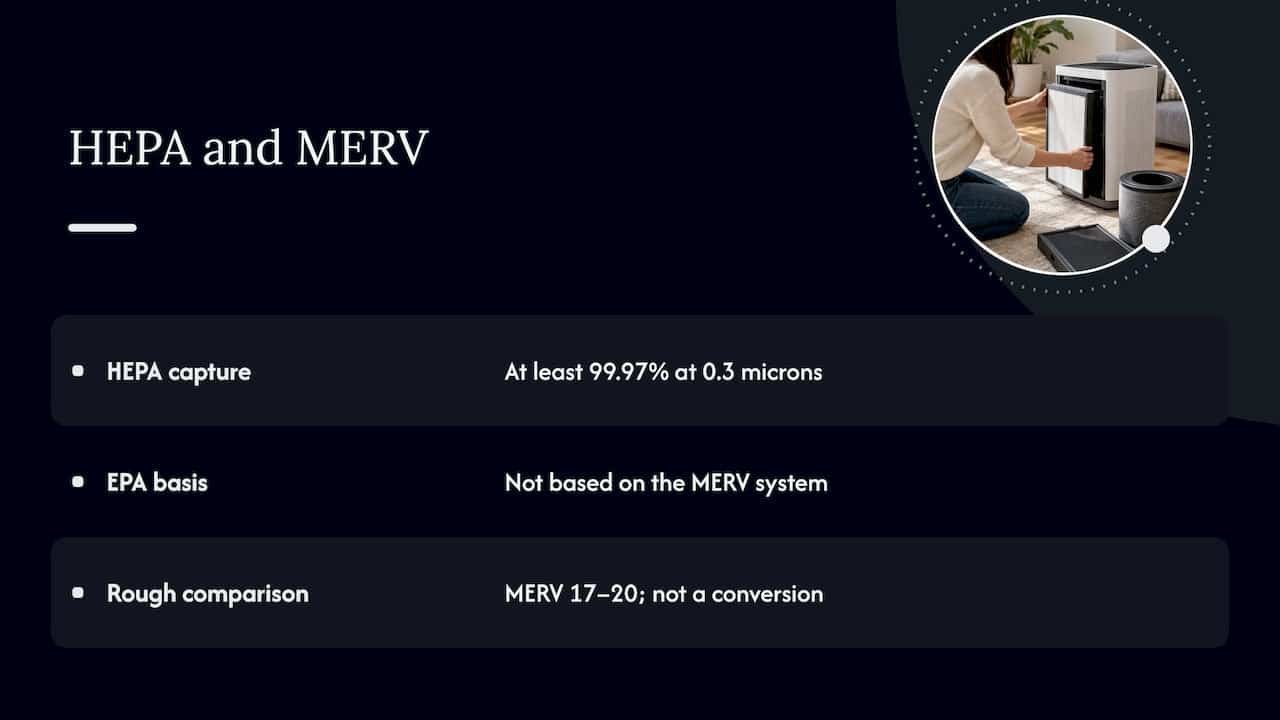
HEPA stands for high efficiency particulate air. A HEPA filter captures at least 99.97% of 0.3-micron particles, and according to the EPA, its listed capture efficiency is not based on the MERV rating system. In other words, HEPA is tested and certified on its own terms.
You will often see HEPA described as “MERV 17 and up.” The EPA’s own technical bulletin does describe HEPA filters with MERV ratings from 17 to 20 as more effective at filtering smaller particles. Treat that as a rough equivalence for comparison, not an official conversion.
HEPA vs. MERV 13: how they compare
MERV 13 is the rating most homeowners ask about, because it is the level the EPA points to for residential systems. Here is how it lines up against HEPA.
| Feature | MERV 13 | True HEPA |
|---|---|---|
| What it is | A rating on the ASHRAE 52.2 scale | A performance standard |
| Capture at 0.3 microns | At least 50% for the 0.3 to 1.0 micron range, per the EPA | At least 99.97% |
| Airflow resistance | Moderate to high | Very high |
| Fits a standard home filter slot | Often, in 4-inch or deeper pleated versions, if the system allows | Rarely without duct or system changes |
| Typical home use | Whole-house HVAC filtration | Portable air cleaners, specialized or modified systems |
The capture figure for MERV 13 comes from the EPA: a MERV 13 filter typically demonstrates at least 50% removal efficiency for particles in the 0.3 to 1.0 micron range. Many real filters do better, especially on larger particles such as pollen, mold spores and dust. But at the hardest size to catch, HEPA is in a different class.
Is a MERV 16 filter a HEPA filter?
No. A MERV 16 filter is a high-efficiency filter, but it is not certified as HEPA. HEPA is defined by its 99.97% capture of 0.3-micron particles, and the EPA states that this efficiency is not based on the MERV system. The same logic applies to the question of whether HEPA equals MERV 17. HEPA filters are commonly placed in the MERV 17 to 20 range for comparison, but a filter labeled MERV 17 is only HEPA if it carries HEPA certification. Check the product label for a stated HEPA rating rather than relying on a MERV number alone.
Why particle size matters
The 0.3-micron figure is used because it is among the hardest sizes for a filter to catch. Particles that small are the benchmark, which is why HEPA is quoted at that size. Larger particles, like pollen and most dust, are easier to catch, so even mid-range MERV filters do well on them. Smaller particles from cooking, smoke and some indoor sources are where higher efficiency matters most.
Airflow also changes results. For a specific filter, lower airflow rates generally mean higher efficiency for smaller particles and lower efficiency for larger ones. A filter’s lab number is a reference point, and what you get at home depends on how your system moves air.
The real limit: what your HVAC system can handle
This is where most HEPA vs. MERV decisions are settled. The filter has to fit the system, and the system has to push air through it.
Airflow resistance and static pressure
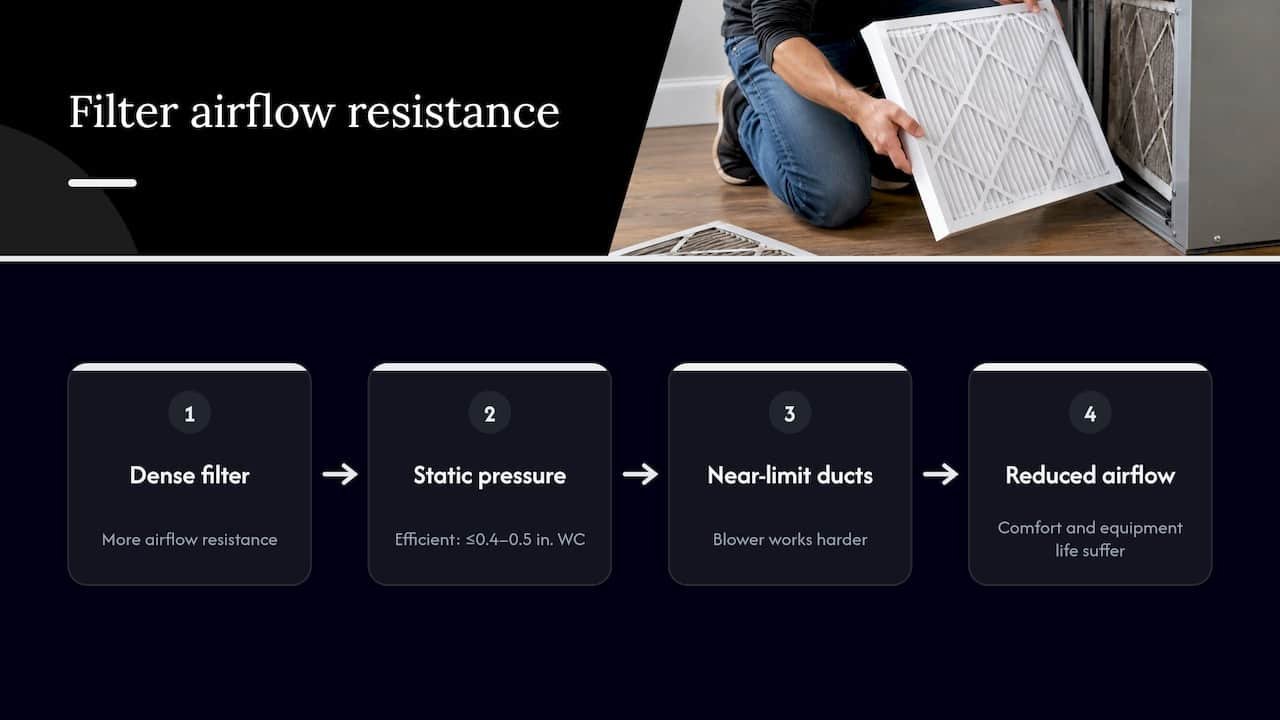
Every filter resists airflow. Denser filters resist more. The U.S. Department of Energy’s Building America program notes that the vast majority of residential ducted systems have filter boxes or grilles undersized for bigger, thicker, high-MERV filters, and that higher-MERV filters impose more airflow resistance than low-MERV ones.
Resistance is measured as static pressure, in inches of water column. Most residential systems operate efficiently with total static pressure no higher than 0.4 or 0.5 in. WC. Add a dense filter to ducts that already run near that limit and the blower works harder, airflow drops, and comfort and equipment life can suffer.
If you want the plain-language version of what that strain does inside the equipment, our guide to what a blower motor does is a good place to start. For a broader view of why air distribution matters, see why balanced airflow matters for your home.
Why a restrictive filter can backfire
The same Building America profile adds that high-MERV filters, which trap more particles, are likely to clog faster, increasing pressure drop. That means a dense filter needs more frequent checks. Reduced airflow can show up as weak airflow from vents, rooms that never reach the set temperature, longer run times and a coil that struggles in cooling mode. A better-rated filter that starves the system does not improve your air, because less air is moving through it.
Learning how restrictive filters affect pressure is worthwhile, and so is keeping dust under control at home between filter changes, since less settled dust means less for the system to move.
How to fit a higher-rated filter safely
The EPA says adjusting duct size, duct length, and/or filter width may help keep total pressure drop within the blower fan motor’s limit. In practice, the usual approaches are:
- Use a deeper filter. A 4-inch or 5-inch pleated MERV 13 has more surface area than a 1-inch one, so it resists airflow less at the same rating. It needs a cabinet or filter rack that accepts that depth.
- Enlarge the filter area. A larger return grille or a media cabinet gives the air more surface to pass through.
- Check duct condition. Leaky, crushed or undersized ducts add resistance before the filter does. Our overview of why clean air ducts matter covers what to look for.
- Measure static pressure. A technician can read it with a manometer before and after the change, which removes the guesswork.
The EPA’s guidance on residential air cleaners says that while higher-efficiency media is beneficial for health, any move to higher MERV or HEPA-level filtration requires verifying compatibility with the existing ducted system so essential airflow is not restricted.
So which should you choose?
The EPA’s recommendation is to choose a filter rated at least MERV 13, or as high as your system fan and filter slot can accommodate. For rooms where you want more than that, it points to a portable air cleaner with a CADR large enough for the room, noting that portable units often reach a high CADR with a HEPA filter.
Here is how that plays out by situation:
- Standard home, system in good condition: Start with a MERV 13 pleated filter in the deepest size your filter slot accepts. Confirm airflow is still strong after the swap.
- Allergies or asthma in the household: Pair the HVAC filter with a HEPA portable air cleaner in the bedroom or main living area. This adds HEPA-level capture without loading the duct system.
- Older or undersized system: Stay at a lower MERV, such as 8 to 11, until a technician confirms the system can take more. A filter the blower can push air through beats a denser one it cannot.
- Wildfire smoke or heavy indoor sources: A HEPA portable cleaner sized to the room, along with a well-fitted high-MERV filter, gives you two layers.
- Rental or investment property: Choose a MERV your equipment handles comfortably and set a replacement schedule you can keep. Consistent changes protect equipment better than an aggressive rating that goes unchanged.
For the maintenance side, our HVAC filter replacement process for homeowners walks through changing a filter correctly, and why inspecting HVAC filters matters explains how often to look. If you want the bigger picture, see the role of HVAC in indoor air quality.
Our perspective: fit first, rating second
We see the same pattern in homes across Orange County and Los Angeles County. A homeowner upgrades to the highest-rated filter on the shelf, and a few weeks later the system runs longer, a room feels stuffy or the coil ices over. The filter was not the problem. The system around it was not set up for that resistance.
Our approach is to treat filtration as part of the whole airflow picture. We look at the filter slot, the return size, the duct condition and the blower, then recommend the highest filter rating that the system supports with healthy airflow. When a household wants HEPA-level cleaning, we point to a room-sized HEPA air cleaner alongside a properly sized HVAC filter, instead of forcing a restrictive filter into a system that cannot take it.
That is also why we encourage a scheduled check rather than a guess. Our licensed technicians can confirm what your system can handle, replace the filter correctly and keep the equipment running the way it was designed to. A filter that fits, gets changed on time and lets air move freely will do more for your home than a number on the box.
— MDTECH
Get your system checked before you upgrade
If you are considering a MERV 13 filter or want to know whether your home can accommodate anything higher, we can help. Our licensed technicians inspect the filter slot, ducts and blower, and advise on the right filter for your system across Orange County and Los Angeles County. See our HVAC services, or book an appointment online if your system is already running poorly after a filter change.
If airflow has dropped, vents feel weak or the system is struggling to keep your home comfortable, our HVAC repair team can diagnose it. Your filter choice and your equipment work together, and it is easier to get right the first time. You can also read more on HVAC filtration and energy savings.
FAQ
Is a MERV 16 filter a HEPA filter?
No. MERV 16 is a high-efficiency rating, but HEPA is a separate standard requiring at least 99.97% capture of 0.3-micron particles. The EPA notes that HEPA’s listed capture efficiency is not based on the MERV rating system. Look for an explicit HEPA designation on the product.
Is a MERV 11 filter too high for a residential system?
Not usually. MERV 11 sits in the range many home systems handle, but resistance varies by filter depth and by your ducts and blower. If airflow weakens after you install it, a deeper filter or a lower rating may be the fix. A technician can measure static pressure to confirm.
What are the downsides of using a HEPA filter in an HVAC system?
The main concern is airflow. Higher-efficiency filters resist air more and clog faster, which raises pressure drop. In a ducted home system, that can strain the blower unless the system is designed or modified for it. A portable HEPA air cleaner avoids that issue.
Can I put a HEPA filter in my furnace or air handler?
Usually not as a drop-in swap. Most residential filter boxes are undersized for thick, high-efficiency filters, so the EPA advises verifying compatibility with the existing ducted system first. Have your system evaluated before making changes.
Sources
- What is a MERV rating? | US EPA
- Indoor airPLUS Technical Bulletin: Filtration (EPA)
- Building America Top Innovations 2014: filter sizing (U.S. Department of Energy)
- Residential Air Cleaners: A Technical Summary (EPA)
- Guide to Air Cleaners in the Home (EPA)
- Estimates of HVAC filtration efficiency for fine and ultrafine particles (Azimi et al., 2014)
- How Do Particle Filters Work? (ASHRAE Journal)