
When a microwave runs, the light is on, the turntable spins and the timer counts down but the food stays cold, the cause is usually one of two things: a setting or door problem you can check in two minutes, or a failed high-voltage part that needs a technician. This guide walks you through the safe checks, explains which internal parts cause a no-heat problem, gives realistic repair costs and helps you decide between repair and replacement.
TL;DR
- Start with the free checks: Control Lock, Demo Mode, power level, Delay Start, the timer function and a firmly closed door.
- If those do not fix it, the likely culprits are the magnetron, the high-voltage diode or capacitor, a door switch, or a fuse.
- Do not open the cabinet. The capacitor can hold a dangerous charge long after the microwave is unplugged.
- Typical repair costs run from about $50 for a minor part to about $500 for a control board on a built-in unit.
- A newer, higher-quality or over-the-range microwave is usually worth repairing. An old, inexpensive countertop unit often is not.
Table of Contents
- Why a microwave runs but does not heat
- Step 1: Rule out settings you can fix yourself
- Step 2: Check the door
- Step 3: Understand the parts that usually fail
- Why you should not open the microwave yourself
- What microwave repair costs
- Repair or replace?
- Our perspective: what we see on microwave calls
- When to call a technician
- Microwave repair from MDTech Services
- FAQ
- Sources
Why a microwave runs but does not heat
A microwave heats food with a magnetron, a tube that produces the electromagnetic waves that cook your food. According to KitchenAid, a magnetron that is not working leaves the microwave unable to heat, and it may also blow a fuse. The magnetron is not the only part involved, though. It needs high voltage from a transformer, a diode and a capacitor, and it needs the door switches to confirm the door is closed.
That is why a microwave can look completely normal while producing no heat. The control board, display, light, fan and turntable run on low voltage. The heating circuit is separate and runs at much higher voltage. If one part in that heating circuit fails, everything else keeps working.
The cause falls into one of three groups:
- Settings and user error. The microwave is working as programmed, just not in a heating mode.
- Door and latch problems. The microwave believes the door is open, or the seal is damaged.
- Failed heating components. The magnetron, diode, capacitor, transformer, thermal fuse or a door switch has failed.
Work through them in that order. The first group costs nothing.
Step 1: Rule out settings you can fix yourself
KitchenAid lists the functional causes homeowners can check: Control Lock Mode, the power level, whether the door is closed securely, Demo Mode and Delay Start. These are worth a few minutes before you call anyone.
Timer function
On many models the Timer button looks a lot like the Cook Time button. GE notes that a microwave may run without heating if the Timer function was used. The display counts down, the microwave stays quiet and nothing gets hot. Clear the display, then enter a cook time using the Cook Time or Start path described in your manual.
Control Lock and Demo Mode
Control Lock disables the keypad, and some models show a lock icon. Demo Mode lets the display and lights run for showroom purposes with the heating turned off. The exact key press to turn each one off depends on the brand and model, so look up your model number in the manual rather than guessing at button combinations.
Power level and Delay Start
A power level set to 1 or 2 heats so gently that you may think nothing is happening. Set it to 10 or High and test. If Delay Start was selected, the microwave will count down without cooking until the set time arrives.
Reset the microwave
KitchenAid’s reset method is simple: clear any display or error codes and unplug the microwave for one minute, then plug it back in. This can clear a control glitch after a power surge. If you have a built-in or over-the-range model with no accessible plug, switch off the dedicated circuit breaker for a minute instead.
The water test
Place a microwave-safe cup with about a cup of water in the center and run it for one minute on high. If the water is not noticeably warm, the heating circuit is not working. Do not run the microwave empty to test it, because that can damage the magnetron.
Step 2: Check the door
A microwave will not heat unless its door switches confirm the door is closed. GE tells owners to make sure the door is closed securely, and if that and the timer check do not help, to contact service.
What you can look at safely, with the microwave unplugged:
- Food debris or grease on the door seal and the edge of the cavity that stops the door from latching fully.
- A door that sags, rubs or does not click shut.
- A bent or broken latch hook.
- Cracks or warping around the frame.
Wipe the seal area with a damp cloth and test again. If the latch is visibly damaged or the door no longer closes with a firm click, stop using the microwave. A damaged door is both a heating problem and a safety problem, and it is the kind of repair our microwave oven door repair technicians handle.
Step 3: Understand the parts that usually fail
If settings and the door check out, the problem is inside the cabinet. This section is for understanding, not for DIY. You do not need to open the microwave to talk intelligently with a technician.
| Part | What it does | Typical sign when it fails |
|---|---|---|
| Magnetron | Produces the microwave energy | Runs normally but no heat; may blow a fuse; sometimes a buzzing or humming sound |
| High-voltage diode | Converts the transformer’s output so the magnetron can use it | No heat, with no other symptoms |
| High-voltage capacitor | Stores and boosts the charge sent to the magnetron | No heat, sometimes a loud hum or tripped fuse |
| Door switches | Confirm the door is closed before heating | Works only if you press the door, or does not start at all |
| Fuse or thermal fuse | Protects the circuit from overload or overheating | Dead microwave, or runs without heating |
| Control board | Directs power to the heating circuit | Erratic keypad, no response, or no heat despite correct settings |
KitchenAid says a broken high-voltage diode or door switch can also cause heating problems, which matches the table above.
How to tell if the magnetron is the problem
You cannot confirm a failed magnetron by looking at the microwave. Technicians test the components in the heating circuit with a meter, typically beginning with the cheaper parts (fuse, diode, capacitor, switches) and testing the magnetron for faults. The signs that point toward it are a microwave that runs but never warms water, a blown fuse that returns after being replaced, or a loud buzzing when the unit starts. Those signs also overlap with a bad diode or capacitor, which is why a proper diagnosis matters before you pay for a part.
Why you should not open the microwave yourself
Some of the most popular search results suggest cracking the case and swapping a fuse. We understand the temptation when the part costs a few dollars, but the risk is real.
The U.S. Consumer Product Safety Commission warns that people can be electrocuted trying to repair a microwave oven and that the job is best left to a professional. Consumer Reports adds that capacitors can hold thousands of volts for hours or days after unplugging. Unplugging does not make the inside safe. Discharging a capacitor correctly takes the right tools and training.
A safer rule: do the external checks in this guide, and stop there. Anything that involves removing the outer cover goes to a licensed technician.
What microwave repair costs

Costs depend on the part, the type of microwave and the labor in your area. As a national reference, Fixr puts microwave repair at $100 to $200, with an average of about $150. The same page shows a low end of about $50 for a minor fix such as a fuse and a high end of up to $500 for a control board on a built-in unit. Treat those as ballpark figures, not quotes. Prices in Southern California can differ, and we do not publish fixed prices because they depend on the model and the diagnosis.
A rough guide to what moves the price:
- The failed part. A fuse or door switch is the low end. A magnetron or control board is the high end.
- The microwave type. Countertop units are the simplest. Over-the-range and built-in models cost more to access and service.
- Brand and parts availability. Some brands stock parts widely. Others take time to order.
- Warranty status. Consumer Reports notes that if a manufacturer’s warranty covers the microwave, the repair may cost less or even be free. Check your purchase date and registration before booking.
Ask for the diagnosis, the part and the labor to be itemized before work begins. That way you can compare the repair total against the cost of a new unit.
Repair or replace?
The answer depends on the microwave’s age, type and price when new.
For over-the-range models costing $300 or less, Consumer Reports suggests that you repair a microwave that is 1 to 3 years old and consider repair at 4 to 6 years. Replacement is not free either: the same article says that installing a new over-the-range microwave can cost $100 to $200 for a simple swap, and hundreds more if electrical, venting or cabinet changes are required. Consumer Reports also says that a microwave used properly should not need replacing more than about once every 10 years.
Applying that to common situations:
| Situation | Likely better choice |
|---|---|
| Over-the-range or built-in unit, under 6 years old | Repair. Replacement may involve installation and cabinet work |
| Mid-priced or high-end microwave, any age under 10 years | Get a diagnosis, then compare the quote to a replacement |
| Inexpensive countertop unit, 8 to 10 years old | Replacement is often more practical |
| Microwave still under manufacturer warranty | Contact the manufacturer first |
| Visible door damage or signs of arcing | Stop using it and have it inspected |
One practical test: if the repair quote approaches half the price of a comparable new microwave, and the unit is past the midpoint of its expected life, replacement is usually the better value. If the unit is newer or built into your cabinetry, repair almost always wins.
Our perspective: what we see on microwave calls
On microwave visits across Orange County and Los Angeles County, we find that the most expensive mistake is not the repair itself. It is paying for the wrong part. A homeowner replaces a magnetron because a video said so, and the real fault was a diode or door switch. Or a unit that needed a $50 part gets replaced outright.
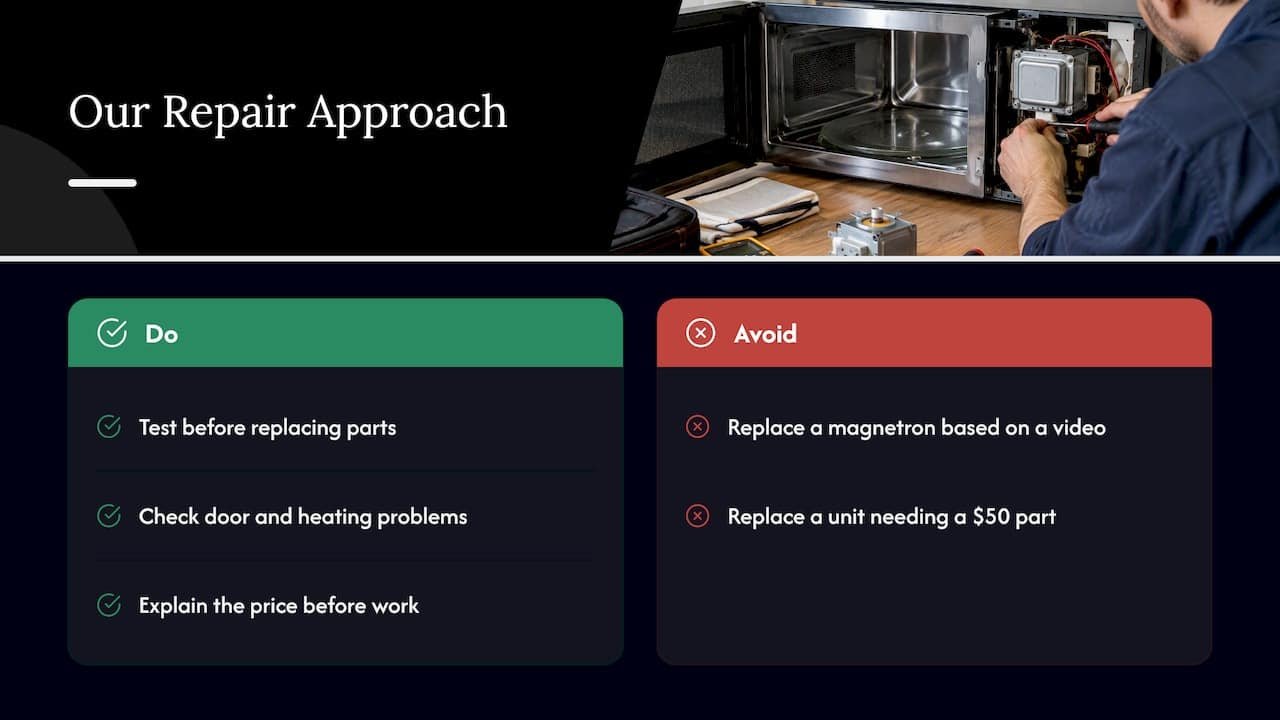
Our approach is to test before we replace. We confirm the cause, explain it in plain terms, and give you the price before we start. For over-the-range and built-in microwaves, where replacement means installation work, we usually find that a correct diagnosis makes repair the sensible option. For an old, low-cost countertop unit, we will tell you honestly when a repair is not worth it.
We also see many microwaves with door problems that were mistaken for heating failures, and heating failures that started with a door switch. That is why we check both. If you want to avoid disruption in your kitchen, our guide on reducing appliance downtime explains how to prepare for a repair visit.
— MDTECH
When to call a technician
Call a licensed technician when any of these is true:
- You have checked the timer, Control Lock, Demo Mode, power level, Delay Start and the door, and the water test still fails.
- The microwave hums, buzzes, sparks or smells of burning.
- A fuse or breaker trips when you start it.
- The door is bent, will not latch or has a damaged seal.
- The microwave is built in or mounted over the range, where removal is awkward and involves the electrical connection and mounting.
If any of those apply, turn the microwave off, unplug it if you can reach the plug safely, and stop using it. If you smell burning, see smoke or sparks, or the unit is mounted over a gas range and you smell gas, treat that as a safety situation and follow our gas safety guidance.
Microwave repair from MDTech Services
We repair microwaves for homeowners, landlords and property managers in Orange County and Los Angeles County. Our licensed technicians diagnose no-heat problems, door faults and control issues on countertop, over-the-range and built-in units, and we work on many brands, including Samsung microwaves and GE microwaves. You can see the full process on our microwave oven repair service page, browse our kitchen appliance repair services, or book an appliance repair appointment online.
If your microwave is part of a larger kitchen problem, such as a refrigerator or range that is acting up too, we can look at all of them in one visit.
FAQ
Why is my microwave running but not heating?
The most common causes are a setting issue, such as the Timer function, Control Lock, Demo Mode or a low power level, or a door that is not closing securely. If those are ruled out, the cause is usually a failed magnetron, high-voltage diode, capacitor, fuse or door switch. A technician can test each part and confirm which one has failed.
How do I reset a microwave that is not heating?
Clear the display or any error code, then unplug the microwave for one minute and plug it back in. For a built-in unit, switch off its circuit breaker for a minute instead. A reset only helps when the problem is a control glitch, so if the microwave still does not heat, move on to the door and water test.
How do I know if the magnetron is broken?
You cannot tell from the outside. A microwave that runs normally but never warms a cup of water, sometimes with a buzzing sound or a blown fuse, points toward the magnetron, but a bad diode or capacitor can cause the same symptoms. Because these parts carry high voltage, leave testing to a technician.
Is it worth repairing a microwave that will not heat?
It depends on age, type and price. Over-the-range and built-in microwaves under about six years old are usually worth repairing, while an older, inexpensive countertop unit often is not. Get an itemized quote and compare it with the cost of a replacement, including installation.
Can I fix a microwave myself?
You can safely check settings, clean the door seal and reset the unit. Opening the cabinet is not safe, because the capacitor can retain a high charge even when the microwave is unplugged. Leave internal repairs to a licensed professional.
Sources
- Microwave – Runs But Does Not Heat (GE Appliances)
- How to Troubleshoot a Non-Heating Microwave (KitchenAid)
- Safety Alerts (CPSC)
- Should You Repair or Replace Your Broken Over-the-Range Microwave? (Consumer Reports)
- Microwave Buying Guide (Consumer Reports)
- Microwave Repair Cost (Fixr)