
For almost every shutoff in a house, a ball valve is the better choice. It closes with a quarter turn, shows you at a glance whether it is open or closed, and holds a tight seal after years of sitting untouched. A gate valve costs less, but it takes many turns to close, wears at the seat, and can fail to shut off when you need it most.
That is the short answer. The details below help you decide what to keep, what to replace, and what to leave to a licensed professional, especially on gas lines in California.
TL;DR
- A ball valve rotates a bored sphere a quarter turn. A gate valve raises or lowers a flat barrier with a multi-turn handle.
- Ball valves are the better fit for on/off shutoffs on water and gas lines. Gate valves are less expensive but slower, and not meant for throttling.
- Neither valve is built to regulate flow. Use one to open fully or close fully.
- Manual valves do not replace the automatic gas shutoff devices California may require. Those are a separate safety layer.
- Gas valve work is not a DIY project. Have a licensed technician handle it.
Table of Contents
- How each valve works
- Ball valve vs gate valve at a glance
- Why ball valves win for homes
- Where a gate valve still shows up
- Why you should not exercise a suspect valve too hard
- Neither valve is for regulating flow
- Gas lines: where the choice matters most
- Which valve for which spot in your home
- Signs it is time to replace a valve
- Perspective: what we see in Orange County and Los Angeles County homes
- Need a valve checked or replaced?
- FAQ
- Sources
How each valve works
Gate valves
A gate valve has a flat or wedge-shaped disk inside the body. When you turn the round handle, a threaded stem lifts the disk out of the flow path or lowers it across the pipe. Fully open, water or gas passes straight through with little restriction. Fully closed, the disk presses against the seats.
Because the disk travels slowly, a gate valve opens and closes gradually. According to the Ferguson Industrial Blue Book, that slow action reduces the chance of water hammer, flows in both directions, and costs less than most quarter-turn valves. The same guide lists the downsides: it is slow to open and close, and it should not be used for throttling.
Ball valves
A ball valve holds a sphere with a hole drilled through it. When the handle sits parallel to the pipe, the hole lines up with the flow and the valve is open. Turn the handle 90 degrees, so it sits across the pipe, and the solid side of the ball blocks the line.
That is the whole mechanism, and it is why the valve is so dependable. There is little to trap debris, and the handle itself tells you the valve’s position.
Ball valve vs gate valve at a glance
| Feature | Ball valve | Gate valve |
|---|---|---|
| Operation | Quarter turn | Multiple full turns |
| Position indicator | Handle position shows open or closed | None visible from the handle |
| Speed in an emergency | Seconds | Slow, and you may lose count |
| Sealing over time | Tight seal, good longevity in on/off service | Seats prone to wear and leakage |
| Corrosion and debris | Fewer internal pockets to trap sediment | Internal parts can corrode or jam |
| Throttling | Not recommended | Not suited, can be damaged half open |
| Up-front cost | Higher | Lower |
| Typical home use | Main shutoffs, appliance and fixture lines, gas appliance isolation | Older homes, rarely used lines |
Why ball valves win for homes
Speed and certainty in an emergency
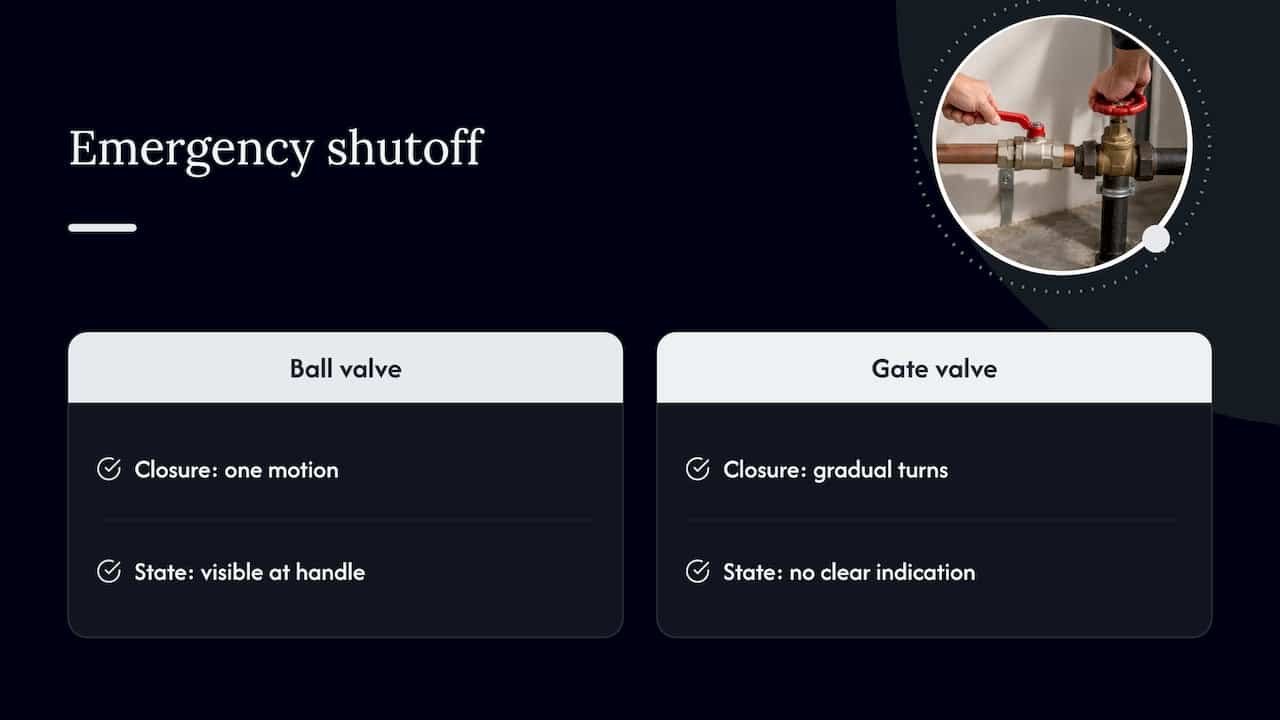
When a pipe bursts or you smell gas, you do not want to count turns. A ball valve closes in one motion, and you can see from the handle that it is closed. The Ferguson Blue Book notes that a gate valve gives no such indication. That makes it easy to believe a gate valve is closed when it is only partly restricted.
Reliability after years of sitting still
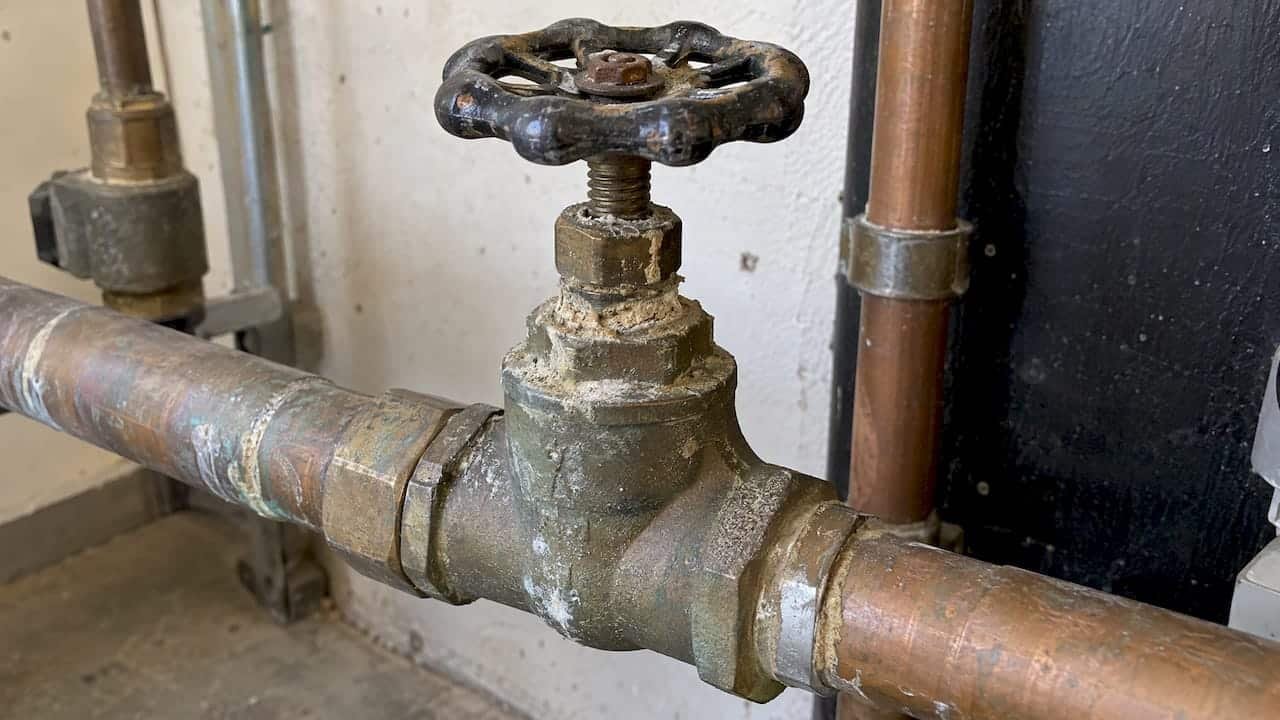
Most home shutoffs are touched once or twice a decade. That is where gate valves struggle. The engineering course material from CED Engineering points to seat wear and leakage in gate valves, and to fluid and debris collecting inside the body. In practice, we see old gate valves that turn a few times and never fully seal, or that will not turn at all because the stem is seized with mineral buildup.
A ball valve has fewer places for that to happen. It is not immune to age, but its failure is usually less sudden and easier to spot.
Cost over the life of the valve
Gate valves are cheaper to buy, and that is the only real argument for them. The cost of a leaking or stuck valve is usually larger than the savings. If the valve fails during a repair, a plumber may need to shut off water or gas at the meter or street, which takes longer and can mean more disruption for your household.
Where a gate valve still shows up
Gate valves are not dangerous by default. They remain common in older houses, and you may have one at your main water line, at a water heater, or on an outdoor spigot. Many of them work well enough for years.
They also have a legitimate role in large-diameter pipe, where a full-bore gate valve keeps pressure loss low. Municipal specifications for water mains still call for resilient-wedge gate valves in some situations; for example, a Fort Myers specification for water valves describes single-wedge gate valves for smaller pipes. That is utility infrastructure, not the shutoff behind your dishwasher.
For a home, the practical advice is this:
- If a gate valve closes fully and stops the flow, you do not need to rush to replace it.
- If it is hard to turn, drips at the stem, or does not stop the flow completely, replace it with a ball valve.
- If the valve sits on a line you may need to close in an emergency, such as the main water supply, replacing it with a ball valve is usually worth the cost.
Why you should not exercise a suspect valve too hard
A gate valve that has not moved in years can be fragile. Forcing it may break the stem or dislodge a bit of scale that then keeps the disk from seating. Older systems can also see what the CED material describes as thermal binding, where temperature changes make a valve hard to turn.
If you test your main shutoff, turn it gently, close it fully, open a faucet to confirm the flow stops, and then reopen the valve. If it will not budge or leaks afterward, stop. That is a good moment to call a plumber rather than risk a flood.
Our plumbing emergency checklist walks through what to do before help arrives.
Neither valve is for regulating flow
Readers often ask whether a half-open valve can turn down water or gas flow. It should not be used that way. According to the Blue Book, a gate valve is unsuited to throttling and can be damaged when it is partly open, and a standard ball valve is not recommended for throttling either. Treat both as fully open or fully closed.
If your real problem is pressure that is too high at the fixtures, the fix is a pressure regulator, not a partly closed valve. We explain how that works in our guide to water pressure regulation.
Gas lines: where the choice matters most
On a gas line the stakes are higher, and so are the rules. Three points are worth knowing.
Manual valves are chosen by code
In California, gas shutoff valves must be selected as the California Plumbing Code, section 1208.13 directs, and valves of 1 inch NPT and smaller must be listed and labeled. In everyday terms, the valve behind your range, dryer, or water heater has to be a listed gas valve, not a leftover water valve from a hardware bin. A quarter-turn ball-style appliance shutoff is the usual choice because you can see its position.
Manual shutoffs are not automatic safety devices
A manual valve works only when someone turns it. The state also recognizes two types of automatic device: the Excess Flow Automatic Gas Shutoff Valve and the Earthquake Sensitive Shutoff Valve, which the Division of the State Architect certifies. Per the DSA program summary, the seismic type responds to shaking above a design level, while the excess flow type restricts gas when flow rises above a trigger rate.
Some local jurisdictions require one of these devices downstream of the meter when certain gas work is done. A Contra Costa County handout on gas shutoff valves shows how a county explains that requirement. Requirements vary by city and county, so ask your local building department, or your technician, what applies to your project in Orange County or Los Angeles County. A ball valve at the appliance does not satisfy that requirement. For more on the automatic devices, see our article on seismic gas shutoff valves.
Gas work is for licensed technicians
Do not swap a gas valve yourself. A poor thread seal or an unlisted part can leak, and you cannot always smell a slow leak right away. If you smell gas, leave the home and call your gas utility or 911 from outside. For routine questions, our guide to gas safety at home covers the warning signs, and a gas line inspection is the right step if you are unsure about the age or condition of your piping.
Which valve for which spot in your home
| Location | Best choice | Notes |
|---|---|---|
| Main water shutoff | Ball valve | Quick, certain closure in a burst-pipe emergency |
| Water heater supply | Ball valve | Easier to service the heater; see our note on a leaking TPR valve |
| Under-sink and toilet supply | Quarter-turn stop | Frequently used for repairs |
| Washing machine hookups | Ball valve | Handle position shows whether the line is off |
| Outdoor hose bibb supply | Ball valve | Easy to close for repairs |
| Gas appliance connection | Listed gas ball-style shutoff | Installed by a licensed technician |
| Large-diameter irrigation or utility line | Gate valve may be used | Low pressure loss when fully open |
Signs it is time to replace a valve
- The handle spins freely or will not turn.
- Water or gas flow continues when the valve is closed.
- There is a drip or green crusty corrosion at the stem or packing nut.
- You cannot tell whether the valve is open or closed.
- The valve is original to a home that has had other plumbing upgrades.
Replacement usually requires shutting off the supply upstream, draining the line, and soldering, threading, or using approved push fittings, depending on the pipe. If the main shutoff itself is the problem, the work may involve the utility meter, which makes it more than a quick hardware-store job.
Perspective: what we see in Orange County and Los Angeles County homes
We work in kitchens, laundry rooms, and utility closets across the region, and valves are among the first things we check on a repair call. The pattern is consistent. Homeowners and landlords often replace an appliance or fixture without touching the old valve behind it, and then find the valve will not close when it is time to disconnect the unit.
Our view is simple. Spend a little more on a ball valve where you may need to shut something off quickly, and have it installed while the line is already open. When we install or convert a gas appliance, including LP to natural gas conversions, we look at the shutoff, the connector, and the fittings as one system, not just the appliance. A good valve is a small part of the job, and a bad one can turn a simple repair into an emergency.
We also encourage property managers to note valve locations and types in their maintenance records. When a tenant calls at night, knowing exactly where to shut off water or gas saves time.
— MDTECH
Need a valve checked or replaced?
If your shutoff valves are stuck, leaking, or you are not sure what you have, our licensed technicians can inspect them and replace worn valves as part of a plumbing repair visit. If the valve serves a gas range, dryer, or oven, our gas appliance repairs team can check the connection and shutoff at the same time. If you are installing a new unit, our appliance installation services include making sure the supply connections are safe and accessible. We serve Orange County and Los Angeles County, and you can book online or call us to schedule.
FAQ
Are gate valves obsolete?
For most new residential shutoffs, yes, in practice. Ball valves have largely taken their place because they seal better and are faster to operate. Gate valves still exist in many older homes and in large-diameter utility lines, and a working one does not have to be replaced immediately.
What are the disadvantages of a ball valve?
The main drawbacks are cost and speed of closure. A ball valve usually costs more than a gate valve, and because it closes in a quarter turn, shutting it fast on a pressurized line can cause water hammer. It is also not recommended for throttling flow. For home shutoffs these are minor trade-offs.
Can I replace a gate valve with a ball valve myself?
On a simple fixture line, some homeowners do. The line must be shut off and drained first, and the new valve must match the pipe type and size. On a main water line or any gas line, hire a licensed professional, because a mistake can flood the house or cause a gas leak.
Is a ball valve the same as an earthquake gas shutoff valve?
No. A ball valve is a manual shutoff that someone has to turn. An earthquake-sensitive or excess flow valve is an automatic device certified separately by the state. Depending on your project and your city or county, you may need the automatic device in addition to the manual valves.
Where should I use a ball valve and where a gate valve?
Use ball valves at your main water supply, water heater, appliance lines, and listed gas appliance shutoffs. A gate valve fits best in large-bore lines where low flow resistance matters and the valve is rarely operated. If you are unsure, a licensed technician can look at your setup.
Sources
- THE BLUE BOOK, Ferguson Industrial
- Control Valve Basics: Sizing and Selection, CED Engineering
- 1208.13 Shutoff Valves, 2025 California Plumbing Code
- Gas Shutoff Valve Certification for Residential Structures, DGS
- DSA Gas Shutoff Valves Certification Program
- Gas Shut-Off Valves, Contra Costa County
- Water Valves and Appurtenances specification, City of Fort Myers