
Meeting gas dryer venting code means installing smooth rigid metal duct at a minimum 4-inch diameter, using a UL 2158A-listed single-piece transition duct no longer than 8 feet, keeping the total equivalent length within roughly 35 feet (minus deductions for elbows), and terminating outdoors with a backdraft damper and no screen. These rules live primarily in IRC Section M1502, with parallel language in IMC 504 and IFGC G2439.7 depending on your jurisdiction’s adopted code. UL 2158A governs the transition duct itself.
Here’s what that means on the ground for your dryer:
- Rigid metal duct only, minimum 4 inches, for any concealed or permanent run.
- Transition duct: UL 2158A listed, single piece, 8 feet maximum, never hidden in a wall.
- Equivalent length capped near the maximum allowed by code, reduced for every elbow you add.
- Termination outdoors, with a backdraft damper and zero screens.
- Manufacturer installation instructions can override the code baseline if they’re stricter.
Pro Tip: Keep the dryer’s installation manual in a kitchen drawer. Inspectors ask for it more often than homeowners expect, and it settles length disputes fast.
Key Takeaways
Gas dryer venting code requires rigid metal duct at 4 inches minimum, a UL 2158A-listed transition duct under 8 feet, equivalent length within roughly 35 feet, and outdoor termination with a backdraft damper and no screen.
| Point | Details |
|---|---|
| Use rigid metal only | Corrugated foil and plastic are prohibited in concealed dryer exhaust runs under IRC M1502. |
| Respect the 8-foot transition limit | The connector duct must be UL 2158A listed, one piece, and never hidden in a wall. |
| Calculate equivalent length | Deduct 5 feet per 90° elbow and 2.5 feet per 45° elbow from the roughly 35-foot baseline. |
| Terminate correctly | Outdoor discharge with a backdraft damper, no screen, and at least 3 feet from openings. |
| Bring in Mdtechservices for compliance work | Licensed technicians handle duct replacement, booster fan installs, and inspection documentation across Orange County and Los Angeles County. |
Table of Contents
- Quick Checklist for Gas Dryer Venting Code Compliance
- What the Dryer Vent Code Actually Requires
- Calculating Equivalent Length the Right Way
- What Inspectors Flag During a Dryer Vent Check
- Fixing a Non-Compliant Dryer Vent
- Get Your Dryer Vent Inspected and Brought Up to Code
- Primary Sources to Reference at Inspection
- Frequently Asked Questions
- Sources
Quick Checklist for Gas Dryer Venting Code Compliance
Before you call a technician or schedule an inspection, walk the vent run yourself with this list:
- Material check: Rigid metal only, no foil, no vinyl, no corrugated plastic in walls or ceilings.
- Diameter check: Confirm 4-inch nominal duct throughout, not a narrower flexible connector.
- Transition duct check: UL 2158A label visible, one piece, 8 feet or shorter, fully accessible.
- Length and fittings check: Count every 90° and 45° elbow between the dryer and the exterior termination.
- Termination check: Backdraft damper present, no screen, at least 3 feet from any window, door, or vent opening.
- Routing check: The duct runs independently, never tying into an HVAC plenum or chimney flue.
Pro Tip: Photograph the manufacturer’s data plate and installation sheet before you close up any wall. Contractors and inspectors both treat that document as controlling when it’s stricter than the code minimum.
Have your tape measure, a flashlight for concealed sections, and the dryer’s manual ready before anyone shows up.
What the Dryer Vent Code Actually Requires
Every rule in this code section exists to stop two things: a lint-fed fire and a house full of trapped moisture. Once you see the logic, the requirements stop feeling arbitrary.
Material and diameter. IRC M1502 calls for smooth-interior rigid metal duct at a minimum thickness around 0.016 inch (roughly 28 gauge), sized at a 4-inch nominal diameter. Corrugated foil and plastic ducting are banned in concealed runs because their ridged interior snags lint, and lint buildup is the fuel source behind most dryer fires tracked in NFPA’s fire statistics.
Transition duct rules. The short, flexible connector between the dryer and the wall duct must carry a UL 2158A listing, come as a single piece, and run no longer than 8 feet. It also can’t be buried inside a wall or floor cavity. That’s the boundary between a transition duct and a permanent run: one is replaceable and visible, the other is rigid metal built into the structure.
Maximum equivalent length. The commonly cited baseline is 35 feet, and every fitting eats into that allowance. UpCodes notes that some jurisdictions and manufacturer instructions apply a shorter baseline, sometimes 25 feet, so you check both the code and the dryer’s own manual before finalizing a route.
The manufacturer’s installation instructions can be the deciding authority at inspection. When they set a tighter limit than the code baseline, the stricter number wins, and code officials are trained to ask for that document before signing off.
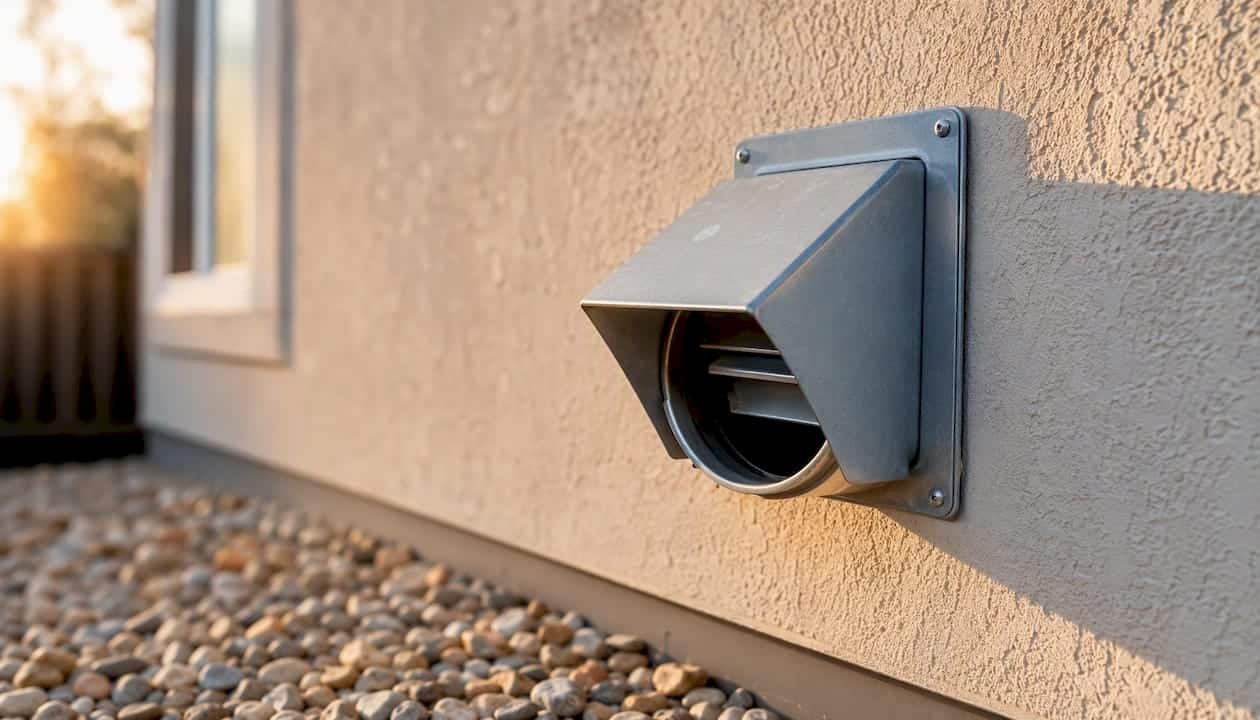
Termination and installation prohibitions. The duct must discharge outdoors, equipped with a backdraft damper, positioned at least 3 feet from any building opening. Screens are prohibited outright because they trap lint at the exact point airflow needs to be strongest. Screws that protrude into the duct interior are also a violation. Sheet metal screws create tiny ledges where lint collects, so installers use rivets or foil tape instead. Venting into an attic, crawl space, or HVAC plenum is never allowed. Beyond the fire risk, BASC’s building science guidance ties improperly vented moisture directly to mold growth and structural rot in framing and insulation.
Calculating Equivalent Length the Right Way
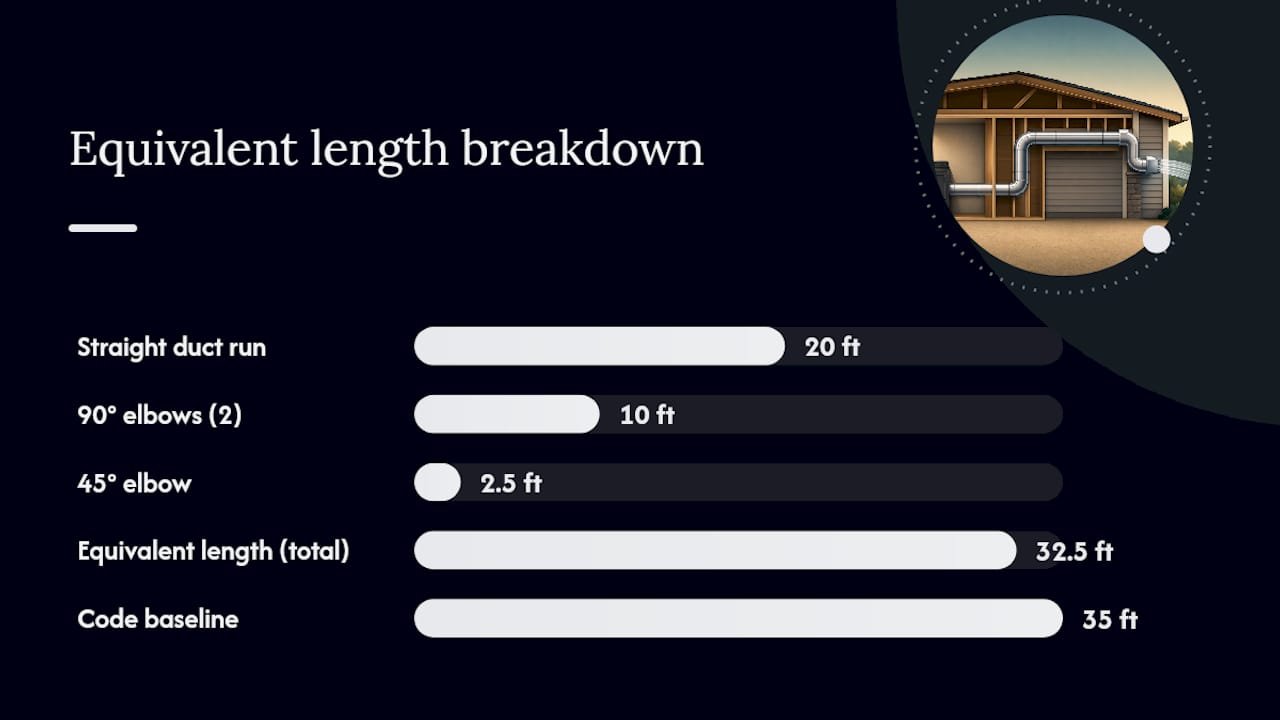
“Equivalent length” adds your straight duct footage to a penalty for every fitting, since each elbow slows airflow the same way extra distance would. The code baseline is roughly 35 feet, but always cross-check the dryer’s manual first.
| Component | Length Deduction |
|---|---|
| Straight duct run | Measured actual footage |
| 90° elbow | 5 feet |
| 45° elbow | 2.5 feet |
| Transition duct | Counted within the 8-foot transition limit |
Here’s a worked example. Say your dryer sits 20 feet from the exterior wall with two 90° elbows and one 45° elbow along the way.
- Start with 20 feet of straight duct.
- Add 5 feet for the first 90° elbow, then 5 more for the second: 10 feet total.
- Add 2.5 feet for the 45° elbow.
- Total equivalent length: 32.5 feet, under the 35-foot code baseline but worth checking against a manufacturer limit of 25 feet if your dryer’s manual specifies one.
If your math exceeds the allowable limit, don’t force it. Options include re-routing to cut elbows, or installing a listed booster fan rated specifically for dryer exhaust. Never compensate with flexible foil duct just to gain a few extra feet.
What Inspectors Flag During a Dryer Vent Check
Inspectors see the same violations repeatedly, and most trace back to shortcuts taken during a remodel or a quick appliance swap.
- Corrugated foil or plastic duct hidden inside a wall cavity instead of rigid metal.
- Duct undersized below the 4-inch nominal diameter.
- Equivalent length that exceeds the code baseline or the manufacturer’s stricter limit.
- A screen mesh over the exterior termination cap.
- Missing backdraft damper at the wall or roof termination.
- Protruding screws inside the duct joints instead of rivets or foil tape.
- Vent runs discharging into an attic, garage, or crawl space rather than outdoors.
- Roughed-in dryer locations with an uncapped, unlabeled duct waiting for a future appliance.
The safety stakes explain the scrutiny. NFPA’s fire statistics tie dryer fires directly to lint accumulation, and improperly vented gas dryers add a carbon monoxide risk on top of fire and moisture damage. Inspectors will ask for the manufacturer installation sheet and product labels, and UpCodes confirms they can require that documentation at both the concealment stage and final inspection.
Fixing a Non-Compliant Dryer Vent
Some fixes are safe for a homeowner to handle. Others call for a licensed technician, especially anything touching the gas line or buried inside a wall.
You can typically handle: replacing an accessible exterior vent cap, clearing lint from a duct section you can reach without opening drywall, and swapping a short transition duct as long as the replacement carries a UL 2158A listing.
Leave to a professional: opening concealed walls to replace buried duct, rerouting through structural framing, adding a booster fan, or touching the gas connection at the dryer itself.
- Replace corrugated or undersized duct with 4-inch smooth rigid metal end to end.
- Swap tight 90° elbows for long-radius fittings to reduce equivalent length.
- Re-route the run to minimize fitting count where the floor plan allows it.
- Install a listed booster fan only where code and the manufacturer both permit one.
When you’re hiring out the work, confirm the contractor is licensed and insured, ask them to reference the manufacturer instructions in their documentation, and get a written scope before permits or inspection scheduling begin.
A Technician’s View on Why This Code Gets Enforced Strictly
Working dryer venting jobs, the violations that worry us most aren’t cosmetic. Corrugated duct buried in a wall or a missing backdraft damper means real fire and carbon monoxide risk, not just a paperwork gap. Inspectors focus on materials and manufacturer instructions because those two documents predict whether the system fails quietly over years. Following both the code and the dryer manufacturer’s own limits is what keeps an inspection from failing and a warranty from getting voided.
Get Your Dryer Vent Inspected and Brought Up to Code
Mdtechservices gets your dryer vent inspection-ready without you having to decode code language yourself. Our licensed technicians handle the permit paperwork, replace non-compliant duct with smooth rigid metal, and install listed booster fans when your run needs one and code allows it.

We serve homeowners and property managers across Orange County and Los Angeles County, and we bring the dryer manufacturer’s installation instructions straight to the code official on-site, so nothing gets held up over missing documentation. If your vent run has extra elbows, a screened cap, or duct buried in a wall you can’t access safely, that’s exactly the kind of job worth scheduling now rather than waiting for a failed inspection. Request an on-site estimate for appliance repair or installation and we’ll walk the vent run with you before anything gets closed up.
Primary Sources to Reference at Inspection
Print or bookmark these before your inspection date:
- IRC Chapter 15, Exhaust Systems, for the core material, diameter, and length requirements.
- UpCodes’ Clothes Dryer Exhaust summary, for plain-language interpretation of termination and length rules.
- UpCodes’ Dryer Exhaust Ducts page, covering manufacturer instruction requirements at inspection.
- The UL 2158A standard, referenced on your transition duct’s product label.
- NFPA’s home fire statistics on dryers, for the safety case behind the rules.
Inspectors will most often ask for the dryer’s manufacturer installation sheet and the transition duct’s UL label, so keep both on hand.
Frequently Asked Questions
What is the maximum length allowed for a gas dryer vent under code?
The commonly applied baseline is 35 feet of equivalent length, reduced by 5 feet for each 90° elbow and 2.5 feet for each 45° elbow. Some manufacturer instructions set a shorter limit, sometimes 25 feet, which then takes precedence over the code baseline.
Can I use flexible foil duct for my gas dryer vent?
No. Code prohibits foil, vinyl, and corrugated plastic ducting for concealed or permanent dryer exhaust runs. Rigid metal duct is required, with a short UL 2158A-listed transition duct allowed only at the connection to the dryer.
Do I need a backdraft damper on my dryer vent?
Yes. Code requires a backdraft damper at the termination point, and protective screens are prohibited because they trap lint and restrict airflow.
How far does a dryer vent need to be from a window or door?
Termination must sit at least 3 feet from any building opening such as a window, door, or fresh-air intake, unless the manufacturer’s instructions specify a different clearance.
Does California have different gas dryer venting rules?
California generally follows the same IRC and IMC framework, though some jurisdictions adopt local amendments or apply a shorter manufacturer-specified length. Always confirm your city or county’s adopted code version alongside the dryer’s own installation manual.
This article is general information, not a substitute for advice from a qualified lawyer. Consult a qualified legal professional about your own circumstances before acting on anything here.
Sources
- Dryer Exhaust Ducts | UpCodes
- Clothes Dryer Exhaust | UpCodes
- IRC 2024 Dryer Duct: Maximum Length, Material, and Exterior Termination | Jaspector
- Home fires involving clothes dryers and washing machines | NFPA