
A GFCI outlet, short for Ground Fault Circuit Interrupter, is a special electrical receptacle that shuts off power the instant it detects current leaking outside its intended path. That single function prevents dangerous electric shocks near water and in other high-risk areas of your home. The CPSC confirms that GFCIs detect very small current mismatches and cut power fast enough to reduce the risk of a fatal shock. The National Electrical Code (NEC), OSHA, and the Consumer Product Safety Commission all recognize GFCI protection as one of the most effective electrical safety measures available to homeowners.
Key Takeaways
A GFCI outlet detects very small current imbalances and trips very rapidly, making it one of the most effective shock-prevention devices in any home.
| Point | Details |
|---|---|
| How fast a GFCI trips | Senses faults at around a few milliamperes and cuts power very quickly. |
| Where GFCIs are required | Bathrooms, kitchens near sinks, garages, outdoor outlets, basements, and laundry areas per NEC. |
| What GFCIs don’t cover | Overloads, short circuits, and arcing faults — those require circuit breakers and AFCIs. |
| Testing frequency | Test every GFCI outlet monthly using the Test and Reset buttons. |
| Mdtechservices | Licensed technicians in Orange County and Los Angeles County handle GFCI inspection, replacement, and appliance safety checks. |
Table of Contents
- How a GFCI outlet detects faults and cuts power
- Types of GFCI devices you will find in your home
- Where GFCIs are required or recommended in U.S. homes
- How to test and reset a GFCI outlet safely
- What GFCIs protect against — and what they don’t
- When you should stop DIY checks and call a licensed electrician
- Routine safety tips and maintenance for your GFCI outlets
- Mdtechservices’ perspective on GFCI safety for homeowners
- Mdtechservices can help with your home’s electrical safety
- Sources
How a GFCI outlet detects faults and cuts power
A GFCI continuously compares the current flowing out through the hot wire against the current returning through the neutral wire. Under normal conditions, those two values match exactly. The moment current starts leaking to ground, such as through a person touching a live appliance near a wet sink, the balance breaks. According to OSHA, a GFCI senses small imbalances around a few milliamperes and can interrupt power very quickly. That speed matters because currents above about 10 mA can cause muscle paralysis, and higher levels can affect the heart.

Picture two lanes of traffic: electricity leaves through the hot wire and returns through the neutral. A ground fault is a car jumping the barrier. The GFCI counts cars in both lanes constantly, and the moment the count differs, it trips.
| Specification | Value |
|---|---|
| Trip sensitivity | around 4 mA |
| Trip speed | very quickly |
| Protection type | Ground fault (current leakage) |
| Coverage: GFCI receptacle | Outlet itself plus downstream outlets on load terminals |
| Coverage: GFCI circuit breaker | Entire branch circuit from the panel |
A GFCI circuit breaker installed in your panel protects every outlet and fixture on that branch circuit. A GFCI receptacle protects itself and any outlets wired to its load terminals downstream, but only if those downstream outlets are connected correctly. Miswiring the load terminals is a common mistake that leaves downstream outlets unprotected without any visible warning.
Types of GFCI devices you will find in your home
Three main types of GFCI devices are available, and each fits a different situation.
- Receptacle (outlet) type. The most familiar form. It looks like a standard outlet with two small buttons labeled “Test” and “Reset” in the center. You will find these in bathrooms, kitchens, and garages. One receptacle can protect additional outlets downstream when wired through its load terminals.
- GFCI circuit breaker. Installed in the main panel in place of a standard breaker. It protects the full branch circuit, including every outlet, switch, and hardwired fixture on that run. A good choice when you need whole-circuit protection or when retrofitting older wiring. OSHA’s construction eTool notes that both receptacle and portable GFCI variants are widely used where installed protection is impractical.
- Portable and cord-connected GFCIs. Plug-in adapters or extension cords with built-in GFCI protection. Homeowners use these for outdoor power tools, holiday lighting, or any situation where a permanent GFCI outlet is not available. Construction crews rely on them heavily on job sites.
Where GFCIs are required or recommended in U.S. homes
Safe Electricity lists bathrooms, kitchens, outdoor outlets, garages, basements, and laundry areas as locations where GFCIs are recommended or required. The NEC has expanded those requirements over successive code cycles, so the specific rules in your home depend on when it was built and what local amendments apply.
| Location | Typical NEC requirement |
|---|---|
| Bathrooms | Required at all receptacles |
| Kitchen countertops | Required near bathrooms, kitchens, and garages |
| Garages | Required at all receptacles |
| Outdoor outlets | Required at all receptacles |
| Unfinished basements | Required at all receptacles |
| Crawl spaces | Required at receptacles near grade level |
| Laundry and utility areas | Required at receptacles near sinks or water |
| Boathouses and pool areas | Required at all receptacles |
Older homes built before the NEC expanded GFCI requirements may not have protection in all these locations. That does not mean your home is code-compliant for its era, but it does mean adding GFCI protection is a practical upgrade worth discussing with a licensed electrician. Always verify requirements with your local authority having jurisdiction (AHJ), since municipalities can adopt amendments that differ from the base NEC.
How to test and reset a GFCI outlet safely
Testing takes under two minutes and should be part of your regular home maintenance routine. Eaton’s installation instructions outline the standard test and reset procedure that applies to virtually all GFCI receptacles.
- Plug in a small lamp or phone charger to the outlet so you can confirm power status visually.
- Press the “Test” button. The outlet should trip immediately, cutting power to the lamp or charger. You may hear a soft click.
- Verify power is off. The lamp should go dark. If it stays on, the outlet is miswired or faulty.
- Press the “Reset” button. Power should restore to the outlet and the lamp should light up again.
- If the outlet does not reset, check whether the upstream circuit breaker has tripped. If the breaker is fine and the outlet still will not reset, the GFCI receptacle likely needs replacement.
Pro Tip: Test every GFCI outlet in your home once a month. Add it to your property maintenance checklist so it does not get skipped. A GFCI that trips but will not reset is telling you something is wrong, and that warrants a call to a licensed electrician rather than repeated reset attempts.
For outdoor outlets, check that the weatherproof cover closes fully and that no moisture has entered the box. A wet outlet box can cause nuisance trips or, worse, mask a real fault.
What GFCIs protect against — and what they don’t
Understanding the limits of GFCI protection helps you avoid overrelying on it. NEC guidance via EC&M makes clear that GFCI and AFCI technologies serve different safety goals, and neither replaces the other.
GFCIs protect against:
- Electric shock from ground faults (current leaking to ground through a person or object)
- Shock from contact with a single energized conductor while grounded
GFCIs do NOT protect against:
- Overloads or short circuits (that is the job of your circuit breaker)
- Shock from simultaneously touching both the hot and neutral wires, because no current imbalance occurs in that scenario
- Electrical fires caused by arcing inside walls or within wiring insulation
That last point is where Arc Fault Circuit Interrupters (AFCIs) come in. An AFCI detects the distinctive electrical signature of an arc, which can ignite insulation or nearby materials. GFCIs detect leakage current; AFCIs detect arcing. The NEC now requires AFCIs in bedrooms, living rooms, and other living spaces, while GFCIs are required near water. Many modern homes need both, and in some locations the code requires a dual-function GFCI/AFCI breaker that handles both hazards on one device.
For a deeper look at how your panel manages these protections, the circuit breaker guide from Mdtechservices covers breaker function and resetting in plain language.
When you should stop DIY checks and call a licensed electrician
Some GFCI problems are straightforward: a tripped outlet, a loose plug, or a weatherproof cover that needs replacing. Others signal wiring issues that require a licensed electrician.
Call a pro when you notice any of the following:
- The GFCI trips repeatedly with no obvious cause, such as a wet appliance or overloaded circuit
- You smell burning near an outlet or see scorch marks
- The outlet has no power even after a successful reset
- The GFCI fails to trip when you press the Test button
- Multiple outlets on different circuits lose power at the same time
- You see exposed or damaged wiring anywhere near the outlet
A licensed electrician will run a diagnostic to identify leakage paths, check load terminal wiring, and confirm downstream protection is working as expected. Panel-level work, including installing a GFCI circuit breaker, always requires a licensed professional. Proper electrical grounding is part of that broader safety picture, and it is something Mdtechservices’s licensed technicians assess during service visits in Orange County and Los Angeles County.
Routine safety tips and maintenance for your GFCI outlets
Keeping GFCIs reliable over time takes only a few minutes each month.
- Test monthly. Press Test and Reset on every GFCI outlet. Log the date so you have a record if an issue arises.
- Inspect outdoor covers. Weatherproof covers should close and latch fully. Replace cracked or broken covers promptly.
- Replace aging receptacles. GFCI receptacles typically last 10–15 years. If an outlet is original to a home built before 2010, consider proactive replacement.
- Avoid nuisance trips. High-draw appliances like hair dryers and power tools can cause trips on sensitive circuits. Plug them into a dedicated outlet rather than a shared GFCI circuit when possible.
- Do not use extension cords as a permanent fix. If you need an outlet in a location that lacks one, have a licensed electrician install a proper receptacle. NIOSH electrical safety guidance reinforces that safe wiring practices, not workarounds, are the foundation of home electrical safety.
- Check after any flooding or water intrusion. Water inside an outlet box can damage the GFCI mechanism even if the outlet appears to work. Have it inspected before use.
Mdtechservices’ perspective on GFCI safety for homeowners
One pattern our licensed technicians see regularly in Orange County and Los Angeles County homes: homeowners reset a tripping GFCI outlet repeatedly without investigating why it keeps tripping. A GFCI that trips once and resets cleanly is doing its job. One that trips every few days, or every time a specific appliance runs, is signaling a real fault in the circuit or the appliance itself.
The other common issue is downstream outlets that have no power and no visible GFCI button. Homeowners often assume those outlets are dead and need replacement, when the actual cause is a tripped GFCI receptacle elsewhere on the same circuit. Checking every GFCI in the bathroom, kitchen, or garage before calling for service saves time and money.
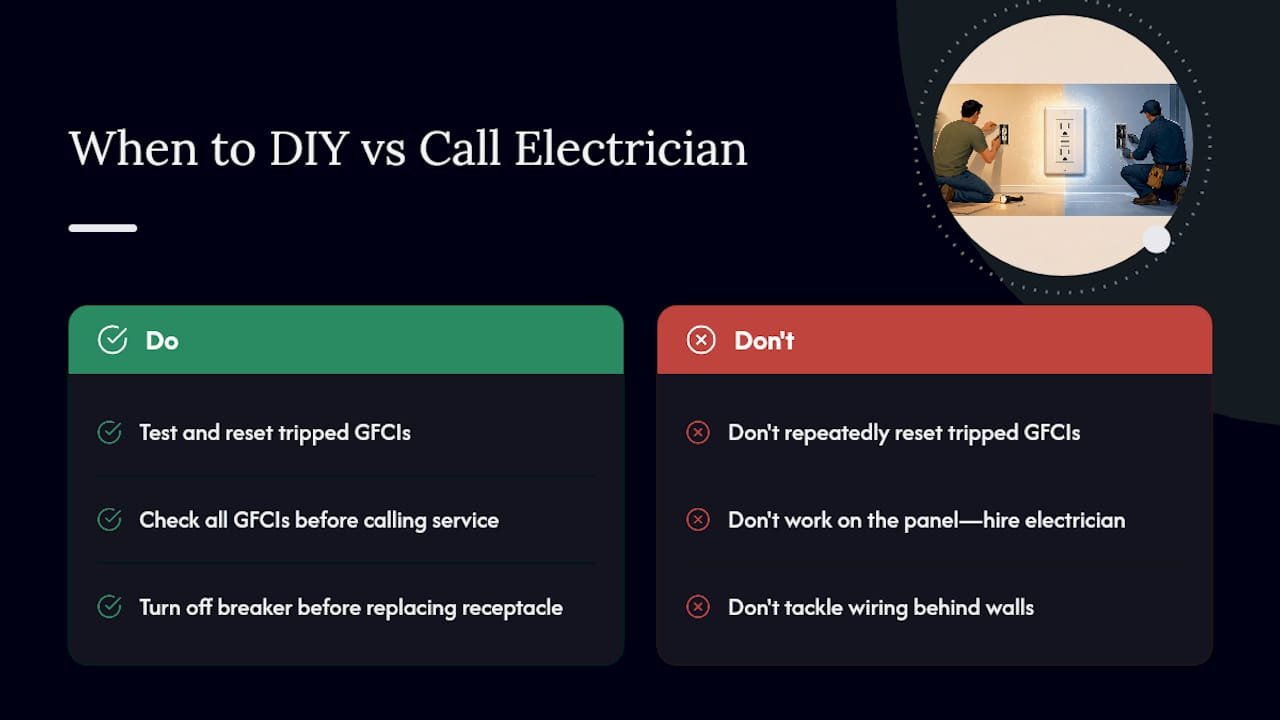
Our position on DIY versus professional work is straightforward: testing and resetting a GFCI is safe for any homeowner. Replacing a receptacle is manageable for a confident DIYer who turns off the breaker first. Anything involving the panel, persistent unexplained tripping, or wiring behind the wall belongs with a licensed electrician.
Mdtechservices can help with your home’s electrical safety
When a GFCI problem goes beyond a simple reset, Mdtechservices provides licensed technician service across Orange County and Los Angeles County. Our team handles GFCI outlet inspection, replacement, and appliance safety checks as part of a broader appliance repair and installation service that keeps your home running safely.

If your outlets are tripping without explanation, failing to reset, or you are not sure whether your home has GFCI protection in all the right locations, book a service visit with Mdtechservices. Before the technician arrives, note which outlets are affected, whether any specific appliance triggers the trip, and when the problem started. That information helps our team diagnose the issue faster and get your home back to full safety. Schedule your inspection online or call us directly to set up an appointment.
Sources
- eTool : Construction – Ground-Fault Circuit Interrupters (GFCI) – OSHA
- Ground Fault Circuit Interrupters (GFCIs) – Safe Electricity